• Skip to main content
  • Skip to footer
the-one-you-feed-podcast-eric-zimmer-logo-dark-smk
  • About
    • The Podcast
    • The Parable
    • Eric Zimmer
    • Ginny Gay
  • The Podcast
    • Episodes Shownotes
    • Episodes List
    • Anxiety & Depression
    • Addiction & Recovery
    • Habits & Behavior Change
    • Meditation & Mindfulness
  • Programs
    • Overwhelm is Optional Email Course
    • Wise Habits
    • Free Masterclass: Habits That Stick
    • Coaching
  • Membership
  • Resources
    • 6 Sabotuers FREE eBook
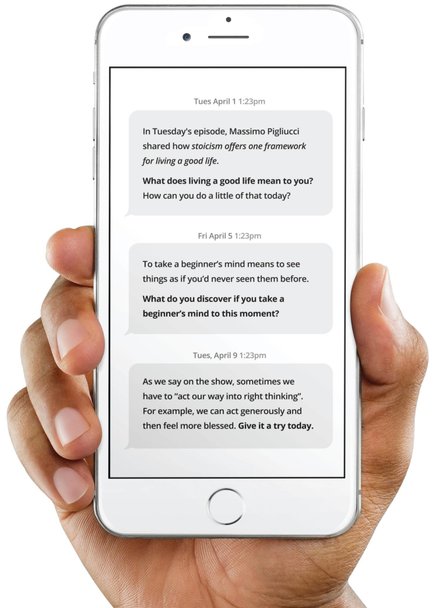
    • Sign Up for Wise Habits Text Reminders
    • Free Masterclass: Habits that Stick
    • Free ebook: How to Stick to Meditation Practice
    • Free Training: How to Quiet Your Inner Critic
    • Anti-Racism Resources
    • Blog
  • Contact
    • General Inquiries
    • Guest Requests
  • Search
Wise Habits Reminders

Podcast Episode

Unhinged Habits: Transform Your Life by Doing Less with Jonathan Goodman

February 6, 2026 Leave a Comment

Watch on YouTube
Listen on Spotify
Listen on Apple Podcast

In this episode, Jonathan Goodman discusses defines unhinged habits and how to transform your life by doing less. He shares how selling his software company led him to focus on writing and living intentionally. Jonathan also explores the importance of prioritizing money, health, and relationships, embracing life’s natural seasons, and making conscious trade-offs. He explains how intense focus can transform habits, the value of childhood passions, and the difference between meaningful and vacant activities. The episode encourages listeners to nurture what matters, let go of what doesn’t, and periodically reset for a more fulfilling life.

Please take our quick 2-minute survey and help us improve your listening experience: oneyoufeed.net/survey

Exciting News!!! Coming in March, 2026, my new book, How a Little Becomes a Lot: The Art of Small Changes for a More Meaningful Life is now available for pre-orders!


Key Takeaways:

  • Discussion of the importance of prioritizing life’s triad: money, health, and relationships.
  • Exploration of the concept of life seasons and the need to focus on different priorities at different times.
  • Insights on habit formation and the necessity of making trade-offs to avoid burnout.
  • The metaphor of the “good wolf” and the importance of nurturing positive qualities within oneself.
  • The significance of recognizing when a season ends to allow for rest and reflection.
  • The idea of maintaining balance in life and the dangers of comparing oneself to others.
  • The role of intentional living and making deliberate decisions about time and energy investment.
  • The benefits of an exploratory mindset and trying new activities to discover what fits best.
  • Discussion on the social and physical benefits of engaging in inclusive activities like games.
  • The impact of modern life on natural rhythms and the importance of consciously ending seasons for personal growth.

Jonathan Goodman has spent 13 winters exploring the world—first solo, then with his wife, and now with their three children—challenging educational conventions while building multi-million-dollar businesses. Featured in Men’s Health, Forbes, Robb Report, Entrepreneur, and Inc., Jon proves that you don’t have to choose between professional success, meaningful relationships, and fulfilling adventure. His new book is Unhinged Habits: A Counterintuitive Guide for Humans to Have More by Doing Less

Connect with Jonathan Goodman: Website | Facebook | Instagram | LinkedIn | YouTube

If you enjoyed this conversation with Jonathan Goodman, check out these other episodes:

How to Create Elastic Habits that Adapt to Your Day with Stephen Guise

Behavior Change with John Norcross

Tiny Habits for Behavior Change with BJ Fogg

By purchasing products and/or services from our sponsors, you are helping to support The One You Feed and we greatly appreciate it. Thank you!

This episode is sponsored by:

David Protein Try David is offering our listeners a special deal: buy 4 cartons and get the 5th free when you go to davidprotein.com/FEED.

Hungry Root: For a limited time get 40% off your first box PLUS get a free item in every box for life. Go to www.hungryroot.com/feed and use promo code: FEED.

IQ Bar: Text FEED to 64000 to get 20% off all IQBAR products, including the ultimate sampler pack, plus FREE shipping. (Message and data rates may apply).

patreon

If you enjoy our podcast and find value in our content, please consider supporting the show. By joining our Patreon Community, you’ll receive exclusive content only available on Patreon!  Click here to learn more!!

Episode Transcript:

Jonathan Goodman 00:00:00  When you consider that we all have this triangle that operates our life of three main priorities money, health, relationships. That’s your life’s triad. The process of betterment is simply the process of thickening that triangle, of reinforcing that structure over time. The problem is, you can’t overload one side of it and ignore the other one, because what happens to a triangle? The damn thing collapses.

Chris Forbes 00:00:29  Welcome to the one you feed. Throughout time, great thinkers have recognized the importance of the thoughts. We have quotes like garbage in, garbage out or you are what you think ring true. And yet for many of us, our thoughts don’t strengthen or empower us. We tend toward negativity, self-pity, jealousy, or fear. We see what we don’t have instead of what we do. We think things that hold us back and dampen our spirit. But it’s not just about thinking. Our actions matter. It takes conscious, consistent and creative effort to make a life worth living. This podcast is about how other people keep themselves moving in the right direction, how they feed their good wolf.

Erich Zimmer 00:01:13  We spend a lot of time trying to add the right habits, the right routines, the right goals. But what if a bigger change comes from removing what no longer fits? In this episode, I talk with Jonathan Goodman, author of Unhinged Habits A Counterintuitive Guide for Humans to Have More by doing less about the idea that you’re not the author of your life, but you can be the editor. We explore why subtraction is so hard. Why say no is often the most honest move, and how clarity comes from choosing fewer things more deliberately. Honestly, Jonathan and I don’t agree on everything, but I find all of his ideas worth considering if you’ve ever felt stretched thin, pulled in too many directions, or quietly frustrated with your own ambition, this conversation offers a grounded and realistic way forward. I’m Erich Zimmer and this is the one you feed. Hi, Jonathan, welcome to the show.

Jonathan Goodman 00:02:14  Yeah, man, it’s so good to be here.

Erich Zimmer 00:02:15  I’m excited to talk with you. We’re going to be discussing your book, which is called Unhinged Habits A Counterintuitive Guide for Humans to Have More by Doing Less.

Erich Zimmer 00:02:25  There’s a number of things in that book that I think are going to be really interesting, because they are a little different than the way I see certain things, so I’m really looking forward to talking through some of that. But we’ll start like we always do with the parable. And in the parable there’s a grandparent who’s talking with their grandchild and they say, in life there are two wolves inside of us that are always at battle. What is a good wolf which represents things like kindness and bravery and love? And the other is a bad wolf, which represents things like greed and hatred and fear. And the grandchild stops. They think about it for a second. They look up at their grandparent and they say, well, which one wins? And the grandparent says, the one you feed. So I’d like to start off by asking you what that parable means to you in your life and in the work that you do.

Jonathan Goodman 00:03:08  There’s a virtually unlimited amount of opportunities we all have these days. What do you decide to do for your work? What trade offs do you decide to accept in order to commit more, maybe to your family or your fitness? Show me your habits.

Jonathan Goodman 00:03:25  I’ll show you who you are. Right? And so what that parable means to me is, hey, what are you focused on? How much are you willing to commit to what you’re focused on? Just last week, I finished the sale of a software company that I owned. It’s called Quick Coach. Impressive, right? I exited. Now a software company. I have that word behind my name. Yep. Put it. The story that you don’t often hear is I lost $1.4 million. And so I sold the company. Sure, I got a little bit of money back, but the reason that I sold the company was because I made a very concerted effort for this season of my life, that writing and authorship was going to be my primary focus for two reasons. Number one is it fills me up energetically in a way that nothing else does, makes me that a human. All these things. And the second is, if you work backwards from the lifestyle properties that I desire, the ability to never miss a meal with my family, a breakfast or a dinner or lunch with my wife, the ability to walk my kid to school and pick him up every single day.

Jonathan Goodman 00:04:30  There’s not a lot of professions that really lend themselves to that. Running a SaaS business is certainly not one of them. No. And so what are you willing to accept in order to go after what you truly want? That’s what that parable means to me.

Erich Zimmer 00:04:45  It’s one of the things I really love about your book is that it hits this idea head on. You’re going to want multiple things. Almost all the time. Like that’s just a that’s part of being a person that’s interested in life. Yeah. And that we are going to have to be making trade offs. I mean, in my book I talk about it as motivation or complexity. Right. We are just we are complex creatures. We are motivated by a lot of different things. But I love how your book takes that on kind of head on. And then secondly also recognizes that there’s a real seasonality to things. There’s a period of time to push hard on work. There’s a period of time to double down on the family. And these things can be seasonal within a year.

Erich Zimmer 00:05:32  They’re also seasonal within a lifetime. Right. The season of life I’m in is a very different season of life than you are in. My son’s 27, so we have very different seasons of life. And if we are comparing ourselves to each other without recognizing that that can be a source of a lot of suffering. So I just loved that degree of sort of frankness and honesty, kind of right out of the gate with the book.

Jonathan Goodman 00:05:56  It’s hard.

Erich Zimmer 00:05:58  Yeah.

Jonathan Goodman 00:05:58  It’s hard. The problem is never in the gaining. The problem is always in the perception of loss somewhere else. When you consider that we all have this triangle that operates our life of our three main priorities, just about every person has these three priorities, right? Money, health. Relationships. That’s your life’s triad. The process of betterment is simply the process of thickening that triangle, of reinforcing that structure over time. The problem is, you can’t overload one side of it and ignore the other one, because what happens to a triangle? The damn thing collapses.

Jonathan Goodman 00:06:31  Yeah, you have to maintain the other sides. And so tell me if this resonates, Eric, you’re crushing it in your business and it’s going really well. But maybe your health has taken a step back. Or you’re crushing it with your health, with your fitness, with your workouts. You look like a fit guy. But maybe you aren’t spending quite as much time calling your parents and you feel guilty about that. No matter what we’re doing, whatever we’re winning at, the benefits of that are downplayed by our brains. Woolley, constant Woolley of what we’re not doing and why is few is not rational. Fear is an irrational response to the unknown. We only feel things if we’ve never taken the time to define them. Once you can define what the unknown is, all of a sudden it’s not scary. It’s either okay. Is this actually a problem? If so, what do I do? Yeah, or most of the time it’s fine. I was scared about nothing.

Erich Zimmer 00:07:28  Write. I love your triangle.

Erich Zimmer 00:07:30  Because it seems to me that most of the time in life, this is the true state of affairs. Lots of things might be going well, but there’s something that’s just not. And of course, we give our attention to the thing that is not going well, right? We focus all our attention there, and I love this idea of reinforcing the walls of the triangle. I also love that you’re pretty clear about the fact that there are times that you’ve got to really focus on one side of the triangle. You know, I’m in that phase right now. Your book is coming out sooner than mine, but I’ve got a book coming out in March, and for me, I’m working harder in a certain way than I normally do.

Jonathan Goodman 00:08:10  Tell me about that. In what way? What are you doing?

Erich Zimmer 00:08:12  Well, I’m just spending more time trying to promote the book. I’m trying to build relationships. I’m trying to connect with people. I’m just putting in more time than I normally do. And so that means that my my fitness is not as on point, maybe as it is at different points, I’m spending less time in certain relationships.

Erich Zimmer 00:08:32  And so now of course maintaining those other two is important. But I’m okay right now is saying like, okay, this is a three month window, right? This is a three month window that I’m going to really be sort of doubling down in this area. Talk to me about that in your own life.

Jonathan Goodman 00:08:51  Well, I’m just coming out of what I call a planting season. You’ve got planting seasons. You’ve got over seasons professionally. What it sounds like. Eric, is that you’re in a planting season right now. You’re going out of your way to reach out to people, myself included, that you might not have otherwise sent a message to saying, yo, I caught you. You are catching people in the act of doing something good. What a wonderful way to live. Right. I caught you. You did something good, I saw it, and then you make a connection. You’re networking, you’re producing more content, etc., etc.. You’re planting. It is much more externally driven, which is great.

Jonathan Goodman 00:09:30  That’s the season that I’ve been in this past year as well. I’ve been very much in a planting season, same, same type of idea. I’ve hosted 40 different meals with over 150 authors in seven different cities. I’ve flown to New York City nine times. I decided that I’m going to have a $50,000 marketing budget this year that is solely dedicated to bulk buys of other authors books as a way to support them, because I believe that when you exist in an industry, you exist. You are a citizen of that industry. But also, of course, what’s a great way to get to know somebody really well that you admire, that has the type of audience that you desire for your product. You buy those shares and you distribute it to your community and you become their biggest fan. And so I would much rather commit $50,000 for me as that budget. Then give that to meta to send more advertisements, or to another ghostwriter to be able to create more content. It’s just two examples, kind of from our work.

Jonathan Goodman 00:10:36  Well, today, as we record, this is the final day of meals because on December 29th I leave for Abu Dhabi and I’ve got an eight year old and a three year old and seven month baby, and then I’m gone for seven months. I’m going to be in Indonesia for three months, in Japan for three months. Next year is a harvesting season in totally focused, right? Very much taking advantage of all of the seeds that I’ve been planting in the last year. Not calling in favors, but I’m not going out of my way to make more connections, going in deeper and working on collaborative projects with existing connections than I need. So that’s how I view when it comes down to these professional types of things. It’s okay to work really hard in a really singular focus for a period of time. But what we got to do is we got to end that season and no one seems like, why are we doing this season? When are we going to end that season and what’s coming next, building off of that season? Yeah, that’s the important.

Erich Zimmer 00:11:37  Part I agree. I mean, I remember I was in the software business for years and years, and what I realized was I had this mindset that like, well, just once this release is done, once this release is done, everybody to all settle down. And I finally realized like, no, it’s not. The minute we get this one done, the pressure is going to be on to do the next one. So if I’m motivating my people with like just push a little bit more, but I’m never delivering on the back end of that for them or me, that’s problematic, you know, because then a season isn’t a season, it just becomes the way everything happens. And so I really relate. I’m going to be very conscious that, like, this is going to end and I’m going to now in this next season, focus more on family or I’m going to focus more on health.

Jonathan Goodman 00:12:25  What I love about software design is that the majority of companies who do it do it in sprints.

Jonathan Goodman 00:12:30  Did your company work that way? Well, you had a two or 3 or 4 week sprint and it was just splint after splint after splint. But it was a very yeah, solo dedicated process.

Erich Zimmer 00:12:40  Yeah. I mean, later in my career, I was doing it long enough that I was in the old way of developing, you know, sort of the waterfall software method. Right. When you work on a release for nine months kind of thing. You know, later in my career, everything became more agile and became more, you know, to your point, these short sprints, which is obviously a better way to do it.

Jonathan Goodman 00:12:58  The other part that I think is really important about your story is how much better you’ve been able to do with what you’re doing now because of your experience in software, because of your other experiences in other worlds. I think we need to talk about that more, about how important it is to explore other people’s worlds, to be able to best exist in your own.

Jonathan Goodman 00:13:19  How many different hats have you tried on in order to figure out which hat fits right?

Erich Zimmer 00:13:23  I mean, I tried on a whole bunch of hats for 40 years, probably before I found the current hat, which seems to be the best fitting hat so far.

Jonathan Goodman 00:13:31  But you able to take some skills from the other house and bring them with you. I mean, I talked about the software platform that I built. Clearly, it wasn’t for me for the beginning. I mean, this was one of the many companies that I had built over the years. And and it was one of four companies at one point that I owned that I didn’t operate. I didn’t operate this one. But I was still, you know, the guy who owned the company. Well, look, I can consume an unlimited amount of content about writing, about authorship. That’s one of the reasons that I knew that it was for me. How do you know that a thing is your thing? You have boundless energy for it. You can consume an unlimited amount of content for it.

Jonathan Goodman 00:14:07  No matter how much you struggle with it, it never burns you out. For me, that’s writing. That’s authorship. I couldn’t watch one five minute YouTube video on SaaS. It bored out of my mind. So, flicking through my social media. Yeah, well, that in and of itself is assigned to me that this is not my thing. Throw this in the bucket of a good idea for somebody else. Yeah, but in doing it and in deciding that I was going to do it because I, I refused to commit to a professional project if I’m not going to commit to a minimum of 3 to 5 years of focus on. So I take a long time deciding what I’m doing, and then when I decide to do it, I’m, you know, this is this is through you is minimum, right? So I did that. Well, the amount of second and third order thinking that I was able to deeply embed, to make me better at making decisions in every other aspect of my life, from, family to how I work with my kids to the way that my wife and I manage our household, to my investments, to, of course, my business and everything in between doing that software thing that is 100% a black eye on my career made me so much better at everything else.

Jonathan Goodman 00:15:19  So how many other hats have you tried? Even if it’s just like this weird thing that you do on the weekends, you might like it like pickleball. What a weird little silly fun game that is. Or you might not like golf. What a what a waste of time that is. You know, it’s just like. What is it?

Erich Zimmer 00:16:00  You talk about this a lot in the book. This idea of exploration. I think having an explorer’s mindset and having the mindset that you’re describing means that success or failure isn’t that you find one thing and you stay with it. It’s more about let me try different things. And if I do it for six months and I like it and I learn something from it, and then I’m like, well, this isn’t for me anymore. Great. You know, I mean, I have a lot of short run little like excursions where I’m really interested in something. And then I have some long ones, like I’ve been a guitar player for 30 years. Right? Okay.

Erich Zimmer 00:16:37  So I’ve got some that just continue. But then pickleball, I mean, I’m age appropriate, right? Sure. I played pickleball pretty intensively for a couple months, you know, and then it just sort of fell off for a couple of different reasons. I may go back to it, but but I kind of I like that. And I think I’m like you in this way that I have some things that are steady, but I also have some things that I just like to try, like do something new, something different. Like I get renewed inside by that process.

Jonathan Goodman 00:17:07  Yeah. You ever see that meme where there’s this guy who’s just shirtless, like sitting on a picnic bench, sipping an espresso with a lion beside him, and he’s just like, you know, chest hair, like, whipped. And it’s like, this is what man was like before pickleball was invented.

Erich Zimmer 00:17:25  What I really want to play is tennis, but I have found that a very hard thing to organize. Whereas pickleball, I just sign up and show up and there’s people to play with.

Jonathan Goodman 00:17:33  But it is tennis. You need to be commensurate in your skill as the other person, right? Who else? The game sucks. Yeah. And like, I played tennis with a neighbor for years and we just we just go 1 or 2 nights a week and go down to the court. We’d walk down the court from a place, but I haven’t been able to find anybody else because, I mean, I’m not very good at tennis. I’m like the guy who can run back and forth and hit the ball back.

Erich Zimmer 00:17:54  But if we lived near each other, we’d be perfect for each other.

Jonathan Goodman 00:17:56  We’d be.

Erich Zimmer 00:17:57  Perfect. That’s about exactly my skill level then.

Jonathan Goodman 00:17:59  You know, pickleball, when I lived in Mexico most winters. And there’s a game. And I kid you not, the age ranges of people who play are 23 to 68 in a single game. Men and women. And don’t get me wrong, those absolutely people who are better and people who are worse. But the fact of the matter is, we can have eight of us and we can just rotate a two on two game for an hour and a half and have a blast.

Jonathan Goodman 00:18:23  There’s not Many games like that. So I think it’s maybe it’s a sport. Maybe it’s not. I don’t really care about that definition, but it’s just a fun thing to do.

Erich Zimmer 00:18:30  It’s definitely a game and I like games, you know? It’s definitely a game. And if you can get a game that causes you to move at the same time, I feel like that’s a that’s that’s quite a victory.

Jonathan Goodman 00:18:39  Hell yeah. But look, I mean, going back to like, question and not about pickleball and how manly or not manly it is. the, the reality of it is humans were made our brains and our bodies were designed to stout and to stop things, to have seasons, to end our seasons. I have a minor in anthropology. I never talk about it, but like, think of it from a pure anthropological point of view. Spring, stumble and fall. Hunter gatherers, foragers, whatever. We worked really, really hard, right? The days were long. The nights were short.

Jonathan Goodman 00:19:12  We didn’t sleep as much. We worked really, really hard. And then the winter would come and we’d stay in with our communities. The days were shorter. The nights were longer. We slept more upon and done it. Done it again and again and again and again. And then you had the clock, and you had the light bulb that was invented. And now all of a sudden, natural time takes a backseat to artificial time. And seasonality is removed. Right now it’s 24 over seven. 365. Humans are terrible at subtracting. We naturally add over the course of any season, no matter who you are, no matter how good of a minimalist you are, doesn’t matter. You’re going to add commitments. You’re going to add stuff, you’re going to add relationships. You’re just going to take it in. If you never end your season, you’re going to be in this constant additive space, pouring water in your cup over and over and over again. Of course, it’s going to spill over.

Jonathan Goodman 00:20:10  What you have to do is you have to stop your season in order to recover, but also in order to iterate and say, is what I’m doing now is what I bought. There is who I’m hanging out with there. That was right for me at that time. Is that right for me now? Based off of who I am today, not who I was when I agreed to that. That’s that’s the process of iterative development. And that flies in the face of this idea of we have to be consistent. We have to get a little bit better every single day. I don’t think that that’s very natural mathematically. I think that that’s correct. I don’t think that’s very human, though.

Erich Zimmer 00:20:47  I have a book titled How a Little Becomes a Lot. So it’s that idea, and I think that there are types of change where consistency, particularly if you if you’re the sort of person who starts things and never can stick with them or can never really get focused. There’s something to be said for for an incremental approach, I think so.

Erich Zimmer 00:21:07  And there’s also, I think, something to be said for intense approaches. You know, I go through seasons like I, I think meditation is important, and so I generally have a meditation practice, but every couple of years I’ll get a, I get a little burr up my behind and I’ll hire a teacher and I’ll go, I’ll go, really, you know, I’ll go really in for, for six months. You know, I’ll kind of really deepen into that. I’ve been a Zen student mainly. And Zen has something happens every year. It’s called on go and go. I don’t know how to pronounce it exactly, but it’s a it’s a period of you, you at this time every year, you ramp your practice up, okay. There’s a there’s a three month period where you, you kind of say, like for this three months, I’m going to really give this more attention than I normally do. And then that ends and you kind of go back to what you’re doing.

Jonathan Goodman 00:22:03  So here’s the cool thing about writing books is that when you send them to people every once in a while, somebody will come back with to you with a really neat key new insight onto the ideas that you’re trying to put out into the world.

Jonathan Goodman 00:22:18  Somebody named Matt reached out to me when I started talking about the concepts. Right. And and he said, I’m, I’m a I’m a writer for Psychology Today. This is really interesting. I’d love to see a copy of your book. Maybe I’ll do an article about it. I’m sure you’ve gotten these messages before you send a copy of the book. And you never expect to hear back. Right.

Erich Zimmer 00:22:35  Yeah.

Jonathan Goodman 00:22:36  So I sent a copy of the book, and and, I mean, it would have been about two months passed and randomly last week he sent me an email and he said, hey, here’s the first draft of the article. I hope you love it. There’s a couple places, though for quotes. You know, I’d love to have your quotes now, you know, totally fine. If not, I can make work but like, better with yours. And I was like, Holy crap. First of all, this guy is phenomenal writer. He’s like, they would do the game, but but also, he actually found a couple of really fascinating pieces of research that backed up a lot of the core themes of the book, which is this idea of intensity transforms, consistency maintains.

Jonathan Goodman 00:23:14  And one of them is that in periods of intense focus, similar to this meditative practice, the architecture of the brain literally reforms around the area that needs to be focused on for that intense period, like your brain. That doesn’t happen with consistency, right? That only happens if you’re really keenly focused. The other one is this aspect of self-identity, and I think this is actually the key is when we self-identify as somebody who meditates, we’re going to meditate more when we self-identify as somebody who exercises, when we self-identify as somebody who is successful in business or a great husband, we tend to follow those patterns probably forever. Or if we fall off, it’s easier to get back. Like, like once we reset our old ceilings to a new floors and we reset a baseline to a higher level of functioning in an area that’s kind of where we exist at. Yeah. And the research that he found was very, very clear, which is that self-identity we formation is best done through short, intense sports around a very specific thing.

Jonathan Goodman 00:24:27  So I think what you’re talking about with this unga unga unga.

Erich Zimmer 00:24:31  Go.

Jonathan Goodman 00:24:32  On, go with this, with this meditative practice. And I think what they figured out, which is often the case with these things, they figure out stuff way before science does because they’re just so much more inwardly focused.

Erich Zimmer 00:24:43  And they’ve had thousands of years to work on it.

Jonathan Goodman 00:24:45  Is that that is what you need to identify as somebody who meditates. And then you can take that with you every single year. And it’s almost like a stepwise gaining function. It’s not the slow. I’m getting better at meditating and more, more purposeful and focused. Right. It’s this like, okay, this three month period, boom. Now I’m at this level. Okay, I’ll keep that More or less consistent. Maybe go up a little bit until that next leap up with that becomes your new baseline with that becomes your new normal.

Erich Zimmer 00:25:17  Before we dive back into the conversation, let me ask you something. What’s one thing that has been holding you back lately? You know that it’s there.

Erich Zimmer 00:25:27  You’ve tried to push past it, but somehow it keeps getting in the way. You’re not alone in this, and I’ve identified six major saboteurs of self-control. Things like autopilot behavior, self-doubt, emotional escapism that quietly derail our best intentions. But here’s the good news you can outsmart them. And I’ve put together a free guide to help you spot these hidden obstacles and give you simple, actionable strategies that you can use to regain control. Download the free guide now at one Eufy Net and take the first step towards getting back on track. I think different people need different things at different times in their life. I think that’s a statement that you and I both would agree with. Based on reading your book and knowing what I know about you. We do see one yearly phenomenon of where people attempt to go all in right as the New Year’s resolution. Yeah. And we know that most of those don’t work. So what’s missing from that case where we agree? Hey, you know, if you really focused hard on something for three months, you would you would hit a new level, right? I less think about habits as a word because I think it’s kind of a I mean, I use it, you use it.

Erich Zimmer 00:26:39  But if you take the scientific definition of a habit, most of what we’re talking about is not actually a habit.

Jonathan Goodman 00:26:43  It’s a great way to put on the cover of a book.

Erich Zimmer 00:26:46  Yeah. What we’re after is momentum, right? I think momentum is about and once you get to a certain point, you have momentum going. Everything else is easier. Talk to me about the people who are trying this every year and it’s not working. What are they missing? What are they not getting?

Jonathan Goodman 00:27:01  So I was a personal trainer for eight years. I’ve worked in the fitness industry for 19 years. The interesting thing about New Year’s resolutions is, yes, you’re right. A lot of people fail with them. But also, that is the single time of year where more people build a long term fitness habit than any other time. So what’s happened effectively is you’ve just increased the size of the pot. The percentage of success of people who started gym routine in January is higher than the percentage of success. When people who started gym routine any other time.

Jonathan Goodman 00:27:43  The number of people who fail when they started gym routine in January is also higher than any other time of the year, but the number who succeed is also higher because there’s just so many more. Right. So I think that gets lost in the conversation up there a bit. Your question of what happens, though, of the people you know, like what’s the difference between the people who succeed and the people who fail? I think is a very good question. And the answer is just commitment. The answer is just commitment. Are you doing this because you feel like it’s something that you should do? Are you doing this because it’s something you’ve wanted to do for a long time, and you really investing into, you know, how you’re trying to get meal delivery, make sure that you’re sleeping 7 or 8 hours a night consistently. I mean, I’m not right now because I know in this season of my life with young children, that ain’t going to happen. Yeah. So now is not a time where I could commit to a very intense fitness protocol.

Jonathan Goodman 00:28:39  It’s as simple as that. None of those three things are very likely sustainable long term, temporally or financially. But instead of just saying I’m going to go to the gym and you stack the habits and whatever, right. You do all those things right. You really commit to it. You accept trade offs. You say this is the most important thing for me from January to March, and then I’m going to enter in a season of call it a chill season where I’m not going to be focused on anything, and then come June, I’m going to enter in a season where I’m focused on my family. And in doing that, I’m going to create an off season checklist for my fitness, which means I’m going to go to the gym twice a week and you know, X, y, z. If you do that and you define it and you make certain trade offs, painful trade offs, you will stick to it. But it’s really hard to do. But that’s the difference between people who stick with it and people who don’t.

Jonathan Goodman 00:29:37  Now is the best time to commit to something. It was a there was somebody who sent me a message a short while ago. I won’t mention his name, young man. He had just started a career, I think he was in law. And he said, I really don’t have time to work out. What can you recommend that I do in order to improve my fitness? And I learnt a little bit more about him. And he had a fiancee and he was starting a career in law, and he didn’t have kids, anything like that. And I said, you have more time and less responsibilities right now than you ever will have for the rest of your life. You have two choices. You can decide to figure out how to make this work now, or accept the fact that you will not be in great shape, probably ever. Now, there might be exceptions, of course, but it’s not going to get easier. You’re on the line. That line is either moving down or that line is moving up.

Jonathan Goodman 00:30:34  And you can always hop the line to the other line, but the lines are accelerating away from one another. You are the closest to a positive outcome today that you ever will be. That’s not to say it will be impossible tomorrow, or the next day, or the next day to have a positive outcome, but you have to accept and understand that you are the closest today than you ever will be. What are you willing to accept in order to make it happen? And if you’re not willing to accept those things, then maybe you don’t want to make it happen, which is also fine. Yeah, it’s just like, do you want this thing or do you not want this thing? Both are fine. The middle is the dangerous part. Middle is the dangerous part.

Erich Zimmer 00:31:34  The middle is the dangerous part. Because you walk around, then not really making progress on anything and feeling bad about it all at the same time. Right. Like, you just get the worst of both worlds, right? I mean, I’ve done coaching work in the past, and sometimes the coaching work I do with people.

Erich Zimmer 00:31:50  We just find out a whole bunch of things they’re not going to do like that. They’ve been saying they were going to do all this time. And we’re like, let’s try that. Nope. Okay, you don’t like it? Let’s try that. Oh, that didn’t work. It may seem like that’s not success, but I know you’ll know it is, because the subtraction of all these things.

Jonathan Goodman 00:32:08  I’d love to hear an example of that. You can obviously change the name in any defining detail.

Erich Zimmer 00:32:12  Yeah. I mean, well, a lot of it is like, I’ll get people who say, I really want to write. I’ve always wanted to write, so we’ll work on starting to write and we’ll realize they really don’t like writing. They like the idea of being a writer.

Speaker 4 00:32:24  Sure.

Erich Zimmer 00:32:25  And writing is hard, right? I mean, I think you do need to give yourself enough time. Try and get yourself in the saddle, enough to sort of learn a little bit about it. But at a certain point it’s worth going.

Erich Zimmer 00:32:38  I was a dream I always had, but it’s not the thing for me.

Jonathan Goodman 00:32:42  I wanted to be the noun, but I don’t like doing the verb.

Erich Zimmer 00:32:44  I don’t like doing the thing. And so now we can drop that, and you can then start to think about, well, what is it I want to do? That’s an example of the sort of thing or, you know, people have all these sort of half dreamt ideas and some of those are worth pursuing and some of them are worth letting go of, because to your point, there’s not the commitment, the desire or the enjoyment of it to make it sustainable. Like, I just don’t think you can win a game that you don’t like playing.

Jonathan Goodman 00:33:15  And so would you say then the solution is, would be to try to play it, and if so, for how long and in what capacity? In order to figure out that it’s not the right game for you to play, or is there some other solution?

Erich Zimmer 00:33:28  I think it’s a try and play.

Erich Zimmer 00:33:29  I mean, if you’re really convinced that’s the game, to try and play it for a while and do it and see, like, is this something I like doing? Am I starting to enjoy it more? Do I have periods in it where it feels good? Does this feel like me, or do I feel like I’m constantly dragging myself to do something that I really, really don’t like doing and writing is, I think for a lot of people, is hard. It’s not that it’s easy, but there’s a feeling of satisfaction with it. I mean I just wrote my first book. It was really difficult. I mean particularly in the beginning, I’m not a writer traditionally. And so I kind of had to, you know, keep getting myself to show up. But eventually it started to get its own momentum because I started to go, oh, I kind of know what I’m doing here. And I could go like, all right, well, that was, you know, satisfying. Or I could see the accumulation of things adding up.

Erich Zimmer 00:34:20  So I don’t think there’s a simple answer to that. But the analogy I often give is it’s like a lot of people are were standing at the edge of a forest, and there’s a path that goes in and about five feet up, it makes a hard turn to the right, and you really want to know what’s around that turn before you start walking. And you will never know from standing where you are. The only way to know is to take a few steps. Then you see a little further, and at any point you can go, all right, that’s the wrong path. Turn around, go back out. But standing at that trying to figure it out is, I think, where a lot of people get stuck. And so it’s like, what experiments can we start doing so that we learn more?

Jonathan Goodman 00:34:58  What do you enjoy being bad at?

Erich Zimmer 00:35:01  Yeah, I mean, I’ve been bad at guitar for 30, 30 years, but.

Jonathan Goodman 00:35:04  It’s but it’s your thing I love it sounds like writing.

Jonathan Goodman 00:35:07  Is that for you too? Yeah. Admittedly, you know, you were not a writer going into your book. No, but you kept doing it because the process was for some weird reason that probably is impossible to explain. There was some level of momentum that you were able to build with it. It was it was rewarding to you in a way that was irrelevant of the outcomes. That’s one of the reasons, you know, I, I think it’s really important to discover what I call your worthy struggle. What’s your work worth doing? I also think it’s very important to understand that there’s a difference between your job and your work. Your job is what you do for money. Your work is what you do for you. Now, they say to follow your passion. And I believe that that’s good advice. But your passion should be your work, not your job. Because once you have to depend on your passion in order to feed your family, it tends to ruin the love that you have for your passion.

Jonathan Goodman 00:36:02  So there’s a lot of talk these days of enough. How do you get the goal line to stop moving? Right? And when it comes to your job, when it comes to money, I believe that that’s very important. You’ve got to figure out where that line is of enough. When it comes to your work though. Your worthy struggle. This thing that you can’t explain. Well, I don’t think you should ever get that goal line to stop moving. I think part of one of the things that gives life its color is pursuing that work and never meeting that goal. Now, again, this is not your job. This is your look, the more that we do that. And so how do you figure out what that work is for you? Well, there’s three pieces and we’ve hit on it all in different parts of this conversation. Number one is you can consume unlimited amounts of content for it no matter what. Number two is you you understand it in such a weird, natural way that you almost can’t even have a conversation with anybody in your everyday life about it, because you understand it so deeply embedded within you, and they don’t.

Jonathan Goodman 00:37:16  And number three is you enjoy the process of betterment within that thing, which means you enjoy struggling within that, which means you enjoy being bad at that thing. You’re probably never going to think you’re good at it. My guess is you’re pretty good at guitar, but the only reason that you think that you’re not is because you compare yourself to other guitarists, because you maximize and guitar playing, and so you surround yourself with other phenomenal guitars I could probably listen to, and I’m like, yo, that guy can strum.

Erich Zimmer 00:37:45  Probably. Yeah.

Speaker 4 00:37:46  Right.

Erich Zimmer 00:37:47  Yeah. I mean, I think that’s absolutely true. And my editor, Chris, who’s editing this and listening right now, is any you know, he’s a phenomenal guitar player. Like, I could work. I could work at something for a month that he would put three hours in and nail it. And I’m like, God, that just drives me up the wall. But actually, it doesn’t really drive me up the wall because I’ve just accepted it.

Erich Zimmer 00:38:09  I’ve just accepted like, this is who I am as a musician. And the point of it is to play. That’s the whole point. It’s not actually even to make anything anymore, although that sometimes happens.

Speaker 4 00:38:24  How do you feel when you’re done playing?

Jonathan Goodman 00:38:26  Describe to me the feeling you.

Speaker 4 00:38:27  Have when you finish.

Erich Zimmer 00:38:29  I just guess satisfied. I feel like I have put time in on something that mattered. There are moments of creativity. I’m fascinated by the process of picking up the guitar and suddenly there is a melody or a chord progression, or a piece of music that simply did not exist 30s ago. And I couldn’t begin to tell you where it came from or how I got it. That process just feels to me like it feels to me very spiritual. And what I mean by that is it feels like I’m aligned with like the way the universe works in some weird way. It just feels like to me, nature seems very creative. And in that moment I’m embodying that thing doesn’t always happen. And there’s times where I’m sort of methodically working on something so that those moments do occur.

Jonathan Goodman 00:39:26  Sure.

Erich Zimmer 00:39:27  And I just love the way I like having a guitar in my hands. I like the way it sounds. I like the way that feels.

Jonathan Goodman 00:39:33  It sounds like days that you play guitar a better days than days that you don’t play guitar.

Erich Zimmer 00:39:39  They are. Yeah. It’s interesting with things like this, because I actually think in this conversation with you and reading your book and thinking about Qatar, that like, I’m very good at sort of consistently playing guitar, like I set myself up so that I, I do it and I try and do it, and sometimes I have to sort of nudge myself a little bit towards it. And it just occurred to me like, what would it be like to go away to like, guitar camp for a week? Right. Like, what would happen if I just for a period of time was like, okay, let’s do the intense version of this. I’ve done the little by little version and I’ve gotten better and better and better and better and better and better.

Erich Zimmer 00:40:20  And I’m fascinated now by this idea of what if I did a very intense version of it for a little while?

Jonathan Goodman 00:40:27  I’d be curious what your what your reaction was if you were to do that. For me. That thing is writing. And what’s interesting is that books can get written, do lots of little riding every single day, and I do write every single day. But my books don’t get written because I write every single day. My books get finished because of intense spurts. The four days where I escaped to a cottage by myself with no internet because I’m working on a chapter and I know the pieces are there, and there’s just these puzzle pieces that I’m trying to fit together that I just can’t wrap my head around. Correct. Technically, again, the math checks out. If you wrote 500 words a day, which takes about 30 minutes on average, you can get a 55,000 word book done in three and a half months. The math checks out, but what you don’t get with that? Oh, a few things.

Jonathan Goodman 00:41:22  Number one, 30 minutes a day doesn’t account for sitting down, opening up your computer, or getting your notes, your notebook, whatever it is, remembering what you wrote about, remembering what you’re trying to achieve. And by that point you have to pee anyway. So then you got to go pee, and then your coffee’s cold. So it doesn’t account for rebooting the book back into your Ram, which probably is going to take 10 to 15 minutes out of that 30 minute period every single time. It also doesn’t account for these really sticky problems that take a lot more higher cognitive functioning, where you’ve got to really sit with a thing for a long time. Nobody writes a book. Nobody writes a good book 500 words at a time. It doesn’t work that way. And so you need both. It’s a heartbeat. It’s a lub dub. The intensity to really push the sticking part to again reset your baseline to a higher level functioning to figure out the sticky problem. And then you need the consistency kind of the day to day.

Jonathan Goodman 00:42:18  Like I’m just getting this like I’m putting in the work. Can I ask you a leading question about your guitar?

Erich Zimmer 00:42:24  Sure. This turned into an interview of me, but sure, have at it.

Jonathan Goodman 00:42:28  I mean, the reason why anybody logs into a podcast is always because they’re interested by the host.

Erich Zimmer 00:42:33  It’s a conversation.

Jonathan Goodman 00:42:34  Host. Yeah. That’s the hidden secret of podcasting, is that the host isn’t interesting in and of him or herself. The podcast fails irrelevant of how interesting the guests are. Yeah, and I’m fascinated by you.

Erich Zimmer 00:42:44  Oh.

Jonathan Goodman 00:42:44  Thank you. So thanks for indulging me. Yeah. Do you find this is very much a leading question? So feel free to shut it down to shoot it down. Do you find the days that you play guitar, you find that you are able to be a kinder, more patient human towards the people that you love?

Erich Zimmer 00:43:00  Well, I mostly play guitar before bed, so.

Jonathan Goodman 00:43:04  Okay.

Erich Zimmer 00:43:04  But I will say that.

Jonathan Goodman 00:43:07  Is the sex better? No. I’m kidding.

Erich Zimmer 00:43:08  No, I do think that there is something about playing guitar in general that makes me a happier, kinder, better person because I’m a more satisfied person. Yeah, but I can’t attribute it to each day in that way.

Jonathan Goodman 00:43:27  Got it. Okay. Thank you for that.

Erich Zimmer 00:43:30  I’m going to hit a few things in the book here. We’ve talked about, you say nine times out of ten. It’s better to remove than add. there’s a line you have in your chapter called, Birds Never Sing in Caves, which is a great chapter title, and it’s about exploring. But there’s a line that I love and you say it’s okay to be boring, but it’s not okay to be vacant. Yeah, that is a great line. Explain it.

Jonathan Goodman 00:43:56  I collect baseball cards. Specifically, I collect Ken Griffey Jr, junk walks, wax baseball codes from the 1990s. They are worthless. It’s the weirdest white, nerdy guy habit you could ever imagine. To everybody, including my wife, it’s boring. I got an email before I came here that a box of cards arrived at my house, and I want to finish this damn call and go home to open up those I can.

Erich Zimmer 00:44:26  You can go get them. We can look at them together if you want.

Jonathan Goodman 00:44:29  Well, I’m not going.

Erich Zimmer 00:44:30  You’re not at home.

Jonathan Goodman 00:44:31  Until later tonight. my point with this is that a lot of the things that we do that bring color to our life as humans, many other people consider to be boring. You might even say this is boring, but I somehow weirdly enjoy it. Collecting board games because you like the out of the board games. You don’t even play the game. You don’t even open them. You just like the out of it. you go to antique auctions and you never bid because you love talking to the co enthusiasts, whatever it is. Having a nerdy hobby that is boring is wonderful. Having no interest, sitting and scrolling, being reactive to everything that comes at you. Because lots of people will try to come at you with information and stuff that’s vacant. It’s okay to be boring. Boring is proactively designing your life about the 1% that makes you weirdly you, which is great because if you do that and you talk about it on the internet, you will attract other people like you.

Jonathan Goodman 00:45:36  And that’s a really cool thing. I trade baseball codes with other grown men through the mail.

Erich Zimmer 00:45:45  But also very specific baseball cards. Very specific fact.

Jonathan Goodman 00:45:49  I am in two different baseball groups for people who collect Ken Griffey Junior baseball cards.

Erich Zimmer 00:45:54  I never had any idea that it got that specific.

Jonathan Goodman 00:45:58  It does. I speak on stage at events, and people will come up to me afterwards in the lineup to ask questions, and they’ll be like, I was going through my old collection, I know you love these. I wanted to give these to you, and they will give me Ken Griffey Junior baseball Cards. The back page of Entrepreneur Magazine in January and February is a column that I wrote about one of my baseball quotes, and about what it means to me that happened because I shared about my weird boiling love and obsession on the internet because I believe it’s not the 99% that makes us the same as everybody else. It’s the 1% that makes us different, that uncommon commonality that brings people together. And the editor in chief of entrepreneur magazine came across it and saw it and reached out to me and said, this would be perfect for this column.

Jonathan Goodman 00:46:49  Would you like to do it.

Erich Zimmer 00:46:51  So you.

Jonathan Goodman 00:46:52  It’s okay to be boring? Boring is proactive. Boring is designing your life. Vacant? Is reactive just getting attacked constantly? It’s not okay to be thinking.

Erich Zimmer 00:47:03  So you asked me questions about what it is about guitar playing that I like. Now I’m going to turn the tables. What is it about a Ken Griffey Junior baseball card like? And again, I know you mentioned one of the things that shows that this thing is for you is because you can’t explain it to anybody else. So I get that. And I’m just curious if you tried to explain it. Yes. How would you do it?

Jonathan Goodman 00:47:28  Well, I can’t explain it, which is, I think, probably the most special part about it. When I was young, from about 8 to 14, for whatever reason, I have no idea why. I always loved baseball. I’m from Canada. Nobody plays baseball here. But like, I played ice hockey too, because what the hell are you going to do in the winter? But I love baseball.

Jonathan Goodman 00:47:50  I love watching baseball, talking about baseball, collecting baseball cards, everything for whatever reason. And then about 14 years old, I lost it. And then at some point 5 or 6 years ago, I guess the social media algorithm knows me better than I know myself. Started showing me videos of of of people opening up packs of baseball cards and whatever. Right? And I watched some of them, so it showed me more of them. And I ended up being the seed investor in a company in the space, which has gone on to do really, really well. It brought up this feeling of me that I really enjoyed. I sit at home when I saw it, my baseball coats. My son and I do it together. I buy Pokemon or Minecraft cards with him, and we’ll sit and we’ll sort our coats together, and we’ll talk about them and open packs. And he’d get to really excited when he opens a pack and gets a Ken Griffey Junior. He doesn’t know who he is. My son’s eight.

Jonathan Goodman 00:48:41  My three year old son opens up packs. He doesn’t know who he is. And so I think the point, though, Eric, is that what is it that you did because it was natural to you before you had external forces acting upon you, trying to tell you who to become? Yeah. And so there’s a process that I like to follow, which I call the childhood passion revival, which is for a two week period. Choose one of your passions that you had as a kid when you were young that you lost. Take it back up. See how it feels. You might find that you really love it. If you don’t, that’s fine.

Erich Zimmer 00:49:20  I was a baseball card collector for sure. Really into it. My version of that is Chris and I have started throwing the baseball together. Just we’ve got we got gloves. We try and go out. We try and throw the baseball.

Jonathan Goodman 00:49:34  Because this is your son.

Erich Zimmer 00:49:35  no. Chris is the editor of this show.

Jonathan Goodman 00:49:38  Oh, cool.

Erich Zimmer 00:49:38  Cool.

Erich Zimmer 00:49:39  My son is a grown man. He’s like.

Jonathan Goodman 00:49:40  Yeah, no, I know you said he’s.

Erich Zimmer 00:49:41  27. I’m not throwing the baseball with you, dad. No, he would if he was here, of course. but no, Chris and I started doing it over the last year or so, you know, because it was something we both enjoyed as kids.

Jonathan Goodman 00:49:53  It’s also a great way to have a conversation with another adult.

Erich Zimmer 00:49:56  It really is.

Jonathan Goodman 00:49:58  I’ve been in a number of, like, like groups of other men who own businesses and things like that, and they’ve been incredibly impactful for me. And to any man, I recommend it because there are so many things that come up that are problems to avoid. For example, I was in a circle with a bunch of men, and one of them came out and said that he was caught in the Ashley Madison scandal. Basically, he was he was caught in adultery and two other men stood up and said, me too. And they spoke very openly about why it happened, what they were looking for and how it happened.

Jonathan Goodman 00:50:28  And I now, as a business owner, know how to avoid that loss of intimacy. It wasn’t about sex for them. It was about intimacy, that loss of intimacy that they had with their wife and able to recognize the signs of that starting to happen. If it starts to happen with my wife, nip it in the bud right away. But my point is, in this group, what we did is we all would sit around in a circle and there was a football, and we throw the football and whoever had the football spoke. But there was something that connected the folks. Even if like a buddy is over at my place, I keep a tennis ball wherever, like our couches are, and whenever a buddy is over, I just pick up the tennis ball and I just, I just lob it at him. And as we’re talking, we just lob it back and forth. There’s something about that that gets the conversation flowing. It’s almost that like little bit of distraction a little bit of if there was a quiet moment, it’s not quite as awkward because then you’re just throwing the ball back and forth and then you can just get back into it.

Erich Zimmer 00:51:24  I think it’s similar why a lot of conversations work well with walking. It’s a similar thing. There’s another activity going on that just makes silence work. But I do love throwing the baseball and talking. It is a great, great thing. I want to talk about something you call the paradox of friendship. You say that our deepest need is for people we don’t need at all.

Jonathan Goodman 00:51:48  Sure. I mean, look, the research seems to indicate very clearly that all of the benefits of friendship, the reduction of stress, anxiety, any joy indicator, quality of life indicators that arise from from relationships tend to maximize themselves with one spouse and one true friend. So additional true friends are not a negative, but they don’t seem to really actually add that much more if you already have one spouse and one true friend. And so the question then is what is a true friend, right? What is a true friend? And so there’s three proxies of true friendship. Number one is what you just hit on, which is uselessness.

Jonathan Goodman 00:52:29  True friendship transcends utility. They do nothing for your social or professional ambitions. It’s deeper than that. Number two is effort. They go out of their way for you just because they’ll pick you up at the airport at two in the morning. Even though you could obviously take a cab because that effort means something. And number three is celebration. It’s very easy to find somebody who will commiserate with you when something doesn’t go well. It’s much harder to find somebody who will be genuinely happy for you and celebrate with you when something goes well. And so if there is somebody in your life that passes these three tests of true friendship, Uselessness, effort and celebration. Cherish them. Go out of your way for them. Cancel on others and your work for them. They’re one of the most important people in your life.

Erich Zimmer 00:53:25  I love that, and I was reading that section. It made me think of a phrase that makes its way around. You know, I don’t know, personal development circles, which is you’re the average of the five people you spend the most time around.

Erich Zimmer 00:53:37  And that phrase bothers me because on one level, I recognize it to be kind of true. And on the other level, it makes it sound like the purpose of relationship is it’s instrumental, which everything you just said is exactly the opposite of instrumental.

Jonathan Goodman 00:53:54  Most often when we hear that phrase, we hear that phrase in a professional context. How are we going to surround ourselves with people who are going to be better to, to help us become better? If you’re the smartest person in the room, find a new room. All of these sayings that are good sayings, they’re true. And the reality of it is you probably have more what I call glass friends. Other books calls them dear friends. Colleagues, write useful friends to you and anyone given time than anybody else. You will probably spend most of your time with some combination of acquaintances and collegial friends at any one given time. But you have to also appreciate that as the seasons change, those people can come and go, and that’s perfectly fine. So it is true.

Jonathan Goodman 00:54:43  Probably professionally, you are the average of the five people that you surround yourself with. That is not the comment on the depth of the quality of your friendship or your life. Neither one is better or the other. There are just different things. There are different things. And so how you decide to spend your time again is an acceptance of trade offs. I give this metaphor of friendship right? The Godin of friendship. And and so you’ve got your grass, your flowers, your birds, your trees. Right? Your glass are your life. Dear friends, utilitarian friends, your colleagues, etc., your flowers or your acquaintances. They add color to your life when they’re in season. These are your neighbors, your church buddies, your pickleball bowls, whatever. Then you’ve got your buds. Those are your parasocial friends. You know they exist. They don’t know you exist. Those are your influencers, thought leaders, podcasters, whatever. And then you’ve got your tree or trees, which are your true friends.

Jonathan Goodman 00:55:37  Here’s the thing. A great big tree shields the sun and sucks up the moisture from the ground, meaning that not as many flowers and not as much grass can grow. Yeah, sure, birds can nest on it. You can look at the boats, but not as much grass, not as much flowers can grow. So you have to make a decision as you are designing the Godin of friendship that you have your golden. Are you going to emphasize a great big tree and allow that to suck up the moisture and block the sun from the other types of relationships that you have in your life. It’s a decision. What do you choose?

Erich Zimmer 00:56:19  That’s a really good and useful analogy. And to think of it that way, because again, it is, as we’ve said, all trade offs.

Jonathan Goodman 00:56:30  It’s not better or worse, but the numbers don’t lie. The amount of hours a day that you’re going to spend with colleagues sharply decline at 60, the amount of time that you’re going to spend with your spouse.

Jonathan Goodman 00:56:44  Accelerate at 60. The same with a true friend, right? If you have a true friend later in life. That person will become very important to you. And so are you going to try to claim the returns on investments that you neglected to make? It’s a hard question.

Erich Zimmer 00:57:01  Before we wrap up, I want you to think about this. Have you ever ended the day feeling like your choices didn’t quite match the person you wanted to be? Maybe it was autopilot mode or self-doubt that made it harder to stick to your goals. And that’s exactly why I created The Six Saboteurs of Self-control. It’s a free guide to help you recognize the hidden patterns that hold you back and give you simple, effective strategies to break through them. If you’re ready to take back control and start making lasting changes. Download your copy now at once. Let’s make those shifts happen starting today. When you feed Net Book, I’d like to end by another line that you gave that I really love, which is you’re not the author of your life, but you can be the editor.

Jonathan Goodman 00:57:55  Well dealt a different hand, write well, dealt a different hand. Some people are born into very fortunate situations. Some people are not. A lot of a life is handed to us. You’re not the author of it, but you can be the editor of it. No matter where you are, no matter who you are, you can make decisions that help improve your odds of betterment for the future without missing the magic in the present, which is the core promise of the book. And that’s done through editing. Great editing is done through subtraction. Editors don’t add stuff. Editors cut out extraneous shit. My guess is that you, listening have a lot of extraneous stuff in your life that you’ve agreed to over the years, either because it was a good idea of the time, or pure acquiescence to where and how you were at the time, and now it’s just become part of your natural routines and rhythms. What are those things? Can you subtract them? Can you edit them out? Can you break free of the routines that you have accepted as normal but no longer serve you.

Jonathan Goodman 00:59:07  It’s a hard thing to do, but I think you’ll find that it’s worth the trouble.

Erich Zimmer 00:59:11  Well, that is a beautiful place for us to wrap up. Jonathan, thank you so much for coming on the show. I really enjoyed the book. There’ll be links in the show notes to where people can buy the book, how they can find your work, and thank you. I appreciate.

Jonathan Goodman 00:59:24  You. Thank you Eric.

Erich Zimmer 00:59:25  Thank you so much for listening to the show. If you found this conversation helpful, inspiring, or thought provoking, I’d love for you to share it with a friend. Share it from one person to another is the lifeblood of what we do. We don’t have a big budget, and I’m certainly not a celebrity. But we have something even better. And that’s you just hit the share button on your podcast app, or send a quick text with the episode link to someone who might enjoy it. Your support means the world, and together we can spread wisdom one episode at a time.

Erich Zimmer 00:59:57  Thank you for being part of the One You Feed community.

Filed Under: Featured, Habits & Behavior Change, Podcast Episode

From People Pleasing to Self-Trust: Breaking the Cycle of Fawning with Ingrid Clayton

February 3, 2026 Leave a Comment

Watch on YouTube
Listen on Spotify
Listen on Apple Podcast

In this episode, Dr. Ingrid Clayton explains how to start moving from people pleasing to self-trust and breaking the cycle of fawning, which is the compulsion to appease others to stay safe. She shares her personal and clinical insights on how fawning develops, its impact on self-identity, and the challenges of healing. Dr. Clayton also discusses therapy approaches, the importance of self-trust, and practical steps for breaking the fawning pattern, emphasizing the value of curiosity, self-compassion, and gradual, body-based healing in reclaiming one’s authentic voice and boundaries.

Exciting News!!! Coming in March, 2026, my new book, How a Little Becomes a Lot: The Art of Small Changes for a More Meaningful Life is now available for pre-orders!


Key Takeaways:

  • Discussion of the trauma response known as “fawning” as a coping mechanism.
  • Exploration of the challenges of setting boundaries for individuals who fawn.
  • Examination of the differences between fawning and other trauma responses like fight, flight, and freeze.
  • Personal stories illustrating the impact of fawning in childhood and adulthood.
  • The importance of nervous system regulation in healing from trauma.
  • Clarification of the distinctions between fawning, people pleasing, and codependency.
  • The role of self-awareness and body-based practices in recognizing and addressing fawning.
  • Discussion on the complexities of healing and the individual nature of recovery journeys.
  • Critique of common therapeutic advice and the need for trauma-informed approaches.
  • Emphasis on the importance of self-trust and curiosity in the healing process.

Dr. Ingrid Clayton is a licensed clinical psychologist with a master’s in transpersonal psychology and a Ph.D. in clinical psychology.  She’s had a thriving private practice for more than sixteen years and is a regular contributor to PSYCHOLOGY TODAY, where her blog “Emotional Sobriety” has had more than a million views.  She is the author of Fawning: Why the Need to Please Makes Us Lose Ourselves–and How to Find Our Way Back

Connect with Ingrid Clayton: Website | Facebook | Instagram | YouTube

If you enjoyed this conversation with Ingrid Clayton, check out these other episodes:

How to Break the People-Pleasing Cycle and Set Healthy Boundaries with Terri Cole

How to Set Boundaries with Nedra Glover Tawwab

Conversations for Radical Alignment with Alex Jamieson and Bob Gower

By purchasing products and/or services from our sponsors, you are helping to support The One You Feed and we greatly appreciate it. Thank you!

This episode is sponsored by:

David Protein Try David is offering our listeners a special deal: buy 4 cartons and get the 5th free when you go to davidprotein.com/FEED.

Hungry Root: For a limited time get 40% off your first box PLUS get a free item in every box for life. Go to www.hungryroot.com/feed and use promo code: FEED.

IQ Bar: Text FEED to 64000 to get 20% off all IQBAR products, including the ultimate sampler pack, plus FREE shipping. (Message and data rates may apply).

patreon

If you enjoy our podcast and find value in our content, please consider supporting the show. By joining our Patreon Community, you’ll receive exclusive content only available on Patreon!  Click here to learn more!!

Episode Transcript:

Eric Zimmer 00:01:08  How many times have you said it’s fine when it wasn’t for me? Only about 100,000 times.

Eric Zimmer 00:01:15  Not because I wanted to be dishonest, but because somewhere in my nervous system, honesty felt unsafe. Today I’m talking with doctor Ingrid Clayton about Forening, the trauma response that can look like people pleasing on the outside, but on the inside is really a strategy for staying safe, especially when fight, flight and freeze are not options. She shares a personal story that makes fun and unmistakable. We unpack why it can be so hard to even see you’re doing it, and we talk about why the goal isn’t becoming tougher or more independent. It’s becoming more connected to your own body, your own truth, and your own choices. I’m Eric Zimmer, and this is the one you feed. Hi, Ingrid. Welcome to the show.

Ingrid Clayton 00:02:00  Hi, Eric. Thanks for having me.

Eric Zimmer 00:02:02  I’m happy to have you on. And we’re going to be discussing your book, which is called Forening. Why? The need to please makes us lose ourselves and how to find our way back. But before we get into that, we’ll start in the way that we always do, which is with a parable.

Eric Zimmer 00:02:17  And in the parable, there’s a grandparent who’s talking with their grandchild, and they say, in life there are two wolves inside of us that are always at battle. One is a good wolf, which represents things like kindness and bravery and love, and the other is a bad wolf, which represents things like greed and hatred and fear. And the grandchild stops and think about it for a second. They look up at their grandparent and they say, well, which one wins? And the grandparent says, the one you feed. So I’d like to start off by asking you what that parable means to you in your life and in the work that you do.

Ingrid Clayton 00:02:52  Oh, it’s such a great question. And, you know, to be honest, I have kind of a tricky relationship with this parable. You know, you’ve read the book, so you’ll see I’m not a real fan of anything that reduces stuff to the binary, as in good or bad. So right out of the gates I’m going, oh, so my fear is bad.

Ingrid Clayton 00:03:10  Well, in my experience, I spent a lot of time on therapists couches and various recovery groups at workshops. You name it, reading the books, trying to get rid of everything that I deemed as bad, right? And ultimately, what that led to was more of the same, right? Because repression leads to anxiety, anxiety leads to more coping. quite frankly, a lot of these things led to a fawning trauma response with this notion that I could sort of weed out all of all of the bad and sort of override the uncomfortable feelings and sort of focus on the shinier side of things. And honestly, if that worked, I’d be like, fantastic. But in my personal experience, I think from a lens of complex trauma and sort of the need to integrate all of the parts of self in order to be whole, I think I’ve had to really look at things like resentments and fear and say, you’re welcome here. You’re welcome here. And I can hold the complexity. It doesn’t mean that it overrides the rest of my experience.

Ingrid Clayton 00:04:16  So I’m sure there’s lots of nuanced views about about the parable. But at first glance, sort of that’s what it inspires in me, is that kind of human tendency to think that we can or wish that we could sort of override all the tough stuff. And I think that can lead to spiritual bypassing and toxic positivity and all kinds of things that kept me stuck.

Eric Zimmer 00:04:37  Yeah, yeah. One of the things I did appreciate about your book a lot is nuance. And despite the fact that I start the show with a binary parable, I would say if you were going to give me a brand, my brand would be nuance. It’s odd that I’m that way. And yet I start with this binary parable. But we’ve been doing it for a long time, and it’s just, yeah, it’s just a lovely, lovely jumping off point. I want to dig into what you just said there a little bit more, because there are sort of two skills that I see in, call it healing or living a good life or whatever.

Eric Zimmer 00:05:14  And one is everything that you’re talking about there, which is learning to recognize why we’re the way we are, why we respond, and not castigating parts of ourselves as bad, integrating everything in. And then there’s also a part of us that is cultivating different, healthier states of mind. And I think a lot about like, when are you doing which I’m not really looking for an answer from you, but I’m curious when I bring that up, kind of how that fits in or how you think about that in your overall approach.

Ingrid Clayton 00:05:48  So the direction that I tend to want to go from. There is out of the analysis which keeps me in my head and into my body, right? So as a trauma therapist, I’m mostly interested in questions like what are you experiencing now? Right? What do you notice coming from more of a somatic perspective? And that’s just partially me. It’s my greatest coping is my analysis. It’s one of the reasons I probably became a therapist. Right. This idea that I can sort of dissect and figure out and but oftentimes, no matter what my aim is, I keep myself stuck on the hamster wheel by the thinking.

Ingrid Clayton 00:06:29  Thinking, overthinking. So often I can arrest that by just taking a breath as even as I was about to say, what am I noticing now? I wanted to take a spontaneous deep breath. Right. And so in terms of this trauma therapy sort of framework, that leads me to more of a regulated nervous system. More of a regulated nervous system means I’m probably not up in that spiral loop loop loop in my head. So when you ask what direction, that’s what comes to mind. It’s sort of the rest of it feels like moving furniture around, right? I can have the couch over here or the couch over there, but ultimately, what do I want to be experiencing in this moment?

Eric Zimmer 00:07:10  Wonderful. Okay, let’s go into the book itself and just start with the basics. What is fawning?

Ingrid Clayton 00:07:18  Fawning is a relational trauma response where you either appease or you caretaker in order to lessen the relational harm. And so, you know, we’ve long talked about fight, flight and freeze. Most people are familiar with those terms, but fawning tends to happen when those responses are either unavailable or they would make things worse.

Ingrid Clayton 00:07:41  And so examples of that, we see it often with childhood, you know, if you’re with your caregivers and they hold all the power and they’re twice your size. And we need our caregivers longer than any other species. Fighting back is probably not available. Even this idea of sort of having a voice and setting a boundary. Things we all talk about as though it’s like available to everyone that’s really not available for children. Similarly, the flight response, where are you going to go? Right. You’re probably going to be brought right back. So fawning is this response that comes online when you have to continue to navigate what feels like an unsafe environment? It appears different than these other responses, and that it has us leaning into the very relationships that are causing us harm. And I think for that reason, how it presents so differently, right. It looks like conscious choice. It looks like agency. It looks different than a typical trauma response that your body is saying, I don’t want this thing to happen, right.

Ingrid Clayton 00:08:44  I think that’s one of the reasons that it’s gone missing in terms of the discourse for a really long time.

Eric Zimmer 00:08:51  So in the book, you give a really good example of the fawning response in talking about being in a hot tub with your stepfather. I’m wondering if you could tell that story as a way of giving people listening, a real life example of what fawning can look like?

Ingrid Clayton 00:09:08  Sure. Yeah, I start the book with my own personal experience in that way where I now know, and this is after decades of trying to unpack this thing that I could never really understand, that my stepfather, I was not only living in an actively alcoholic family. So lots of instability, a narcissistic family system. So lots of rage. And he was also grooming me. Right. So 13 years old, I’m sitting out in the hot tub by myself, and I’m used to him sort of raging and feeling afraid when he gets home from the bar. Like, what’s this behavior going to be like? But this night he was seemingly kind and curious about me.

Ingrid Clayton 00:09:47  It was like he was extending this olive branch and it was a welcomed moment. It was like I could relax, like, oh, thank thank goodness. But in that moment, I also experienced the first time I felt just as unsafe with him when he was seemingly being kind. Right. So come and sit on my lap and I’m so glad we can be this close and you don’t seem to mind. And I thought, why is he saying that? Why would I mind? I probably should mind. And it was this sort of cascade of experiences in my body and in my thought process. But what happened? Reflexively, right. Because fawning is not a conscious choice. All of our trauma responses come online in a nanosecond. The body chooses the one that it thinks will get us through unscathed. Right? And so I find myself not pushing back and being like, what are you talking about? Or get away from me, you asshole! I don’t leap out of the hot tub. My body knows all of those things are going to embarrass him or make him mad, and then I’m going to be in a whole lot of trouble.

Ingrid Clayton 00:10:55  And so I stay sort of sweet, and I keep my voice sort of neutral, if nothing else. Well, why would you say that? And no, this is perfectly fine. And I want to run, right. I do not like him at all, but every fiber of my being knows I need him to like me. And so I stayed long enough until I felt like it wouldn’t be obvious that I was, you know, dying to get out. And then I sort of get out in this very controlled way. It felt like slow motion, to be honest. I can still recall it to this day, many, many decades later. And it was the first moment of what felt like became this pattern throughout. Not only how I had to navigate my home life, but many subsequent relationships after I left, which is in order for me to be okay, I have to prioritize your wants, your needs, and it includes this feeling of true self abandonment. Right. It’s like I wanted to leave.

Ingrid Clayton 00:11:57  I wanted to yell, but because that’s not available to me, I’m essentially abandoning myself, prioritizing you. But again, it’s it’s the body always prioritizes survival. It’s not interested in like, my self-esteem in that moment.

Eric Zimmer 00:12:30  I want to ask another question about fawning. So in general, what we’re saying is fawning is when I go along with the situation that I’m in or the person that I’m in in order to protect myself.

Ingrid Clayton 00:12:43  Yes, that’s one presentation of it. And I think that was clearest in the relationship with my stepfather. But the other side of that coin is I had a mom who was absent. I saw her really disappear into this relationship once this man came into her life. And so fawning in that sense, when you’re being neglected or abandoned, the people that you need are not showing up for you for whatever reason. Fawning can also present as caretaking. It’s sort of running circles around the other people in our lives, doing all their emotional work for them. Again, it’s with this hope that, like, if I can get you to stand upright, maybe then you’ll really take care of me.

Ingrid Clayton 00:13:26  Yeah. So it has these different presentations.

Eric Zimmer 00:13:29  In the example in the hot tub. You’re conscious of the fact that you really don’t want to be there. Right? And yet there’s this automatic response that’s happening that’s overriding all that because it’s it’s a safety and protection mechanism.

Ingrid Clayton 00:13:47  Yeah.

Eric Zimmer 00:13:48  You also, at other points in the book, talk about how when this response is embedded enough, we might not even be conscious that that’s what’s happening.

Ingrid Clayton 00:13:59  That’s right.

Eric Zimmer 00:14:00  Talk a little bit more about that.

Ingrid Clayton 00:14:01  Well, there’s a couple of things. One, again, if you think about childhood trauma just out of the gates, we need our caregivers. And so when there’s chaos happening, abuse or neglect happening, the body goes, oh, I cannot make my caregivers wholly bad or wrong. I need them to survive. So this is just a reflex that happens right out of the gates. It’s sort of a hallmark of of relational trauma, really is my body is going to soak up all the shame, right? There’s a part of me that has to go.

Ingrid Clayton 00:14:34  Maybe it’s me. Maybe it’s my fault, this sort of idea that if I broke it, I can fix it. But say a little bit more about your question again, because I feel like I’m missing a piece that I want to get back to.

Eric Zimmer 00:14:46  It’s the when we know that we really don’t want to be in a situation, and we fall on, versus when the fawning response is so built in, we don’t even really recognize that we’re doing it at all.

Ingrid Clayton 00:14:59  Yes. So you don’t recognize it. In other words, if if the body has to choose, I need you to be good so I can still rely on you, then I’m going to be bad. And it must be me. And maybe I’m. I mean, I did this with my stepdad. There was a big part of me that was like, maybe I’m. Maybe I’m overreacting. Maybe it’s no big deal. I mean, I literally lived in that sort of self gaslighting place for decades and decades. And quite frankly, a lot of us are also told you’re being selfish.

Ingrid Clayton 00:15:29  You’re being ridiculous. That didn’t really happen, right? So that kind of feeds into this inability to see what we’re doing. But also and I have different experiences throughout my life. There are moments where I might have a conscious sense that I do not like what’s happening, and I see my body sort of leaning in to manage the fallout anyway. But I have just as many moments where I don’t ever clock it, maybe until years or decades later. It’s when I go back and go, oh my gosh, that’s what that was. But in the moment I might just be thinking, no, everything is fine, right? And I think for a lot of us that lived in sort of chaotic environments, let’s face it, it is just the air that you breathe every single day. You lose this differentiation. There is no contrast to say like, oh, this is a healthy attachment. And this is one, you know, with a lot of rupture and no repair. The body just starts to accommodate, accommodate, accommodate.

Ingrid Clayton 00:16:31  And I think particularly with childhood. You know, I say that I left that house, I drove first hundreds of miles and then ultimately moved thousands of miles away. But I took this blueprint with me, right. So that my only sense of real relational safety in the world was built day in, day out on a response that meant my entire sense of safety resides outside of my body. Okay, so it’s this hypervigilant presentation of am I doing it right? Do you like me? Do you validate me? Can you give me permission? And of course, then this perpetuates some of those same types of relationships where I’m like, why am I dating someone else who’s cheating on me or exploiting me or is unavailable, right? It was like that was the patterning in my body where my coping said, I know how to respond to this. It’s where my skill set was formed, but it ultimately almost felt like my power or currency that my body was like, I know how to navigate these situations, and that’s deeply confusing when it starts to just feel like it’s your chemistry and you don’t have any sense of what healthy chemistry is, right?

Eric Zimmer 00:17:40  Yeah, I agree, and I find this a really challenging part of all of these things is separating out.

Eric Zimmer 00:17:49  When some of these coping mechanisms or ways of relating have become entirely embedded in the way. I am almost right. And trying to be like, okay, is this the way I am? So, for example, I mentioned to you before the show, fawning, I, I recognize this in myself. Right. In a minute, we’re going to get to two other terms that you use and differentiate from fawning but people pleasing. Codependency, right? Like I recognize that. Yeah, I recognize the ways it’s been problematic. I also recognize that some of the actual aspects of me, I think they’re aspects of me are like kind of laid back, not real strong preferences. and one of my highest values is kindness. And one of my highest values is not making everything about me and about caring about other people. And all of that gets put into this soup. Yeah, it can be very difficult to disentangle some of the time, and I think I’ve gotten a lot better at it by doing some of what you described, which is I can feel into like what’s happening inside me.

Eric Zimmer 00:18:54  Right. What’s the urgency factor on what I’m doing. You know how, how frantic might it feel. How tense might it feel. Like I think there’s ways to ferret that out a little bit more. Yeah. But I think it’s still really confusing.

Ingrid Clayton 00:19:08  It’s very confusing. And to your point, I think this is almost the definition of fawning, is that it attaches itself to anything that is maybe an innate quality that we have, like these assets, our generosity, our kindness, even our financial resources, our sexuality, all kinds of things Forening can attach itself to that. If it feels like this is going to be beneficial to the other person, and then it’s going to be better for me in the long run. But what I’ve seen with my personal experience in my clients is that as we sort of unfun, as we heal and we become more of ourselves and less of a perpetual trauma response, we don’t lose any of our inherent goodness or, you know, assets or generosity. It’s like on one hand I can say, listen, did I become a clinical psychologist because I was in one giant phone response my whole life? Like, yeah, probably.

Ingrid Clayton 00:20:06  Right. It makes a whole lot of sense that I’d be sitting in an office where my world is dedicated to helping somebody else, right? But at the same time, I’ve always been deeply empathic and curious, like from, you know, the tiniest child, I have memories of wanting to sort of understand. And both of these things are true Where we start to discern is not just in this body based way that you’re talking about, which is profound, but also in terms of like, do I feel like I have conscious choice and agency? What if I don’t want to be this generous right now? What if I don’t have capacity to show up for your stuff again, and I really need to go fill my own cup? This is where we tend to feel the rub. It’s like, oh, man, I don’t maybe feel like I have a choice. What if I can’t set a boundary, right? Some of the hallmarks of really chronic fawning is like boundaries don’t just feel hard, they feel literally impossible.

Ingrid Clayton 00:21:04  The stakes feel so high in our bodies. It feels like life or death, right? That’s where we are definitely meant to have more flexibility. Right? And it’s always going to be in my view, this is going to be a lifelong endeavor. It’s not like we reach some finish line where we go, woo!

Speaker 4 00:21:22  Have it all figured out, right?

Ingrid Clayton 00:21:24  Like I know where I end and where fawning begins. It’s like, no, probably not. I will always have a body. I will always have these primitive responses that come online. And I think that in a way, knowing that is part of what helped reduce so much shame that I’d been carrying for so long. It’s like I didn’t find because I was doing anything wrong. I fawned because my body was doing everything right, because my body knew instinctively these other responses are not available, right. It was a very loving response. And it’s like, again, there’s the yes and yes. And none of us are meant to live in survival mode all the time.

Eric Zimmer 00:22:09  Right. And I think it’s similar. I mean, you have an addiction history. I do too, right? I mean, my addiction was a perfectly seems like for a while it was a very good and effective coping strategy. There’s a reason that I did it again and again and again because it served a need that I had. That’s right. And so that’s part of the way of taking shame out of addiction. Yeah. For me is like, okay, it’s not that I, you know, I wanted to be bad. It’s that I was I was trying to cope with something I didn’t have any tools to cope with. And this is how I did it. And it served me well until all of a sudden it really didn’t, you know. And I think these trauma responses fall into the same category. Like you may have saved your life. Right? Right. It may have saved your life. They certainly made something that was very difficult to get through. You got through it. And yeah, when the situation isn’t there, you don’t want to be stuck to these coping mechanisms that at this point in life are causing probably more harm than good.

Ingrid Clayton 00:23:07  That’s right. Yeah.

Eric Zimmer 00:23:08  Yeah. You talk about this nuanced message. I just want to read something you wrote, because I love this, and I often feel like this myself. You say? I’m afraid I’m often the buzzkill therapist with a very unsexy message. Get in touch with all your pain, your wounds, the shameful ways you feel like you’ve coped with them. And then you’ll get better, but you’ll never attain the best case scenario, at least not 100% of the time. Yes, but I love that because it’s so honest. I’ve joked that if I was to be completely straightforward in the way that like, I talk about like what help I give people, I’d be like, I think I can teach you not to make things worse. Like, yeah, well, is that really? But when you realize the ways we can make things worse, that’s a big thing.

Ingrid Clayton 00:23:52  I know that’s so true.

Eric Zimmer 00:23:54  And so I love that about you, too, because I think that we have to be honest about what those people who are responding to some form of adverse childhood effects, trauma, whatever the word you want to use, what healing actually really does look like.

Speaker 5 00:24:11  Yeah.

Eric Zimmer 00:24:11  And recognizing there’s no perfection, there’s no end line. There’s no you don’t have to wait to get to a certain point before life can be better. There’s, there’s There’s a lot of things to know about the process. And I think you speak to that really well.

Ingrid Clayton 00:24:23  Thank you I appreciate that. It’s really important to me. You know, I think especially in this age of not just authors but and podcasters, but all this, you know, the mental health content we have online, online and how many people are providing it. On one hand, it’s this incredible resource. I go, oh my gosh, I wish I had this when I was growing up. But I think we have to be really careful as people that are providing the content that I don’t in this effort to like, be a good marketer, that I can’t sort of put this best face forward all the time. That makes it look like, well, I’ve got it all figured out, right? I think it’s a sexy marketing message.

Ingrid Clayton 00:25:00  It’s sort of like I have the ten step program that’s gonna, you know, fix it for you. And again, here’s the problem is that I did all of those ten step programs or what have you. And then I still felt like me at the end. Only now I’m feeling more broken and more ashamed. And when I talk about fawning in particular, whether it’s working with my clients directly or, you know, creating content online, I do not want to perpetuate their fond response. In other words, they now believe that I have all the answers. I’m still just externalizing their sense of safety and agency. It’s like, well, now come run it through my nervous system because I’m more healed than you are, and I’m keeping them disconnected from their own body, from their own wisdom. And I think we’re doing more harm in that way. So it’s why I not only lead with my personal story to show. Listen, I’m walking through this just like you, but I really make a conscious effort to pull the mask on my own process so that we’re not trying to achieve something that doesn’t even exist.

Eric Zimmer 00:26:04  Yeah, yeah. Beautifully said. I mean, you say at one point we’re the only ones who know how to heal ourselves. And I think that is so valuable. Like, we can follow people who are further along in certain journeys, but but we’re still going to have to integrate this for ourselves. And, and I think about this a lot. I think all about the marketing things that you talked about. I also think about the nature of and I think about this in 12 step programs, like a lot of 12 step programs, there’s a testimony, right, which is where basically people are saying, like, I work these 12 steps and all of a sudden I was all better, or I did this and I was all better. The last several years, I’ve thought a lot more about the people who are sitting there who are like, I tried those things and I’m not better. Yeah, meditation is another one, right? I tried to meditate and I don’t feel any better.

Speaker 5 00:26:53  Right?

Eric Zimmer 00:26:54  It’s this recognition that we are all starting from different places with different levels of challenge, and we will respond to different things.

Eric Zimmer 00:27:03  And so that’s why your point about we’re the only ones who know how to heal ourselves is so valuable and true.

Ingrid Clayton 00:27:10  I think it’s so important. And I you know, I talked a little bit about this in the book, but since we’re bringing up the recovery piece that, yeah, I’m 30 years sober and much of my life would not be what it is today if it wasn’t for that foundation. So I’m incredibly, incredibly grateful. But I will also say again, there’s another sort of yes. And is that there were even aspects of me sort of being a good girl, working a good program, kind of being of compulsive service, and always looking in my inventory to see where I was to blame and only focus on my side of the street. And there’s a lot of that that I think, first of all, is there’s a lot of patriarchy that’s sort of embedded in there, but and fawning, you know, just to say, is not a gendered response. It’s an equal, equal opportunity defender.

Ingrid Clayton 00:27:54  But I would say I don’t think I’ve met a woman yet who hasn’t had some experience of it. And yet a lot of boys or men are conditioned more towards a fight response, like you’re allowed to kind of we say, man up, I hate that term. But yeah. And so if you think about the founders even of the program, sort of, you know, originating this experience. It makes sense to me that if they were more geared towards a fight response, also white men. Right. So you think about other forms of power and marginalization that it being suggested that they go be of service and get out of themselves was a useful approach. But for someone like myself or for many women or marginalized people, we are not in ourselves to begin with. Right. So this idea of like, how do I grow a self first before I can start to differentiate, like when I need to sort of get over myself a bit and be back in a community minded space? These things are tricky and there’s no panacea.

Ingrid Clayton 00:28:51  There’s no one right way. Again, I love the community aspect of 12 step recovery. It’s like all my best friends and the most important people of my life I’ve met in those rooms, but it’s like a yes. And and this piece kept me stuck from healing my trauma for a long time. So can we just have all of the nuanced, complicated conversation so that each of us can run these ideas through our own body, through our own systems and go, oh, you know what? Just like we do in in recovery, it’s sort of like you can see what feels true for you when you hear someone else say it. And so let’s have the folder conversation.

Eric Zimmer 00:29:49  Eight years ago, I was completely overwhelmed. My life was full with good things, a challenging career, two teenage boys, a growing podcast, and a mother who needed care. But I had a persistent feeling of, I can’t keep doing this, but I valued everything I was doing and I wasn’t willing to let any of them go.

Eric Zimmer 00:30:09  and the advice to do less only made me more overwhelmed. That’s when I stumbled into something I now call this style point method, a way of using small moments throughout my day to change not how much I had to do, but how I felt while I was doing it. And so I wanted to build something I wish I’d had eight years ago. So you don’t have to stumble towards an answer that something is now here and it’s called overwhelm is optional tools for when you can’t do less. It’s an email course that fits into moments you already have, taking less than ten minutes total a day. It isn’t about doing less, it’s about relating differently to what you do. I think it’s the most useful tool we’ve ever built. The launch price is $29. If life is too full, but you still need relief from overwhelm, check out overwhelm is optional. Go to one you feed. That’s one you feed. Slash overwhelm. There’s that phrase in recovery take what you want and leave the rest. Right.

Eric Zimmer 00:31:13  Which I think is a really just it’s a valuable way to approach it. And I agree, I think that the early years of my recovery saved my life. And they used the phrase gave me a blueprint for living.

Speaker 5 00:31:24  Yeah, yeah.

Eric Zimmer 00:31:25  And I needed to go and do some deeper healing.

Speaker 5 00:31:29  Yeah.

Eric Zimmer 00:31:30  Around why I was the way that I was. Right. And I think, like you said, it’s all nuance.

Speaker 5 00:31:36  Yes.

Eric Zimmer 00:31:36  I want to hit a couple other things before we move into the healing part of this. Talk to me about people pleasing and codependency. You talk about fawning in those that they’re all in the same family tree, but but make some distinctions for me.

Ingrid Clayton 00:31:50  Well, I think the biggest distinction, you know, we’ve used these terms for a long time, so they’re familiar to most people. But codependency in particular, you know, came about as a response really to addiction to the, you know, the addicted family system. And it similarly carries this disease model. And it’s really based on, to me, what feels like pretty antiquated notions of your disease of control or your need to control.

Ingrid Clayton 00:32:20  And similarly with with these approaches that are like, well, just go and raise your self-esteem and take care of yourself. And why would you care what anyone thinks of you and stay on your side of the street? All of these things, of course, made sense to me. It’s like, well, I don’t want to care what people think of me. I don’t want to be enabling other people. But none of these things spoke to the origins of the behaviors for me. I never intended to control. I never intended really to please. My deep intentions were to stay safe. And again, these were not conscious choices. So applying these seemingly conscious solutions, which basically uses a part of the brain that’s offline when the phone response is online. It’s like you’re speaking to different languages. And then I would try to do it differently. And when it wasn’t available to me again, I’m like, oh my gosh, now I’m really broken. So what I love about the language of the font response in this context is that it puts these behaviors that we’ve talked about for a long time.

Ingrid Clayton 00:33:26  It kind of enlarges it in two directions. It puts it into the body, into the nervous system where I go, oh my gosh, I make sense. There was a reason for these behaviors. It honors the origins of the thing. But secondly, it also moves it back into the context, the relationships that necessitated a phone response. And I think that’s missing in codependency. It kind of put all of these, you know, maladaptive behaviors into a person’s body as though they’re just dysfunctional. And it’s like, wait a second, I’m not dysfunctional, but I did adapt to a dysfunctional environment. Right. And so again this reduces the shame. But it also gives us a different way in to work on these things from a trauma body based perspective. And everything I said I think similarly applies to people pleasing. It sounds like it’s a conscious choice. You can just decide to do it differently, and you can’t decide to do it differently when what you’re feeling in your body is utter terror. So we have to address that piece first.

Ingrid Clayton 00:34:31  That terror is there for a reason. You’re not meant to just override it. In fact, asking people to do that is really traumatizing them. It’s doing more harm.

Speaker 5 00:34:42  Yeah.

Eric Zimmer 00:34:42  I think the other thing that your approach takes into consideration and that we know use the word antiquated.

Speaker 5 00:34:50  Is.

Eric Zimmer 00:34:50  That I feel like for a long time and again, I’m not a I’m not a psychologist, but I’ve been around this kind of stuff for a long time in the recovery movement, in a lot of what the Buddhist stuff I was reading was, and even a lot of psychology. There was this idea for a while that we should just be these independent creatures that are self-sufficient.

Speaker 5 00:35:09  That’s right.

Eric Zimmer 00:35:09  Unto ourselves. And that’s a need. Anything from anyone else is a failure.

Speaker 5 00:35:16  That’s right.

Eric Zimmer 00:35:17  I think that’s profoundly misguided.

Ingrid Clayton 00:35:19  Yes, we are hardwired for relationships, right? I have mirror neurons. It’s like my body only knows that it exists in the world. When people are mirroring back to me as a tiny baby, like.

Speaker 5 00:35:30  I.

Ingrid Clayton 00:35:30  See you. Right. So to your point, we really end up mythologizing what is healthy dependency? What is healthy caregiving? Again, you know, the women as the caretakers for, you know, history. I think we’ve also mythologized them. We’ve kind of put this burden on their shoulders, like, you are the ones that are meant to sort of keep the show running. And yet why don’t you go put yourself first? Right. You you hand them this double bind and then you blame them for it. And so yeah, I think I don’t have the answers to all of these things, but it feels important to me to. Let’s name how complicated this really is. It’s another way where we go, oh my gosh, it makes sense that I’m having this experience. And again, I think if we can reduce the shame, you’re like halfway there to having a remarkably different experience.

Eric Zimmer 00:36:22  Staying with this theme of nuance, you said something that I thought a lot about, which is for foreigners, line isn’t about moral failure, but about survival.

Eric Zimmer 00:36:31  I thought about that with myself. Like, how many times have I lied?

Speaker 5 00:36:37  You know.

Eric Zimmer 00:36:38  About primarily how I feel inside, right? That’s where the primary lies are. Oh, I’m fine. It’s okay. Don’t worry about it. It’s all that.

Speaker 5 00:36:48  Yeah.

Eric Zimmer 00:36:49  Looking at it as a lie, it feels like I’ve done something wrong. Whereas when I look at it from a survival lens, it’s like, well, of course I was doing that.

Ingrid Clayton 00:36:58  That’s right. Yes. There was so much of my stuff that I had to keep hidden because I learned the hard way that when I didn’t, which is the other thing I think we need to name. Even in my own personal experience as a child, you know, I had an intervention for my parents when I was 16 years old. I tried to do all the things that all of us are told to do our whole lives, which is set a healthy boundary. Have a voice. Like, I asked for help. I brought in all of the right people and you know what happened is that it literally made it worse.

Ingrid Clayton 00:37:30  It made it so much worse because now I had this stepfather who was grooming me and hated me, but now I didn’t even exist in my own home. And I had a mom who told me out loud, I don’t believe you, right? You’re being selfish. You made it all up. And so we also go. Of course, there’s stuff that we’re we’re shape shifting to kind of be what the environment needs us to be. That’s an aspect of lying we’re withholding because I absolutely know this relationship or this community cannot hold my truth or I’m going to be steamrolled as a result. And so it’s uncomfortable, you know, maybe to look at some of these things. I think we think it’s easier to kind of place it again in these sort of a lie is a bad thing, this good or bad notion. But it’s like, well, wait a second. Like, what was the intention here? What were you keeping safe? And even that question alone, it’s so much more interesting to me, first of all.

Ingrid Clayton 00:38:26  But it reveals something that now I can be in relationship to and I can work with. I go, this really important part of me I was trying to keep safe. I don’t get to access any of that. If I just go, oh, I’m a liar, I’m a loser, I’m bad. It all kind of gets kicked under the rug. And and who does that help, right? That doesn’t get me any more free. It gets me even more stuck. It’s another layer of like, you can’t be real. You can’t be a whole self. Go along to get along.

Speaker 5 00:38:57  Yeah.

Eric Zimmer 00:38:57  So let’s turn our attention to the second half of the book, which starts to outline some strategies for fawning less. Chapter five, where this all sort of turns and starts is called the magic of trust in yourself. Say more about that and what’s in that chapter.

Ingrid Clayton 00:39:17  I think that idea, even of self trust, is so foundational to this whole process because like I said, all of my safety was found in self abandonment.

Ingrid Clayton 00:39:28  All of my safety was residing outside of my own body. So unfollowing then starts with taking that hypervigilant external focus and being curious about me, right? It’s again that question of what am I noticing? What am I experiencing? It’s sort of building, maybe for a lot of us, an internal sense of safety or a compass for the very first time. Again, a million different ways in to doing that. But I think even if you think about the senses being the language of the nervous system, just being mindful and curious about looking around your own environment and noticing what you see. What do you hear? Right? People love maybe touch, sense, so they have a touchstone that they tap into that brings them into the present moment. When we’re orienting with our senses these things sound small, but I’m telling you, they are mighty in terms of coming into the body, coming into reality. I’m not in my patterned conditioning when I’m using my senses to look around and notice what I see. In fact, I’m coming out of autopilot.

Ingrid Clayton 00:40:42  And so all of these things, as a practice, sort of, over time, start to create more connective tissue between me and my own body, what my body is telling me. It brings me back to the gut, which is our second brain, right? That can sort of alert us to these gut feelings, among other things our instincts, our inspirations, our callings. And even, as I say, all of that right now, what I was about to say was, it feels like magic. And I go, oh, yeah, that’s why I called it the magic of Trusting Yourself.

Eric Zimmer 00:41:14  A question I have posed to people on this show a lot, and I’ve thought a lot about, is this idea of self trust, intuition, gut feeling.

Speaker 5 00:41:25  Yeah.

Eric Zimmer 00:41:25  The problem that I see with that is that for people who have experienced a lot of trauma.

Speaker 5 00:41:35  Yeah, it’s.

Eric Zimmer 00:41:35  Really hard to know what is the trauma response and what is me. Right. So, for example, I may feel a great deal.

Eric Zimmer 00:41:44  You know, we use the classic trauma scenario, a soldier, right? A soldier may feel a great deal of fear when a car backfires. They’re not actually in danger in that moment.

Speaker 5 00:41:55  That’s right.

Eric Zimmer 00:41:56  Right. And so if we extrapolate that out to complex trauma, we can have all sorts of gut feelings, intuitions that that feel like gut feelings or intuitions that are.

Speaker 5 00:42:06  Trauma.

Eric Zimmer 00:42:06  Responses. And how do you teach people to start to even delineate those things?

Ingrid Clayton 00:42:13  Oh, it’s such an important thing that you’re naming. And so, you know, going back to what you read about me saying, I’m kind of the buzzkill therapist is this is a part of that journey, is that if I’m ever to discern in the moment between is this discomfort or is this actually danger? To your point, if you have a history of trauma, the body is going to signal danger every time. Right. It’s why our trauma responses and fawning for me was like five steps ahead of wherever I went. Even in environments that may have been perfectly safe, my body goes, I ain’t gonna risk it.

Ingrid Clayton 00:42:48  You know what I mean? Like, I’m going to I’m going to lead with the phone response first. So part of coming back into self then is two things came into mind. This is also why I don’t start the healing work relationally with other people, because the body’s going to signal danger every time you’re going to get stuck, it’s going to feel frustrating. You’re going to go see, I knew this wasn’t possible. Okay. But when we start with this internal sense in the safest place that you can find, maybe it’s in nature. I feel safest in nature. It’s sort of my church going on private walks where I just even in my city neighborhood, just notice the green, notice the trees connecting me to self, connecting me to self. this is where I might actually notice some anxiety or some fear. And this is why I also said I have a tricky relationship with that parable, because when I start to notice that my body wants to go.

Speaker 5 00:43:52  Oh.

Ingrid Clayton 00:43:52  Avoid it, or fix it, or change it, or make it nice, make it good.

Speaker 5 00:43:57  Overwrite.

Ingrid Clayton 00:43:57  It. And the work actually is to go, oh, I am afraid right now. Can I linger there even just a moment longer? And I talk about doing this in lots of different ways and different modalities and trauma therapies in the book. But the real shorthand of it is, as I start to grow my capacity for things that don’t feel good. Right? Oh, I’m feeling my fear, I’m feeling the overwhelm, and I’m responding to it differently. I’m not checking out, I’m not overriding it. And the body starts to.

Speaker 5 00:44:33  Go.

Ingrid Clayton 00:44:34  Oh, we can we can tolerate this kind of upset. Now, this is what grows our capacity over time to where we’re in the moment. And instead of being triggered and being like, alarm bells, it’s dangerous. We can actually know is this danger? And I mean, from a body based not like a analysis perspective, we start to be able to respond more and more in the moment to this may not feel good. I may not like this.

Ingrid Clayton 00:45:04  I may have been a people pleaser, if you call it that, my whole life and I’m in this moment. I recognize you are not pleased, but it’s not making me go.

Speaker 5 00:45:13  Oh, I’m full of shame.

Ingrid Clayton 00:45:15  I did it wrong. I’m so guilty. Let me fix it. Yeah, I can sort of stand in my truth, in my self trust and go. It’s okay that we see things differently. I. I really trust myself and I’m hearing what you’re saying and it’s valid, but I’m valid too, right? So this is work that tends to take some time. It tends to be slow moving. That’s by design. Any time we move too quickly, the body can go right back into that overwhelm. And so the biggest thing I can say for folks is to carry your curiosity and your patience and then just continue to notice and trust, notice and trust.

Eric Zimmer 00:46:01  You describe several trauma therapy modalities in the book Internal Family Systems, Somatic Experiencing, eMDR, and how you’ve had powerful healing experiences from all of those things.

Eric Zimmer 00:46:16  If somebody’s just starting to begin their unflinching journey, how might they know what approach would work best for them. And and what should they be looking for in a therapist. It is. There’s a lot of different ways to go here.

Ingrid Clayton 00:46:30  That’s right. Ideally they would find someone who is trauma trained, not just trauma informed. Trauma informed is good, trauma trained is better. And yes, I have worked with those three modalities as a client and therapist, and they tend to be some of the more popular modalities. So you probably, you know, going to be able to find someone that works with one or all three of those, but any one that you call as a potential client, you should be able to say, do you work with complex trauma? What therapy modalities do you use? You could give them a little bullet point about what you’re working on and say, how does what you do in particular, how will it help me with that? And if you decide to meet with them, these conversations don’t end just because you decided to give them a try.

Ingrid Clayton 00:47:26  Within 1 or 2, maybe three sessions, you should absolutely be having another conversation. Like, how is this feeling for me now? Do I feel like this is useful? Do I feel like it’s moving in the right direction? Here’s the very tricky thing if you identify with the phone response. We are phoning for our therapist. We want our therapists to like us. We want them to know how earnest and hard working we are, and how compliant and what a good client is. We want to be their favorite. We have got to try to set all that stuff aside or maybe even say, listen, here’s my history. I want my therapist to like me. I want you to know all these things about me, and I really want to have a different experience of myself in the world. And so can you help me check in with me so that we can even decide together? Does this feel like it’s going in the right direction? Is it safe for me to push back in here? Is it safe for me to continue to ask questions? Right.

Ingrid Clayton 00:48:28  I think I talk about this in the book, but there were many times throughout my life where I recall a therapist offering me like, their thoughts on something or suggesting that I try something in the room and I would be.

Speaker 5 00:48:42  Like, oh.

Ingrid Clayton 00:48:42  Okay. And then I would sit there and basically what I’m thinking is, how long do I have to sit here for them to think that I tried, or them to think that, you know, and really what my body is saying is this does not work for me. This does not work for me. But I didn’t think I could say that. I didn’t want to hurt their feelings. So as a trauma therapist, I want people to know you are not hurting our feelings. If you say this doesn’t work for me, you are giving me powerful and important feedback. Listen, I can have one tool that works really well for me, and I offer it to one client and they’re like, oh my God, this is my favorite. It’s amazing.

Ingrid Clayton 00:49:19  The next person I see, they’re like, it does nothing, right. It’s not that there’s anything wrong with them, it’s the wrong tool for the job in their body. So that’s why I say trauma trained and like sort of the more tools in their tool belt the better because that means they can go. Oh, I can see that you’re responding to this. And maybe not this, but mostly what you need to know is it’s okay to say I’m confused. I’m overwhelmed. You lost me ten minutes.

Speaker 5 00:49:50  Ago.

Ingrid Clayton 00:49:51  Right? This isn’t working for me. Can we try something else? And if your therapist basically responds with, well, maybe you need to try harder, I’m going to give you permission in advance. That’s the wrong therapist.

Speaker 5 00:50:02  Yeah, yeah, yeah.

Eric Zimmer 00:50:04  There’s so many things you said in there that I relate to. Certainly wanting to be the ideal client, you know.

Speaker 5 00:50:10  Yes.

Eric Zimmer 00:50:11  I’ve had this history of like, I’m happy to be very vulnerable.

Speaker 5 00:50:15  Yeah.

Eric Zimmer 00:50:15  As long as it’s already a problem that I’ve solved.

Eric Zimmer 00:50:18  And I can tell you how I solved it. Like I was really feeling sad and scared. But then I did x, Y and z and a, B and c and and and now I’m okay. Like that seems like vulnerability.

Speaker 5 00:50:32  Right?

Eric Zimmer 00:50:32  But it’s not for me. For me. That’s right is I’m right in the middle of feeling it right this second. I don’t know what to do.

Speaker 5 00:50:41  Yeah.

Eric Zimmer 00:50:41  And it’s taken me a long time to get to that place where I can do that.

Ingrid Clayton 00:50:46  My deepest vulnerability now in therapy is when I can tell my therapist. Holly, I think you just checked out. You’re not paying.

Speaker 5 00:50:54  Attention.

Ingrid Clayton 00:50:54  When I call her out, I go, oh, I feel like you left again. Right? And it’s not even that she left, but my perception is that she left. And listen, we’re talking about relational trauma. You don’t think I’m going to have issues that are going to come up in my relationship with my therapist? So if she were to get really defensive and be like.

Speaker 5 00:51:14  What are you talking about?

Ingrid Clayton 00:51:16  But she doesn’t, she’s like, oh, interesting. Do you remember exactly when you felt that feeling that I popped out and she’ll check in with herself and sometimes she might even say, well, maybe I did get distracted because I was thinking of this thing, but it’s like so soothing for my nervous system, because she’s going to be in this deep reality with me, and I don’t have to worry that I’m going to hurt her feelings and she’s going to leave.

Speaker 5 00:51:42  Yeah, I.

Eric Zimmer 00:51:43  Love what you say about starting with yourself before you move out to try and be relational.

Speaker 5 00:51:50  Yeah.

Eric Zimmer 00:51:51  You also then go on to say at some point, this is a relational problem, you’re going to have to bring it into your relationships. And you’ve got a really lovely section about assertiveness and finding your voice. And I think that we just think that we should all of a sudden be able to do it.

Speaker 5 00:52:09  Right.

Eric Zimmer 00:52:10  Right. Like all of a sudden I should just be able to have that conversation, right? There’s a lot of steps that can prepare us to get to that point, and I would I just love to walk through some of them with you, because I think it’s a really helpful way to think about, like, I don’t have to go all the way to Z, I can do a B, then I can do C, then I can do D, you know.

Eric Zimmer 00:52:33  And so how.

Speaker 5 00:52:34  Do we.

Eric Zimmer 00:52:34  Go about preparing ourselves to eventually get to the point where we can say the things that we feel like we might need to.

Speaker 5 00:52:42  Say?

Ingrid Clayton 00:52:43  Yeah, well, there’s so many ways. Then I feel like my brain was just flooded with a lot of them. But I’ll tell you what came to the top of mind. So first of all, I think I talk about in the sort of individual process of re attuning to yourself, one thing that tends to be really helpful is taking space, right? So taking space from your relationships initially or particularly the relationships that trigger you, even if it’s like taking five minutes in the car by yourself before you walk in the door. But things like a journaling where you sort of say at the top, like if I was allowed to feel how I really feel, what would I say? Right? Creating space and permission to be in touch with what your body knows, but your mind might still be going, no no no no no.

Ingrid Clayton 00:53:27  So first you have to be able to sort of own it and recognize it before you can do it differently. But then once you do. Own it and recognize it. How do you again respond to it differently? Not with shame, but with curiosity, with self-compassion. So we’re already changing our relationship to the thing itself before we bring it forward. And then I say, you know, what tends to happen for most of us initially is we do this work in hindsight because you’re not going to catch it in real time or certainly in advance. So maybe you leave a lunch with a friend or a conversation and you realize you kind of have that like anxious feeling and you don’t feel good about yourself. And you go, you know what? I did it again. I wanted to maybe bring something forward. And I didn’t do it. It felt too intense in the moment. I wish I would have done it differently then I would say, does it feel like that’s a safe relationship, first of all, and would you be willing to go back and say, you know what? I’m not feeling great.

Ingrid Clayton 00:54:33  I really wanted to bring more of myself into this conversation, and I just sort of freaked out. And I left and I didn’t say the hard thing. I’m wondering if I can do it now, and particularly for people that are recognizing that these tendencies have been so pervasive, I might even say, go to those relationships, to your partners, to your best friends, and say, I’m realizing I’ve been living in a chronic foreign response, and I’m going to be doing things differently, even if it’s silly. Like maybe I would have always said, I don’t care where we go or I don’t care what we do. I’m going to make a conscious effort.

Speaker 5 00:55:10  To.

Ingrid Clayton 00:55:10  Think about what I want and to ask if we can do it differently, or if I disagree. I’m going to be trying to say it and sort of laying the groundwork in advance with these safer relationships. It does two things. I think it lets the body No, it’s a little bit safer when it comes time for game time, when you want to do it in the moment, but it’s also an opportunity for both people to go.

Speaker 5 00:55:34  You know what?

Ingrid Clayton 00:55:35  It’s time for us to kind of renegotiate how we show up here. And if I’m basically saying I want more intimacy, I want you to know more of me. And at the end of the day, what I ultimately really want is I want to know more of you, too. I’m wondering, are there parts of you that you want to bring in that maybe you haven’t been able to? So now we’re creating not just this personal safety, but more of a collective safety. We’re saying, hey, we’re in this together. You know, you talked about the lying thing. And back when I got sober in my early 20s, I realized I was so used to lying. I lied about everything with, like, zero stakes. It was just. If I really thought that you thought a better answer of what I had for lunch was spaghetti and meatballs. When I had a PB and J. I would tell you I had spaghetti and meatballs, but I had a friend that I was getting sober with and she did the same thing.

Ingrid Clayton 00:56:31  And so we made a pact together. We’re like, oh my gosh, we don’t want to keep doing it. And I’m telling you, night after night we would have this long conversation and get off the phone and one of us would call the other one back and we’d be like, okay, I just.

Speaker 5 00:56:45  Lied.

Ingrid Clayton 00:56:45  I just lied, I did it again. Here’s what really happened. And it was this ability to go back to a safe place and kind of have a do over that created more and more and more of a sense of safety, where maybe then the next time we got on the phone, we might even say, like, well, I want to tell you, I did this. But the truth is, you know, I did this instead. And I think the same is true with Forening as it becomes more conscious, this reflexive, like, what do you need? Who do you need me to be? How can I take care of you? We start to notice more and more in the moment where there are opportunities to hold on to ourselves.

Speaker 5 00:57:25  Yeah.

Eric Zimmer 00:57:26  It’s amazing. So many of my relationships in the past, fawning made sense because to be direct and straightforward or to say what I want brought about a whole lot of conflict and strife.

Speaker 5 00:57:41  Yes, yes, yes.

Eric Zimmer 00:57:43  But I’m in a relationship now and have been for a decade now or so where that’s not the case. And yet. And yet I find myself wanting to do what you’re saying. Like, I can’t I can’t think of an example right now, but wanting to tell a small miss truth about something completely inconsequential. Because it would go over better.

Speaker 5 00:58:08  Right.

Eric Zimmer 00:58:08  There’s this persistent sense. It’s one of the things I’ve had to work on a lot is like you’re not going to be in trouble.

Ingrid Clayton 00:58:16  No boy that lives in my body.

Speaker 5 00:58:18  So I’m going.

Eric Zimmer 00:58:18  To be in trouble.

Speaker 5 00:58:20  Yeah.

Eric Zimmer 00:58:21  Which I just constantly think, well, to say, I constantly think I’m over exaggerating. My habituated response when I’m not being more conscious is I’m going to be in trouble.

Speaker 5 00:58:33  For.

Eric Zimmer 00:58:34  All sorts of silly things that my current partner would never care about.

Eric Zimmer 00:58:38  It’s this conscious choice, or it’s about being more conscious about my choice. I should say. There’s a couple other things you had in that section that I thought were really helpful, and one of them was helpful to write a script of what you’d say.

Speaker 5 00:58:52  Yeah, right.

Eric Zimmer 00:58:52  Because a lot of times I think we expect we can go into these conversations, but when we go into the conversation, it’s for many of us it’s going to be stressful. It’s going to cause anxiety for good reason. And we also know that when we’re anxious, we don’t think very well.

Speaker 5 00:59:10  Totally. Yeah.

Eric Zimmer 00:59:11  And so for me, knowing exactly what I want to say, having like actually scripted out and and you say this to imagine yourself saying play out the conversation are all these things we can do to get us. And then you have another great one, which is called bookending your actions. What do you mean by that?

Ingrid Clayton 00:59:30  It means before you go into the lion’s den or something that feels really hard, you do something in advance that connects you to yourself, that feels really regulating, that reminds you of your intentions.

Ingrid Clayton 00:59:41  Right? You’re sort of basically getting in your right mind, but you don’t just do it before you make a commitment to also do it right after. And in my experience, this allows us to stay more grounded throughout. Yeah, but it also just drops you back into that regulation at the other end of of a hard conversation. And, you know, one thing, I didn’t mention it in the book, but I’ll mention it here. In terms of the scripting, I don’t recommend ChatGPT as your therapist, but this is one area where my clients have been using ChatGPT for the like. How do I say the thing that’s clear and kind, and they’ll bring back to me like, well, here are the options. And we’re both kind of surprised. Like, well that yeah, that sounds pretty good, right? So when you’re anxious and you’re worried and you don’t want to come off mean, you can put all that stuff in the prompt and be like, I don’t want to be mean, but I do.

Ingrid Clayton 01:00:36  I have a hard time holding on to myself here. And oftentimes those generated responses at least can give you the tone, the sense of the thing, and then you can make it your own. But I think that’s really helpful knowing what you want to say, even sending it in writing, if you feel I don’t think there’s anything wrong with that. If you go every time I get in the room, I freeze. I can’t do it. And then I hate myself again. Then I go, well, so what’s what’s stopping you from sending it in an email? You might even say in the email, I keep wanting to have this conversation. I do want to have it, but I’m going to send you this now as a placeholder, as a reminder, as like, can we circle back and make sure that we attended this one thing, because I don’t want it to go missing. What a way to support yourself. How fantastic. Right?

Eric Zimmer 01:01:24  Yeah, it makes me think of a previous marriage that did not work.

Eric Zimmer 01:01:28  I think nothing was really going to fix it, but something that was helpful was we would be minutes into any difficult conversation and we would both be flooded. Right? It was just like there was no safety. It just didn’t exist.

Speaker 5 01:01:42  Yeah.

Eric Zimmer 01:01:43  And so our therapist for a while was like, anything you guys want to communicate, that’s important. Or high stakes, you have to write it out, give it to the other person. That person has to have time to think about how they want to respond. Like it was that, like hair trigger.

Speaker 5 01:01:56  All.

Eric Zimmer 01:01:57  The time. But that actually turned out to be helpful for us because.

Speaker 5 01:02:01  I believe that, yeah.

Eric Zimmer 01:02:02  You know, each of us was able to think about, how’s the best version of me going to respond to this, not what tends to be showing up in our dynamic, which is the worst version of me.

Ingrid Clayton 01:02:11  Right, right, right. Yeah. That’s powerful.

Eric Zimmer 01:02:15  okay. Pause here real quick. Do you have your book handy? I was going to ask you to read a section to end, but if you don’t have it, then.

Speaker 5 01:02:25  I.

Ingrid Clayton 01:02:25  Think I have one hiding. Oh I do.

Speaker 5 01:02:28  Okay.

Eric Zimmer 01:02:30  so I thought the place we could end is having you read one of the later paragraphs in the book that really stood out to me.

Speaker 5 01:02:37  Oh, okay.

Eric Zimmer 01:02:38  Let me see if I can find it. It’s the last paragraph before the story at the end about, I think, grace.

Speaker 5 01:02:47  Great.

Ingrid Clayton 01:02:48  This will be an ongoing process. We will miss the mark. So will others. Unfollowing is attempting to hold all the complexity to enlarge our ability to engage in conflict, because conflict is a natural part of being in relationship. Unfollowing means entering a complex world and knowing that we don’t have all the answers in advance.

Filed Under: Featured, Podcast Episode

Why Family Relationships Are So Hard and What Actually Helps with Nedra Glover Tawwab

January 30, 2026 Leave a Comment

Watch on YouTube
Listen on Spotify
Listen on Apple Podcast

In this episode, Nedra Glover Tawwab talks about why family relationships are so hard and what actually helps navigate them. She explores the complexities of family dynamics, self-sabotage, and why people resist change. Nedra also shares insights on managing discomfort, setting boundaries, and accepting others’ limitations. The conversation covers practical strategies for healthier relationships, the challenges of being a “cycle breaker,” and how to navigate difficult conversations. You’ll discover compassionate guidance for breaking free from unhealthy patterns and fostering self-awareness, acceptance, and growth in family and personal relationships.

Exciting News!!! Coming in March, 2026, my new book, How a Little Becomes a Lot: The Art of Small Changes for a More Meaningful Life is now available for pre-orders!


Key Takeaways:

  • Family dynamics and their impact on personal development
  • Understanding and managing unhealthy relationships
  • The concept of self-sabotage and its connection to discomfort
  • The role of emotional patterns in addiction and recovery
  • Navigating relationships with individuals resistant to change
  • The significance of personal accountability in healing
  • The complexities of shame and its effects on relationships
  • Strategies for effective communication and resolving circular conversations
  • The importance of self-compassion and acceptance in difficult relationships
  • Recognizing and addressing the influence of family roles and expectations on identity

Nedra Glover Tawwab is the author of the New York Times bestseller Set Boundaries, Find Peace and The Set Boundaries Workbook. A licensed therapist and sought-after relationship expert, she has practiced relationship therapy for more than fifteen years. Tawwab has appeared as an expert on The Red Table Talk, The Breakfast Club, Good Morning America, and CBS This Morning, to name a few. Her work has been highlighted in The New York Times, The Guardian, and Vice. In this episode, Eric and Nedra discuss her new book, Drama Free:  A Guide to Managing Unhealthy Family Relationships

Connect with Nedra Glover Tawwab: Website | Facebook | Instagram

If you enjoyed this conversation with Nedra Glover Tawwab, check out these other episodes:

How to Make Great Relationships with Dr. Rick Hanson

How to Have Healthier Relationships with Yourself and Others with Jillian Turecki

By purchasing products and/or services from our sponsors, you are helping to support The One You Feed and we greatly appreciate it. Thank you!

This episode is sponsored by:

David Protein Try David is offering our listeners a special deal: buy 4 cartons and get the 5th free when you go to davidprotein.com/FEED.

Hungry Root: For a limited time get 40% off your first box PLUS get a free item in every box for life. Go to www.hungryroot.com/feed and use promo code: FEED.

IQ Bar: Text FEED to 64000 to get 20% off all IQBAR products, including the ultimate sampler pack, plus FREE shipping. (Message and data rates may apply).

patreon

If you enjoy our podcast and find value in our content, please consider supporting the show. By joining our Patreon Community, you’ll receive exclusive content only available on Patreon!  Click here to learn more!!

Episode Transcript:

Nedra Glover Tawwab 00:00:00  Even if you’ve trained for it. You went to school for it, you worked hard for it. You’ve done all the work to be in a healthy relationship. You may still feel like, oh, I don’t deserve this good person. It’s the discomfort of being in a new situation.

Chris Forbes 00:00:22  Welcome to the one you feed. Throughout time, great thinkers have recognized the importance of the thoughts. We have quotes like garbage in, garbage out or you are what you think ring true. And yet for many of us, our thoughts don’t strengthen or empower us. We tend toward negativity, self-pity, jealousy, or fear. We see what we don’t have instead of what we do. We think things that hold us back and dampen our spirit. But it’s not just about thinking our actions matter. It takes conscious, consistent, and creative effort to make a life worth living. This podcast is about how other people keep themselves moving in the right direction, how they feed their good wolf.

Eric Zimmer 00:01:07  Have you ever gotten to the end of a long and exhausting conversation, and realized you didn’t even know what you were fighting about anymore? Because sometimes the issue isn’t the topic, it’s the loop in this conversation. I’m talking with licensed therapist and bestselling author Nedra Glover Tawwab about how family dynamics can keep us trapped in patterns that feel impossible to change, especially when old wounds and expectations are baked into the relationship. We talk about how to recognize a circular conversation before it eats your whole night. Why never go to bed angry? Might be some of the worst advice ever, and how couples can set simple parameters for conflict so it doesn’t turn into a four hour tennis match. Ned’s book is drama free and this episode is full of clear, usable language for protecting your peace without torching your relationships. I’m Eric Zimmer and this is the one you feed. Hi Nedra, welcome to the show.

Nedra Glover Tawwab 00:02:10  Thank you for having me again.

Eric Zimmer 00:02:12  I am very excited to have you on. We will be discussing your latest book called Drama Free A Guide to Managing Unhealthy Family Relationships. But before we do that, we’ll start the show like we always do with the parable. In the parable, there’s a grandparent talking with their grandchild, and they say, in life there’s two wolves inside of us that are always at battle.

Eric Zimmer 00:02:32  One’s a good wolf, which represents things like kindness and bravery and love. And the other is a bad wolf, which represents things like greed and hatred and fear. And the grandchild stops and they think about it for a second and look up at their grandparent and say, well, which one wins? And the grandparent says, the one you feed. So I’d like to start off by asking you what that parable means to you and your life and in your work, and obviously you’ve answered before, but we change.

Nedra Glover Tawwab 00:02:58  Yeah. You know our pre conversation we were talking about the choices that we can make. So to me that parable represents our freedom to choose.

Eric Zimmer 00:03:10  Yeah that is very simple and succinct. And I tend to agree with you that at its heart that’s what it’s about, that our choices matter. We get to choose and our choices matter. Okay let’s jump into the book. And I just want to kind of start with a line that you say early in the book, which is the relationships that impact us the most are those with family.

Eric Zimmer 00:03:29  The wounds are deep and the relationships are filled with expectations. Say a little more about that.

Nedra Glover Tawwab 00:03:36  In families, our history is from birth until present. And so whatever challenges we have within our family, for many of us they have existed not just presently, but they’ve been there for a long time. And because those relationships were our primary relationships, they were the first relationships we had, the ones in which we learned about ourselves and other people. Its deep and how we connect with ourselves and other people. And sometimes it’s hard for us to recognize that when we go to therapy and the therapist is like, tell me about your family. You know, most people are like, oh, why are you asking about them? It’s so important because it helps us connect who you are to who you are in your family, who you were allowed to be in your family, and what happened to you in that system?

Eric Zimmer 00:04:31  Yeah. When I hear the word dysfunctional family, I always think of, well, my own family, of course, but I also think of the old Tolstoy quote that starts Anna Karenina, which is happy families are all alike.

Eric Zimmer 00:04:44  Every unhappy family is unhappy in its own way. Do you think that’s true, or do you think that there are real clear patterns of the ways in which we are dysfunctional in our families.

Nedra Glover Tawwab 00:04:56  I think there are levels to dysfunction. I think what we talk about typically as dysfunction, when I hear the word, I think of shameless. I think of that family and their chaos with substance abuse and financial issues and, you know, people stealing like these very big things happening. But I think it’s also having a parent who won’t allow you to express your feelings. I think it’s also experiencing divorce and your parents not getting along. Yeah. It’s also your siblings bullying you. It’s also your grandparent having a very apparent favorite. You know, it’s it’s so many things. It’s not just those, you know, drug abuse and, you know, these really big things. It can also be these small things that impact us in ways that maybe we don’t consider because we’re looking at the trauma and there’s trauma and a lot of stuff.

Nedra Glover Tawwab 00:05:54  There’s dysfunction in a lot of things. The dysfunction just means something isn’t working, something isn’t healthy. It’s not going well. There is a problem.

Eric Zimmer 00:06:02  Yeah, yeah. You know, it was helpful for me to eventually start to look at it from a perspective of everybody has developmental needs, and mine didn’t get met for various different reasons. And many people’s don’t get met for various different reasons. And there doesn’t even have to be fault in that. There’s simply just, hey, you know, some things that I needed to get, I didn’t necessarily get. And I think it’s very easy to get into comparative suffering with this stuff to say, oh, you know, well, geez, I heard about this guy who went through all this awful stuff and I didn’t go through anything like that. So I must be okay. I must be fine. How do you get clients kind of over that barrier?

Nedra Glover Tawwab 00:06:45  What doesn’t work for you doesn’t work for you. And I think sometimes we do look at other situations and we like to level them as bad or worse or better when we don’t have to judge someone else’s situation against our own for our situation to not be good.

Nedra Glover Tawwab 00:07:01  You’ll hear this sometimes with siblings, where siblings will say, well, my situation was worse because I needed blank and you didn’t need this. Or they listened to you more. They did. You know, whatever these things are, and it’s like you can still have a problem and that other person can have a problem. The problems don’t need to be the same. It doesn’t need to be. You know, I was only abused if this thing happened. It’s like there are tons of things that we might say is damaging to a child. And it doesn’t have to be. Well, my parents lock me on the porch. You don’t have to have these horror stories of, you know, complex sort of meaning for us to have issues with our families. And I think it takes away from suffering when we put ourselves in the position of having to have a really big story in order to suffer.

Eric Zimmer 00:07:51  Yeah, I found the adverse childhood experience testing and score that idea of there’s a whole lot of different adverse childhood experiences you can have, and that was a lens that sort of helped me as a recovering heroin addict.

Eric Zimmer 00:08:06  I was 24 years old and I was like, well, how did I get to be like this? Right? I didn’t choose to end up here. And so it was really interesting because in the first part of my recovery, I was told very clearly by just the circles I was in. Don’t think about that. Don’t worry about that. Just here are the things you need to do to get sober. And that actually worked for me. It actually worked for me. That focus worked for me. I’m not saying it will work for everyone because different levels of trauma are different, but the day came where I did have to reckon with what had happened in my past.

Nedra Glover Tawwab 00:08:40  At what point would you say in your sobriety that was how many years of being sober before that reckoning occurred.

Eric Zimmer 00:08:47  That reckoning occurred about three and a half years in, and my marriage fell apart. And I was in so much pain and I realized like, well, yeah, of course you’re in pain because a marriage would end.

Eric Zimmer 00:09:00  But I recognized the patterns that I had in relationships. I’d always had them. I was re-enacting this same sort of drama over and over and over. I’m not saying that that was all my fault. I think, you know, in our situation, it was both our challenges. You know, we we met at a heroin dealer’s house. So you can imagine, like, you know, we we brought some things to that relationship. But yeah, it was about three and a half years in for me. And again, I don’t think there’s a right time. That was just when it sort of came to a head for me and really forced me to really look deeper.

Nedra Glover Tawwab 00:09:33  I’ve worked in substance abuse treatment, and I think one part of it is being clean. But another really big part of it is figuring out why you were abusing anything in the first place. Yeah, and some people really live in that just being clean part. But if you don’t figure out why you were abusing in the first place, I wonder how things show up in other ways.

Nedra Glover Tawwab 00:10:00  Yeah. You know, I don’t know if you’ve heard the term dry drunk.

Eric Zimmer 00:10:04  Of course.

Nedra Glover Tawwab 00:10:04  Yeah. Yeah. It’s a person who is sober, but they have all the behaviors that they had when they were alcoholic. Why? They’ve done no work. They’re just not drinking. Yeah. And so there is no change in the person. They’re not treating people better. They’re not less manipulative. They’re not less violent. In some instances, it’s just like they’re sober. Yeah. And that doesn’t necessarily improve who you are as a person or make your relationships better. What really makes your relationships better is figuring out, you know, why that was an issue in the first place?

Eric Zimmer 00:10:37  Yeah. What was interesting for me was, you know, I got into recovery and I really worked the 12 steps pretty diligently. And so I was doing work. You know, a lot of deep work, but the work tended to be oriented towards how I was behaving and the way it was presented to me. And this is, you know, Columbus, Ohio, 1995.

Eric Zimmer 00:10:57  Right. So I’m not making a judgment about the 12 steps or they’re effective. Anything the way it was presented to me, it was very me focused and that was good. I had to take responsibility for myself, my behaviors. But there wasn’t a lot of now let’s untangle that thread of, you know why you feel the need to act that way. It was just sort of like, well, don’t act that way so much. And I’m oversimplifying, but like you’re saying, I hit a point where I don’t feel like I could get on to the next part of my healing without spending some time recognizing where I had come from and what had happened. And it was interesting because then I went from there into it was called Inner Child Work back in 1998, you know, John Bradshaw and I went into that situation and that was all the person I was working with was oriented around. That was the whole game, and that was useful for a period of time. But I also hit a point where I went, wait, okay, now I need to sort of emerge from everything that happened to me and sort of integrate this, my responsibility with what had happened to me.

Eric Zimmer 00:12:02  And I think that’s what you do very, very well. In your book, you bring together, okay, there’s this dysfunction. Here’s why you are and it is still your responsibility to work with those things differently and more skillfully.

Nedra Glover Tawwab 00:12:15  While many people say that, you know, depression is anger turned inward. And so when you look at substance misuse, you look at some mental health issues. You look at our relationships. Some of us, we do have a tendency to it’s me, it’s me, it’s me. It’s my behavior. When in actuality, perhaps there is someone else we need to be angry at. That doesn’t mean we need to hit them or we need to yell at them. But maybe there is some recognition that I don’t think I was nurtured. Yeah, I don’t think I was loved in a way that I actually felt. I think, you know, they were trying to be loving, but what I really needed was this. I find that when we talk about our families, when I have new clients, getting them to the point of even saying anything about their family is a victory.

Nedra Glover Tawwab 00:13:08  Yeah. Because they want to sugarcoat everything. It’s like my mom was great and wonderful. She was lovely. She worked really hard. She picked me and my brother and sister up and de La, and she beat us poorly, you know? But she was a great person. It’s like, okay, great. She she made great spaghetti. But wait, let’s go to this part about her, you know, beating you. What was that part?

Eric Zimmer 00:13:31  Right. I think the other version of that is they did the best they can, which is a true statement. Right? True. That is absolutely true, but does not mean that you don’t have impact from the best they could do, right? It doesn’t mean the best they could do was okay for you, right? Both those things can be true. And you talk about that a few different points in the book. Is this recognition that multiple things can be true. We can, you know, recognize the things that happen to us when we are younger and we can have a relationship with our family.

Eric Zimmer 00:14:00  I mean, there’s a way to be angry about some of the things that happened and also be grateful for some of the things that happened. Right? That both those things are possible. But I do agree. I think the tendency is towards sugarcoating.

Nedra Glover Tawwab 00:14:11  Yeah, it’s really difficult for us to reconcile that those relationships aren’t black and white like it’s this or it’s that. It’s all these things, and it doesn’t mean that you don’t love a person. It just means that you recognize some problematic parts of that relationship. And recognizing that can really help you move away from some of your stuck points or be healthier in your relationship, or choose a lifestyle that actually works for you instead of one that you’re trying to pretend to exist in. You know, we don’t realize how much we’re playing into the roles that were assigned to us. I think about some of the things that were told to me as a child, like, you’re so nice, you’re so this. So if I was anything else, it was like, oh, you’re not being yourself.

Nedra Glover Tawwab 00:14:58  I’m like, wait, I never said I was nice. Like, you kept saying that because I was a baby, that dude or something. Now I’m 12 and I got stuff to say, you know, like, I’m, I’m not saying this about myself, but, you know, sometimes people will try to get you to be a certain way because it’s to their advantage. It’s to a parent’s advantage to have a child that listens and sit still and will eat anything you cook and doesn’t have an issue, you know that’s to their advantage. It’s to teachers advantage to have you quiet in the classroom. So yeah, if that’s what we want, of course we’re going to, you know, try to encourage a person to be that way, to tell them, you know, you’re a good girl, a bad girl behavior because we are seeking a certain type of behavior from a person, but most people don’t fit into that. I think some people pretend very well.

Eric Zimmer 00:15:49  Yeah. So what does a parent do in that situation? Because as a parent there is a role of, okay, I do kind of need to shape the behavior of a child to some degree.

Eric Zimmer 00:16:00  Right. That’s part of my job as a parent. Right. And there are certain behaviors that I want to encourage and others I don’t want to encourage. Right. Like I do want to encourage being kind to the people around you. And I want to discourage hitting them. I mean, just very simple, right? So how do parents do that without doing what you just suggested, which is, you know, sort of forcing them into a box, labeling them, making them feel if they’re not that way, you know, getting shame involved. And this is a big topic, but what are a couple things that that parents could think about as ways to do that, that are less harmful.

Nedra Glover Tawwab 00:16:35  I think about the difference between change and behavior and changing personality. I think sometimes parents lean towards trying to change their personality. There are some people who will always, you know, be boisterous. Right. Do we want to take that away from them, or do we want to let them know the times and places where they can do that? I happen to be a parent of a child, and the octave in which she speaks is typically very loud.

Nedra Glover Tawwab 00:17:01  I’m like, where are we? We’re in a car, girl. You know, it’s like, why are you that loud? Are you Mariah Carey? Like it’s you’re just screaming, you know? So there are times when, you know, if we’re at a place running around, I don’t care. But if we’re walking into the library, I may say to you, you know, we’re going into a quiet space. Remember to use your quiet voice. You can be loud. I’m not saying you should never be loud. Sometimes we try to strip the person of a behavior. They have to be organized. They have to, you know, be kind to everyone. Well, there are some people who don’t deserve our kindness. Should we listen to every adult because they’re older. No. You know there are some things that require further examination. I grew up in a time where you respect adults no matter what. And I knew a lot of adults who didn’t deserve respect. Yep. I’m like, you want me to listen to this person?

Speaker 4 00:17:55  Just like.

Nedra Glover Tawwab 00:17:56  I don’t think that this person should be telling a kid what to do. They don’t seem to have it together themselves. But it’s interesting that we don’t allow kids to have the preferences that we want for ourselves. Adults have lots of preferences. I don’t want to deal with this person. I don’t want to go here. But with kids it’s like, nope, no preference. You have to do everything I do. How do we as adults allow them to have some freedom? Not complete freedom, but just a little bit.

Eric Zimmer 00:18:25  Yeah, and I think you’re talking about learning to teach kids about context. That context matters, right? And because that’s ultimately what as a grown human, we need to be able to do is respond wisely and appropriately to the contexts that we are in. And so if we always limit a child in a particular way and just, you know, in a box, then they’re not learning that context, they’re not learning how to evaluate a situation and say, oh, well, maybe I want to respond this way, or maybe I want to respond that way.

Eric Zimmer 00:18:55  So I think that’s the other limitation of just this very prescribed approach is we’re not teaching the one of the, I think, key skills of being an adult, which is that context recognition.

Nedra Glover Tawwab 00:19:06  Yes, I love that context. Thank you.

Eric Zimmer 00:19:09  I’d like to talk now about shame. Shame is a big one, and I think it seems to be one of the things that I, in working with listeners of the show and getting to know a lot of listeners of the show, and having worked with people who are in addiction and recovery for a long, long time. Shame is a huge issue. Talk to me about the ways that shame gets in the way of our own healing process.

Nedra Glover Tawwab 00:19:38  Shame limits our ability to be honest with ourselves and with others. We fear that we will be judged. We fear that what has happened to us will be held against us, as if we have some control over it. And shame keeps us in unhealthy patterns. It keeps us in unhealthy relationships because we’re too afraid to own up to what happened.

Nedra Glover Tawwab 00:20:03  I’ve heard too many adult children of alcoholics say I didn’t have any kids. I didn’t have any friends growing up because my parent was drunk and I was embarrassed. I didn’t want to bring anybody home. You know, the shame of that isolated them in ways that they don’t even have, you know, childhood memories of friendship like other people do in sleepovers. And that that connection that is so vital for kids growing up because they’re like, you know, it was just it was too embarrassing. So that shame can really hold us back from moments in life that we deserve to experience.

Speaker 5 00:20:39  Yeah. What do you say about people who.

Eric Zimmer 00:20:41  Have shame of even being seen and loved? Even that very positive reaction towards them causes them to almost want to hide and feel like they don’t deserve it.

Nedra Glover Tawwab 00:20:53  Yeah, we have to learn to love ourselves. We have to learn to live with our stories. We have to learn to allow people to love us. When you haven’t experience authentic love, it can feel very weird.

Nedra Glover Tawwab 00:21:08  You know, sometimes we equate love with pain. We equate it with dysfunction. We equate it with abuse. You know, I think of parents whipping their kids and maybe saying, you know, I did that for your own good and wanting a hug afterwards. Like, that’s an interesting dynamic, you know, to to get spanked and then hug someone like in what sort of. So it’s, it’s sort of teaching like, you know, this is a part of relationships. I heard you and then we love each other. So how do we sort of say, this is loving and this is not loving? We have to unlearn our idea of love and demand something different. You know, I don’t want to be loved in a painful way. I don’t want to be loved in a way where you do things to me, and I have to accept everything that you do. That’s not the type of love that I want.

Eric Zimmer 00:22:17  People often use a phrase that I’m curious kind of what you think about, and it’s they refer to something as self-sabotage.

Eric Zimmer 00:22:25  You know, I’m self-sabotaging. Does that make sense to you psychologically, or is there something else you would call that?

Nedra Glover Tawwab 00:22:33  You know, I do think that self-sabotaging is a thing. I think when we are uncomfortable with something, we tend to move back towards chaos because that is familiar. And so many of us, we can be in the most relaxing state, but because we’re not used to being relaxed. It’s like, where’s the drama? Where’s the chaos? Someone’s not arguing. Okay, let me pick our argument. And that’s where that, you know, quote unquote self-sabotage comes in. Do I think we know we’re doing that? No. I think most self-sabotage is unconscious. I don’t think most people are saying, you know, I really want to harm myself right now. Let me mess this situation up. Oh, let me cheat in this relationship. Oh, I should steal this and get caught. You know, it’s not that conscious. It is a Byproduct of our discomfort. It is a byproduct of not believing that we can exist differently.

Nedra Glover Tawwab 00:23:29  So yes, self-sabotage is a thing. Is it something we should pay attention to? Absolutely. When we notice you’re really in situations that aren’t so bad. I was dealing with the situation with a family member who said, oh my gosh, I never get to talk to your kids. So I told them the exact day to call my kids every week. You know, these are the days where they don’t have activities. They won’t call on those days. And so they will say, oh my gosh, I never get to talk to your kids. Now some people might say, oh, they’re self-sabotaging a relationship. I would say I’m not going to enable them by forcing this. But I also think what they’re trying to do is they have this thought of people should reach out to me. Love is you coming to me is not me coming to you. And people care about me when they do blank. When someone is very direct with you, that might be off putting and so you are able to live in your story of being unloved because you’re creating this environment of not being loved.

Nedra Glover Tawwab 00:24:26  Even though there’s a clear behavior that you could exhibit. So I think self-sabotage is sometimes that where people are being clear. I’ve heard people say, like, all they want is for me to be more affectionate and I can’t do it. And it’s like, sounds like that would change the relationship if you threw out a few I love you’s, but for some of us, it’s so hard to do.

Speaker 4 00:24:47  That.

Nedra Glover Tawwab 00:24:47  That I don’t think it’s like a conscious thing of.

Speaker 4 00:24:50  Oh, I’m.

Nedra Glover Tawwab 00:24:51  Not going to do that for them. I think it’s more, I feel so uncomfortable doing this that I just, I can’t do it. I can’t train myself to say it. I can’t practice it. It is so uncomfortable for me. So I think of self-sabotage as a discomfort.

Eric Zimmer 00:25:09  Yeah, I think that’s a great way to think about it. And actually a more empowering and useful way to think about it. Because self-sabotage. I start saying, well, I just am doing this because I don’t think I deserve it.

Eric Zimmer 00:25:21  And that may be true, but you got closer, I think, to the real thing, which is when I’m doing whatever that behavior we’re labeling is. Self-sabotage is what’s going on inside me, around that specific behavior. And I think that, you know, that’s a layer deeper and a layer more helpful.

Nedra Glover Tawwab 00:25:39  I think of the same thing with the phrase imposter syndrome. I think imposter syndrome is a manifestation of your discomfort. You receive something, then you question, oh my gosh, do I deserve this? Am I going to do a good job that they pick the right person? Am I supposed to be graduating from this thing? Do I you know, it’s discomfort. It’s really just discomfort.

Speaker 4 00:26:01  Yeah.

Nedra Glover Tawwab 00:26:02  I don’t know how to exist in this new space. Even if you’ve trained for it. You went to school for it. You worked hard for it. You’ve done all the work to be in a healthy relationship. You may still feel like, oh, I don’t deserve this good person. It’s the discomfort of being in a new situation.

Eric Zimmer 00:26:20  So I think that most change involves some degree of discomfort. Right. If it didn’t, everybody would change everything. Right. But it does tend to bring us to a point of being uncomfortable. I don’t think it’s the only reason people don’t change, but it is a big one. So what are ways of meeting that discomfort? Okay. I have decided I’m going to set a boundary with my mother about X, and every time I go see my mom, I just I’m to. I can’t do it. I said that several times. People say I just can’t do it. You know, I remember with my dad, he’s in a memory care unit and it’s too late. But I remember I would get these ideas of like, all right, I’m going to try and talk with my dad. And in a deeper way, I’m going to bridge this gap between us, you know. And when I was younger, I would just for a long time, the pattern was so strong, I would just literally when I got there, think, I don’t want to.

Eric Zimmer 00:27:11  That was a dumb idea. I don’t want to. And then later I got to. Okay. All right. I’m a little bit past that, which was so subconscious, but it’s still this is incredibly uncomfortable. So how do people lean into that feeling of uncomfortableness and actually get through? To do.

Speaker 4 00:27:28  It?

Nedra Glover Tawwab 00:27:29  You have to want to change your life enough. You have to want to change the relationship enough. And sometimes our ambivalence is a sign we’re not ready. We don’t want to accept that I should be ready now. And it’s like, you’re not ready now. You know, sometimes I’ve had difficult conversations like I was forced into them, just like the other situations made me ready. It’s like, dang, I didn’t want to say this now, but I feel like my hand is forced and I have to say it. So to me, you know, that was like a beautiful unfolding of other things to put me in a situation, to have to say this very clear thing. But there are times where we may not be ready.

Nedra Glover Tawwab 00:28:09  And, you know, I think we don’t have to, you know, I think we trick ourselves to think like, I have to say this and, you know, sometimes I’ll have clients and for years they talk about the same issue over and over, and it’s like you’re not ready to change it. And that’s okay. You know, I think talking about it is helping you get ready. I hope you get ready. But sometimes we never get to the point of having that hard conversation. We just stay in that processing phase. But I think that it can be quite challenging to force ourselves to do something with a level of discomfort that we’re not ready to receive from that other person. Right? Because sometimes we’re not ready because we know it’ll end the relationship. Sometimes we’re not ready because we know that the other person will give us the silent treatment the rest of the trip. If we say this thing, sometimes the discomfort makes sense. It’s like, you know, I wouldn’t want to put you in a position where you’ll have to deal with this sort of outcome.

Nedra Glover Tawwab 00:29:07  So I don’t have a lot of judgment around people not having those conversations. I think conversations, I think things work themselves out in the way that they’re supposed to.

Eric Zimmer 00:29:18  We had John Norcross on recently, who was one of the people who was one of the early researchers of the Stages of Change model, and you write about the stages of change model in your book, and you say that some of the stuff in psychology is similar to, you know, the stages of change and breaking a habit. And I think what you’re talking about is people often are in the contemplation phase. I know I should have a conversation with my mother, or I know it would be helpful to have a conversation with my mother, but I’m not ready. And one of the things that the Stages of change model does, and I think is interesting, is it points to things that you can do that are stage appropriate. So instead of lamenting that I’m not in the action phase, there are things we can do, questions we can ask ourselves, ways of approaching that might move us out of contemplation into action.

Eric Zimmer 00:30:09  What are some of the things that you try and do with a client when the time seems right, or if they’re frustrated? Right. I can’t seem to get to action on this. What are some of the things in the contemplation stage that are helpful to do?

Nedra Glover Tawwab 00:30:21  You know, in the contemplation stage, I think my job is to move people towards deeper thought is not necessarily to move people towards action, it’s to move them towards thinking about their situation, the pattern of the situation, and perhaps their acceptance is it will always be this way and I want a relationship. So these are things I have to deal with. So in the contemplation stage we talk a lot about dealing with things better. You know, not necessarily trying to change anything. But you know, if you go over there they’re going to do this thing. How will you manage it this time?

Speaker 5 00:30:59  Yeah.

Eric Zimmer 00:30:59  You write in the book, if you feel stuck in the contemplation stage, you know, here’s some questions you might consider, right? How might change be beneficial to my mental and emotional health.

Eric Zimmer 00:31:08  You know what am I giving up to stay the same? Who benefits if I don’t make any changes? I think those are really useful questions. And as you said, it’s to get people to think deeper, you know, more deeply about what is this? You’ve got a chapter which I think you could have just titled the book and it would have been a bestseller, right. Which is basically how to manage relationships with people who won’t change because nearly everybody has something there. Like if my partner.

Speaker 6 00:31:37  Would just do this one little thing.

Eric Zimmer 00:31:40  So talk to me about managing relationships when people won’t change, and how to sort of sort out what is like, yeah, I can live with that. And no, I can’t. I’ll give you just a couple examples maybe that you can refer to. One would be someone who’d say, my spouse won’t quit smoking, I love them, everything is great, but they won’t quit smoking and we’ve got kids and it just pisses me off. That’s on one hand versus somebody who’s saying my partner feels like they’re really sort of emotionally abusive to me.

Eric Zimmer 00:32:09  Maybe those aren’t the words they would label it, but they would come in with signs of that. And those are very different things, but both really significant.

Speaker 4 00:32:18  Yeah.

Nedra Glover Tawwab 00:32:18  In those situations, I think what we need to focus on is changing ourselves. We can certainly make requests, but we can’t force a person to stop smoking. As the daughter of two cigarette smokers and I do not smoke, you know, in my home it’s no smoking. That is what I can do here. I can’t make you stop smoking. I can say, you know, when I come visit, I don’t want to stay with you because I don’t want to live in a smoke filled environment. Or I can say, you know, to my partner, can you smoke outside instead of smoking in the house? Or I can say to my partner, can you wash your hands after you smoke your cigarettes before holding me? Those are some possible changes you can make. But to get them to quit. That is a bigger issue for them to manage.

Nedra Glover Tawwab 00:33:08  And sometimes we’re trying to get people to be like us because we’re so great and wonderful, and we want them to be exactly like us, and they don’t want that. You know, I think they are doing what they want to do, and we have to figure out how to be in relationships with people when they are doing what they want to do. They’re resistant to change. Sometimes they don’t see any harm in their behavior or they are not ready to do any work. You know, when we get to the phase of being ready to do the work, we think everybody should be at the same phase. Why is this person being so rude? Don’t they know about the work?

Speaker 4 00:33:47  Is this like.

Nedra Glover Tawwab 00:33:48  You are doing the work? If you’re doing the work? You don’t be rude to them. You do what you can in this dynamic. It’s not about them having to have all these tools. You have the tools. So often with my clients, I talk about The person that you’re speaking about.

Nedra Glover Tawwab 00:34:05  They’re not in this room. The only person we can work with today is you. Not your partner, not your kids. So let’s talk about what you can do in the relationship. You can organize the date nights. I can’t tell your partner that because they’re not here. I can’t tell your mother to start calling before she stops by because she’s not here. I can say to you, you know, maybe you want to say this, or what do you do when she just comes over and she hasn’t called? Like, those are things that we can work on.

Speaker 4 00:34:37  Yeah.

Nedra Glover Tawwab 00:34:37  We can’t work on a person who isn’t ready to change because they just want to be themselves. So the real change is you showing up as this force and saying, hey, this is not okay. This is not something that I want in this relationship. I cannot tolerate this or, hey, can you please do this thing or can you shift it a little bit? You know, for this reason, those are the things that we can do to manage our relationships with people who do not want to change, because everybody is not interested in change.

Eric Zimmer 00:35:08  Yeah, there’s a quote I love. I don’t know who said it, but it says something to the effect of, you know, when you realize how hard it is to change yourself, you recognize how nearly impossible it is to change someone else. Right. Ourselves is a tall order. So let’s say a client presents with what I just suggested, which is? It just makes me mad that my partner is doing x, Y or Z. It could be smoking. It could be like they just won’t change their diet and their doctor has told them they need to. Or let’s not even go into problem drinking. You know, but it’s of a similar thing. What does a person do within themselves to become more accepting of that is that the basic thing is become more accepting of it.

Nedra Glover Tawwab 00:35:49  You know what? I think I could have titled this book. You’re uncomfortable and you’re trying to make people change to deal with your discomfort when people won’t change. It’s hard to watch them be as they are. If we know smoking is better, if we know that this better diet will save your life, it’s hard to watch them do these things.

Nedra Glover Tawwab 00:36:09  And so what we try to do is make them fix our discomfort. Stop eating like that so I can stop feeling uncomfortable watching you eat. Stop smoking so I can stop feeling uncomfortable about.

Speaker 4 00:36:21  You know, you’re getting lung cancer. It’s. Yeah.

Nedra Glover Tawwab 00:36:25  You know, I want to be able to live my life however I want to live it. If I want to eat 500 pieces of candy a day, please let me. Please, please let me live this life that I want to live. This is my choice. But we feel like, you know, if it’s not good for them, we have to stop them from doing it. We’re not stopping them from doing it. Sometimes we’re making them want to do it more because they know they’re already doing something that they shouldn’t be doing. Sometimes we’re getting in the way of their quality of life, you know, despite health issues. People may still want to eat poorly because they enjoy it, so you’re pressuring them to change their diet isn’t necessarily changing them as much as it’s adding problems to the relationship.

Nedra Glover Tawwab 00:37:10  The part that you can change is what you cook for the household, you know, so they could go out and stop at, you know, KFC or wherever and eat whatever they want to eat. But what are you cooking at home? What are you purchasing for them to buy? What are you eating in front of them? Those are the sort of things that you can manage. You can’t manage what they choose to put into their body.

Speaker 5 00:37:31  Yeah, that is an.

Eric Zimmer 00:37:32  Easy thing to sort of hear. And a very difficult thing to.

Nedra Glover Tawwab 00:37:37  To apply.

Eric Zimmer 00:37:38  To apply and live out for sure. Another thing in this, managing relationships with people who won’t change is, you know, you say if you want to maintain relationships with people who want change, it’s up to you to make changes, right. You have to do the work to accept situations. Another thing I think this is really helpful, which is like if you’re in a difficult Relationship and you’re not ready to go. And I was this way for a long time in a marriage that was really bad.

Eric Zimmer 00:38:02  I just was in this place. But saying to myself, I’m choosing to stay in this relationship despite what the relationship is, I am not stuck. I’m not powerless, and I am making a choice.

Nedra Glover Tawwab 00:38:13  We have to acknowledge the role we play in our own discomfort. We have to acknowledge the role.

Eric Zimmer 00:38:19  We check in for a moment. Is your jaw tight, breath shallow. Are your shoulders creeping up? Those little signals are invitations to slow down and listen. Every Wednesday I send weekly bites of wisdom, a short email that turns the big ideas we explore here in each show. Things like mental health, anxiety, relationships, purpose into bite size practices you can use the same day it’s free. It takes about a minute to read and thousands already swear by it. If you’d like extra fuel for the weekend, you also get a weekend podcast playlist. Join us at one. That’s one. You get a newsletter and start receiving your next bite of wisdom. All right. Back to the show. I think those choices often feel very constrained, though.

Eric Zimmer 00:39:13  They feel like, yeah, I’m making a choice, but I’m choosing between several really terrible alternatives here. And it’s not like there’s a good choice on the board. If there was, I would pick that one. But I’m choosing between things that seem almost equally bad, which I think is why it’s so hard to get out of a relationship, particularly if you’ve got children. I mean, there isn’t a great choice there. You know, the great choice would be, could I roll back the clock and, you know, not have gotten here. But we do have the choice. And it’s often feels like those choices are constrained by a series of not good options for sure.

Nedra Glover Tawwab 00:39:49  I think that we stay because As we are fixated on other possible outcomes and family relationships. Just because you end a relationship with one person doesn’t mean that you’ll never see that person again, or you won’t hear about them. It’s like, no, they may still come to the holiday gathering because other people have a relationship with them.

Nedra Glover Tawwab 00:40:10  They might still come up in conversation because other people have a relationship. Other people may ask you about this person and where your relationship with them is. So there are so many different things that you can do that you know, I think further damage your ability to leave the relationship.

Eric Zimmer 00:40:32  Yeah. I like the idea that you talked about earlier, which is recognizing that we are in a contemplation stage and maybe allowing ourselves to be there. For myself, when I was in that difficult marriage, one of the things that was the most painful, and it took me a while to realize it, one of the most painful things was how bad I felt about myself, because I couldn’t figure this out. You know, I felt like I should know what to do, and I should do it. And it was complicated, right? It felt complicated to me. And one of the ways that I existed better in there. And maybe I shouldn’t have existed. I don’t even know the answer now, what I should have done.

Eric Zimmer 00:41:09  But one of the things was to have some compassion for where I was in the process and recognized, like, if this was an easy choice.

Nedra Glover Tawwab 00:41:15  You would have.

Eric Zimmer 00:41:16  Made. I have made it by now. You know, and I see lots of people who are in difficult situations who are very hard on themselves because they feel like they should have solved it. Yeah. Some of these are not easy problems to solve. Like you said, there’s lots of consequences to action.

Nedra Glover Tawwab 00:41:33  Yeah. With families, I mean, the relationships are so longstanding. To terminate a relationship you’ve been in for 30 years or to terminate a relationship with a parent. I think it it’s such a big deal, and it shouldn’t be taken lightly. You should take your time to figure out if this is really what you want to do. Now, there are some instances that will speed up their process, like if there’s a safety issue. But you know, for many other issues, it’s a slow process. I used to work with kids and foster care and they were removed from their homes, you know, sometimes for some very severe reasons.

Nedra Glover Tawwab 00:42:12  And most of those kids want it to go back home. They weren’t like, you know what? I’m done with my mom. She burned me in the bathtub. I never want to talk to her again. It’s like, when can I see my mom? So even them and those, you know, horrific situations, sometimes there was no idea that I could be without this person who has given me life, even if they harmed me in a very severe way. So it takes many of us some time to get to the point of acknowledging that this relationship is more damaging than I am able to live with.

Eric Zimmer 00:42:47  What you just told that story points to how thorny these things are, and how difficult to sort out for so many of us in so many ways. I want to continue down the thread a little bit about managing relationships with people who won’t change chapter, and you talk about a couple of things that might be problematic for us. And one is you say our beliefs about others abilities say more about what you mean by that.

Nedra Glover Tawwab 00:43:12  Yeah, we expect people to be like us. So if we’ve changed something, we think they should be able to change it. And we don’t all have the same ability to change. We don’t all have the same desire to change. We don’t all have the same capacity and support to change. And we have to recognize that in others that their disempowerment is really where they are. They are disempowered. Everybody’s not empowered enough to make these changes. I think about, you know, in families where people are like, I’m a cycle breaker. I’m the only person in my family who acknowledges, you know, the abuse or I’m the only person in my family who, you know, stands up against this issue. And it’s like, yeah, it must be hard being really different. I’m not shocked that there are tons of people who are like, nope, don’t want those problems. You know, most people are like, nah, I’ll just I’ll just stay down here and do my thing and we’ll be all happy.

Nedra Glover Tawwab 00:44:08  No one wants to deal with the blowback of that. So, you know, it’s not necessarily about like they have the information as much as they need to also have the ability to support and many other things to actually implement some changes.

Eric Zimmer 00:44:25  A really clear example of that in my life was watching my partner, Jenny’s mom, develop Alzheimer’s. We were the primary caregivers for her. And, you know, there was a period of time where I felt like in my mind, it was like, well, she should be able to do that. And then it became clear. At a certain point I just really realized, like, well, hey, how do I know what she’s what she’s capable of, right? And the fact that she can’t do it is probably a pretty good sign she can’t do it right now. And in that case, it was really easy to let go of because it was very clear, like, oh, there are tangles forming in her brain that are shutting down parts of her brain and that no longer works at all.

Eric Zimmer 00:45:06  Easy to let go and go, well, that’s her ability, right? It’s a lot harder to see that with other people. But when we realize that there are so many countless causes and conditions that make anybody who they are and we don’t know even a fraction of those, usually.

Nedra Glover Tawwab 00:45:21  We don’t know the story of everyone in our lives, even if we spent every day with them. You know, we often think, oh, I know everything about my mom, I don’t I wasn’t with her during her childhood. I have no clue what happened. Yeah. You know, so I can only guess some of the things that I know. I don’t know every experience that my partner has had. I only know the ones that they’ve mentioned to me. And now there may be others that shapes who they are and makes them think a certain way about their abilities. We have to be very careful to not project who we are and what we’re capable of. On to other people.

Eric Zimmer 00:46:00  Yeah, because even in that case of like, okay, I know about my partner’s past, they’ve told me everything.

Eric Zimmer 00:46:06  There are things that affect us that we don’t even know about. Right. I mean, I’m sure there are countless things that have happened to me that shaped me or moved me or in some direction that I couldn’t tell you they did. I don’t know, I don’t know why I’m the way I am. There are some big things I can point to, but I think we’re always shaped by so many factors.

Nedra Glover Tawwab 00:46:26  And we’re shaped in different ways.

Eric Zimmer 00:46:28  Yeah, yeah. The next line that you say in this chapter about, you know, managing relationships with people who won’t change is that expectations are healthy, but they should be based on the individual, not their role in your life. Say more about their abilities versus their role.

Nedra Glover Tawwab 00:46:45  All people are not all things. There are times, particularly with parents, where our expectation is that they’re nurturing, they’re loving, they’re supportive, they’re kind. They’re this their that. Your mother is not nurturing. You could want that to be an idea of a mother, perhaps on TV, perhaps in other people lives.

Nedra Glover Tawwab 00:47:05  But you have to look at the person you’re talking about. Does this person as your mother, their role of mother? Do they exhibit those qualities? And often it’s a no. So you can want someone to be something and that’s, you know, that’s fine. But to try to make them that way, particularly after you’re an adult and they’ve done all of this parenting and they’re continuing to be themselves is quite challenging to, you know, request or require that from a person. It’s not necessarily the healthiest for your relationship to say, you know, my siblings should be like this, or my grandparents should be, you know, this particular way because this is what grandparents do. It’s like, what in particular are your grandparents doing? Because that’s what they’re capable of. What in particular are your parents doing? That’s what they’re capable of. We’re not talking about people on TV. We’re not talking about things you read in books. We’re talking about the reality of your particular situation.

Eric Zimmer 00:48:06  Yeah, that line, you should do this because of, like you said, your role.

Eric Zimmer 00:48:12  You know, that’s what a sister should do. That’s what a partner should do. That can cause a lot of suffering in a hurry.

Nedra Glover Tawwab 00:48:17  Yeah. For sure. I think it’s a way that we continue to harm ourselves by holding people to their role and not to, you know, who they actually are. We. And it’s hard, you know, it’s hard to accept that a person isn’t what you need. And many of us will try to keep, you know, looking for signs of, oh, was that the thing I needed? It’s like, no, that’s not it. Again, because some people just don’t have certain qualities in them.

Eric Zimmer 00:48:45  Yeah. I had a good laugh reading your part about going card shopping and how like we go card shopping and the cards are just so positive that most of our relationships are not that clear cut. And, you know, there’s maybe some good things, there’s some bad things. And then that cards don’t show any of that nuance. And I think it’s kind of funny to imagine writing cards that would be, you know, a dysfunctional family card line, I think.

Eric Zimmer 00:49:13  I think I may have just found the job for my partner in this show, Chris, who’s the editor. He may be uniquely suited to do that given a sense of humor. It does bring up feelings of, okay, it’s Mother’s Day, you know, these sort of holidays, I think, and Mother’s Day and things like that can really be difficult for people because we do have to acknowledge on some level when it’s happening, that our relationships aren’t what we wish they were.

Nedra Glover Tawwab 00:49:42  Yeah, and I’ve seen people pretend on social media, you know, I know their personal situation. But on social media on Mother’s Day or Father’s Day, they have this heartfelt for the father who gave me everything I ever needed, who was you know, they write the card on social media and I’m like, you just reconnected with this guy two years ago. What are you doing? You know, so there is this internal pressure, you know, for us to fit inside of the card. And sometimes what we really need is to, you know, maybe go to the card section where the card is super basic, that just says, Happy Father’s Day, happy birthday.

Nedra Glover Tawwab 00:50:21  You know, we don’t we don’t like those cards. We like the ones with the beautiful messaging. But, you know, we just need to congratulate them on the day. We may not need to speak to the quality of the relationship, because what we’re saying in the card is not necessarily true.

Eric Zimmer 00:50:36  Yeah. We were just discussing our upcoming Spiritual Habits program, although by the time listeners hear this, it may not be upcoming anymore. I don’t know. Anyway, it happens every Sunday and we were looking at one of the Sundays was Mother’s Day, and we were like, should we have the program on Mother’s Day or not? Easter felt like, well, Easter is a pretty major holiday. We’ll skip Easter, Mother’s Day. The debate was interesting because on one hand we were like, well, there’s a lot of people who are going to want to spend time with their family. Mothers are going to want to be with their children. You know, people might want to be with their mother. And then we went, well, there’s a lot of people to whom Mother’s Day is a difficult day for, you know, my partner, you know, Mother’s Day.

Eric Zimmer 00:51:11  Her mom has just passed other people. I know Mother’s Day is difficult because they don’t have a good relationship with their mother or with their children. And so it was just interesting to have this debate about how this day is not the same for everyone.

Nedra Glover Tawwab 00:51:26  Yeah. It’s really not. And we need to be sensitive to that. You know maybe there’s another card line to people who lost their mothers, who are grieving that loss. You know, maybe they need a card because that is a real thing, that this day doesn’t have the same meaning to all of us, like many holidays. You know, Thanksgiving, Christmas, you know, all of those holidays. Some people, you know, their memories of holidays are terrible. It’s like, you know, this is the time of year when, you know, this horrible thing happened to us, or this is the time of year when my grandmother died or this is, you know, so it’s not like this day or this experience is happy for everyone.

Nedra Glover Tawwab 00:52:05  And so we do have to be sensitive to people who maybe have some family issues.

Eric Zimmer 00:52:11  This is the day I have to spend with a bunch of people that I barely know, and pretend that we are really close. I mean, on a more benign way. I think that’s a lot of people’s experience. You know, it’s like, why am I with these people that I only see on Thanksgiving? And I don’t even particularly necessarily want to, but I feel like I should. So here we all are. And and everybody feels uncomfortable. I wouldn’t know anybody like that, by the way. I’m just.

Nedra Glover Tawwab 00:52:34  Just throwing that out there.

Eric Zimmer 00:52:36  Throwing out? Yeah. Things I’ve heard about. Things I’ve heard about. Yeah. Let’s talk about an Instagram post that you had recently that I thought was really interesting, which was ways to end a circular conversation. So first, what is a circular conversation?

Nedra Glover Tawwab 00:52:52  A circular conversation is one that just goes back and forth. There is no. And you say something, they say something, they say something. You say something and you keep going round and round. And sometimes we are doing that because we want to convince the person of a thing. We want to get them to agree with us or think like us, because we think that that is the true way to change their behavior, when in actuality, people can change their behavior without being convinced or agreeing to what you say. We, you know, spent 18 years as children. I certainly did a lot of things that I didn’t understand or respect. You know, I was like, stand over here. Okay, fine. I wasn’t like, why convince me to stand here? It’s like, no, we often do things that people ask or request. So in circular conversations, we’re just really just, you know, it’s kind of like playing tennis. We’re just going back and forth, back and forth, back and forth. And not everything has a resolution.

Eric Zimmer 00:53:50  Yeah. And often these circular conversations are not only circular, they repeat themselves over and over and over and over again.  It’s like the circular conversation that just keeps happening every two weeks. You know, it’s a circle within a circle, I guess. So what are ways of ending circular conversations that are constructive?

Nedra Glover Tawwab 00:54:08  Agree to disagree. Now you can get really creative with your agreeing to disagree. You know, I’ve heard your position. It doesn’t sound like you know we agree on this. Let’s just tap out for now. Or you know, thank you for your perspective. Mine is different and I’d like to revisit this in the future or I’m right.

Eric Zimmer 00:54:29  You’re wrong.

Nedra Glover Tawwab 00:54:30  I’m right, you’re wrong.

Eric Zimmer 00:54:31  I’m right, you’re wrong. And let’s move on.

Nedra Glover Tawwab 00:54:33  Hold on. You know, there there are so many ways to get out of that conversation without continuing to be right on the wheel of. I have to convince them. It’s like, you know, or not. You know, I’ve heard adults argue over really interesting things like, this person is a better singer. It’s like singing is a preference. Like you don’t have to have this conversation with the person.

Nedra Glover Tawwab 00:54:55  Like, okay, great. It’s nice you think that. Moving on, I disagree.

Eric Zimmer 00:55:00  This is an old drunken argument, but and it’s stupid, but it just came to mind when you said it, which was I was getting me and my partner at the time were arguing about whether the White Stripes or the strokes were better, and it was actually getting heated. And, you know, I looked back on them like, that is just preposterous. Like, there is no better in this sort of situation, right? There’s just preference. But I was young and didn’t didn’t apparently fully recognize that in my drunken state. But you’re right, there are a lot of conversations that really are that way. It’s like, but there isn’t a right answer here.

Nedra Glover Tawwab 00:55:36  There’s just your preference in my preference and preferences can be respected without being, you know, agreed upon.

Eric Zimmer 00:55:46  Okay, so that’s one way. Agreeing to disagree. What are some other ways of getting out of a circular conversation?

Nedra Glover Tawwab 00:55:52  I don’t want to talk about this anymore. You know, so not even saying, hey, I agree to disagree, but I’m out of here. I don’t want to talk about this anymore. You know, this conversation is starting to get heated. Or, you know, this conversation is moving in a direction that I don’t necessarily want to go. So I will tap out.

Eric Zimmer 00:56:11  So let me ask a question about that. I’m going to do a little bit of gender stereotyping here, which is a dangerous thing to do. But I’m going to I’m going to wade into it for a second. Okay. And I’m just going to say that that is a complaint that many women have about the men in their life. Let’s do away with gender. One person is saying, I bring up this thing that matters to me. And you always say, I don’t want to talk about it. So we never really get to chance to talk about it. So maybe that’s not a circular conversation. That’s something else.

Nedra Glover Tawwab 00:56:37  Yeah, I would say that there is a continuation of back and forth in a circular conversation.

Nedra Glover Tawwab 00:56:43  If you never want to talk about anything that is problematic because you’ve never talked about it, so do not want to talk about it is interesting you’re just shutting down. But if you’re having the conversation with someone like I’ve noticed sometimes, you know, in disputes, it’s like my point, your point counterpoint, counterpoint at this point. And another example and another example, it’s like we have five examples. We have two counter points. When will we say okay got it. Thank you for all of this information. I’ll take it back to the team. Yeah, that was enough. I think I know exactly what you’re needing in this moment. So it’s not saying I don’t want to talk about it, but it’s like we’ve talked through it because sometimes we think that arguing for a long time makes the conversation more productive. When there are things we could say in a shorter window of time that will be more productive than arguing for four hours. A four hour conversation is guaranteed circular.

Eric Zimmer 00:57:39  Yeah, I sometimes think one of the worst pieces of marital advice I’ve ever heard was never go to bed angry, you know? Because what that ends up causing is lots of circular conversations well into the night, when both people are way too tired to be having a useful conversation about anything.

Nedra Glover Tawwab 00:57:55  Yeah. You know, I think it’s one of these things we have to learn how to communicate with other people. And just because you communicate well in one relationship doesn’t mean that those same communication skills work in other relationships. So it’s not just about, you know, you leaving the interaction. It’s about the other person knowing when to stand down. You know, it’s like, how long should we argue about something? And those are conversations you can have, particularly in a partnership in a marriage, you would want to have that conversation like what are healthy arguing skills? What are the things we shouldn’t do? I remember when I started dating my husband, we were like, no arguing via text or when we’re out with our friends like, you can’t call and be like, hey, remember? Like those are just not good times. So how do you say, you know, like after 30 minutes, we need to take a break. We have to set some parameters around how we talk to each other in relationships.

Eric Zimmer 00:58:51  Before you check out. Pick one insight from today and ask, how will I practice this before bedtime? Need help turning ideas into action? My free weekly Bites of Wisdom email lands every Wednesday with simple practices, reflection and links to former guests who can guide you even on the tough stuff like anxiety, purpose and habit change. Feed your good wolf at one you feed. Net newsletter again one you feed net. newsletter. I think that’s a great point. We had a guest recently. I can’t remember who said it, but they said when there’s communication problems or something’s not working, it’s always good to try and talk about the way we talk about things like, here’s how we and now we’re on the same team. Are going to talk about these things. You can’t implement that rule in the middle of an argument usually. But outside of that, to agree to some guidelines can be really, really helpful.

Nedra Glover Tawwab 00:59:48  Yeah. And it really sets the stage for future communication because sometimes we get it wrong. You know, like sometimes, you know, in a conversation I’ll say something in the wrong way.

Nedra Glover Tawwab 00:59:58  The intonation is off. But when you talk about how you talk and disagreements, you can correct that in future interactions. Like, wow, I didn’t notice that I was yelling. But, you know, in the future I could be more mindful of my tone. So that’s really helpful in our relationships to talk about the way in which we communicate well.

Eric Zimmer 01:00:20  Nedra, that I think is a great place for us to wrap up. I always love talking with you. I think we have great conversations. Your new book is wonderful. Again, it is called Drama Free A Guide to Managing Unhealthy Family Relationships. And we’ll have links in our show notes to where people can get access to the book and all the stuff that you do. So thank you so much for coming on.

Nedra Glover Tawwab 01:00:41  You’re welcome. Thank you for having me again.

Eric Zimmer 01:00:43  Thank you so much for listening to the show. If you found this conversation helpful, inspiring, or thought provoking, I’d love for you to share it with a friend. Share it from one person to another is the lifeblood of what we do.

Eric Zimmer 01:00:56  We don’t have a big budget, and I’m certainly not a celebrity. But we have something even better. And that’s you just hit the share button on your podcast app, or send a quick text with the episode link to someone who might enjoy it. Your support means the world, and together we can spread wisdom one episode at a time. Thank you for being part of the one You Feed community.

Filed Under: Featured, Podcast Episode

How To Cultivate Excellence in a Chaotic World with Brad Stulberg

January 27, 2026 Leave a Comment

Watch on YouTube
Listen on Spotify
Listen on Apple Podcast

Falling off a goal is normal. Knowing how to get back on track—without shame or drama—is the real skill. I’m hosting a free 60-minute live workshop on Tuesday, January 27 at 7pm ET to teach a simple framework for getting unstuck. Register now for Falling Off is Part of It: The Framework for Getting Back on Track (Without the Drama)!

In this episode, Brad Stulberg explores how to cultivate excellence in a chaotic world. He explains how excellence is a lifelong practice rooted in daily effort, presence, and values, not a final achievement. Brad also discusses the importance of process over outcome, balancing ambition with self-kindness, and finding meaning through consistent, value-driven actions. The conversation also covers overcoming burnout, the illusion of perfect balance, and how to live intentionally in a chaotic world, offering practical advice for cultivating fulfillment and true greatness in everyday life.

Exciting News!!! Coming in March, 2026, my new book, How a Little Becomes a Lot: The Art of Small Changes for a More Meaningful Life is now available for pre-orders!


Key Takeaways:

  • The concept of excellence as a continuous practice rather than a fixed destination.
  • The transformative nature of pursuing goals and its impact on character and personal growth.
  • The importance of a process mindset, focusing on daily efforts and consistency.
  • The metaphor of “feeding the good wolf” to emphasize nurturing positive qualities.
  • The balance between striving for outcomes and being present in the process.
  • The significance of measuring effort over outcomes for sustained progress.
  • The idea of “raising the floor” to improve performance on average days.
  • The role of care and commitment in achieving excellence.
  • The distinction between meaningful engagement and the pitfalls of comfort and convenience.
  • The necessity of intentional living and effort in a chaotic, technology-driven world.

Brad Stulberg researches, writes, and coaches on performance, well-being, and sustainable excellence. He is the bestselling author of The Practice of Groundedness and Master of Change, and coauthor of Peak Performance. Stulberg regularly contributes to the New York Times and his work has been featured in The Wall Street Journal and The Atlantic, among many other outlets. He serves as the co-host of the podcast “excellence, actually” and is on faculty at the University of Michigan. He lives in Asheville, North Carolina.

Connect with Brad Stulberg: Website | Instagram | Twitter

If you enjoyed this conversation with Brad Stulberg, check out these other episodes:

The Practice of Groundedness with Brad Stulberg

Mindfulness and Understanding Identity with Cory Allen

By purchasing products and/or services from our sponsors, you are helping to support The One You Feed and we greatly appreciate it. Thank you!

This episode is sponsored by:

Hungry Root: For a limited time get 40% off your first box PLUS get a free item in every box for life. Go to www.hungryroot.com/feed and use promo code: FEED.

IQ Bar: Text FEED to 64000 to get 20% off all IQBAR products, including the ultimate sampler pack, plus FREE shipping. (Message and data rates may apply).

Check out Mountains to Cross by Dr. Abraham George. It’s the story of how a life built on success was redirected toward compassion, and how that choice led to the founding of Shanti Bhavan, a school helping children break free from generational poverty. Find it wherever books are sold.

patreon

If you enjoy our podcast and find value in our content, please consider supporting the show. By joining our Patreon Community, you’ll receive exclusive content only available on Patreon!  Click here to learn more!!

Episode Transcript:

Brad Stulberg 00:00:00  We’re often focused on the goal that we are trying to achieve and all the things that we’re going to have to do to achieve that goal. So maybe it is to finish a marathon, or if you’re a woodworker, to build a table, or if you’re an artist to compose a piece of music. But what we don’t realize is that in the process of pursuing those goals, we’re not only shaping the outcome, but we’re shaping ourselves. We’re shaping our character.

Chris Forbes 00:00:30  Welcome to the one you feed. Throughout time, great thinkers have recognized the importance of the thoughts. We have quotes like garbage in, garbage out or you are what you think ring true. And yet for many of us, our thoughts don’t strengthen or empower us. We tend toward negativity, self-pity, jealousy, or fear. We see what we don’t have instead of what we do. We think things that hold us back and dampen our spirit. But it’s not just about thinking. Our actions matter. It takes conscious, consistent and creative effort to make a life worth living.

Chris Forbes 00:01:06  This podcast is about how other people keep themselves moving in the right direction, how they feed their good wolf.

Eric Zimmer 00:01:15  If you’ve been chasing a goal, any goal, this is a useful question. What is this pursuit turning me into? Because, as Brad Stolberg says, the things we work on and the way we work on them, work on us. This has been on my mind a lot as I pour myself into marketing my upcoming book. I don’t want to turn this into an anxiety ridden, joyless slog, and this conversation was really helpful in keeping me in the right lane. In his latest book, The Way of Excellence, Brad reframes excellence as a practice, not a finish line. We talk about why the arrival moment is rarely the point, and why the calm you want at the top of the mountain is something you have to carry with you, and how a process mindset can turn the grind into something that actually feeds you. I’m Eric Zimmer and this is the one you feed. Hi Brad, welcome to the show.

Brad Stulberg 00:02:11  It’s great to be here. Thanks for having me.

Eric Zimmer 00:02:12  I should say welcome back because this is your third, possibly fourth. I’m not sure it’s been a while since we’ve had you on. And you put a book out every couple years, which makes me happy because I love reading them. And the new book is no different. It’s called The Way of Excellence A Guide to True Greatness and Deep Satisfaction in a Chaotic World. And we’ll get into it in a second. But we’ll start like we always do with the parable. And you’ve heard it before. But here we go again. In the parable, there’s a grandparent who’s talking with their grandchild, and they say, in life there are two wolves inside of us that are always at battle. One is a good wolf, which represents things like kindness and bravery and love, and the other is a bad wolf, which represents things like greed and hatred and fear. And the grandchild stops. They think about it for a second. They look up at their grandparent and they say, well, which one wins? And the grandparent says, the one you feed.

Eric Zimmer 00:03:07  So I’d like to start off by asking you what that parable means to you in your life and in the work that you do.

Brad Stulberg 00:03:14  I don’t remember exactly how I answered last time around, so hopefully there’s a little bit of variation, because I’d like to think that as I get older, I see the world differently and mature. I’m going to answer this time by saying that the things that you work on in the way in which you work on them also work on you.

Eric Zimmer 00:03:34  That’s good, that’s good. And that’s kind of a good summary of a lot of what you talk about in the book. Say that again. The things you work on and the way you work on them. Work on you.

Brad Stulberg 00:03:45  That’s right.

Eric Zimmer 00:03:46  Say more.

Brad Stulberg 00:03:46  So what I mean by that is when we select projects in our lives, this can be professional. These can be personal. A combination of the two. We’re often focused on the goal that we are trying to achieve, and all the things that we’re going to have to do to achieve that goal.

Brad Stulberg 00:04:04  So maybe it is to finish a marathon, or if you’re a woodworker, to build a table, or if you’re an artist to compose a piece of music. But what we don’t realize is that in the process of pursuing those goals, we’re not only shaping the outcome, but we’re shaping ourselves. We’re shaping our character. The way in which we train for that marathon is going to teach us about facing failure in fear and resilience in what we’re capable of. The way in which we compose a song is going to teach us about creativity, and going deep to the well and trying to draw out these beautiful insights and what that means for our own lives, the way in which we build the table, in the attention, in the focus and the intimacy that we bring to the craft is going to have a big effect on us, too. And I think we spend a lot of time, and rightfully so, focusing on how our being impacts the things that we do, but the things that we do in the way that we approach those things, they also impact our being.

Brad Stulberg 00:05:02  And I think that if we can choose the right things to do and do them in a way that aligns with our values, that feeds the good wealth.

Eric Zimmer 00:05:09  And is there a process then of connecting those dots sort of consciously? Is there a process of saying like, okay, as I’m training for this marathon, I’m paying attention to the ways in which it’s changing me. I’m paying attention to what I’m learning. I’m paying attention to how I’m doing it, versus what’s really often is the case is we’re just eye on the goal 100%.

Brad Stulberg 00:05:35  And I think this really is the crux of a process mindset, which is just so integral to excellence in any domain, in any field, in a process, mindset essentially says that you want to select a big goal. It’s really important to have a peak to aim for without a peak. You don’t really know where you’re going. But once you select that big goal, once you know which metaphorical peak you want to climb, you actually want to forget about the big goal and instead focus on all the small day to day steps that it’s going to take to achieve that big goal and to really focus less on the peak that’s way out ahead of you, and more on climbing where your feet are.

Brad Stulberg 00:06:14  There is this incredible story that comes from the winningest or one of the winningest, I should say, Winter Olympians. Her name is Kelly Humphries. She’s a bobsledder. She’s got three gold medals, won bronze medal and five world championships. So she’ll be competing in the upcoming Olympics. So she has been at the top of the sport for 20 years. And I talked to her for the book, and I asked her about how she prepares for an Olympic cycle, and she told me that she wants to win that gold medal like it’s the most important thing there is. I said, well, of course you do. You’re a badass competitor. I’m not surprised. She said, here’s what I do. An Olympic cyclist for years. Those four years are breaking down into two by two years, and then each of those two year blocks has an emphasis. And then each of those two year blocks are broken down into one year blocks. And each of those one year blocks are broken down into four quarters. And each of those quarters are broken down into months.

Brad Stulberg 00:07:02  And each month is broken down to weeks, and each week is broken down into days. And I wake up in the morning and I’m focused on the workout that I’m doing today. And I think that’s the essence of a process mindset. And when you have that kind of mindset, you really open yourself up to learning so much from the path and the pursuit. Well, not sacrificing the results. If anything, giving yourself just as good or better chance achieving the result.

Eric Zimmer 00:07:26  So for you, weightlifting is a been a big part of the thing that you focus on for excellence. So are you consistently setting goals like, okay, I want to be able to lift X amount. Are you setting goals out there and then you’re deconstructing them? And I guess the way I’m asking that is it’s an ongoing lifestyle for you, but do you still find goals to be part of what drives the energy?

Brad Stulberg 00:07:54  So to answer your question, yes, I do still set goals and I think that sometimes we can self handicap by not setting a goal.

Brad Stulberg 00:08:00  And this is something that I go back and forth on. And there’s a real tension in the book. So we use weightlifting as an example because it’s so concrete. I could say that my goal is to deadlift as much weight as possible, and that would be a really good goal, because of course that’s what it is. And I don’t know what that number is going to be. I could also say that my goal is to deadlift £550, and you could argue, well, that’s too narrow. What if you get injured? Or what if you’re actually limiting yourself? What if you could deadly £570? But by not naming a number, I think you kind of open yourself up to being a little bit wishy washy. So I do think it’s really helpful to have that concrete goal. But then, as I said, once you have it, to largely forget about it and to do what you can to just be where you are on any given day as you work towards that goal. I mean, my actual craft, right, is being a writer.

Brad Stulberg 00:08:49  And that’s exactly how a book works. Like you have a word count that your publisher asks you for. Right. The book’s got to be 65,000 words, whatever it is. Once you have that word count, like if you sit there every day and you say, oh my God, how am I going to get to 65,000 words? You’re never going to make any progress. What you do is you say the book’s going to have 18 chapters, each chapter is going to be about 4000 words. Each chapter is going to have somewhere between 4 and 8 sections. And then when you sit down to write, you’re working on writing one section of a book, which is so much more manageable than 65,000 words.

Eric Zimmer 00:09:19  Yeah, I found the book writing process given it’s my first time. Is this your fourth, fifth book? How many books have you written?

Brad Stulberg 00:09:26  My fifth book.

Eric Zimmer 00:09:27  Okay, so you’ve done this a bunch of times. So for me, I really looked at like, how do I measure what I’m doing? And I didn’t feel like I could measure word count because I don’t know how many words I can write in a day.

Eric Zimmer 00:09:41  I don’t know whether the words I write or any good. I felt like it was hard to measure, but I had a I mean, I knew when I had to have a manuscript in and I knew how many words it had to be. For me, it was more a process of measuring effort. Right? So I was like, okay, here’s what I can dedicate to writing. Right now, all I’m going to measure is whether I sat there and did my best for those time windows, you know, and those time windows were broken up, in my case, literally into 30 minute sections. Now, almost always, if I could get going, I wrote longer than 30 minutes. But that was my like, rip the parachute and get out of the extremely uncomfortable moment. So that’s kind of how I did that. Now, as I got better, I could start to say, all right, my goal is to get a section done today or, you know, get this chapter wrapped up by the end of the week.

Eric Zimmer 00:10:34  Talk to me about measuring effort and where that’s valuable and where measuring progress in a particular specific way is useful.

Brad Stulberg 00:10:42  Measuring effort is always valuable. We can’t often control what the outcome is going to be. We can only control the effort that we put in. So it would make sense to make the the lotus of our focus, the effort. Because that’s the thing that is within our control. That also gets at these two mindsets that I think are so important to making progress in anything. The first is what I call consistency over intensity. So people think that in order to be great at something, you’ve got to really be intense all the time and you’ve got to pull the all nighter. You’ve got to write 2000 words a day, you’ve got to do the heroic effort at the gym, and then you’ve got to post about it on social media. That’s kind of how the culture operates. But what I found in talking to people who are actually excellent at what they do not who perform greatness for the internet, but who actually do.

Brad Stulberg 00:11:28  The thing is that they’re much less focused on intense efforts on heroic days. They’re focused on just consistently showing up and giving what they have to give on the day. That is the definition of measuring effort. And the goal isn’t to have a heroic day, week, month, or even year. The goal is to have a heroic decade, a heroic body of work, and that really requires a shift in mindset away from intensity, in a way, from needing to be the hero and towards consistency and just showing up, getting started, giving yourself a chance. The second mindset that is a close cousin of consistency over intensity is the importance of raising the floor. What this means is that every performance and every performer in any field, they’re going to have a distribution of, of performance using that word a lot. But this will make sense in a sense. So it’s a bell curve and some days are going to be great. Some days are going to be in between and some days are going to be not so good.

Brad Stulberg 00:12:22  And everybody loves to focus on what can you do to raise the ceiling, what can you do to make the best days even better? But based on any normal distribution, most days by definition aren’t going to be your best days. So what actually becomes more important to lasting progress is what you do on your bad days, instead of just phoning it in or giving up or saying, oh, it’s not there today, or catastrophizing, you say, all right, today is not going to be a great day. What can I get out of my not so great days? A path of progress A path of performance requires raising the floor and getting more out of yourself on those not so great days. That’s arguably more important than what you do on your best days, because it’s very easy to perform well when everything is clicking and you’re having a great day. It’s much harder to get something out of yourself on the days when things aren’t going well.

Eric Zimmer 00:13:07  I had another experience over the last year though. That was really goal focused and it was interesting for me.

Eric Zimmer 00:13:15  Exercise is a lifestyle thing. I don’t generally have specific goals. I’m just I mean, I have goals about how often I do it, but it’s a lifestyle thing. It’s intended to go on. But I did this thing this year where I was going to hike 75 miles in four days in like mountainous terrain carrying a backpack. We were going to be sleeping out, so it was something I had to train for. You know, sometimes I find that so invigorating because I, I, I have something I’m aiming at now. I was given by the people who were hosting this event, a training plan that broke down literally, you know, this week you do five miles, eight miles, 12 miles. This week you do. And so then I you know, I obviously was then able to deconstruct it to every day. And and that’s where the effort was to show up and do that thing on that day. And yet the goal was invigorating. And I honestly didn’t know if I was going to be able to do it, not because energy or endurance, but I was like, what? What weird 55 year old injury is going to pop up here, you know, is it going to be the ankle, the foot, the knee? You know, what thing might pop up here? And so I was really trying to hold this tension that you’re talking about of like I really want to do it like this is my goal.

Eric Zimmer 00:14:32  I’m set at it and I’m gonna have to accept if I can’t. That I did my best, you know. And I did it. I got to the thing. It was fine. I was paying close attention to that process of trying to sort of hold these couple of conflicting things, or maybe not conflicting, but, you know, different approaches under one umbrella. And that’s so much of what you talk about in this book.

Brad Stulberg 00:14:53  Yeah, there’s so much nuance here. And I’m glad that you’re you’re speaking to this and that you got to experience it yourself personally. People often say, myself included, process over outcomes. So don’t worry about the outcomes. Just focus on the process. I actually think it’s process and outcomes. Outcomes are important, especially professionally. If you’re starting a business, you need it to bring in revenue. If you’re an athlete, you want to win, you want to finish the hike. There’s a reason that there’s a scoreboard. In sports, if you’re a musician, you want to complete the song and have people listen to it.

Brad Stulberg 00:15:26  That’s totally normal to deny yourself that natural human drive of wanting to perform well, it’s a fool’s errand. However, you can acknowledge that outcomes matter, that you really want them, that you find them motivating, exhilarating, and fulfilling, while at the same time acknowledging that all your fulfillment and satisfaction is going to come from being present in the process, and that by being present in the process, you’re actually going to give yourself the best chance at the outcome. There’s this quote from the late Robert Essig that I just love, that says that the only Zen you find on the tops of mountains is the Zen that you bring up there. He doesn’t say, don’t worry about the tops of mountains. He doesn’t say, don’t try to go up there. He says, no, go up there. Just realize that the only zen that you’re going to find up there is the Zen that you create and the Zen that you bring up there. And it’s not just woo woo. I’ve talked to hundreds of truly elite performers in the culinary arts, in the performing arts, in the creative arts, in sport and entrepreneurship.

Brad Stulberg 00:16:21  And they all say some version of the same thing, which is, heck yeah, they were thrilled when they got the outcome. But what they actually remember is the process of working towards it and the people along the way that they did it with.

Chris Forbes 00:16:57  You.

Eric Zimmer 00:17:05  I think that’s kind of what I was saying earlier about consciously connecting the dots. Being able to derive enjoyment along the way. And one of the things about breaking things down into really small things in the habit literature, they talk about celebrating, right? You know, which is maybe a little bit of a strong word for what I’m going to do after a day of of getting my writing time in, but I’m going to feel good about it. I’m going to consciously feel good, like take the time to savor that. It was the same thing with training. For this thing, I tried to really be like, I’m out in the woods hiking a lot more. This is great. I’m with people that I like. I’m, you know, finding those things along the way because, you know, this, you I think everybody knows this to some degree that you aim it something and you get it.

Eric Zimmer 00:17:56  The satisfaction of that moment is relatively fleeting. It’s not that it’s not there. We wouldn’t be compelled by it if there wasn’t anything there. But we way over assume how good that will feel, and we can miss all the days in between because we’re only looking out there.

Brad Stulberg 00:18:15  It’s such an astute observation. researchers call it the arrival fallacy. Because I listen to your podcast, I know that you’ve had guests on it that have spoken about it, so I don’t need to retread that ground. What I do want to bring to bear that I haven’t heard as much before is I think that people confuse, or they mistake the ephemeral, fleeting high of achievement with satisfaction and meaning. And I think so often we think that what’s going to make us, quote unquote happy is the high of achievement, when what actually makes us happy is something that looks a lot more like satisfaction or meaning in. The difference to me is that feeling that you get after a hard day’s work on a meaningful project, where your head hits the pillow and you just fall asleep easy.

Brad Stulberg 00:18:57  Not because you’re physically or mentally tired, but because you know that you had a good day. You put an effort on something that matters. That is such a satiating feeling. That’s very different than that buzzing feeling of achievement. And it’s a lot harder to fall asleep after that buzzing feeling of achievement. And that buzzing feeling of achievement starts to look a lot like anxiety. And I don’t think that’s an accident. I think that’s how you get hooked on needing the next achievement versus rooting yourself in the process where you have more satisfaction. And again. The great paradox of all of this is by being in the process, you give yourself the best chance at the achievement anyways.

Eric Zimmer 00:19:34  Yep, the book is about excellence, which we’ve been talking about here, but I want to talk very specifically about what you mean by excellence.

Brad Stulberg 00:19:44  So I’m going to start by telling you what excellence is not okay. Because I think it helps to define a negative first and then we’ll get into what it is. So excellence is not hustle culture.

Brad Stulberg 00:19:55  Greatness, which is waking up at 4 a.m., having a 48 step routine, flexing your six pack abs from a cold plunge at two in the morning for everyone on Instagram to see, that is the performance of greatness. It’s not the real thing. Excellence is also not what I call pseudo excellence or optimization, just doing as much of everything as possible. Go go go go go. Turn yourself into a machine. Turn yourself into a robot. Excellence is not something that you need to have great genetics for. It’s not reserved just for professional athletes or Grammy winning musicians. What excellence is, is involved engagement in something worthwhile that aligns with your values and goals in both parts of that definition are so important, so involved. Engagement means a level of caring and commitment and attention, and then something worthwhile that aligns with your values and goals is what we’ve been talking about. You want to point that commitment, that caring, that attention at a project that supports the person that you want to become and the qualities that you want to develop.

Brad Stulberg 00:21:00  And when you put those two things together, you can enter into this groove, into this pocket, into this slipstream of a really harmonious way of doing and being where you feel like you’re making progress towards something that matters to you. And it’s not only a destination you want to achieve, but a path that you want to walk that is shaping you as a person along the way. And that’s excellence. And that’s available to all of us.

Eric Zimmer 00:21:22  Yeah. You also say that excellence combines mastery and mattering, and I like that also. Right? It’s about getting better at something that you feel like it matters. That’s right. You also say that we’re made to move towards excellence as a tree is made to move towards the sun. Why?

Brad Stulberg 00:21:38  So there’s some really fascinating science behind excellence and in particular biology. Since the beginning of life, the earliest single cell bacteria species, there is this imperative that evolutionary biologists call homeostatic upregulation in essentially means that all living species have this innate hardwired capacity or drive to survive and to flourish in.

Brad Stulberg 00:22:08  From bacteria evolved multicellular organisms evolved nervous systems evolved mammals evolved primates, and all the way down the chain. Some billions of years later, here we are in that early imprinting hasn’t gone away. We are hardwired to survive and to flourish, and for the longest time, for species. That meant two things. And men don’t die and procreate, right? Like, that’s what evolution has designed us to do. But humans, we have a cognitive capacity, this big prefrontal cortex in our brain. And we have lifespans that allow us to do more than just survive and procreate. So we have to figure out ways to channel that drive to flourish into other activities. And this is the genesis of art, of innovation, of sports, of music. These are all ways that we can harness that drive to flourish beyond just surviving and procreating. But that drive, the reason that it feels so good is that it goes back to the beginning of time. Like all living species have this, and it goes back long before we even had the ability to think.

Brad Stulberg 00:23:10  So this is precognitive, and I think that everyone knows this because if you watch Steph Curry take over a basketball game or you listen to, I don’t know, a Bruno Mars concert or Taylor Swift or name your favorite musician, or you taste the creation of a master chef. You don’t think it’s excellent in your brain? You don’t say, oh, Steph Curry’s arm angle is perfect and he’s shooting at the apex of the shots. You don’t tell yourself the way that that singer is able to find the rhythm you know is mathematically correct. No you feel it deep in your bones. It’s like a visceral felt sensation and experience when we observe excellence. And the same thing is true when we create it in our own lives. And it’s that feeling that is what we are driven toward, and it’s why we find it so satisfying and fulfilling.

Eric Zimmer 00:23:58  All right. So you’ve given us a lot of what excellence is, and you just gave some real clear examples, Steph Curry or a great chef or a great musician.

Eric Zimmer 00:24:09  I have a question. So playing the guitar matters to me I like it I love doing it. Making music is important to me. I am also not that great at it. Even given putting a lot of time into it, I think that’s a lot of people, right? That’s most people. That’s the vast majority of us, right? The vast majority of musicians are not Bruno Mars or like even my best friend Chris. He’s outstanding. Most people aren’t that good. So those of us who are sort of, we’ve got this thing that matters to us that we like doing. How do we adapt excellence so it works for us.

Brad Stulberg 00:24:52  Another misnomer that I probably should have spoken to earlier, but I’ll address now, is that excellence is not a standard. It’s not saying that you’ve got to be in the top half a percentile of your craft. It’s a way of being and doing right. It’s the process toward improving, toward caring deeply about something. So I’ll use myself as an example. I’ll go back to power lifting, the thing that is my excellent passion project outside of work is deadlifting as much weight as possible.

Brad Stulberg 00:25:19  I am never going to be a national class deadlift. I’m not even going to be a regional class dead lifter. Okay, I’m hardly the strongest person at my gym if that. So I am a I’m good because I spend a lot of time on it. I’m probably like, you are a guitar now. The pursuit of getting better at deadlifting has taught me so much. It’s taught me how to stay patient. It’s taught me how to deal with frustration. It’s taught me how to navigate injury. When I walk up to a bar that has more weight on it than I’ve ever lifted before, and I face fear, it’s taught me how to face that fear. It’s taught me how to be vulnerable. When I do go to a powerlifting meet and I’m in front of other people, it’s taught me the value of consistency and showing up when I don’t want to. On those days when I just don’t feel like practicing, I just don’t feel like going to the gym. I still go to the gym.

Brad Stulberg 00:26:06  All of those qualities are really important, regardless of if I ever win a trophy for deadlifting and all of those qualities. They’re going to make me a better father, a better husband, a better writer, a better friend. So pursuing a craft that you care about, with integrity and with deep care, like that’s that’s the reward, and then you don’t know how good you’re going to be until you try. You don’t know what your genetics are. You don’t know what your limitations are until you try. But regardless of where you end up, it’s the pursuit. It’s the process that fills our life with meaning and satisfaction. Because I think my approach to powerlifting is excellent, but I’m never going to be an Olympic powerlifter, that’s for sure.

Eric Zimmer 00:26:47  Yeah, I agree with with everything you’ve said, and I think the fact that I still continue to do guitar as long as I have is because I’ve internalized an idea of excellence that works for me. You know, I’ve internalized like, okay, this is what about this that I can put attention and focus on.

Eric Zimmer 00:27:06  And, you know, I learn about myself through doing it, and I like it. You know, I like. I like it, and it’s interesting because the time where I don’t like it is because I’m judging it.

Brad Stulberg 00:27:20  Yeah. That makes a lot of sense. I mean when you’re judging it then you’re not in the moment doing it. You’re thinking about it. Yeah. so one it degrades presence and then two, you’re comparing yourself to some kind of standard that may or may not be reasonable. I think that your experience with guitar goes back to the definition of excellence. It’s involved engagement. So you’re focused, you care about it. You probably feel some kind of intimacy with with the process of making music, and then know you well enough to know that you value creativity in generative thinking. And these are all things that you have to do as a musician. That right there is defining excellence for yourself and pursuing it. And the reason that this is so important is a lot of people are struggling with burnout.

Brad Stulberg 00:28:05  And there’s there’s these two kinds of burnout, and there’s one that gets talked about all the time, which is I just am way overworked. I’m working 100 hour weeks and I’m just done. And that that affects some people. No doubt about it. But there’s this other kind of burnout that I think is really important to name that I call zombie burnout. And zombie burnout happens from not doing enough of what lights you up. So you’re not working a 70, 80, 60 hour week. You might be working a 40 hour a week, or not even a 40 hour week, but you’re still feeling kind of empty and apathetic and exhausted and burnt out. And I think for a lot of people, it’s because life has become this, like one numbing ourselves to death experience of passive consumption. And I think the pursuit of excellence, whether it’s in the gym, whether it’s gardening, whether it’s playing the guitar, whether it’s baking, whether it’s cooking, it gives you a feeling of aliveness and satisfaction. That is the complete antidote to this sort of zombie burnout.

Brad Stulberg 00:29:01  And I think so many people right now are longing for aliveness and to feel alive and reclaiming this kind of genuine, heartfelt excellence is just such a wonderful avenue to that feeling of aliveness.

Eric Zimmer 00:29:12  So you and I are fortunate. Right. You write, which is something you love to do for a living. I get to do this for a living and I got to write. A lot of people don’t. Most people don’t. So a lot of people are in a zombie burnout place because they don’t feel like what they do offers satisfaction or a path towards excellence. How can people at least make an attempt to reframe that and focus on, like, making the best out of whatever the thing is?

Brad Stulberg 00:29:45  There is this misconception that your job is who you are and like your value is through your job. Some people are really fortunate to have work that they enjoy, and that pushes them and that aligns with your values. That’s great. But for a lot of people, a job is just a way to make an income and to pay for food and to pay for rent and to support yourself.

Brad Stulberg 00:30:05  Support a family. And there’s no need to pursue this kind of excellence at work. That doesn’t mean that you should give up on it altogether. That might mean that you pursue it outside of work, in a hobby. I don’t love the word hobby. I prefer a practice. So take up a practice, as you mentioned, like play an instrument, work on a physical fitness goal, learn how to garden. I know someone that recently got into bonsai care and bonsai trees like it doesn’t so much matter what the thing is. As much as that we have something and you’ve got to start really small. No one gets to a £500 deadlift overnight, right? You start with the bar. No one runs a marathon overnight. You start with just running for five minutes. It really comes down to not just connecting your worth to your job. Not assuming with the only place that you can strive for excellence is in one’s job in creating these pockets of your life where you can pursue it in something that is invigorating.

Brad Stulberg 00:31:01  And if you’re somebody that then says, well, I don’t even know what’s invigorating to me anymore. A really helpful exercise is to think about the things that lit you up when you were a kid, before you had all these pressures. Yes. We change, we evolve, we transform a lot over time. But we also have innate parts of our temperament that are fairly stable, and a great inroads into figuring out what kind of things might let you up now is to look back to grade school or to middle school. Another avenue into this is to look at people that you admire in your respect and ask yourself, what? What do you admire and respect about them? Like, what are the things that they do? What do they push their self in? And then to start sampling with some of those activities, I think the trap that is so easy to fall into in the modern world is a job that you’re just kind of going through the motions, scrolling TikTok where you’re just kind of going through the motions.

Brad Stulberg 00:31:50  2 or 3 beers to put yourself to sleep because you’re sick and tired of going through the motions. And that’s what I think is just so important to disrupt.

Eric Zimmer 00:32:24  That is the trap a little bit that a lot of people find themselves in. And, I mean, I can find myself in it if I’m not. Oh, we all can’t. I’m not.

Brad Stulberg 00:32:33  Being judgmental. You have to pay attention.

Eric Zimmer 00:32:34  Yeah, exactly. I work hard all day, and I care about what I do, and I get tired from it. Right. You know, I get to the end of the day. I’m tired. I’ve been focusing and. And so then I’ve got to try and do this thing that gives me pleasure when all I really feel is tired and I want to check out.

Brad Stulberg 00:32:57  Yeah. There’s a there’s a time delay notion to this, right? It’s like the difference between eating Skittles and eating brown rice. So Skittles tastes great in the moment, and they’re really easy to eat, and they make you feel pretty good when you’re eating them.

Brad Stulberg 00:33:08  And Skittles is pulling up your TikTok feed and doom scrolling for two hours. But after you’ve eaten Skittles for two hours, you don’t feel so good. Whereas brown rice, it’s not as exciting, doesn’t taste as good right away. But if you make brown rice a staple of your diet, you’re going to feel a lot better. And I think we’re constantly faced with a choice between Skittles in brown rice. And it’s about having the the self-discipline and the self-compassion, because it’s the kind thing to do to yourself, to choose the brown rice. So to to choose to invest time and energy in an activity that might be a little bit harder at first. You might face some resistance at first, but once you get going, it’s going to be so much more nourishing for you.

Eric Zimmer 00:33:49  Yeah, there is an adaptation, period, really, if you’re trying to sort of break out of that. It is hard at first, I think changing any behavior is challenging at first. And, you know, you’ve talked about it and obviously I’ve written a book about it.

Eric Zimmer 00:34:07  You know, it’s small steps, right? So maybe you don’t suddenly devote from 5 p.m. to 9 p.m. every night to a new hobby. Right. Like, that’s too much like, disrupt a little bit. Have a couple less Skittles, a little more brown rice. You know, a little less Skittles, a little, you know. And and because it takes time for that satisfaction to catch up, as you’re saying, it’s a slower coming thing. And that takes a certain amount of focus to get there.

Brad Stulberg 00:34:36  It does. And you build that focus like any other muscle. So to your point, you don’t go into the gym and bench press £400. You work up to it. I think that here the laws of physics, they apply not just to physical objects, but to our minds too. So the only equation I remember from physics is f equals ma force equals mass times acceleration And what we’re really talking about is forward progress is getting acceleration, getting inertia. And if what you’re trying to push is too heavy, the mass is too big.

Brad Stulberg 00:35:05  You’re never going to get it moving. You’re going to have zero acceleration and zero force. But if you start with just a little pebble or a little stone, you can get it going. And then once you get it going, it’s easier to keep going. And then you can add on and add on and add on. And that’s how we make progress in anything. That’s how we develop force to make progress 100%.

Eric Zimmer 00:35:24  And we all know it, we all know it, but it sometimes is hard to do. And I think part of the reason it’s hard to do is that we often think something is going to be more quickly transformative than it is. We think, oh, I hear these guys talking. And it sounds like maybe if I start playing guitar for 30 minutes a night, like, I’ll be a better, happier person. And I believe long term you will be. But playing guitar one time for 30 minutes isn’t going to change your life. You’re probably not going to feel all that different one time.

Eric Zimmer 00:36:00  And that’s where I think buying into the whole approach is so important, right? Buying into like, okay, you know. Yeah, a little by little a little does become a lot. And that’s how the rewards accrue. Also they’re very tiny to start. I mean not all the time but but sometimes. Right. It’s you know, staying the path. And that’s why I think you talked about this. I think they’re paying attention to this very subtle satisfaction when I say, I’m going to do something and I do it, I feel good inside. It’s it’s not a big thing. But I also when I say I’m going to do something, I’m going to change this and I don’t change it. There’s a there’s an internal feeling that doesn’t feel good. And learning to pay attention to those subtle ones for me is important in the process.

Brad Stulberg 00:36:48  Those little jolts of intrinsic satisfaction are the ultimate reward that keep us coming back. If we can’t tune in to those. Or if we’re too rushed to tune in to those, then we miss out on a lot of the joy and fulfillment in the satisfaction, which is why we do it in the first place.

Brad Stulberg 00:37:04  I do want to go back and keen on something that you said, because I think it’s such an astute observation. When you commit to this, you’re not committing to a result or to a standard. Like you said, you’re not going to sit down and play 30 minutes a day and suddenly become the best guitar player in the country. What you’re committing to is a process in a journey and a path, and it’s that process and journey and path that is so fulfilling and so rewarding, and that gives you that sense of aliveness that you might be looking for, where that process and journey and path ends, how high you climb, you don’t know. You have to find out. That’s also a part of the thrill. And the exhilaration is is finding out. And I think, again, that’s like misconception. The sacred cow that I’m really trying to slay with this book is that excellence is a standard. It’s not a standard. It’s a way of going about doing something.

Eric Zimmer 00:37:55  Let’s talk about care. So the first part of the book sort of defines what excellence is.

Eric Zimmer 00:38:01  And I’m having a hard time not jumping down the philosophy rabbit hole. But I think we’ve got the general idea, and you and I can maybe do that in the post-show conversation or something. Let’s move on to what you call part two mindsets, habits and practice. And the first one there is care. Talk to me about care.

Brad Stulberg 00:38:19  Care is the engine of the whole thing. You can have all the talent in the world, but if you don’t care deeply about what it is that you do, then you’re never going to express your potential, and you’re never going to find it as satisfying or fulfilling as possible. I think that what happens all too often is that we prevent ourselves from really caring because we’re scared that if we care deeply, we might fail or we might experience heartbreak. By not caring deeply, we protect ourselves from those things. But we also miss out on all the fulfillment and satisfaction and texture. So the example that I like to use is everybody can think back to middle school or high school, and there was always a popular kid who was too cool to try.

Brad Stulberg 00:39:02  You know, he sat in the back of class. He kind of phoned it in during gym and during music, and he wasn’t actually cool. What he was was scared. He was scared of trying and failing. So he just didn’t try. And so many adults have yet to outgrow this tendency. I think so often we prevent ourselves from trying hard because we’re scared to face our own vulnerability, that if we try hard, things might not work out exactly how we want. And so much of getting on this path requires overcoming that fear and embracing our vulnerability in stepping into the arena and trying hard. Anyways, I really have come to believe that the things that we care deeply about, they’re the things that break our hearts, but they’re also the things that fill our lives with meaning and joy. And you can’t have one without the other.

Eric Zimmer 00:39:52  I think you’re right. I don’t think you can. In this chapter, you also talk about identity, right? Like if your identity was I’m a power lifter.

Eric Zimmer 00:40:03  Talk to me about why a single identity is problematic and what’s a better approach.

Brad Stulberg 00:40:10  Right. So when you care deeply about something, you do start to identify with it. And that’s a beautiful thing. You say, I’m a parent, I’m a writer, I’m a husband, I’m a wife, I’m a podcast host, whatever it might be, I’m a power lifter. That’s very natural. However, if that’s the only thing that you are, it makes you pretty fragile. Because what happens when Brad the power lifter, gets injured or has a terrible performance? Or what happens when Eric the podcaster experiences a month where downloads are down? If your only identity, if your only self-worth comes from one thing, then when something bad happens in that one thing, it’s really disorienting in, and it really can set you back. The metaphor that I like to use here is if you imagine a house that only has one room, and that one room catches fire or floods, you’re going to have to move out of the house altogether.

Brad Stulberg 00:40:58  You don’t know where you’re going to live, but if you’ve got a house with multiple rooms in one room, catches fire or floods, then you can go seek refuge in another room while you work on the fire and flood. And our identities are the same way. If we build an identity house that only has one room. Well, when something bad happens in that one room, it’s going to be it’s going to be bad. But if we can build an identity house with multiple rooms, then we can go seek refuge in those other rooms. So in my identity house, a huge room is Brad the writer. Because I’m a crafts person, that’s what I do. But I’m also Brad the parent, Brad the husband, Brad the athlete, Brad the neighbor. And I can spend time in each of those rooms to help give me strength and fortitude and resilience. So we think that in order to be great at something, in order to be excellent, you have to go all in. You have to be obsessed.

Brad Stulberg 00:41:47  But that’s just not true. And there’s research that shows this. What happens is you become fragile. So yes, you have to try really hard. And yes, I have to spend a lot of time in the writer room of my identity house. But that doesn’t mean that I let the other rooms get moldy. I’ve got to keep them in good enough shape because I don’t know when I’m going to need them. It also means that in different seasons of life, I’m going to spend time in different rooms. So during a book launch, yeah, I’m spending a lot of time in the writers room. But you better believe it that when I’m not in the middle of a book launch, the most important room in my house is the husband room in the father room. So it’s just this really nice metaphor for thinking about what are the components of our identity and how are we emphasizing or de-emphasizing them at different times of our life.

Eric Zimmer 00:42:30  We have a chapter called Trade Offs, where you talk a little bit about some of this.

Eric Zimmer 00:42:34  You say, drop the weight of balance. It’s an illusion. What do you mean by that? Because what you just said sort of sounds like balance a little bit, but talk to me more about that line.

Brad Stulberg 00:42:45  Balance is conceived by the Self-Help industrial complex says that you need to be the perfect husband or wife, the perfect parent. Stay up on all the latest streaming TV shows, have a fantasy football team. Be a great chef. Keep the house clean, be a great friend, go to church or synagogue and on and on and on. And what happens is by trying to be balance, which we’re told is going to relieve us of stress, we actually end up stressing ourselves out. So no one that has lived an excellent life that I’ve ever come across has prioritized balance. However, that doesn’t mean that you should say, I’m only going to do one thing and just completely obsess over that one thing. What it means is that you’ve got to bring self-awareness to the trade offs that you’re making, and constantly check in and adjust.

Brad Stulberg 00:43:32  So back to my identity house example. I did not say that you need to have a certain number of rooms, and you need to spend the same amount of time in each room at all seasons of life. What I said, actually, is that you’ve just got to make sure the important rooms never get moldy. So during a certain season of life, you might spend 90% of your time in the athlete room when you’re training for that first marathon. But that doesn’t mean that you don’t have family dinners. It doesn’t mean that you completely phone it in on your job. You’ve got to spend enough time in those rooms so they don’t get multi. It’s fascinating that in the reporting for this book, really over the last decade, I’ve talked to so many people who have been incredible performers and who have also lived really good lives. And when you zoom in on any one moment of their life, they don’t look very balanced at all. They’re really focusing on 1 or 2 things. But when you zoom out and you look across the totality of their life, they actually appear to be quite balanced.

Brad Stulberg 00:44:24  And I think that’s such a healthier, better, more accurate way to think about being a full, whole person while still giving yourself permission to give your all to the things that you care about.

Eric Zimmer 00:44:34  I always think of balance as the concept. It makes some sense. measuring it in bigger time increments. Yeah, because there are seasons in our year. There are seasons in our life. Some of those seasons are somewhat quick seasons, like a book launch. Okay. It’s a 3 or 4 month thing. It’s got a lot of intensity. Some are seasons in general, like when you’ve got younger children is a very different season than I’m in. Right? Yeah. Like I’m in a season of life where I’m, like, hoping my son will come home. You know. Right. So you get to these different, you get to these different points. And recognizing that is really important because what I’ll see is people who have young children comparing themselves to what I do. And I’m like I couldn’t do this then.

Eric Zimmer 00:45:21  Right. If I had done this then it just wasn’t the right time in my life to do this thing. Your life is in a season. Mine was in a season. Those seasons are going to change. And seeing that balance in a in a much bigger way is really, really helpful. At least it is for me.

Brad Stulberg 00:45:38  I think it’s the only way to pursue excellence and not not again, not winning the gold medal, but excellence. Meaning you give your all to things that you care about because you can’t care about everything with the same intensity at all times. And that’s where the trade offs come in. A very practical tool that is worth talking about here is this notion of minimum effective doses. So when you are in a season of life or when you’ve made a decision that, hey, I’m going to spend a lot of time in this one room of my identity house, what’s the minimum effective dose for other rooms? So during a book launch, instead of exercising five days a week for 60 minutes, my athlete room, it’s going to look different.

Brad Stulberg 00:46:18  I’m just going to train for 20 minutes a day, four days a week. That’s the minimum effective dose to not let that room get moldy. The family room normally family dinners every night of the week. Non-negotiable. During a book launch. I’m going to be traveling a lot, but what I’m not going to do is say I’m spending three weeks on the road consecutively. No, no, no. At least two family dinners a week for that month. And then at the end of that month, I need to recheck in and come back for the French room in the identity house again. During a book launch, I’m not going to be answering text messages all day and having deep conversations with my friends, but I am going to make sure that I check in at least once a week. I’m going to take some time on a Sunday to call my two best friends. That’s the minimum effective dose and those minimum effective doses. They help us stay in touch with the whole person that we are, even as we pursue excellence in one domain.

Eric Zimmer 00:47:05  I want to talk about discipline because in order to be excellent at something, you have to have some degree of discipline, right? You have to continue to do something, and nobody wants to do anything all the time. It’s not the way we’re wired. You talk about somebody named Leo Norton in the book, so talk to me about Leo Norton’s approach to discipline.

Brad Stulberg 00:47:27  Yeah. So it’s it’s Lane Norton. Oh, Lane. And yeah. So it’s Lane, but it’s Leo is close enough, so Lane is incredible. Lane is a powerlifter like myself. He is the current world champion for his weight and age class. And the way that Lane talks about discipline is just so elegant, and it’s essentially showing up and getting started, even on days that you don’t want to. That’s all that discipline is to him. It’s not hemming and hawing. It’s not thumping his chest. It’s not putting on a parade and telling everyone how tough he is. It’s not necessarily always finishing the workout because sometimes it doesn’t make sense if you’re sick or you’re injured, the last thing you want to do is push through that.

Brad Stulberg 00:48:11  What discipline means to lane is showing up, getting started, giving yourself a chance. And I think that that is one of the most powerful definitions of discipline that there is, because that’s really what it comes down to. You show up, you get started, you give yourself a chance. And if you do that over and over and over again, you can’t help but make improvement. And it also gives you the respect and the grace that you need to shut things down when it’s not going to happen. That’s a part of discipline, too. Any athlete knows that if all you do is put your head down and push through, it’s going to blow up your career because you’re going to injure yourself. So yes, we need the discipline to push through, no doubt about it. But we also need the discipline to show restraint at times. Both are important.

Eric Zimmer 00:48:53  Yeah. He talks about disconnecting how you feel from what you need to do. He says we’ve gotten a lot more in touch with feelings in general, which is a good in some ways, but in certain cases we’ve given too much space to our feelings.

Eric Zimmer 00:49:07  People end up being completely governed by feelings, and for them, life can be pretty hard. I think all of that is true, and there seem to be people who are able to shove their feelings to the side and just do the thing, and that doesn’t seem to work for everybody, because everybody’s heard this advice. Just do it. I mean, you know, just do it.

Brad Stulberg 00:49:30  Nike.

Eric Zimmer 00:49:31  Yeah. So there’s more at work than just that. That’s obviously the best and most streamlined approach. It’s the one I try and take. I’m supposed to do X. Just go do X. Like let’s not in or debate. And that works. A lot of the time. And there are times where the debate has already started and it is going on, and it seems like the feelings are big enough that it’s not just like I get out of there kind of thing. What works for you? Do you have situations like that, and if so, how do you work with them?

Brad Stulberg 00:50:00  Oh my gosh.

Brad Stulberg 00:50:01  Yeah. I think that this is such a fascinating paradox that the second most important thing to just do it is self kindness. And not beating yourself up when you don’t just do it. Because what often happens is you miss a day and then you berate yourself and you beat yourself up and you judge yourself. And we know based on decades of really good Psychology research that self-judgment and guilt and beating yourself up not only makes you feel like crap, but is associated with disrupted habits, so it decreases the chance that you’re going to get back on the bandwagon. Self kindness says what I’m trying to do is really hard. It’s hard to be a human. It’s hard to be a human right now. And I’m not always going to succeed. I’m not always going to just do it. And when I don’t, I don’t have to beat myself up. I can say, all right, you messed up. I can try to evaluate and say, here’s why. I can tell myself what I’m doing is hard. It’s going to be hard to get back on the bandwagon.

Brad Stulberg 00:51:03  But you can. And then you begin again the next day. And that’s a paradox that lies at the heart of this chapter of the book, which is fierce. Self-discipline requires fierce self kindness. It’s not one or the other because you can’t do really hard things sustainably if you’re not kind to yourself. Because if every time you beat yourself up when you fail, or when you don’t give your full effort like why would you step into the arena if you know that you’re going to beat yourself up for not succeeding. So the biggest badasses that I came across in doing this research. They were so disciplined and they were also so kind to themselves.

Eric Zimmer 00:51:36  Yeah, I love the way you say self-talk. That sounds like and this is what you wrote. You’re saying this to yourself. What you’re trying to do is hard, but you’re capable of doing hard things. This matters to you and nobody’s going to do it for you. Let’s muster some gentle yet firm persistence. Get started and see what happens. And I’m glad you wrote that out, because that’s, I think, the trick to figure out what the internal conversation and feeling is that stops you, and then figure out how to change that conversation.

Eric Zimmer 00:52:09  So a big part of this is all structural, right? There’s we can we can set up our environment. We can know when we’re doing what we there’s a lot of structural things that we can do. And those are all really important and, and often solve a huge part of the thing. But then there’s also the moment that you’re standing there at a choice, you know, and I think that’s the moment where learning to do what you just described is so important. Not BS myself, but what can I say to myself that sounds real, that gets me over this hump.

Brad Stulberg 00:52:42  That’s right. And generally speaking, it’s true. Like, most people don’t need to beat themselves up, and they don’t need David Goggins to tell them that they’re soft and they have to be harder when they’re in the middle of failing. What they need is they need a good friend and learning to be your own good friend and to essentially, say, trying to start an exercise habit when you’re obese and you’ve never exercised before is really hard.

Brad Stulberg 00:53:04  When people have judged you for your weight and looked at you funny in the gym, that is so freaking hard to still want to show up in. You’re capable of doing this, and you’re capable of having your own back, and you’re not always going to succeed. And that’s okay. But you just keep showing up because you’re the kind of person who can show up, like that’s what you need to hear. And I talked to gold medalist Eric, who will say, this gold frickin medalist who will say that they struggle not to hit the snooze button. And what they say is what you’re trying to do. Trying to win a gold medal. Of course, that’s hard. Like you don’t need to be harder on yourself. You need to have your own back. And that’s every bit is true for the person that has never run a step in their life that wants to run their first five K. So yes, you need personal responsibility and accountability, and you do have to do the hard things, but the only way it’s going to be sustainable is unless you also have your own back.

Eric Zimmer 00:53:51  Right. And I think just recognizing things that are hard to do, you’re not going to be successful at them all the time and look for progress and minimize the emotional drama around when you don’t do it. For me, it’s just like you didn’t do it yesterday. We don’t need to go into it simply. Why? Why do you think you didn’t yesterday? How do we get back on track? Yeah. Keep the drama to a minimum. Because everything you said is so true that that being hard on ourselves stops us from what I think is one of the single most important elements in making change in life, which is learning. You have to learn what works and what doesn’t work. And if you are so hard on yourself, you don’t learn. You just shame. And that doesn’t work.

Brad Stulberg 00:54:37  It doesn’t work. And here’s here’s a dirty little secret about performance and excellence. And I don’t think people realize this is it’s not being a ten out of ten all the time. It’s far from it. It’s being a six or a seven out of ten almost all the time.

Brad Stulberg 00:54:52  And it’s when you have a 0 or 1 out of ten day not letting it turn into a 0 or 1 out of ten week or month or year, it’s nipping it in the bud. And the way you nip it in the bud is through that self-talk of self kindness. What I’m trying to do is hard. Here’s what I learned. Let me get back on the bandwagon.

Eric Zimmer 00:55:07  Right. And and for me, a lot of things 80% like my minimum rule, like, okay, if I’m, let’s say trying to exercise six days a week and I do that 80% of the time, but I can do that. Month after month, year after year, I’m winning that game. That’s good enough. Trying to aim at 95% might for me throw me off, because then I’m like, I didn’t do it. And if I didn’t do it, I’m going to quit. And you know, so having a standard that is still high enough to matter but forgiving enough to allow life to happen.

Brad Stulberg 00:55:41  Yeah, it’s like the it’s the importance of consistency over intensity.

Brad Stulberg 00:55:44  Yeah. You know, progress over perfection. There’s all these little pithy sayings, but they all point at the same thing, which is to make progress and not in an overnight way that immediately fades out, but in a way that is sustainable and lasting, is you’ve got to settle into a groove where you can be consistent and where you do give yourself a chance.

Eric Zimmer 00:56:02  Yeah, I don’t know if you’ve noticed this. Do you have an iPhone or are you an Android guy?

Brad Stulberg 00:56:06  I have an.

Eric Zimmer 00:56:07  iPhone. You’re an iPhone guy. Okay, you just mentioned the snooze button and I use alarms on my phone all the time. I use them to wake up. I use them to remind me to do this. The new setting on the new iOS is when an alarm goes off, you tap to snooze it. You have to slide to turn it off. The default behavior is just put it off, put it off. It’s easy to put it off. It’s you have to work harder to turn it off.

Eric Zimmer 00:56:33  And I just notice that shift because I pay attention to that sort of stuff. And I was like, that’s really odd, you know? But I think it’s culturally sort of apropos. Or maybe my phone is smart enough that it’s learned that I hit the snooze button. I don’t know, I don’t know, I don’t know which it is there. Either way, it’s an ominous sign, I think.

Brad Stulberg 00:56:52  Yeah, I think that’s right. It’s funny. I use, an analog alarm because I find that if my phone’s in the bedroom, like, I just if I wake up in the middle of the night, that, like, habitual urge to check it is too strong. So I literally have, like, a button that I got to press and, I’m pretty productive. I mean, I’ve written a lot of books, I’m a pretty good athlete, and I want to hit that snooze button every morning. Maybe it’s because I have young kids. Maybe it’s because I am somewhat depressive at baseline.

Brad Stulberg 00:57:19  But like, very rarely do I wake up and say, you know, seize the day. Like jump out of bed. Let’s go. And I think people look at someone like me and they think that must be how I feel. But that’s just not true. I’ve just gotten good at realizing that, hey, even though I don’t really feel like getting going, like, I know it’s good for me, and I know if I just get started, I’ll probably start to feel better after. I think in the book I write that like, we think that we need to feel good to get going, but oftentimes we need to get going to give ourselves a chance at feeling good. And my God, is that a central facet of my being?

Eric Zimmer 00:57:52  Me too. Me too. I mean, I have I have so many different phrases that I use around that depression hates a moving target. You know, sometimes you can’t think your way into right action. You have to act your way into right thinking.

Eric Zimmer 00:58:02  But I’m I’m similar. I have a traditionally lower mood setting. If I do what I feel like doing, that is often problematic for me. It doesn’t mean I’m always making myself do stuff I don’t want to do. But there is that deep knowing for me that movement and progress is what causes me to feel better. That’s the order of operations and not the other way around.

Brad Stulberg 00:58:25  And people experience this with everything. It’s it’s not really a part of the book, but I think it’s adjacent enough to mention there’s a lot of loneliness and isolation right now. And I think a big part of it is people feel like, oh, the effort to go hang out with friends, it’s just not worth it. I’ll just sit on my phone like I don’t really feel like going there, but nobody ever regrets going to hang out with their friends when they get home. They feel energized, they feel alive. And I think more and more our technology is letting us just tap that little button that says, nope, go to sleep.

Brad Stulberg 00:58:54  Nope. Don’t go hang out with your friends. Nope. Don’t go to the gym. Nope, don’t play guitar. Just sit here and watch TikTok. And that’s how we get this kind of zombie burnout state when we’re super tired. But we’re not really tired from doing anything that made us feel alive.

Eric Zimmer 00:59:06  Yeah, you talk at some point in the book about something called Shitty Flow. Talk about that, because I think this is a really important idea.

Brad Stulberg 00:59:13  I love this term. So flow is something that’s often confused with excellence in flow is coined by Mihalache Mihaly. And it is this peak state where you lose a sense of self-consciousness. Often your perception of time and space gets altered and you’re just like completely in the zone. And there are some incredible ways to experience flow. You can experience flow when you’re making love to a partner, you can experience flow is an athlete, is a musician, is a writer, is a creative, is a leader. When you’re public speaking, those are all great.

Brad Stulberg 00:59:43  However, in the modern world, the most common experience of flow is actually something that psychologist David Pizarro calls shitty flow. And that is, you lose the sense of self-consciousness. Your perception of time and space gets altered, but it gets altered. Scrolling on X or getting enraged in the comments of a Reddit post, or watching nonstop episodes of a shitty TV show on Netflix, and it has all the qualities of that flow state. But when you’re done with it, you feel like crap. Yeah, and that is the definition of shitty flow. And all of us, I think, fall for shitty flow. And it feels really good. That’s why we do it. Another prime example of shitty flow right now is sports gambling, or going to a casino and playing slot machines. Those are flow states. You can get into a flow state, but that doesn’t mean that it’s good for you. And that’s one of the ways in which excellence is totally different than flow. Excellence. If we go back to that definition, it’s got to be connected to your values and goals.

Brad Stulberg 01:00:40  It’s values laden. So the goal is to get into a groove, to get into a rhythm, to get into a flow state that is also aligned with your values.

Eric Zimmer 01:00:48  Yeah. What’s so important about that? Because I’ve thought about this. I didn’t have the language. Shitty flow is just a great, simple term, but I did notice the similarity between doing something that puts me in a flow state and just disappearing down the internet or in a TV show, right? And you’re right, they share commonalities. And I do think there’s a natural desire as a human to sometimes just get out of your head. You know, it’s wired into us to a certain degree to want to do that. Some people do it via drugs and alcohol. I certainly took that to its furthest extremes, and that’s okay. But it’s similar to another idea of refuge in the Buddhist concept. You take refuge. What’s refuge is somewhere you go when you like. You just need some shelter, you know, this is somewhere you go and you just need to turn your brain off for a little while.

Eric Zimmer 01:01:41  But then some people make this distinction between sort of true and false refuge, a true refuge. You actually emerge from it sustained and and replenished. False refuge. You don’t. You feel worse and and it’s shitty. Flow is the exact same thing. And it’s so easy and it’s so prevalent. It’s just it’s a hard time to prioritize what matters and things that have meaning and things that take effort. When as a culture, we are more and more and more opting for comfort as our value.

Brad Stulberg 01:02:16  Oh, I could not have said that better myself. There’s a reason that the subtitle has Chaotic World in it. Like we live in a really chaotic world. However, I think that the most important thing to fight for is our sense of aliveness and our humanity and our ability to create and connect and contribute, because that is so much of what makes life worth living. At the end of the day. Yeah, we could go through life in the Philosophers Tube, where we’re just constantly in a tube giving drugs that make us feel happy all the time.

Brad Stulberg 01:02:46  But that’s generally not a good life. However, the way that technology is going, I think more and more we’re going to have the chance to choose that tube for ourselves, to just numb ourselves to death. With synthetic, you know, the equivalent of meth and digital methamphetamine, whatever you want to call it. it might feel really good in the moment, but that doesn’t lead to satisfaction or meaning. And I think increasingly we’re going to have to orient ourselves around choosing satisfaction and meaning, even when it’s the harder choice.

Eric Zimmer 01:03:15  Yeah, I really don’t know how it all plays out. I can’t tell to what extent that is the choice that that a lot of people will make. I know it’s a choice I’m trying to make, you know, and it’s a conscious choice and it’s a difficult choice, I agree. I mean, when it comes to going out, like I have this rule, like I have to do something outside my home a couple nights a week.

Brad Stulberg 01:03:35  Yeah. Me too. Otherwise I get depressed.

Eric Zimmer 01:03:37  I never want to do it.

Brad Stulberg 01:03:38  Yeah. Me neither. My wife knows me well. My wife’s always like, go hang out. Go to that thing. You’ll feel better after.

Eric Zimmer 01:03:43  Yeah. My partner and I have this thing where we’ll pick a series that we really like. I think it’s good art, good TV, and we’ll watch it, and I like it. And it’s the easiest thing in the world to do. So I always have to force myself to go out. I’m like, this is ridiculous. Like, you know, this is good for you. And I’m always glad that I did. You know? I’m always glad that I did. But it is a real choice. And I just look at. I mean, Michael Eisner wrote a great book on this called The Comfort Crisis. So these are not new ideas, but I look at how I think more and more that becomes a value. Like I have a value that on one hand would say, don’t ever use Amazon.

Eric Zimmer 01:04:21  Like if I were truly following on my values, I don’t think I would use Amazon, and yet I do. Which causes me to have to really reflect and go. I’m making convenience and comfort of value. I’m orienting around that and that doesn’t feel good.

Brad Stulberg 01:04:38  I think that you just want to be careful with absolutism.

Eric Zimmer 01:04:43  Yes, of course, of course.

Brad Stulberg 01:04:45  And I know that you are. And I think that’s where it’s like there’s nothing wrong with certain conveniences and comfort. Modern medicine. Antibiotics are a great example. Like, it’s very convenient when you have strep throat to just take antibiotics and then your bacterial infection goes away. Well, that’s a good use of convenience. Yes. if you orient your entire life around trying to reduce friction and trying to reduce exerting effort, you’re not going to have what I would consider a satisfying life. So I think that the value probably that we’re both holding, whether consciously or subconsciously, is the exertion of effort. Like it is good to exert effort. Yes.

Brad Stulberg 01:05:22  That doesn’t mean that you should make everything hard. It doesn’t mean you should torture yourself. It means that you should find worthwhile things and give them effort. And what that is going to mean is different for everybody. But we’ve all got to have that last we, you know, float along an algorithmic conveyor belt to God knows where. That’s not a good life.

Eric Zimmer 01:05:39  Yeah. Well, we are, as always, happens with you over time already. And, need to wrap up. It’s so funny. Some conversations. I’m watching the clock in, like, okay, I got to get this thing to about an hour and other conversations. I look up and I’m like, oh, we’re way over an hour. So years are always the the latter. You and I are going to talk a little bit more in the post-show conversation, because I want to talk about the idea of rest and renewal and what actually counts as rest and renewal. Listeners, if you’d like access to that, you can go to one.

Eric Zimmer 01:06:11  You can you support the show. You get all sorts of great extras like ad free episodes in this conversation with Brad. Brad, thank you so much. It’s always a pleasure.

Brad Stulberg 01:06:21  The feelings are mutual. Thank you.

Eric Zimmer 01:06:23  Thank you so much for listening to the show. If you found this conversation helpful, inspiring, or thought provoking, I’d love for you to share it with a friend. Share it from one person to another is the lifeblood of what we do. We don’t have a big budget, and I’m certainly not a celebrity, but we have something even better. And that’s you just hit the share button on your podcast app, or send a quick text with the episode link to someone who might enjoy it. Your support means the world, and together we can spread wisdom one episode at a time. Thank you for being part of the One You Feed community.

Filed Under: Featured, Podcast Episode

Discovering Life Beyond Alcohol: Strategies for Lasting Sobriety and Emotional Wellness with Casey McGuire Davidson

January 23, 2026 Leave a Comment

DISCOVERING LIFE BEYOND ALCOHOL
Watch on YouTube
Listen on Spotify
Listen on Apple Podcast

Falling off a goal is normal. Knowing how to get back on track—without shame or drama—is the real skill. I’m hosting a free 60-minute live workshop on Tuesday, January 27 at 7pm ET to teach a simple framework for getting unstuck. Register now for Falling Off is Part of It: The Framework for Getting Back on Track (Without the Drama)!

In this episode, Casey McGuire Davidson talks about discovering life beyond alcohol and strategies for lasting sobriety and emotional wellness. She shares her struggles with alcohol, repeated attempts to quit, and how support, coaching, and treating sobriety as an experiment helped her succeed. Casey also discusses the challenges of early sobriety, the importance of community and self-care, and practical strategies for replacing drinking habits. The conversation emphasizes curiosity, planning, and support as keys to lasting change, offering hope and encouragement for anyone considering a break from alcohol.

Exciting News!!! Coming in March, 2026, my new book, How a Little Becomes a Lot: The Art of Small Changes for a More Meaningful Life is now available for pre-orders!


Key Takeaways:

  • Personal journey of struggling with alcohol and attempts to quit.
  • Challenges faced during early sobriety, including anxiety and withdrawal symptoms.
  • Benefits of sobriety, such as improved emotional stability and better sleep.
  • The concept of treating sobriety as an experiment rather than a permanent decision.
  • Importance of support systems, including coaching, therapy, and community groups.
  • Strategies for replacing drinking habits with healthier alternatives and activities.
  • The role of public accountability in maintaining sobriety goals.
  • Understanding the cultural conditioning around alcohol and its impact on social interactions.
  • The significance of creating new rewards and self-care practices to replace alcohol.
  • Encouragement to approach sobriety with curiosity and openness to change.

Casey McGuire Davidson helps successful women drink less + live more. She’s a leader in the modern sober curious movement of women who are gray area drinkers going alcohol-free. An ex-red wine girl turned Life and Sobriety Coach, Casey is passionate about helping busy women change their relationship with alcohol. She specializes in working with busy women with full calendars and overflowing to-do lists, who are doing all the things and then coming home and drinking to forget about all the things. Casey hosts the Hello Someday Podcast, rated in the top 1% of global podcasts, which teaches women the tried and true secrets of breaking out of the drinking cycle and creating a life they truly love. She’s the creator of The Free 30-Day Guide To Quitting Drinking and The Sobriety Starter Kit. Casey’s helped thousands of women turn the decision to stop drinking from their worst-case scenario to the best decision of their lives.

Connect with Casey McGuire Davidson: Website | Instagram | Podcast

If you enjoyed this conversation with Casey McGuire Davidson, check out these other episodes:

Special Episode: 4 Different Journeys to Sobriety

The Joy of Being Sober with Catherine Gray

The Magic of Being Sober with Laura McKowen

Oliver Burkeman on Modern Time Management (2019)

By purchasing products and/or services from our sponsors, you are helping to support The One You Feed and we greatly appreciate it. Thank you!

This episode is sponsored by:

Check out Mountains to Cross by Dr. Abraham George. It’s the story of how a life built on success was redirected toward compassion, and how that choice led to the founding of Shanti Bhavan, a school helping children break free from generational poverty. Find it wherever books are sold.

David Protein bars deliver up to 28g of protein for just 150 calories—without sacrificing taste! For a limited time, our listeners can receive this special deal: buy 4 cartons and get the 5th free when you go to www.davidprotein.com/FEED

Aura Frames: For a limited time, save on the perfect gift by visiting AuraFrames.com /FEED to get $35 off Aura’s best-selling Carver Mat frames – named #1 by Wirecutter –  by using promo code FEED at checkout. This deal is exclusive to listeners, and frames sell out fast,  so order yours now to get it in time for the holidays!

patreon

If you enjoy our podcast and find value in our content, please consider supporting the show. By joining our Patreon Community, you’ll receive exclusive content only available on Patreon!  Click here to learn more!!

Episode Transcript:

Eric Zimmer 00:00:00  Hey, it’s Eric. Quick question. Did you set a goal in January that’s already gone quiet, or have you fallen off a goal even before that and haven’t been able to restart? If so, you’re not alone. Here’s what I’ve learned. After three decades of studying how people change, everyone falls off. The difference between people who succeed and people who stay stuck isn’t discipline. It’s knowing how to get back on track without turning it into a crisis. That’s a skill. And most of us were never taught it. So I’m hosting a free live workshop on Tuesday, January 27th at 7 p.m. ET. It’s called Falling Off is part of it: how to get Back on track. And I’m going to teach you the exact framework I use for getting unstuck without all the shame and drama your brain wants to add. Whether you’re off track right now, or you just want to be ready for when it happens because it will. This workshop will show you a different way. It’s 60 minutes, it’s free and it might change how you think about setbacks for good. Register at www.oneyoufeed.net/restart.

Eric Zimmer 00:01:03  In this episode, I’m joined by Casey McGuire Davidson, sober coach and host of Hello Someday, and we talk about what changes when you try to stop managing alcohol and start getting curious about life without it.

Eric Zimmer 00:01:18  We get into the parts of it, nobody glamorizing the 3 a.m. anxiety, the mental bargaining, the constant negotiation in your head. And we also talk about what’s on the other side steadier emotions, better sleep, more patience, more peace, and the surprising relief of not being pulled apart inside if a break has been on your mind. Casey lays out what those first weeks really take and what they can give back. I’m Eric Zimmer and this is the one you feed. Hi Casey. Welcome to the show.

Casey McGuire Davidson 00:01:53  Hey, thank you so much. I’m excited to be here.

Eric Zimmer 00:01:55  Yes. Welcome back. I should say you’ve been a guest before, and you have a wonderful podcast called Hello Someday, and you are a sober coach for women. So you explore all things sobriety related, and I’m looking forward to talking with you. I think we originally thought, let’s have Casey on and talk about Dry January. Well, if you’re listening to this, you know that it is now the end of January. So we will be talking about perhaps dry February or dry April or whenever you want to do it, as well as reasons to continue on beyond 30 days.

Eric Zimmer 00:02:33  But before we get into all that, we’ll start, like we always do with the parable. In the parable, there’s a grandparent who’s talking with their grandchild, and they say, in life there are two roles inside of us that are always at battle. One is a good wolf, which represents things like kindness and bravery and love, and the other is a bad wolf, which represents things like greed and hatred and fear. And the grandson stops. He thinks about it for a second. He looks up at his grandfather and he says, well, which one wins? And the grandfather says, the one you feed. So I’d like to start off by asking you what that parable means to you in your life and in the work that you do.

Casey McGuire Davidson 00:03:16  Yeah. Well, I mentioned this when we’ve chatted before, but that parable is actually super close to my heart for a very specific reason, which is I stopped drinking ten years ago, and when I stopped drinking, I could barely make it past day for alcohol free for two years before I had my last day one.

Casey McGuire Davidson 00:03:41  I was kind of a bottle of wine a night girl. I was super successful despite it all. You know, I was a director at a fortune 500 company, had been married for, you know, 14 years, had two awesome kids And was incredibly worried about my drinking and had spent a long time trying to moderate and then a longer time trying to stop, and had never been very successful. one night I woke up the same as I had done a million times before at 3 a.m., feeling awful, crushing anxiety, asking myself how why I did this again, why did I drink the bottle instead of the two glasses I meant to? And someone in one of my online groups of people who were stopping drinking recommended a coach that I’d heard of before. And so I reached out to her the next morning, and that was my last day, one which was insane. I did not want to quit. She will talk about this. She suggested 100 days alcohol free to begin. And the reason this parable means so much to me is she talked about naming your addictive voice, which is what I think of as the voice that whispers in your ear that tells you drinking is a good idea, that it’s no big deal, that everybody drinks, that you know, you just need to put some more rules around it and do it better.

Casey McGuire Davidson 00:05:10  And she called that voice Wolfie. And it was actually based on the parable. She talked about starving the wolf, you know, in terms of like the one you feed. And the way I think about it is the idea that the closer you are to drinking, the stronger the pull it has on you, right? Alcohol is like a magnet and that, you know, can be scientific. It can be habit change, it can be emotional pull. But the idea that you are going through the drinking and withdrawal cycle and when you are close to your last drink, you are going to crave it. You are going to want it. You are going to feel less happy without it. And the further you get away from it, the more you starve the wolf, the weaker it becomes. So I used to call. Still do my addictive voice, Wolfie. In terms of like. Oh my God, Wolf, he’s telling me this, you know. Screw you Wolfie. You’re lying to me.

Casey McGuire Davidson 00:06:06  It just really helped to externalize it. And so that is what I call the voice. So based on the parable.

Eric Zimmer 00:06:13  That is a wonderful story. And what I love about what you said, there’s a few things. One is what made this time different than the times before was that you had more help. And I think that is a general rule that we can apply to nearly anything that we’re trying to change. We’ve tried to change. We’ve had maybe some success, maybe no, success didn’t work. We try again. The way that I see most people work their way through is exactly how I find my way to sobriety. Was I just kept adding more each time. Okay, well, I tried that. That didn’t work. So let me also then do this thing, you know. Oh, I tried that and now this. And it’s this ability to add additional resources that help our change efforts. Those resources could be learning, reading a book, getting a sober coat, so many, many different things.

Eric Zimmer 00:07:07  So I really love that. And I also love the idea of giving our inner voices a name. I have a couple of inner voices. Mine aren’t drinking voices anymore in my book. In the chapter on self-compassion, I talk about how you know my inner voice is more air these days than it is anyone else. Although recently I have found another inner voice which only some people are going to get this reference. And it is Robert Smith who is the singer of The Cure who dressed up in crazy goth makeup, and I just can see a picture of him in my head and he’s like, super dramatic. Like it’s not a breakup, it’s like the death of your soul kind of thing. And so I have an occasional Overdramatic part of me that I will label as Robert Smith, which makes me laugh because I just see that picture of him in my mind. So naming voices really, really powerful. I want to ask a question about this idea of Dry January, or your idea of trying 100 days away from alcohol.

Eric Zimmer 00:08:09  Where’s the value in trying an experiment like that versus deciding like I’m just done?

Casey McGuire Davidson 00:08:17  Yeah, yeah. I mean, so many reasons that I think it’s helpful. The first of which is, you know, nobody actually wants to stop drinking or almost nobody does. I always used to describe it as a love hate relationship that I had with alcohol for the longest time. And I will say, even when I had my last day, one when I was moving away from alcohol, quitting drinking was my worst case scenario in life. I spent so much time and mental energy and, you know, trying to keep alcohol in my life. I for years, like, very clearly was like, I need to get a handle on this so that with the goal that I never have to actually stop drinking. I knew it was going nowhere good, but it took me a long time to get away from it. And that doesn’t happen in 30 days. At the same time, if I had thought to myself, oh my God, I will never have a drink again, right then, the first time or the fifth time, I walked by someone on a patio with their girlfriend having a big glass of red wine, which was my jam, I would be like, oh my God, I am never going to feel that again.

Casey McGuire Davidson 00:09:44  I am never going to have that again. And so I might as well have it one more time, right? And I never would have gotten started or wouldn’t have gotten very far. So in my mind, I hadn’t made it past De 4 in 2 years. But I was like, I am going to treat this with curiosity, with excitement, with the idea that it is an experiment. Like, I know what my life is like when I’m drinking. I know the highlights and I know the lowlights. Now 80%, maybe more of my drinking was lowlights, right? Like the idea of like, I’m always thinking about if I have enough wine at home, I’m always telling myself that I’m only going to have two glasses. And yet, if I didn’t have a bottle of wine, I was calculating. If I had time to stop at the grocery store before my son’s daycare closed. I mean, that was the extent of like, can I do this or not? Trying to figure out how to make sure I had enough, how to have that third glass without my husband noticing.

Casey McGuire Davidson 00:10:46  3 a.m. wake ups hangovers in the morning, promising myself I’d take a break and then drinking again like that is not a highlight, right? Passing out on the couch, pretending I was so tired and fell asleep. The highlights were a date night on a Friday night or a girls night out. Or, you know, the concert you went to. Now, I never was like, oh, and the lowlight was, I don’t remember the end of the night. My husband had to drive me home. I overpaid the babysitter and hope she didn’t notice whatever. But I couldn’t imagine going without alcohol forever. And yet, at the same time, 30 days is not enough time to change your perspective on alcohol. And the reason is I sort of compare it to doing a commuter flight like a puddle jumper, you know, DC to New York versus a longer flight to Europe. Or I flew to Africa a couple of years ago. Right. Puddle jumper. You are just waiting for it to be over when you’re drinking.

Casey McGuire Davidson 00:11:45  First two weeks suck. They just do. You are in withdrawal. You are uncomfortable. You don’t sleep well yet. All that stuff. And then the next two weeks, you’re literally counting down the days you’re not drinking until you can drink. As your reward for not drinking. Right. Like I fixed myself. If I can go a month, clearly there’s nothing to see here. Clearly there’s no problem. Let’s go back to drinking. And if you are going 100 days or a longer period of time, you have to settle in. Like I flew to Africa. It was two red eyes. I, you know, I went with my kids and my husband. I downloaded their shows on the iPad. I downloaded things on my phone. I got multiple books, I brought snacks, I got a new neck pillow, and, you know, even, like, got the little foot hammock because I’m short, you know, like, whatever. I had to figure out how to enjoy it. And if you are doing 100 days alcohol free, you have to be like, all right, what am I going to do? Instead of drinking on Friday nights, I’m not going to hold my breath and just wait for it to be over.

Casey McGuire Davidson 00:12:52  All right. Should I join a yoga class on Friday night? Should I join a running club so I have something to amuse myself in the evenings? Like, am I going to meet my friends for brunch instead of happy hour? What new habits might I develop? Should I get my bike tuned up so I can go for bike rides like you settle into it? You’re like, what am I going to do on a date night with my husband? Because I’m not drinking? He suggests a brewery. I suggest a coffee house with live music, you know? So that’s the difference. And when you get far enough away from alcohol, the pull on it lessens and you can see it more clearly. You can see the impact it had on your priorities in your time. You suddenly you’re like, oh my God, is this what healthy feels like? Am I supposed to like, was I supposed to feel this way all the time because I felt like garbage for over two years. I mean, the only reason I took an I took four months off with support because I was worried about my drinking and then I got pregnant.

Casey McGuire Davidson 00:13:50  So like, who knows if I would have gone back to it earlier. But I was more emotionally stable, I was happier, my marriage was better. I was more patient, parent like, go figure. Yeah. And yet I was like, and now I’m fixed and now I can drink like a normal person. Let me go back to it. So when I got away from it the second time, I felt so good at 100 days, everybody noticed. I was happier and more emotionally stable and more optimistic that I was. It was easy to be like, you know what, I want to see what six months feels like, and then it’s six months. I was like, you know what? I want to go for a year. It wasn’t until I got to a year that I was like, I think I’m done. I think I’m good, and I still don’t think about forever. I have zero intention of going back to drinking, but I don’t sit there and be like, oh my God, when I’m 75, I’m going to picture myself not drinking like, nope.

Casey McGuire Davidson 00:14:42  I’m just like, I’m good. I don’t drink anymore. That identity change, you talk about all that kind of stuff?

Speaker 4 00:14:48  Yeah.

Eric Zimmer 00:14:49  Yeah. I think it’s really interesting because as you know, I just got done writing a book called how a Little Becomes a Lot, which is a belief in, you know, little things. Small steps at 30 days is a smaller step than a hundred days. And yet everything you said I absolutely agree with that is 100% my experience. I quit drinking 30 days a couple of times, and it was exactly as you described, two weeks of misery, a week of like. And then the countdown, you know, the countdown to being able to start again. And yet, as I often say, a little bit of something is better than a lot of nothing. 30 days is a start. Yeah. And you’re right, it takes longer before you really start to feel the benefits. And I love that. That is such a good analogy about how you sort of settle in, how you actually make plans for, okay, what am I going to do in this window? And I think that’s something that you do very, very well in your work, in your podcast, in some of the guides that you create is give people a plan for here’s how to go about it.

Eric Zimmer 00:15:56  So whether we’re talking 30 days, whether we’re talking 100 days, whether we’re talking a lifetime, we are talking about a period of abstinence. And I would love to just try and walk through some tips that are in your guide. I said to you before the interview, that’s my plan. And you know, I follow interview plans about as well as I followed laws when I was a teenager, which is to say, not very much. So we shall see. But I’d like to start giving some of these tips and kind of see where the conversation takes us and try and make this really practical if we can, along with the fact that, yeah, I can’t help but get philosophical, it just it just comes pouring out of me.

Speaker 4 00:16:36  I love that.

Eric Zimmer 00:16:37  But start today. That’s the first one. Talk to me about start today.

Casey McGuire Davidson 00:16:40  Yeah. I mean, I think that if you are contemplating taking a break from drinking or any change, it is really easy to go four days, five days and be like, you know what, I’m going to start again on Monday.

Casey McGuire Davidson 00:16:54  There is, first of all, I had a hard day at work. I had a good day at work, my kids being challenging. You know, there’s a girls night coming up. There’s a date night coming up like it is so easy to put off beginning. I remember talking to my coach the first time I talked to my coach, I was on like day six, and I was like, okay, here’s the thing I’m really worried about. I am going to Italy and how am I going to not drink in Italy? Like, this is impossible. I am a red wine girl, right? I planned this trip a year ago and she was like, all right, when are you going to Italy? And I was like four months from now.

Speaker 4 00:17:33  And she was like, why.

Casey McGuire Davidson 00:17:34  Don’t we worry about that in three and a half months? Like it.

Speaker 4 00:17:38  Just. Yeah.

Casey McGuire Davidson 00:17:38  There’s never a good time to stop drinking. There is always something coming up. And if you were thinking about this, if you are listening to this podcast, if this has been on your mind, start today.

Casey McGuire Davidson 00:17:52  And it is okay if you don’t want to begin. If you don’t want to stop drinking. On my very first day, my coach said to me, nobody wants to stop drinking. You want to feel better and I can promise you that if you stop drinking, you will feel better. And just taking that first step and then that next step and noticing, oh my God, this Monday morning without a hangover is so much better than walking into work feeling completely depleted and, you know, just trying to get through the morning and hating putting on eyeliner while looking at my bloodshot eyes like that’s awesome. I had my first good night’s sleep on day nine. Like I was like, oh my God, sleeping through the night. This is incredible. So just begin, even if you don’t want to.

Eric Zimmer 00:19:10  As you were saying that I occasionally wish that like, I could feel as bad as I would feel drinking for like three days because it would restore all my gratitude for how good I feel. But you just get used to it, right? I’m used to feeling pretty good, but just a couple days of that, I’d have enough gratitude to carry me another year because it’s terrible.

Casey McGuire Davidson 00:19:32  Oh my God. You can get that by getting the flu and just the headache and the queasiness and the like. Oh, God. And the lethargy and I, you know, I every time it happens, I mean, ten years, it’s happened a few times. I’m just like I used to make myself feel this way on a regular basis. Like, how did I move through life thinking this was good enough?

Eric Zimmer 00:19:59  I have been trying so hard not to get the flu. Yeah, because I had to record my audiobook last week. So starting in like mid-December, I was like, and I see how people become germaphobe because I was trying so hard. And now all of a sudden I’m like, I see everywhere. But anyway, I’m letting it go. Now it’s past. I don’t want to get the flu, but I’m not going to obsess about it. So let’s go back to the second step, which is to make this time different.

Casey McGuire Davidson 00:20:28  Yeah, I think and we’ve talked about this, that if you actually want to stop drinking, okay, I just said you’re never going to want to.

Casey McGuire Davidson 00:20:36  But if you are attempting to take a break from alcohol in any form for any length of time, and I did this a million times, you promise yourself you’re not going to drink until the weekend, or you promise yourself you’re going to do dry January, or do two glasses of wine at night and you don’t. All that means is you do not have enough support yet. So adding support, do you find that right level is key? And so for me, when I went back to drinking, of course, my intention was to have a glass of wine on a date night with my husband. You know, first of all, that first time I had two, I wanted three. then the next Friday night, I was like, oh, well, let’s split a bottle. And then very quickly, whatever the days were, I was back to a bottle of wine a night and thinking about it and trying to stop and waking up hungover, you name it, the lot. I was listening to podcasts, sobriety podcast.

Casey McGuire Davidson 00:21:38  I had been a member of a group of people. It was called the Booze Free Brigade, who were people trying to be on the alcohol free path and trying to get out of the drinking cycle and be sober. I had read some what we call Quetelet, which is books about people stopping drinking. I had been sober for a period of time, so I knew what it felt like to not be hungover on the daily and, you know, not be horribly anxious and overwhelmed and shaky. And yet I kept doing the same thing. So on my last day, one I, you know, started working with a coach that was different, that was adding more things. And then I added an a sort of program like I have. I have one that helps women stop drinking, But I added a program for eight weeks of like people who are on the alcohol free path and, you know, etc., etc. with tools. And then I added therapy and I already had working out and then I added anti-anxiety meds because that was a long standing issue for me.

Casey McGuire Davidson 00:22:44  Like I kept adding more support. So making this time different. Add one more thing. Add two more things like throw the book at it. But just because you failed before doesn’t mean that this time won’t work. You never know when the time is going to be that you stop drinking. And mine was not, you know, a big date. It was a Wednesday in February. My sobriety date is February 18th. There is nothing around that one. it was just the death of a thousand cuts. It was the same as previously. But that day, I added one more layer of support, and I wanted to drink on day two, and I didn’t. And then I wanted to drink on day four, and I didn’t. And I was in tears on day 16. I wanted to drink so much, but I had talked to my coach that morning, you know, and told her I was good. And then things happened at work, and it was a Friday night and I drove past, you know, a bar.

Casey McGuire Davidson 00:23:42  And I was like, oh my God, I want a drink. And I didn’t. And the next day, no day has ever been as hard for me in ten years. Then day 16 and I woke up the next morning and I went for a run and I was like, oh my God, the world is gorgeous. So this time will be different. And the way to make that happen is to add some more support.

Eric Zimmer 00:24:04  Yeah, I couldn’t agree more. And I think that ability to believe it can be different is really, really important. And I think it speaks to the idea of learning to work also with the shame of addiction, and believing that you’re a person who doesn’t know how to not drink, versus a person who is weak versus a person who is once an addict, always an addict. I mean, there’s a thousand little words for it, right? But the minute we position it, at least for me, and I position any sort of change this way, it’s a matter of learning skills.

Eric Zimmer 00:24:45  And a certain point comes where you have enough of the skills that you’re able to stay sober in an ongoing way. There are times where you have some skills that allow you to stay sober most of the time, except on day 16 when you have a bad day at work and you drive by a bar, right? Okay, well, then you learn. Okay, well, what do I do when I have a bad day at work and I want to drive by the bar? It’s this learning process and adding resources and skills. So I really love that idea of try again. I end my book with Keep Coming Back. And what I mean is not necessarily just to recovery, but to whatever it is. Keep coming back to yourself. Keep coming back to your ability to heal. To change. To grow. Because I think we all have it. How much we change, how different we become. Those things are different per person, but we all are able to make meaningful steps forward. And I think the way to do it is sort of like you say, keep adding help and support.

Casey McGuire Davidson 00:25:47  And we’re allowed to change. A lot of times people are scared of change and they’re scared of change, partially because they’re like, my husband is my drinking buddy or my girlfriend. This is what we do. Or they will be bummed if we go out for this person’s birthday and I don’t drink. And the truth is, you are allowed to evolve. You should evolve. You know, drinking a ton and throwing up in the bathroom and the middle of the night is not as cute at 40 as it.

Eric Zimmer 00:26:18  Was.

Casey McGuire Davidson 00:26:18  At 25. Like it’s the last quote unquote epic I certainly didn’t want to be doing that at 50. Also less cute. You know, like and we know that really gets worse. I was like, who do I want to be when I’m 50 years old? So I quit at 40. You know what? Will my relationship with my son be like when he’s 18, not eight years old? If I keep going the way I’m going, I am allowed to be a different person.

Casey McGuire Davidson 00:26:45  I am allowed to evolve.

Eric Zimmer 00:27:16  All right. Number three. This one, at first glance, sounds trivial. Yes. Which is? To get your alternate beverages ready. And I want to talk about this from a drinking perspective. And then I think we also need to talk about it from.

Casey McGuire Davidson 00:27:30  Other anything.

Eric Zimmer 00:27:31  Addiction perspectives. Yeah. But what do you mean by that and why does it matter.

Casey McGuire Davidson 00:27:35  So it is always more effective or easier to replace an ingrained habit with a new practice rather than going the deprivation route. So this is different for everyone. There are definitely people who are like, you know, non-alcoholic beverages, meaning non-alcoholic beer, non-alcoholic wine or whatever is is a slippery slope. It’s dangerous. And if it is triggering to you, absolutely avoid it. You don’t need it. But I love the idea of keep the ritual, replace the ingredients. Like that really works for me and it helps for so many women I know. You know, you sit down at dinner, you don’t want the kid cup, right? You are an adult.

Casey McGuire Davidson 00:28:22  You’re not a teenager who’s lost your privileges like, you know, don’t drink.

Eric Zimmer 00:28:27  Out of a sippy cup for you.

Casey McGuire Davidson 00:28:29  Exactly. You know, so, you know, women always say to me like, oh, my God, I just really want to sit on the porch on a summer afternoon and have a glass of rosé. And I’m like, you can’t there? You know, I have this bubbly rosé. That’s my favorite. It tastes just like rosé. You just are not consuming the alcohol. And if not, like, you know, you can have cranberry and lime and and soda you can have. When I stop drinking, non-alcoholic beverages really weren’t a big thing. I used to have sparkling grapefruit drink. But the idea is like for a lot of us, it’s muscle memory, it’s habit. It’s, you know, taking the glass to your mouth, like. And that doesn’t have to be alcohol. It can be something else that tastes great. But like, even just the idea.

Casey McGuire Davidson 00:29:24  Like opening my fridge and seeing 17 different kinds of non-alcoholic options. And by the way, not seeing alcohol. I highly recommend getting the alcohol out of your house, because that’s a visual cue that will trigger the craving to drink. But it made me be like coming at it from a point of expansion, not deprivation. Like, oh my God, should I try this one or this one? That one’s interesting, you know?

Eric Zimmer 00:29:49  Yeah. I just the other night was in a restaurant and decided I would. I kind of like mocktails from time to time. I don’t drink them often because I just don’t like to drink sugar as a general rule. Although if I was in my first 30 days, I would be gulping these things. But now, 18 years later, I need less of it. But sometimes I still want something like that. And this one had a spirit in it. It was reminiscent of alcohol in a way that I’m not used to, and I’ve tried that. My friend of mine drinks, who’s been sober a long time, drinks non-alcoholic beer, and I tried a sip of his beer one night, and for me, it’s too triggering.

Eric Zimmer 00:30:23  Yeah, yeah. Place. It usually works for me as any time, particularly early in sobriety, that I was going somewhere that people were going to be drinking. I wanted a special drink for me. That was the place, like it really worked for me. It was like, okay, I’m going to a party. They’re all going to be drinking. I love ginger beer. I’m bringing ginger beer. That kind of thing really works for me. But that idea of that substitution is really important. It’s interesting to think about direct substitution, like, okay, I normally drink alcohol, now I’m going to drink a friend of mine, it is cranberry lime and club soda has been for years sober friend of mine, direct substitution and then times where we need a different kind of substitute. So for example, if you’re a weed smoker again, smoking a vape jewel would be better than smoking weed if you’re trying to stop and and at some point. Right. And so I think the thing that makes this all work is this idea of understanding the habit loop.

Eric Zimmer 00:31:20  And I’ve had Charles Duhigg on a couple times who didn’t come up with the idea but sort of popularized it. And James Clear put it in his book, which is that you have a cue, a stimulus of some sort. You then have a routine and then you have a reward. The Q is whatever makes you want to drink. Sitting down to dinner, you’re used to having a glass of wine, getting off work. You’re used to doing this, and then you change the behavior in the middle because you still want the reward. It’s very difficult to get a certain stimulus and not want the reward. It’s like if you get stressed, you want the reward of being unstressed. So the way that you get unstressed may very well need to change. But to your point, I think that substitution is a key element in thinking about stopping. Something is like what do I do instead? Yeah, is so important.

Casey McGuire Davidson 00:32:10  And that can be like instead of going home, you know, directly on a Friday night.

Casey McGuire Davidson 00:32:16  And I had two little kids when I stopped. But I started, you know, love the idea of sober treats replacing that reward system. So I would block off my calendar at 4 p.m., which I’d never done. But trust me, once I stopped drinking, I was so much more productive. Go figure. I’m not moving through the world with brain fog and and hangover. and I would go get a pedicure, and then I would go pick up takeout sushi because I didn’t have the. I was a red wine girl, so I didn’t have the association with, you know, sushi with red wine. I could have green tea. That felt very good. I would come home and watch a movie that was different than taking my husband and my kids out for dinner. And of course, I would pick a place that had red wine that I liked. Or if we were going to a restaurant on a Friday night, I would call my husband in advance and I would be like, if you get there before me, order me a chocolate milkshake.

Casey McGuire Davidson 00:33:15  Which is crazy. Like, you know, I was that girl who was like, no thanks. I take my calories in wine. Oh my God. Chocolate milkshakes were the best. Not all the time, but when I went out and would normally have alcohol. One thing I wanted to jump in on because you mention it and I should have said it. So I was a big red wine girl. I have had non-alcoholic red wine. It is too close for me. It is too close. I do not drink non-alcoholic red wine. I am a huge non-alcoholic beer person. It tastes really good. It meaning for me but it is not that close for me. Like the wine glass, the red color, the act like it’s just I don’t love that. So you know, definitely decide what is closer to close. The other thing I think is really helpful, like you said, is changing your patterns, right? Like sitting around the house all day Saturday and not having that reward at the end of the day is really hard.

Casey McGuire Davidson 00:34:18  So I would, you know, I call them anchor activities, but I would go to the gym and put my kids in kids club and I wouldn’t even work out. I would like sit in a steam room or go in the hot tub or like read my books sometimes, like just take time for myself, go to a garden store and like, look at all the flowers, the classes they had. Like just opening my mind to things that were different than what I had always looked at.

Eric Zimmer 00:34:45  That’s such a good idea. The next one on your list is know what to expect in your first week.

Casey McGuire Davidson 00:34:50  Yeah, yeah. I think that knowing what is coming up, knowing what is normal takes the power out of it. So typically in your first week you wake up feeling like crap. You just do. If you drink like I drank, right? You wake up with 3 a.m. with crushing anxiety. Maybe you feel sick. Maybe you have a headache. You’re thirsty. You’re like, how am I going to deal with it the next day? You decide you’re going to stop or take a break or whatever it is.

Casey McGuire Davidson 00:35:20  You go to work and something happens, right? Big, big things, small things, you know, and then you want to drink and you feel like you deserve to drink. And you start thinking, this is too hard. Maybe I overreacted. Maybe I just need to cut back. If my husband drinks, why can’t I like I don’t need to stop completely. What you need to know is that it’s normal. That is your addictive voice trying to get in your head. That is not your voice, right? External. Like people are like, I just really want to drink because I’m stressed and I’m like, okay, let’s reframe that. You’re the voice in your head is whispering that you should drink because you’re stressed. And so in the first week, if someone tells me in the first week they don’t want to drink, I don’t even believe them. I’m like, look, it doesn’t happen. Typically because you are craving, you are on withdrawal. This is a habit, you know.

Casey McGuire Davidson 00:36:10  Day four is hard. Know that day five is hard. Know that you need a plan for your first weekend. Know that you need the alcohol out of your house. Know that if you are more irritated, angry, resentful, sensitive, emotionally sensitive to perceived slights, that is all normal. And you can be like 80% of that is you are an early sobriety, 20% is that person maiden insensitive comment or your your spouse is being really difficult or whatever it is, but it doesn’t last forever. And if you know this is part of the process, it helps. And I’m always like, don’t do the hardest part over and over and over again. Like get to the better part.

Eric Zimmer 00:36:53  Yeah. I often say to people, it’s worth knowing that it’s going to get worse before it gets better, right? There’s this idea like, if we just stop drinking, things would be better. Well, yes, eventually. But in the beginning, at least for me, it does not feel better. It feels worse.

Eric Zimmer 00:37:08  Yeah, right. It just does, because I have all the things that I was drinking or using to deal with suddenly are there without a drink. And I also have the additional screaming for a drink going on in my head. And I think the beginning is is rough and that’s worth knowing. But I love what you said, which is like, don’t keep going through the worst part again and again and again. You know, get to the part where indeed it does get easier. So I think what you’re saying is the first seven days are really hard, and day 16 is also really hard. Yeah, but I think that’s a useful point to make, which is everybody’s going to be a little bit different. You know, you may have a hard first week than an easy three months and then a rough week, or we just don’t quite know when the hard pops back up. And so knowing that it will is helpful. I think this idea is that if we think of alcohol, I love your analogy of being like a magnet.

Eric Zimmer 00:38:05  The further you are from it, the less the pull is. You know, and life is life, right? Like. I mean, life is hard. Life is hard for me now, 18 years sober. Now, it’s far easier than it used to be. I know how to deal with it all better. And it is life. And so life is challenging, particularly getting sober, because for a lot of us, we may have been not doing a lot of things that needed done, or we let alcohol or drugs do a lot of things that needed done, mainly emotional regulation. It gets so much better. And I think that’s the key, is that by staying with it and getting further away, that pole goes away. And to me, that’s the worst part of it. Hangovers suck. Being embarrassed of things sucks. All that stuff is really lousy. And for me, the worst part is the obsession.

Casey McGuire Davidson 00:38:53  Yes, absolutely. The constant thoughts.

Eric Zimmer 00:38:56  And then if you’re in later stages along with it, is the constant, I need to stop doing this.

Eric Zimmer 00:39:01  I need, you know, that. And I describe it as being torn apart. Inside is the worst part for me. When I think back on like, what are the feelings in life that I never want to feel again? That’s a big one. Being torn apart like that inside, and that’s what goes away, which is just a miracle to me. And it’s just so amazing to me that that’s the that’s the promise. The promise is this disappears.

Casey McGuire Davidson 00:39:27  Yes.

Eric Zimmer 00:39:27  As a problem. Problems in life don’t disappear, but that problem disappears. And the problems that that thing was causing also go with it. And it seems impossible to believe, particularly on day two, that like the day will come where I just don’t want it.

Casey McGuire Davidson 00:39:45  Yeah, yeah.

Eric Zimmer 00:39:46  That’s the promise that I think is so incredible.

Casey McGuire Davidson 00:39:49  Yeah. I mean, I look at it all the time because I work with women, you know, taking them initially from day one to day 100 and then six months and all the things that come up as part of it, which is everything in life.

Casey McGuire Davidson 00:40:03  You know, I mentioned like day nine, my first night of really, really good sleep. I loved putting eyeliner on and not having my eyes be bloodshot and watery. I loved not being hungover. I mean, that’s pretty freaking incredible. And I had gotten so used to it. And, you know, I at the end of 30 days asked my husband because my worst fear was that I would be bored or boring or whatever it is. And I was like, hey babe, have you noticed anything, you know, different or whatever? And he was like, you know what? Our life is just a lot more peaceful. You’re a lot more even, like you used to come home and it would be like super up or super down. And I think I even, like, worked myself into outrage in order to have a reason to drink. Like, I would come home and be, you know, outraged at the news or about something that happened at work, not even to me. Like this person was slighted or this person did X and I or this project got blown up.

Casey McGuire Davidson 00:41:07  And then I would come home when I had stopped drinking, my husband would be like, how is today? And I’d be like, oh, it’s fine. And he’s like, what? Like it was fine. I was like, yeah, I had a couple of meetings. This one was good. This one, you know, this guy said this and whatever. And, I walked, I got a latte that was cool. And he was just like, oh my God. Like, this is amazing. And so that was really good. And some of my clients, I remember this vividly. One of them said her husband, because I always am like, ask your person. Ask them if they notice anything. And and he was like, yeah, I see the light coming back in your eyes and you seem happier and more optimistic. And she said it was day 22. She’s like, well, not waking up without hating myself. It’s pretty awesome, you know? And like, people go through this and on the outside.

Casey McGuire Davidson 00:41:59  Everything looks great, right? I was. I smiled, I had a ton of friends. I went through my meetings and then this internal what is wrong with you? Why can’t you cope with life? This is too hard. I hate my life. You know, whatever it was, was this constant ticker tape. And I am really going to screw up my life because I’m drinking and it is going to be my own fault.

Eric Zimmer 00:42:23  Yeah, yeah, there is a certain point. I think I remember this in my second time getting sober before I got sober, I realized that I had no optimism about anything in the future because I was drinking and I had been sober eight years before, so I knew what it looked like not drinking. I knew what it looked like drinking. I knew how sick I was, and I had no optimism for the future because in my mind, it was all going to get worse and I was going to mess it all up because of my drinking and my drug use.

Eric Zimmer 00:43:01  And I just I remember a day in the shower where I realized that where I was like, I have no positive belief in the future at all for myself. And I don’t do I don’t do well in that state, you know, like I’m a generally fairly optimistic person and that’s that’s important to me. And so I do think that that is a big one. There’s this there’s a self recrimination, there’s all that. And then there’s just that pessimism, that belief that knowing.

Casey McGuire Davidson 00:43:29  I felt doomed.

Eric Zimmer 00:43:30  That’s a great word for it. Yeah. Doomed.

Casey McGuire Davidson 00:43:33  Well my life was pretty great. I mean, what’s amazing is I used to go into work and be like, I hate my life. This recurring thought in my head was like, shoot me now. I was not suicidal, but that was just my go to random, terrible thought. And I remember I kind of miss early sobriety and people kill me when when I say this, but it is such a tender and transformational time. Everything feels like it’s in Technicolor.

Casey McGuire Davidson 00:44:00  You have so many moments and realizations and you know, your dopamine comes back up and suddenly you just experience these weird bursts of joy. And again, not in your first two weeks, maybe not in your first 16 days, but sometime around day 30. And I remember walking into work, it was freaking March, right in Seattle, and which is not a lovely time. But you know, the sky was blue and these birds flew up and I was walking into work at 730 and I was like, I love my life. And I was what I had gone from. I hate my life. This is too hard. I can’t stand it. I’m doomed to. I love my life. Bursts of like emotional joy in a month. It was crazy.

Eric Zimmer 00:44:45  Yeah, it really is remarkable. Okay, number five, find and dive into sober support.

Casey McGuire Davidson 00:44:53  This is really important because whether or not you realize that you have been conditioned, brainwashed your entire life to believe that alcohol helps you, to believe that it is good to believe that it is required, or that you are missing out if you are not drinking at a celebration, at an event, on a Tuesday, at a work happy hour or whatever it is, we are told that alcohol helps us.

Casey McGuire Davidson 00:45:23  You know, be a more patient mom, connect with our friends, sleep, relax. all these things. And it’s like a circular firing squad, right? Because we say it to each other too. Like you’re like, oh my God, my toddler is melting down all of your girlfriends. Or be like, you deserve a drink. It’s wine time, happy hour, whatever it is. And so you have these deep seated beliefs that if you don’t drink, you are missing out, or you will be bored or boring, or you won’t be able to transition from work to home or whatever it is. That is not true, but it is very hard in this busy world to believe that or understand that, or feel like your life is not going to be terrible if you don’t drink, so you are not alone. Drinkers typically hang out with a lot of other drinkers. I did so. Surrounding yourself, immersing yourself in other voices that support where the desired behavior is, the behavior you want to change, and is the behavior that is celebrated is really important because I promise you, you are not the only person doing this.

Casey McGuire Davidson 00:46:35  There are a ton of other people who are smart and cool and funny and all these things who also struggle with, by the way, a highly addictive substance that causes anxiety and depression and makes you sleep terribly and feel physically ill. And so you are not alone. But you need that social support and it doesn’t have to be people. It can be podcasts, it can be books. It can be anything that tells you in some way or another. You don’t need to drink. Nobody needs to drink. You’ll be happier without it. This is good. You should be proud of yourself.

Eric Zimmer 00:47:14  Yeah, I think at a certain point of substance abuse disorder. Is that what we call it these days?

Casey McGuire Davidson 00:47:20  Yeah, absolutely. Okay. And there’s the spectrum, right? Mild. Moderate. Severe.

Eric Zimmer 00:47:24  Yeah. I think at a certain point on that spectrum, I have a very strong belief that we simply cannot do it alone, that that voice in our head is will be too much for us. And where you get that help, where you get another help.

Eric Zimmer 00:47:42  I think the world is so different. I mean, it’s so different than 30 years ago for me in Columbus, Ohio, where there was one and only one option, which was AA. I think we had n a, then two and then even 18 years ago it was more or less the same thing. The world is so different now. I think 12 step programs are a wonderful place. If they work for you because they are free, they are everywhere. You are immediately around a lot of people. It’s I think it can be it can be an amazing thing. But there are so many other games at this point and I think wherever you find it, you know, I know a lot of people who’ve done really well with just like a small group, like, what was it, your booze free brigade?

Casey McGuire Davidson 00:48:28  Booze free brigade? Yeah.

Eric Zimmer 00:48:30  All sorts of clever names out there for these little groups of people, particularly women. I think women do this much better than men do it. But yeah, I’m a big believer in support.

Eric Zimmer 00:48:41  A therapist is support. A podcast to support a coach is support. An app is support. You know? And for me it’s always like, okay, How do I get more? Because if we look at 12 step programs, they start by saying that we’re powerless over alcohol. And that’s a statement that rubs a lot of people the wrong way. And I get it. But then it goes on to say that what we need, and it calls it a higher power, which we often transfer to being spiritual. But I think the core idea there is 100% solid. We don’t have the power in and of ourselves right now to know how to stop doing this. So where do we get power? And the most obvious easy place is people. Yeah, right. Other people. That’s the most obvious place, I believe, for power. Now, some people who are more spiritual or God focused are going to tap into that, and that’s going to be valuable. But we need more resources and support.

Eric Zimmer 00:49:39  I’m sort of just saying what you said in like a sentence in like, as typical of me, a 400 word monologue. But let’s go on to the next one. I’m impressed so far that we are actually somewhat sticking to this plan. We’re running out of time though. Six share your not drinking initiative with the people around you.

Casey McGuire Davidson 00:49:59  Yeah, and this is I mean, your whole book is fantastic. This is behavioral change. Have it change 101. Right? Like if you make a Smart goal, if you tell other people, if you state your intention out loud that you are going to do something, you are, what, 2 to 3 times more likely to succeed, something around that. You trying to do this alone in your head with zero accountability other than to yourself when you have tried that before, is setting you up to fail. Right. So everyone I drank seven nights a week unless I was trying to not drink, right? Nobody was going to, quote unquote, not notice that I was turning down a glass of wine.

Casey McGuire Davidson 00:50:42  They would have thought I was pregnant or like God knows what. So I needed to tell people I needed that accountability. So I told everyone that I was doing 100 day no alcohol challenge. I hadn’t made it past day 4 in 2 years. I told my morning workout group. I told my kids my son was eight. He’s like, cool mom. I told my husband I had to because he knew if I had a hard day, what I wanted was him to pick up a bottle of wine on the way home because it made me happy. I told everyone my girlfriends, and that was because I needed to put it out there. And so also if you just are like, no thanks, if you hang out with drinkers, they’re probably going to be like, oh, just have one. It’s no big deal. You’re like, I got to work early workout. They’re like, yeah, but you know, you can have one. And you know, because alcohol is a magnet. You have one.

Casey McGuire Davidson 00:51:38  Your brain lights up. You want the second one. Suddenly it’s a party on your couch, whatever it is. So I needed to be like, I am not drinking. And then it’s way easier to tell them, like they’re like, come on, it’s a party, or it’s my birthday. And you’re like, dude, I’m on day 42 of 100 day challenge. Like, I’m not drinking now. I am, you know, doing great.

Eric Zimmer 00:52:00  Yeah, I think this one is somewhat tricky because I agree with you. Like almost completely. I think that is the best way to go. I think there are some cases where we’ve said we’re quitting so many times before. Oh yeah. Right. That another announcement that we’re quitting it can be tricky. But I think in general the science is unequivocal on this that like you said, you have people that know what you’re doing that are more or less in your corner. You’ve got a far, far better chance. So although the person might be like, yeah, I’ve heard that one before.

Casey McGuire Davidson 00:52:36  Oh my God, my husband was so confused. He was like, you really? He was like, you know, the idea of like, let’s see how long this one will last. He thought I’d call him by Thursday. And, you know, tell him. But, like, again, like you talked about, like, keep trying, keep adding support. I don’t care if you’ve tried and failed a million times in your partner. It’s like, rolling their eyes. Do it one more time.

Eric Zimmer 00:53:00  Yes. Keep coming back to it. Start a sober treat list and plan out treats for yourself every day. I assume you mean more than simply cupcakes and ice cream, but I’ll have to expand the definition of treat.

Casey McGuire Davidson 00:53:13  And this is again, like I think we get blinders on and get really lazy when we are drinking about rewards, right? Like bored, drink happy, drink angry drink lonely drink, you name it, drink hard day, good day, whatever it is, your easy button and it is your reward for getting through the day or getting through the week, or dealing with a toddler or whatever it is your mother called, I don’t know.

Casey McGuire Davidson 00:53:38  And so you need other rewards, right? You need to reframe your craving and reward cycle to be like, this is my treat for being sober. So even if you treat yourself a million times, be like, this is my treat for being sober. And I mean my first weekend. I think my treat for being sober was like leaving the house midday on the weekend, telling my husband to deal with the kids. I went to buy new running shoes as part of my like, this is my treat. I’m buying running shoes and I sat in my car with my heated seats, drinking a latte, and it was quiet and I was like, this is my treat for being sober. But it can be fresh flowers. It can be a new journal. It can be a magazine to read alone at a coffee shop. Essential oils. You don’t want to feel deprived. They should feel like a period of extreme self-care. And the other thing is when you want to drink. If you are past your first two weeks where you’re just craving, you’re like, oh my God, I really want to drink.

Casey McGuire Davidson 00:54:40  Identify why? Why do I want to drink? I’m overwhelmed. I’m angry. I’m resentful. I want to celebrate. You can solve for that, right? You can be like I’m lonely. Okay? I’m not drinking right now. What do I do? I’m overwhelmed. I want to celebrate. There are a million ways to solve for each of those. We just have gotten used to our easy button.

Eric Zimmer 00:55:02  I think that is so, so true. That we get locked in and we think that the answer is, I need a drink, or I want a drink, and there’s some truth to that, but there’s also the truth to exactly as you said, I want to celebrate. I want to be less stressed. I don’t know how to deal with being angry. And to your point, there are lots of answers to those questions. Once you are not hyper fixated on there being only one answer, then you start to see there are multiple ways to solve each of those situations. The other thing that I kind of noticed, and I had two very different sobriety experiences.

Eric Zimmer 00:55:43  I had one where low bottom, you know, weight £100, hepatitis C going to jail, all that stuff. And there was a certain amount of just having been beaten into submission for me the second time, it was harder. I think it was a little bit more like what you were describing. Like on the outside, everything was going well. I had a good job. I had just gotten promoted. I lived in a nice area of town. I drove a nice car. I all of that sort of stuff was all there. And so the second time just felt harder for me. And I remember part of what I struggled with the second time was I would give myself these treats, but my brain would be comparing them. Yeah, I’d be like, essential oil. Are you effing kidding?

Casey McGuire Davidson 00:56:32  Right?

Eric Zimmer 00:56:33  Right. Like, I need three shots of whiskey. Yeah, stat! Right. And it is a matter of just recognizing, like, okay, this isn’t going, you know, this isn’t that.

Eric Zimmer 00:56:43  But it’s I think as we talked about earlier, it’s that substitute. You’re putting something in the place that is different, that does some of what alcohol quote unquote did or oftentimes once did. Yeah. And I mean, the honest truth is like if I need to de-stress after work, as somebody who’s sober 18 years, I don’t have the rip cord of two shots of whiskey. Agreed. Like that isn’t happening. Which means I do know how to de-stress after work, and it’s usually more gradual and less intense. It feels like, you know, well, that would work a lot faster. Yeah. However, as is obvious, the things that happen, the things that I do work more effectively and I often think of it this way, I think of like, you talk about this a lot. Like admitting. Like, yeah, I do want to drink. Part of me does want to drink. Drinking did give me this and it did give me that is what I sort of have tried to do is I look at like total points of pleasure versus points of pleasure in a very short window.

Eric Zimmer 00:57:57  Yeah, right. Put me in a room with 50 people I don’t know at a networking event. There is going to be a part of me, even 18 years later, that is going to think this would be better with a drink. Whether it would be or not is sort of debatable, but probably probably I would do I would be a better networker in those two hours with a couple drinks probably. Now for me the equation is oh, two hours of that versus burning my entire life to ground to the ground seems fairly obvious, but sometimes we have to add those points up and go like, okay, yeah, that little thing would be better, but all of this other stuff over here would be worse.

Casey McGuire Davidson 00:58:39  I mean, I think it also is around the idea of you’re like really essential oils versus two shots of whiskey. Totally get it. And I think it’s also about romanticizing sobriety. We spend so much time romanticizing drinking, focusing on what it gives us and zero time romanticizing sobriety. So waking up in the morning before my house wakes up, having a cup of coffee in my quiet home without a hangover, that is my treat for being sober.

Casey McGuire Davidson 00:59:14  Yeah. Going to the bus stop and not feeling shaky and not wanting the other parents to, like, look at me too closely because I didn’t want them to see that I didn’t look great. Meaning shaky, bloodshot eyes, you know, you name it. That was my treat for being sober. I also saved a ton of money not drinking. I saved $550 in my first month, right? And I was not drinking $30 bottles of wine. It was like 13 to $16 bottles of wine, but it adds up. So $550 is money for a gym membership with kid care and hot tubs and all that good stuff. It’s money for babysitters. It’s money for massages and pedicures and fresh flowers. And I’m like, these are my treats for being sober. Zero hangover. More patient hiring a babysitter so I can go do what I want to do. And then that allows you to keep your self in this emotional green zone, to do those small calibrations so that by the time you get home, you don’t have to go from fifth gear to first gear really quickly.

Casey McGuire Davidson 01:00:29  Right? You’re not at that point of like your nervous system being shot?

Eric Zimmer 01:00:33  100%. All right. We’re going to run out of time. We’re not going to get through all of them. You and I are going to continue in a post-show conversation where we’re going to hit a few of these we did not get to, but I want to end with number ten before we head out of town. Listeners, if you would like access to this post-show conversation to add free episodes to special episodes, and also urgently and importantly, support the show, which can always use the support as an independent podcast. Go to one UFI. All right, here we go. We’re going to end with number ten. Think of not drinking as an experiment rather than a punishment.

Casey McGuire Davidson 01:01:11  Yeah. I want you to get curious and excited about what’s next. I mentioned this, but you know what your life looks like when you’re drinking. I drank on a regular basis for 20 years, except when I was pregnant. Sometimes I drank more, sometimes I drank less.

Casey McGuire Davidson 01:01:29  But you know what it looks like. What you don’t know is what your life could look like without alcohol in it. What would your experiences or days or evenings or relationships be like if you weren’t drinking? Thinking about drinking, recovering from drinking, prioritizing drinking. And I was just curious, like, would I be more optimistic? Would I feel less doomed? Would I be less angry and resentful? Like, would I be happier? Would I be healthier? Would I sleep deeply? Would I have less anxiety? What habits would I form like? I deserved to find out I was 40, I was going to do February, March and April anyway. I had done that drinking forever. I was just like, let me give myself this experiment and find out.

Eric Zimmer 01:02:22  I love that idea that being curious about what life would look like if we changed something that fundamental. I think it can be a really exciting and amazing time. And like you, there are parts of me that although in general, I’m happy to be where I am.

Eric Zimmer 01:02:38  On sobriety, there are certain things about early sobriety that are indeed magical that I sometimes miss. All right, Casey, thank you so much. It’s always a pleasure to have you on. You and I will continue here in a moment, but great to have you here. Thank you.

Eric Zimmer 01:02:52  Thank you so much for listening to the show. If you found this conversation helpful, inspiring, or thought provoking, I’d love for you to share it with a friend. Share it from one person to another is the lifeblood of what we do. We don’t have a big budget, and I’m certainly not a celebrity. But we have something even better. And that’s you just hit the share button on your podcast app, or send a quick text with the episode link to someone who might enjoy it. Your support means the world, and together we can spread wisdom one episode at a time. Thank you for being part of the one You Feed community.

Filed Under: Featured, Podcast Episode

Time Anxiety: The Illusion of Urgency That’s Stealing Your Joy with Chris Guillebeau

January 20, 2026 Leave a Comment

time anxiety
Watch on YouTube
Listen on Spotify
Listen on Apple Podcast

Falling off a goal is normal. Knowing how to get back on track—without shame or drama—is the real skill. I’m hosting a free 60-minute live workshop on Tuesday, January 27 at 7pm ET to teach a simple framework for getting unstuck. Register now for Falling Off is Part of It: The Framework for Getting Back on Track (Without the Drama)!

In this episode, Chris Guillebeau explores time anxiety and the illusion of urgency that is st. aling your joy. He explains the pervasive feeling of never having enough time, discusses the psychological roots of time anxiety, and shares practical strategies for managing competing demands, avoidance, and procrastination. Chris also offers insights on creating personal “rules of engagement,” decluttering schedules, and embracing acceptance, encouraging listeners to cultivate a more intentional, compassionate, and fulfilling relationship with time.

Exciting News!!! Coming in March, 2026, my new book, How a Little Becomes a Lot: The Art of Small Changes for a More Meaningful Life is now available for pre-orders!


Key Takeaways:

  • Definition and exploration of time anxiety as a psychological issue.
  • The distinction between feeling overwhelmed and traditional productivity challenges.
  • The impact of competing priorities and requests on time management.
  • The concept of “rules of engagement” for managing daily demands.
  • Strategies for overcoming avoidance and procrastination.
  • The importance of self-awareness and intentionality in managing time.
  • Practical tips for improving time management, such as allowing buffer time for tasks.
  • The idea of “time decluttering” to create space in schedules.
  • The role of cognitive distortions in exacerbating time-related stress.
  • Encouragement to embrace a mindset shift towards a more fulfilling relationship with time.

Chris Guillebeau is the New York Times bestselling author of The $100 Startup, Side Hustle, and The Happiness of Pursuit, which have sold over one million copies worldwide. During a lifetime of self-employment that included a four-year commitment as a volunteer executive in West Africa, he visited every country in the world (193 in total) before his thirty-fifth birthday.

Connect with Chris Guillebeau: Website | Instagram | Facebook | LinkedIn

If you enjoyed this conversation with Chris Guillebeau, check out these other episodes:

Chris Guillebeau (Interview from 2014)

How to Accept Limitations and Make Time for What Counts with Oliver Burkeman

Time Management for Mortals with Oliver Burkeman

Oliver Burkeman on Modern Time Management (2019)

By purchasing products and/or services from our sponsors, you are helping to support The One You Feed and we greatly appreciate it. Thank you!

This episode is sponsored by:

David Protein bars deliver up to 28g of protein for just 150 calories—without sacrificing taste! For a limited time, our listeners can receive this special deal: buy 4 cartons and get the 5th free when you go to www.davidprotein.com/FEED

Aura Frames: For a limited time, save on the perfect gift by visiting AuraFrames.com /FEED to get $35 off Aura’s best-selling Carver Mat frames – named #1 by Wirecutter –  by using promo code FEED at checkout. This deal is exclusive to listeners, and frames sell out fast,  so order yours now to get it in time for the holidays!

patreon

If you enjoy our podcast and find value in our content, please consider supporting the show. By joining our Patreon Community, you’ll receive exclusive content only available on Patreon!  Click here to learn more!!

Episode Transcript:

Eric Zimmer 00:00:00  Hey, it’s Eric. Quick question. Did you set a goal in January that’s already gone quiet, or have you fallen off a goal even before that and haven’t been able to restart? If so, you’re not alone. Here’s what I’ve learned. After three decades of studying how people change, everyone falls off. The difference between people who succeed and people who stay stuck isn’t discipline. It’s knowing how to get back on track without turning it into a crisis. That’s a skill. And most of us were never taught it. So I’m hosting a free live workshop on Tuesday, January 27th at 7 p.m. ET. It’s called Falling Off is part of it: how to get Back on track. And I’m going to teach you the exact framework I use for getting unstuck without all the shame and drama your brain wants to add. Whether you’re off track right now, or you just want to be ready for when it happens because it will. This workshop will show you a different way. It’s 60 minutes, it’s free and it might change how you think about setbacks for good. Register at www.oneyoufeed.net/restart.

Chris Guillebeau 00:01:10  One of the most important things you can do in your life is to give yourself the gift of time. There’s a cliché about time is the most precious resource, which is also true. It’s a cliché and it’s true. It’s the most precious resource. Yet we don’t really live that way.

Chris Forbes 00:01:31  Welcome to the one you feed. Throughout time, great thinkers have recognized the importance of the thoughts we have. Quotes like garbage in, garbage out or you are what you think ring true. And yet, for many of us, our thoughts don’t strengthen or empower us. We tend toward negativity, self-pity, jealousy, or fear. We see what we don’t have instead of what we do. We think things that hold us back and dampen our spirit. But it’s not just about thinking. Our actions matter. It takes conscious, consistent and creative effort to make a life worth living. This podcast is about how other people keep themselves moving in the right direction, how they feed their good wolf.

Eric Zimmer 00:02:16  If you’ve been walking around with that low level feeling that you’re behind on your calendar, on your goals, maybe even on your life, Chris Gilbert has a name for it time anxiety. Chris is back on the show with his latest book, Time Anxiety The Illusion of Urgency and a Better Way to Live. And what I loved about this conversation is how specific we get. We talk about the two kinds of time anxiety the daily. There’s not enough hours, and the existential life is moving fast. Am I too late? We get into practical things like time blindness, building better time rules, and why? Simply noticing where your time goes can start changing the whole pattern. I’m Erich Zimmer and this is the one you feed. Hi, Chris. Welcome back to the show.

Chris Guillebeau 00:03:05  Thanks, Eric. It’s great to be back.

Eric Zimmer 00:03:06  It has been a long time. I don’t know how long. at least probably 7 or 8 years. But I remember, fondly talking to you, so I’m happy to see you.

Eric Zimmer 00:03:16  You have a new book out. It’s just going to structure a lot of our conversation. It’s called time anxiety, the illusion of Urgency and a Better Way to Live. But before we jump into that, let’s start in the way that we always do with the parable. And in the parable, there’s a grandparent who’s talking with a grandchild, and they say, in life there are two wolves inside of us that are always at battle. One is a good wolf, which represents things like kindness and bravery and love, and the other is a bad wolf, which represents things like greed and hatred and fear. And the grandchild stops. I think about for a second. They look up at their grandparent and they say, well, which one wins? And the grandparent says the one you feed. So I’d like to start off by asking you what that parable means to you in your life and in the work that you do.

Chris Guillebeau 00:04:03  Eric, what a great question. I remember however many years ago it has been that you first asked me that question.

Chris Guillebeau 00:04:09  I have no idea what I said years ago, but it’s funny because I’ve heard this parable a couple of other times since it’s come up, but I think you were the first one that brought it to my attention. I mean, what a wonderful allegory. Like it sits with you, you know? So even as you’re saying it now, like I’ve heard it before, but it’s like I’m it’s hitting me differently. And I even just wrote down on this index card like kindness, bravery and love. You know, I’m like, okay, that’s that’s what I want to be. You know, that’s that’s the wolf that I want to be feeding. But I also recognize that I have greed, I have fear, I have whatever the other undesirable characteristic was. So I guess that’s how it strikes me. I’m like, I do feed both of these wolves. I can’t say that I feed the, you know, the other wolf, like 0%. So I’m just trying to, like, work on my ratio and try to have the kindness, bravery and love be higher.

Eric Zimmer 00:04:56  Yeah, it seems like that other wolf just kind of knows how to eat on its own, right? Like it’s, you know, we talk about, like, you know, which one are you going to feed? But I’m like, I think that guy kind of know he can scavenge pretty well for for what he needs. It’s that other wolf that kind of needs. Needs a little bit more. Needs a little bit more of my attention and nourishment. That’s right. All right. So your latest book is about time anxiety. And you wrote early in the book A Definition of time anxiety. And I just want to read it because I think it sets us this whole conversation up really, really well. And you say it’s for those who feel like there’s never enough time for the things that matter, who fear they’re too late for something important in their life, and who sense there’s something they should be doing right now but aren’t sure what it is. What led you into time?

Chris Guillebeau 00:05:41  Anxiety the definition that you just read from? In a lot of ways, it came from conversations I had with a lot of people as I was researching this topic.

Chris Guillebeau 00:05:51  I went out and did a study with about 1500 people, and I was really surprised at just the remarkable, I wouldn’t say universality, but at least the commonality of the responses. And so many people said very similar things. So many people said like, you know, time anxiety. This is the problem of my life, the defining problem. I think about this all the time. It affects me in so many ways. So that’s the it’s a little bit of a roundabout way to answer, but that’s the second part of what kind of drew me to it. But the first part is like, this was my problem and I was often thinking, and I still am, but a little bit less than. I was just constantly feeling stressed out about. How do I spend the time that I have? Am I doing the right things? You know, there’s so many things I could be doing and it’s great to have choice, but it’s also a little bit overwhelming sometimes. And this sense of, oh, like, life is short and I want to use the time, well, you know, which wolf do I feed? Right.

Chris Guillebeau 00:06:46  And just trying to kind of pick it apart. And so it was affecting my life in a lot of ways. And as I discussed it with more and more people, I noticed that a lot of people really latched on to this idea and said, I’ve never heard this phrase before, time anxiety. But whatever it is, I have that like that affects me too. Yeah. So I wanted to kind of explore it a little bit more.

Eric Zimmer 00:07:04  Exactly. I think, I mean, I certainly do in many of the different forms that you’ve talked about, but you break it down into sort of two core components. One is existential. Time is running out in my life. The older I get, the more this one feels like it’s okay. Boy, it sure is running out fast. But then there’s also the daily routine. There’s just not enough time in any day. So it’s this weird thing, like there’s not enough time from both angles.

Chris Guillebeau 00:07:31  Yeah. And I as I talked with people, you can kind of tell that most people tend to gravitate towards one or the other, or they latch on, they’re like, oh, that’s that’s me.

Chris Guillebeau 00:07:39  You know, it’s like the existential, as you said, you know, time is running out. What do I do with with my life or the like? I have a pretty good vision for my life. At least I know more or less. You know what I want to do. But I’m really struggling with how, you know, competing priorities because a lot of advice that we get is, you know, it’s very reductive. It’s very much like we need to prioritize, like, okay, that’s true. We need to prioritize. But what happens when you make a list of your priorities and you you still are not able to fit it all in, right? And there’s there’s more that you want to do than you’re able to do. And so that can be overwhelming and distressing. Right. And so ultimately the you know, the best response to this, you know, is connecting the two problems. Like, you know, we need to connect our day to day to, you know, what we feel is purposeful and meaningful and such.

Chris Guillebeau 00:08:27  But we also need to be able to let go of a lot of things along the way, because we’re not going to be able to do, you know, everything that that we want to do. That’s ultimately like the direction we need to go in. But first, I think a lot of people are just stuck in one of those loops.

Eric Zimmer 00:08:39  Yeah, I love what you said about competing priorities. And I’ve got a book coming out in March. And one of the things that’s.

Chris Guillebeau 00:08:44  Great, congratulations, by the.

Eric Zimmer 00:08:45  Way. Thank you. Thank you. That I talk about is this idea of motivational complexity. We want all sorts of different things. We have values. We have needs, we have desires. There’s just this whole soup of things going on inside of us. And if we don’t acknowledge that and do our best to cope with it, I don’t think you ever get complete clarity. It’s always changing. It’s always shifting. But recognizing that that’s the nature of the game, I think can be really helpful.

Eric Zimmer 00:09:14  And that comes up in this book again and again and again, which is to recognize on one sense, the reality is you’re not going to get to do all the things that you could think of, that you want to do or that matter to you. Like, that’s not going to happen. And I feel like I recognize that early in my life and wrestled with it a lot. Like it was a pain. It felt like a pain. I feel like I’ve become a little bit more accepting of it over the years.

Chris Guillebeau 00:09:41  Interesting. I think it’s good that you recognize that early in life, because people often tend to. Comes a little bit later. You know, if at all. I think some people never experience it. But if you understand, oh, this is a this is a problem. It is a pain point. And I have to accept, you know, that I’m not going to be able to do everything I want to do. And, you know, we I think it’s interesting because with kids, we’re always telling kids like, you can dream big and like you can be anything.

Chris Guillebeau 00:10:06  I think that’s very helpful, you know, for developing an imagination, you know, at a certain age. But then, you know, at some point the messaging has to shift of like, okay, you can do anything, but you probably can’t do everything right. So, like, what is it that you really want to do? And actually to really pursue that thing, you’re going to have to close some other doors. And so it is painful. It is difficult. But on the other side of that pain, it’s actually something much greater. On the other side of that pain is like, oh, it’s actually joyful, right? I could spend my whole life regretting things that I didn’t do or paths I didn’t go down, or I can just accept that’s how it is for every life. You know, for every person, for every life and for every. Even if you’re just thinking about your own life. Like for every timeline of your life. Like for every path you could go down.

Chris Guillebeau 00:10:51  Like some doors have to close for others to open. And so it can actually be kind of exciting and relieving once you kind of work through it. But I think, at least for me, I was just stuck in not being able to to work through that and just, you know, feeling so much angst and regret over it.

Eric Zimmer 00:11:06  I was just recording an intro for another show that will release sometime in the future, but this idea was in there. It was about desire and recognizing desire and looking at desire and saying like, am I willing to pay the price to recognize that desire? And in the cases where you realize, no, it’s a real relief to set those aside. And I was in it, I was sharing. Like for me, and I’ve shared this on the podcast before about when I started this podcast was about when playing in bands had wrapped up for me and I had this. I wanted to be in a band. I want to be in a band. I want to be.

Eric Zimmer 00:11:45  And it was always kind of there. And I looked at my life and I was like, the way I’m traveling and the fact that I want to do this podcast means that’s off the table, at least for now. And that turned out to be a relief. I mean, of course there’s some sadness over it, but it also turned out to be a relief because I wasn’t carrying this thing around, that I was feeling bad about myself for not doing. And I think this is to what you’re saying.

Chris Guillebeau 00:12:08  And it allows you to it allows you to fully develop this new creative outlet, right? And to really focus on it and do it well and like. And how many years has it been now? Right. Like when I talked eight years ago or something like 11 years, 11 years. It’s very rare. Of course, as you know, you know, for a podcast to continue so long and to grow, and I think it’s because you had to like let go of some other things, but you’re not letting go of all of your creativity.

Chris Guillebeau 00:12:32  I guess that’s the other point. It’s not like you’re like, oh, that was my creative life, and now I’m letting go of it. It’s your creative life develops, you know it develops, it changes, it evolves. And you could still be, you know, playing bands and doing that. And that’s fine. That’s like that’s another permutation. But, you found something. I would say it’s probably better you found an evolution in a transformation.

Eric Zimmer 00:12:53  Yeah. And there may be a time that I do that again when I’m not traveling so much. And so I think that’s the other thing often is season of life. Right. Recognizing what season of life are you in? Like my the editor and my best friend for the show, Chris, they recently adopted a baby, and he’s he’s my age. And so his season of life has just suddenly shifted dramatically. But recognizing that like, okay, the season of life I’m in right now looks very different than it does with me and my son, who’s 27, very, you know, very different seasons of life.

Chris Guillebeau 00:13:31  I think what you want in different seasons, your life changes what you bring to the table your capacity And I think a lot of people just don’t own this or they don’t recognize this. Maybe they’re kind of rebelling against the change. It’s uncomfortable. It’s like I’m used to doing it this way, or they just don’t always realize, like they don’t realize that the very, that very point about seasonality and lifespan. I mean, that was difficult for me. And I eventually kind of learned to accept you can kind of fight against it for a long time, but you’re not going to win. Right. Yeah. And so it is much better to be like, okay, you know, that’s I had these moments, I had these peak moments for a long time. And it’s really great that I had those moments. And I probably need to do something different. I’ll have some other peak moments or I’ll try something else, you know. So these are things I think, that are important to work through in life.

Multiple Speakers 00:14:39  So the book.

Eric Zimmer 00:14:40  Starts with more of addressing that daily routine part. This feeling that there’s just not enough time in the day. And there’s a couple different things that we can talk through. But I wanted to bring up the idea of time blindness. You’ve got a chapter that says time blindness hinders your sense of time. What is time blindness?

Chris Guillebeau 00:15:02  So time blindness is a condition that’s experienced by a lot of people with ADHD or another type of neurodivergent, but not exclusively like other people you know who might be more neurotypical can also experience this. Basically, it kind of refers to our inability to estimate how long something takes. And a lot of people think, oh, I’m really good at keeping up with time. But, you know, first of all, even if you are really good at keeping up with time, it’s not the best use of your cognitive attention. Like, we all have limited cognitive energy we can give, and there are clocks and timers and tools that are much, much better at keeping up with time.

Chris Guillebeau 00:15:36  So you can be thinking about lots of other things. But in addition, a lot of people are just like, we really struggle and I can say, include myself in this too, because I have ADHD. Like, we really struggle in like I’m going to just try to do one more thing, you know, before I run out the door to this meeting or to run this errand, and then we end up being inevitably late. Yeah. Or it’s like I’m working on a task and this task is going to take, you know, X amount of time, but actually it’s going to take a good bit more because I didn’t think about the tasks that precede the task or what else has to happen, or, you know, just the time to transition and all this. So basically, like we don’t estimate time. Well, and one of the best things you can do is to allow more time for transitions and allow more time to get somewhere or allow more time between meetings and commitments and such. And it just makes your life so much better.

Chris Guillebeau 00:16:21  It’s a very simple recommendation. I wrote a little manifesto for the book, and I had like my top ten recommendations, and I kind of put it at the top of like, allow 10 to 15 more minutes than you think you need for every task and for every transition. And if you do this, it’s going to make your life better. Because a lot of people, they really resist this idea of like adding extra time because they just feel like they’re losing something. You know, they’re like, what if I leave ten minutes early? What am I going to do with that? Like, I’ve wasted that time, you know? And the reality is, if you’re often late to things like a lot of people are, you’re probably not going to go from being like ten minutes late to always being ten minutes early. Most likely you’re just going to be on time, right? but even if you are a little bit early to things like, is that the worst thing in the world? You know, like, you know, bring a book, bring do something right.

Chris Guillebeau 00:17:07  Like, like you’re going to have a little bit of extra time. Mostly you’re going to feel better. So it’s mostly I should say it’s partly a strategy of like logistics and organizing your life. But I think it also is about relieving some of that stress that you feel, because if you’re constantly running behind, then it has a high cognitive cost.

Eric Zimmer 00:17:24  Yeah. As somebody who used to be a software project manager, I can tell you that it’s not just people who have ADHD who don’t know how long something’s going to take. It’s pretty quick. I mean, I just basically was always like at least double what they said, how long it was going to take. And then there were certain people that I knew, like, okay, you’re gonna probably have to 3 or 4 x that, like they just have no sense. And I think we want to be optimistic. You know, we’re always planning. I think a lot of the plans we make are based on best case, which rarely occurs. Sure.

Chris Guillebeau 00:17:57  And so one time, maybe one time, I did this task along, you know, and this long took. Right.

Eric Zimmer 00:18:03  So yeah. And the the extent that I use timers, alarms and calendars is amazing, I would be lost without them. Like, if I’ve got ten minutes. Like, say our call ended and I have another call in ten minutes. If I do not set a timer for ten minutes, I’ll start doing something and I’ll look up and I’ll be like, oh, well, I’m ten minutes late. Now, like again and again. It’s. And so I think when we recognize these things about ourselves. We can put systems in place that make it better. And there’s a lot of great recommendations in this book for that exact thing.

Chris Guillebeau 00:18:38  Yeah. That’s great. You found those systems that work for you. I imagine it’s made a big difference in your life, like doing those, installing those timers and setting up the countdowns and all those things.

Eric Zimmer 00:18:46  Yeah, it’s sort of also, like with my memory, I just realized I remembered so little, I was like, I just early in my life was like, it all has to go.

Eric Zimmer 00:18:54  It all has to be put in some storage keeping place. I think sometimes being really, really.

Multiple Speakers 00:19:02  Really bad at something.

Eric Zimmer 00:19:03  Causes you to develop systems faster than the people who are only a little bit bad at.

Chris Guillebeau 00:19:08  It. I think you’re absolutely right. Yep.

Eric Zimmer 00:19:11  What are time rules? You talk about time rules exist to serve you. You don’t exist to serve them.

Chris Guillebeau 00:19:18  Yeah. When I when I say that it’s like a chapter heading. It’s meant to be like a suggestion or an aspiration. Like our lives are governed by time rules, and some of these things are internalized at a young age. We grow up and we under like a certain environment with our parents or other family, and it’s like, this is what happens at certain times. You know, a dinner is usually served at this time, and it’s usually pretty consistent in whatever family. Or maybe it’s very inconsistent, but there’s usually some sort of like, this is how time operates in your life. And so you grow up and you don’t usually question that very much.

Chris Guillebeau 00:19:51  And then you might end up, you know, kind of developing these rules about time or also engagement with people about, you know, I have the rule that I must complete all of these things before I begin something else, or I have a rule. I respond to every email within an hour or within 24 hours or whatever. And so you have a lot of these things that are probably not very defined, like you’ve never written down, like you’re on my list of time rules, but nevertheless they affect your life in a lot of ways. So I think it’s very helpful to one identify like what are the time rules that you have been operating by? Where did those come from and are they currently helping you or serving you? You know, so in your case you might say like, well, I’m using timers to keep up with with things, you know, between different appointments and such. Is that serving you? Definitely. Like this is a good time rule for you. Yeah, right. But I think a lot of people, when they start thinking about this, they they notice some things that are not necessarily that helpful for them.

Chris Guillebeau 00:20:46  And if they could maybe let those go or develop some other time rule, then they might actually be better off. You know, and I always encourage people to like flip the script a little bit and think about what you really want to do and like. Speaking of priorities. Like what is most important to you? Not not what is most important to other people who have expectations for you? I’m not saying those things are irrelevant, but if you’re thinking about your life and how you want to spend it, you know what do you feel like you’re not giving attention to that you would like to? You know, it could be some hobby or some some personal development thing or something you want to learn or just practice or whatever it is, you know, and then, you know, is there a way you can start incorporating that a little bit more in your life, and can you set some time rules around that? And like, I’m going to do this thing before I do these other things. so it’s just kind of a way, like a little schematic of thinking about how you actually spend the hours of your day and trying to align them with your, your core motivations.

Chris Guillebeau 00:21:39  And something that I think is really important to keep in mind is like, if you don’t make these decisions for yourself, like if you don’t decide how you’re going to spend your time, most likely someone else is going to decide that for you, right? Like, if you don’t just make decisions throughout your life, like most likely you’re going to have a boss, you’re going to have a working environment. You might have a partner, a relationship, family, other people like the decisions will just end up being made. And maybe those some of those decisions are great and fine and comfortable and the same ones you would have made on your own. But most likely you probably make some different ones if you took more ownership and autonomy of it.

Multiple Speakers 00:22:11  You have a.

Eric Zimmer 00:22:12  Chapter on cognitive distortions. Why are cognitive distortions important in managing time? Anxiety?

Chris Guillebeau 00:22:21  Cognitive distortions are essentially beliefs that we end up internalizing that affect a lot of our behavior. And so we might experience this cognitive distortion of personalization, of feeling like either people are out to get us.

Chris Guillebeau 00:22:39  It’s not so much like paranoia like that, but just that we are a failure where other people are thinking poorly of us, other people are judging us all the time. You know, if we make a small mistake, it’s a disaster. All all is lost. And, you know, black and white thinking is another distortion, right? There’s a lack of nuance, you know, and so if you begin to kind of recognize this in yourself, and I can be a very rigid thinker, it’s something I’ve had to kind of work through and catastrophizing as well. Like, you know, everything is just terrible because one thing is not as amazing as I hoped, or I didn’t achieve the outcome that I wanted to with this one thing. Right? Yeah. Then once you begin to recognize that, then you can start to kind of tell yourself a different story. You know, and realize like, oh, okay, maybe it’s actually not that. You know, if I go out in the woods, I might not be attacked by a bear, right? Like, there’s there’s alternatives.

Chris Guillebeau 00:23:28  Like, other things could happen, you know? Yeah. and so I, we put this in the beginning of the book also, just because I think when I first wrote, I wrote like five drafts of this book. Like, I just kept writing and writing, which I wouldn’t necessarily recommend as an author. Like, I think 2 to 3 drafts is good.

Eric Zimmer 00:23:44  Good, good.

Chris Guillebeau 00:23:45  Yeah, yeah. if I knew how to get to the fifth one first, I would have done that. It’s not like I wanted to keep doing it. But the point is, I had a lot of, like, philosophy and, like, theory in the book. And I, as I kind of wrote draft to draft, I kind of removed a lot of that. I kept some of it, but like, I really wanted it to be very practical and to address what I think is a really deep emotional need that people have. And when people feel really stressed and distressed and overwhelmed, they don’t need philosophy or theory.

Chris Guillebeau 00:24:15  They need to know, like, how do I get out of this? Right? And so that’s why I wanted to talk about cognitive distortions early.

Eric Zimmer 00:24:22  Yeah, I really like that section. I have a phrase I use a lot, which is extreme language causes extreme emotions. And in there you have a section called Everything is Ruined, which is I just I just love that that phrase has that phrase has all sorts of problems in it. Right? Like everything is a cognitive distortion because you are a black and white thinking and then ruined your catastrophizing. I just think it’s one of those phrases, it’s all ruined.

Chris Guillebeau 00:24:51  You know, like we can all see that, that that thinking is problematic. You know, if our friend is doing it, it’s very easy to be like, hey, man, you know, like, let’s look at this a different way, you know? But when it happens to us, you know, then it’s it’s difficult. Like we have to kind of learn to do that.

Chris Guillebeau 00:25:09  I mean, I think this is, you know, I’m not the one who came up with this idea, but learning to speak to ourselves as we would to a friend is is pretty helpful advice. It makes a lot of sense. And you’re like, oh yeah, I wouldn’t actually talk to, you know, a friend who is struggling or suffering in this way. I wouldn’t just say, get your act together, you know, which is how I often speak to myself. There’s probably a more effective route to creating whatever the behavioral change or the change in my emotional state than just the tough love thing all the time.

Eric Zimmer 00:25:37  Right. I think the other part of that idea, talk to yourself like you would a friend that is so valuable is there’s this thing Ethan Cross from the University of Michigan talks about called Solomon’s Paradox, meaning I can be really wise when it comes to your problems. I’m terrible at my own, basically, like King Solomon was this way. Apparently he was very wise, but his own life was a train wreck, right? If you actually imagine what you would say to a friend, if you actually do that imaginative act of putting yourself in their shoes, not only are you kinder you.

Eric Zimmer 00:26:10  Sometimes you can sort of hedge around that Solomon’s paradox a little bit because that’s the thing we need. Often with cognitive distortions is we need a different voice in our head.

Chris Guillebeau 00:26:21  Yep. You have this tunnel vision thing, right? And so it’s just like you said, you need a different perspective review I like I ran a note about that. Solomon’s paradox. Yeah, well, Eric, I’ve never actually had any problems, but I’m glad.

Eric Zimmer 00:26:31  But you’re just assuming. Yeah. Sure. In my case, yes. I want to kind of go back, maybe to the beginning, because the first section of the book is to give yourself more time, which sounds kind of impossible. Where do we start with that idea of giving ourselves enough time? Because a lot of these things that we’re talking about, about prioritizing what’s important, about putting systems in place, about all these things, require some degree of time. And if we’re overwhelmed day to day, we feel like we can’t already keep up. How do we find time to do some of these other things?

Chris Guillebeau 00:27:10  They do require time, but I think they also require capacity and they also require the belief that this is possible.

Chris Guillebeau 00:27:18  I have to believe that I can be better, right? And then I need to have the capacity or the energies to somehow address that. If you start by telling people like you need to build systems into your life, I feel like that’s very it’s true. It’s interesting because it’s true, it’s true and it’s helpful, and yet it’s very off putting. Or at least it leaves people feeling kind of discouraged, you know, because they’re like, okay, you know, because, like, I’m just overwhelmed. What are these systems, you know, how do I do this? So I think one of the most important things you can do in your life is to give yourself the gift of time. There’s a cliche about time is the most precious resource, which is also true. It’s a cliche and it’s true. It’s the most precious resource. Yet we don’t really live that way so often, so frequently. So, so many of us. And so a really practical thing you should start with is just and I think everybody can do this and everybody probably, you know, I don’t want to say should, but I think it’s very helpful is to begin just noticing how you spend your time and just that’s that’s all you have to do, right? If you’re like, oh, I like this concept, but I don’t quite know what to do.

Chris Guillebeau 00:28:19  Just notice how you spend your time and do that this week. Like pay attention to how you spend your time and how you feel about it. Like as you’re going through the day and ask yourself, like, what is bringing me energy? Like good energy? What is draining my energy? In an ideal world, what would I like more of? What do I want to do less of? Who are the situations or the people that are, you know, positive for me and negative and just without even doing anything else, right? Like, you just start with this. And I think if you start with that, like you naturally begin making some other decisions and just kind of getting a little bit closer to like, whatever your desired truth is. And then to get more practical and you’re like, okay, like, how do I actually give myself the gift of time? So, you know, a few years ago decluttering was like a big thing. And like, I mean, it still is, but like, I’m going to go through my house and like, clean stuff up and tidy up my space.

Chris Guillebeau 00:29:10  And I think that’s helpful and fine and probably good. But again, if time is our most precious resource, then it’s not so much like our physical possessions that are stressing us out. It is our time commitments. So I have a little exercise about time decluttering. How can you like go through your calendar and like what have you been added to on your calendar that you could remove? Maybe you agreed to do something at some point and you need to be on that meeting. Do you need to do this thing like, you know, and so take a couple of things off, right. Start taking items off your calendar. Try to reduce the number of notifications you have on your phone and you close an inbox. A lot of us have multiple inboxes. We’ve got email. We’ve got social media, which all has direct messages. Maybe you have other means of contact and such. Can you close at least one of them down? I’m not saying you have to close yourself off to the world. It’s just like a little bit, right? What can we do when you start practicing these things? And I think that is helpful.

Chris Guillebeau 00:30:02  And then as you are like removing you kind of notice because you’re continuing to notice. How does this feel? Right? I’ve just cleared up a little bit of space before I put something else in that calendar appointment that I have have cleared. Let me just think about, like, what do I actually want to do? How do I want to to spend my time? And I think that’s an important place to start. And it gives you some confidence and capacity to think about the rest of the things.

Eric Zimmer 00:30:41  Yeah, I love that idea of just paying attention because there’s always that observer effect. Also, the minute you start observing something, you almost immediately start to improve it. I think in a lot of ways it just it just sort of starts to happen. There’s another part in there where you talk about an identity shift, and I really like this, you know, shifting from something like, I will always feel frazzled and overwhelmed to I’m a person who is figuring things out like that is a totally different reframe on where we are.

Chris Guillebeau 00:31:12  I want people to know that if they are distressed about like where the time is going and what am I doing with my life? All these questions, I think it’s really, really important to know that things can be better like that. You can make this identity shift, and the identity shift doesn’t mean that like every one of your life problems is solved. Like, of course not. But it does mean that that you know you can be better tomorrow than you are today. Like there’s something you can do now that will help your future self. I think if you don’t have that internalized belief, then you can feel really discouraged and even clinically depressed just because you’re, you know, like life is meaningless. Like, okay, well, life is meaningless, but in the meaninglessness, where can we find meaning? You know, I think that’s where we have to kind of get to.

Eric Zimmer 00:31:57  What I like about this book is it is hitting this thing from a couple of angles. So we recently created a four week email course called overwhelm is optional, which the entire point of the program.

Eric Zimmer 00:32:09  It’s not a time management course at all. It’s all a course about how do I relate to my full life as it is in a different way, so it feels less overwhelming. And it’s also really helpful to do things that improve your quote unquote, time management ability. And I think that’s what you’ve done really well in this book is you’ve hit both of those, you’ve hit like, here are some really practical things you can do, you know, steps you can take. And here are some ways of thinking about this problem differently so that you relate to it differently. And if you’ve got a problem that you can both partially solve and relate to better, you’ve come a long way.

Chris Guillebeau 00:32:52  Well, thank you for saying that. And your course sounds very helpful as well. I think, you know, for me, I wanted to address the psychological problem of feeling overwhelmed as opposed to the productivity problem or the how can I be more productive? And I think as a person who, like, read every productivity book and like really got into like all the methods and like every journal, you know, every bullet journal.

Chris Guillebeau 00:33:16  I got a variation. Yeah, exactly. I know, and I and I loved that. And I also kind of realized. Am I getting better at doing the wrong things? You know, I’m getting really good, very effective at doing the wrong thing or very efficient, I should say, at doing the wrong things or not always the wrong things. But like, I was constantly trying to, like, win this war of like, oh, I want to do all these things, and I want to be more communicative and more responsive to people and not let anybody down. And, well, that’s impossible in life. You’re going to let people down. Right. I feel like all of those methods and tools and tips and such, you know, they’re kind of predicated on this false promise, which is that you can do it all. And so I think it’s much more important, like as we started from the beginning, like, let’s accept that there’s a lot we can’t do. And in that acceptance there’s some grief and some sadness for sure.

Chris Guillebeau 00:34:03  But as we work through that and accept it, then we can probably get more excited about the things that we are able to like. You know, whatever limited control we have or autonomy or choice. You know, how are we going to spend that? And that’s that’s exciting. Once you can get through it.

Eric Zimmer 00:34:17  We talked earlier about competing priorities. You’ve got a chapter called Use Rules of Engagement to decide between competing requests. What are competing requests? Is that different than competing priorities. And how do we use rules of engagement to to sort that out?

Chris Guillebeau 00:34:33  Yeah. So rules of engagement kind of borrowed this from like a military concept of like, you know, how generals and armies and soldiers are supposed to engage, you know, in any kind of conflict. And there’s various rules about proportionality and there’s rules about, you know, who can strike first and, you know, all this kind of stuff. And so, like, we don’t have to stay on the military metaphor too much. But I like this idea of, like, okay, throughout our life or throughout our day to day.

Chris Guillebeau 00:35:00  Let’s just say we’re constantly encountering, you know, a lot of requests or demands or opportunities for our time, whether it’s somebody asking directly or it’s also just all the different distractions, you know, that we tend to encounter ourselves, especially with with being online. And so most of us tend to just kind of go through the day somewhat ad hoc, you know, and we have like a little bit of a schedule. We have some outline, but we don’t necessarily have a plan for how we respond to, like different requests and things that come up. And so maybe it’s helpful and you could do this very structured or rigid, like or not. Maybe it’s very loose to just think about what are the rules of engagement for how I spend my time. And, you know, if I have chosen to prioritize something, then, you know, what does that actually look like? So, you know, I talked to a couple of people who were like training for a marathon, for example. And so if they do that, they have like it’s going to require a certain blocks of time for the training, and it’s kind of non-negotiable.

Chris Guillebeau 00:36:02  Like, you can miss some training sessions, but you can’t miss too many of them. Like, you have to make this a big part of your life. And so maybe your rule of engagement is like, you do this, you know, first thing in the morning before anything else, or if that’s not possible for you. I think that one of the people I talked to, you know, she had to do her training, like after work. And so that was a little bit hard because she’s tempted to just like crash out after work and do other stuff. But she’s like, no, no, I have to kind of set this up in a way that there’s a show I like to watch, and I really enjoy that show. I don’t feel guilty about watching that show. I’m not going to immediately come home from work and like, go sit on the couch. I’m going to do my, you know, workouts first and then I’m going to switch to that. So that’s just one example.

Chris Guillebeau 00:36:39  But I think there’s lots of ways to think about, you know, setting up rules of engagement for yourself that that again serve you. It’s not just designed to like make you work harder. They need to like, serve your overall like interests.

Eric Zimmer 00:36:49  Do you have some for yourself?

Chris Guillebeau 00:36:51  Yeah. Do I have some for myself? I think one thing is I tend to do my best work in the mornings like my creative work. So I try to do like calls or conversations a little bit later. I try to like always, like when people ask for a call, I’m like, can we do it at this at this time? Like, these are times I’m available. I always work with lists. Like I constantly have a list next to me and I’m like, okay, I’m doing it. This is what I need to do. I’ve got three things I need to do today. What are those three things I’m going to feel good about myself if I get like, these three things done. There’s a lot of other stuff I would like to do.

Chris Guillebeau 00:37:23  But, you know, if I get to that, that’s great. Here are the things that I, that I need to do. And so I’m going to try to avoid, you know, too many distractions or other things until those things are done. It’s pretty common, I guess, but I also feel like it works.

Eric Zimmer 00:37:35  Yeah, yeah. One of mine is I generally can’t say yes to anything without consideration.

Chris Guillebeau 00:37:44  Okay. That’s great. Wow.

Eric Zimmer 00:37:45  Right. Because there’s a ton of things I want to say yes to. Like if you presented me an idea, if you’re like, Eric, why don’t you come hang out and we’ll go do this for two months? I’d be like, yes, because I want to spend time with you, I like you. That sounds great. Yeah. And I can’t consider those things outside the context of my life. I just in my brain, I’m like, I want to do it. Sounds fun. And I might already have nine other things to do that.

Eric Zimmer 00:38:12  Right. Or and so for me that’s been one is like even though I’m enthusiastic about something. Back to our point before not everything fits right. And so I have to look and be like okay, well I can’t do that and do that and do that. And so just learning to be like, I’m really interested, let me get back to you. As, like as a starting rule was like a rule of engagement.

Chris Guillebeau 00:38:33  That’s smart. I’ll make a suggestion for the listeners. Something that I’ve heard from a lot of people has been helpful. When you’re asked to do something that is far in advance, whether it’s a month in advance or three months or however long, we tend to say yes automatically just because it’s far in advance, you know? Right. Or we think, oh, this is okay. You know, maybe I want to go to this person’s wedding. You know, in three months or six months, or maybe it’s a work obligation. Or maybe it’s. It could be anything.

Chris Guillebeau 00:39:00  Right. And so we say yes. Not really thinking about our future self, you know, or like, like maybe my future self will want to do that. So then of course, like the time comes up and you’re like, oh, this is on my calendar, I don’t know. And then you’re like, should I go and not really enjoy it or do I back out? But I have to have that conversation. So to avoid a lot of that, it’s very helpful to think about future commitments as if they were happening like now, like tomorrow or the next day. You know, if somebody says you want to do this thing, imagine if it was coming up very soon in the near future. You know, would you say yes? And if you would, that’s great. Then you’re like, yeah, of course I would love to do that in three months or whatever. But if your answer is no, you know, the way you feel is probably not going to change. You know, over however much the time is, you’re still going to feel the same way.

Chris Guillebeau 00:39:44  So maybe now it’s like now you have an opportunity up front, not commit to that thing because, you know, okay, I’m not going to want it to do it later. So treat future obligations as if they were happening very soon. And I think that also creates long term. You’re buying yourself some time now and you are thinking more about your future self.

Eric Zimmer 00:40:00  That’s a really great idea. I think it’s also a really great idea, because we always assume that life in the future will be calmer. Right, right, right. Exactly right. We’re like, oh yeah, well, three months from now I’ll be past, you know. Oh, I’ll be past my book launch. Things will settle down that.

Chris Guillebeau 00:40:17  This is the time for this and this is oh, it’s the holidays. That’s it’s going to get things are always busy.

Eric Zimmer 00:40:21  Things are always. Exactly. Yeah. There’s always too much I want to talk about the reverse bucket list because you’ve put a lot of things in front of you, like, I want to do this, I want to do that right.

Eric Zimmer 00:40:32  Like you, you’re striving at things. But talk to me about the value of the reverse bucket list and how that’s been helpful for you personally.

Chris Guillebeau 00:40:40  Yeah. So I am a future oriented person, or at least that’s my default state. I’m always thinking about what’s next, and in some ways that’s fine and healthy in other ways. You know, I’m not really, you know, appreciating the present moment or reflecting on like, good things in my life that have already happened. So I should I should say first the reverse bucket list. It’s kind of exactly like it sounds. The bucket list that everybody’s familiar with is like all these things I want to do in my life one day, and I want to go to Portugal for five weeks, and I want to ride the hot air balloon and learn to speak French and all these things. And so Reverse Bucket List is looking back and like, what are the cool things I’ve already done? Yeah. And, you know, it’s a bucket list. It can be anything.

Chris Guillebeau 00:41:22  It’s like people often think about adventurous things and I think that’s helpful. But it could also be, you know, I made a really good relationship choice, you know, x number of years ago or something, or I was in a difficult spot and I found my way out of it. or. Yeah. Just anything that you are proud of. And when you look back. And so what I found when people do this as an activity, it’s like, just take some time and write down, you know, it’s been 15 minutes and write down the things you were proud of in your life that that you had some choice or decision making ability or some initiative you took to make those happen. People remember stuff that they have completely forgotten, and it’s usually like really big things in their life too, which is funny. You know, it’s just like they’re not thinking about those things. And so I think it’s just a way to to appreciate yourself more, to be more grateful for, you know, who you have allowed and enabled yourself to become.

Chris Guillebeau 00:42:11  And maybe it also helps you think a little bit about like, oh, you know, that was a good thing or a good feeling or a good, you know, sentiment or something. Maybe. Maybe I want more of that in my life. How can I get closer to to that when I did that thing, you know, when I was 20 or 30 or 15 or however old, like I want to do more of that. So for me it was very helpful just because, as I said, I’m always thinking about what’s to come. I don’t always like nostalgia. Sometimes I’m like distrustful of it. But when I did the reverse bucket list, I was like, oh, I have done a couple cool things, you know? That’s nice.

Eric Zimmer 00:42:43  Yeah. One of the things I love about your writing is it’s very practical. It’s also there’s a lot of self-reflection in it. And one of the sections that really caught me was you sort of describing how for years you were I mean, you said a goal to visit every country in the world, right? So that’s a pretty itinerant type lifestyle.

Eric Zimmer 00:43:06  And how you did that for a while. And then life sort of switched and you sort of stayed in one place and did the same thing a lot. Like, I don’t know how many podcast episodes you did, you probably did more podcast episodes in like three years than I did in like 11 or something. Right? Then how you found yourself on the other side of that kind of thinking back to that you that used to do more things right? And I love this idea of sort of shifting between these things. Can you talk a little bit for you? Because this is a problem I have with me. It’s balancing novelty and and the future and all these things that we’re talking about, along with the ability to be present, to be consistent, to be here alive now. And I sense that in that section from you, that challenge.

Chris Guillebeau 00:43:51  Yeah. I mean, I think there’s just a there’s a creative tension to it. And I don’t know if it’s balanced that we’re all seeking, you know, like balance is like balance feels very mid, you know, I mean it feels very like like I want to live on the edge, you know.

Chris Guillebeau 00:44:05  But maybe, maybe it’s the edge that changes. Like I want to live on the edge. But what that looks like is different you know over over time. And yeah, I mean, I’ve tried to think about, you know, how you framed that question. And I was just kind of remembering. I was like, oh, yeah, I was doing all those countries. And then the podcast and, and also the podcast I was doing was very simple. It’s not like these in-depth conversations like you’re doing. Just to be clear, I was doing like very short episodes. I guess some of it is a grass is greener thing. Some of it is like, oh, when I’m doing this, then I missed this. You know, I think another part of it is I personally am comfortable having a portfolio of things that I do, and I’m not a kind of person that’s like, this is my niche, this is my lane. I have to do this. I have a number of good friends who have been very, very successful, you know, in writing books or in life or in work or business by saying like, this is my narrow topic and I’m going to and I think that’s admirable for people who have that bent.

Chris Guillebeau 00:45:00  But for me, I’m, I’m not that. And so for, you know, whatever fulfillment I have tends to be and like following something for a while and going deep with it and hopefully connecting it to other things. So it’s not completely out of left field, but it’s not going to be the same thing that I’ve been doing before, or else I’m just going to end up feeling kind of, I don’t know, bored or kind of stuck and not challenged. I do want to be challenged. I guess that’s part of it.

Eric Zimmer 00:45:25  The other thing that you’ve been doing is writing a really good Substack called A Year of Mental Health, which I encourage people to check out. You’ve been doing a post with three times a week about mental health for the last year.

Chris Guillebeau 00:45:38  Yep. It’s a little bit of my own journey and such. And then also other people’s experiences and just trying to provide some tools and activities for reflection.

Eric Zimmer 00:45:46  So what are the posts on there? Recently that I saw was about this very thing.

Eric Zimmer 00:45:50  It was about specialists and and and generalists. And in it you make sort of the point, like if you’ve read this far, you’re not a specialist, right?

Chris Guillebeau 00:45:59  I think most people are not. I think most of us are not.

Eric Zimmer 00:46:02  I agree. I mean, on one hand, you could say I’ve been in the same lane for all this time and the show’s broad enough to allow me to sort of pull on a bunch of different threads to me, within reason. Sure. So today, what’s your process of thinking about, like, here’s what I want to do next year, or here’s what I want to do over three years. Like, how are you walking through that, knowing that being a generalist means there’s there’s a bunch of different places and directions you could go.

Chris Guillebeau 00:46:34  Well, first I have a comment on what you mentioned about your show. Like you’ve been able to go on a different, you know, go pull on a few different threads and such. Well, a lot of different threads, but yet it’s still somewhat connected.

Chris Guillebeau 00:46:44  I think that’s really key. I think choosing the right theme was really critical for you, right? And you chose a theme that is is deliberately broad, yet it also means something. And I think that that was the key. And so I encourage people to like if you’re trying to figure it out, like I’ve got this thing and this thing and this thing, it’s like what unites these things? Like what brings them together. And so that’s like when I started the blog the Art of nonconformity long ago, it was kind of like that. It was like, oh, I’m interested in this. Like the tagline is like unconventional strategies for life, work and travel, which is like the opposite of a niche, right? It’s like life, work and travel. It’s like everything, you know, right? Yeah, right. Hopefully there’s like a controlling idea there. You know, the controlling idea. I borrowed that phrase from Don Miller. He’s really good about this. you know, it’s like, what is it that you want people to take away? And for me, it was like, you don’t have to live your life the way other people expect.

Chris Guillebeau 00:47:37  Within that framework we can do a lot, you know, but yet it’s also, you know, we can go in different directions. So as for how I decide, I think at this point, how do I decide? I mean, I there are certain mediums that I like. I love writing books. I’m excited about your book. Next spring, make sure you give me a galley. I would love to see it in advance. We can help. I love writing books. That’s a medium that I have been with for a while. I like doing events. I have a new event that I started earlier this year and I’m doing round two next year. It’s all about bringing neurodivergent people together, and so there’s a lot of planning that goes with that. So that like these kind of cycles, they tend to take up a lot of space in a good way. I don’t know, I try to leave room for like 1 or 2 other big things each year, and it’s not always super strategic.

Chris Guillebeau 00:48:25  I don’t know, like you said, three years, I’m not sure three years from now what those things will be. Yeah, I guess I think in like a 1 to 2 year cycle. And I do like a little bit of an annual review every December where I’m looking back on my year and looking ahead. And what does this month look like? What does this month look like? Okay. I have a book coming out, so I’m doing book tours. Okay. This is event season. Oh, this is like a little down space so I can use that time. There’s like 60 days here where I can, you know, build some other creative project. And it’s not like I’m doing nothing else. Like there’s still like, you know, probably 20 hours a week. That’s kind of consistent throughout the year. But then I try to have this, like good block of time. That kind of varies a little bit.

Eric Zimmer 00:49:04  You have a chapter title that I think is funny. Be right back.

Eric Zimmer 00:49:08  I’m just going to disappear and never return.

Chris Guillebeau 00:49:11  What is what’s that about?

Eric Zimmer 00:49:13  What’s that about? I mean, I think we all relate to it on some level. You hear it and you’re like, oh yeah, okay.

Chris Guillebeau 00:49:17  Well, right. I think it’s about avoidance and I feel like I should do another book. Like all on avoidance.

Eric Zimmer 00:49:23  Yes.

Chris Guillebeau 00:49:24  Just. Yeah.

Eric Zimmer 00:49:25  Yes.

Chris Guillebeau 00:49:26  Just because I think I began that chapter, you know, talking about these stories of people, there was a British man who was facing this prison sentence for fraud. And so obviously he’s going to prison. That’s a big deal. But it wasn’t like a life sentence, you know, it was like relatively minor. And he pretended to be in a coma to avoid going to prison. And his his act was so good that he actually was hospitalized. I think it was for like more than ten days and was convincing, you know, to doctors and nurses. I don’t even know how you would do that. Right.

Chris Guillebeau 00:49:58  But and he was eventually caught like a few weeks later. He’s like shopping, you know, on CCTV. But basically he went, you know, to such extreme effort to, you know, avoid something. And obviously that was a negative thing he was avoiding. But still. So I haven’t faked my own death. There’s other stories about people faking their death to like, you know, avoid stuff. So I haven’t done that, but I have been pretty good at avoiding things and like difficult conversations or things I should do. Or there’s a story I think about, like when I was really young and I started this business and I hated talking on the phone. I was so bad at talking on the phone. Like phone anxiety is actually a real thing. I don’t know if I had that, but I just, you know, if I had to make a phone call, I would have to psych myself up for like 20 minutes. I’d be, like, holding the phone and just practicing like a script, you know? And these are not for difficult conversations.

Chris Guillebeau 00:50:45  This is just like a normal, like, I don’t know, sort of sales process, but not even like a cold call. It’s like somebody wanted to talk to me about something. It was very hard. And so sometimes there was one time when somebody wanted to buy something and I just all they wanted was a phone call and I couldn’t do it, you know, I couldn’t do it. So this is a little bit of a long story, but I guess what I was coming to is like, this chapter is about how avoiding things I mean, not maybe not like a mind blowing revelation, but the more you avoid, the more space it takes up in your brain. And if you can find ways of compelling yourself to make progress, then you will feel better. And so one of those ways we talked about the reverse bucket list. I also have a to dread list, which is like all the things I am dreading. And it’s like, oh, I need to do. I need to send this email.

Chris Guillebeau 00:51:26  I need to make this call. there’s this, you know, technical tool that I’ve been paying for for two years that I don’t need. I need to go and cancel it, but they’re going to make me jump through some hoop, you know? So I need to like, do so. Making it to dread list and working through that list is very helpful.

Eric Zimmer 00:51:43  Yeah, avoidance is really such a profoundly bad strategy and yet such a completely compelling approach. Right? I think, you know, it’s just it just makes a lot of sense. And, you know, the more that we avoid, the thing gets bigger and bigger in our mind. I’ve got to talk about, like, rules of engagement or I have a rule I don’t I don’t follow it perfectly. But the general rule is if I’ve decided that something needs to be done that I really don’t want to do, the decision point is over. Yeah, I try and do it as fast as I can because I’m going to carry the dread all that time.

Eric Zimmer 00:52:27  If I just do it, it’s gonna it’s gonna suck. Either way, I also ask myself, like, are you ever going to want to do this? And if the answer is no, never. Because we get into that, like, I’ll feel more like it. Or maybe right if I’m never, ever going to want to do it, the sooner the better, because I just minimize the total units of suffering that go into that thing. But it’s really hard.

Multiple Speakers 00:52:52  It’s hard.

Chris Guillebeau 00:52:53  It’s great. I mean, I think it’s great that you’ve been able to like, do that. I mean, I think that’s one of those things. I hear that and I’m like, oh, I love that. I wish, I want to do that. Will I do it? I don’t know if I.

Multiple Speakers 00:53:02  Will.

Chris Guillebeau 00:53:03  Because to go back to the time anxiety, we can always feel the time with something always, you know.

Multiple Speakers 00:53:08  Yeah.

Chris Guillebeau 00:53:08  So it’s very easy to just okay, I need to do that and I’m going to do that.

Chris Guillebeau 00:53:13  Like I’m going to do that. Right. You’re telling yourself this, I will do that thing. But I also have these other things. Let me just do these other things. And then you just it never happens. I’ll do it tomorrow. I’ll do it tomorrow, you know.

Eric Zimmer 00:53:21  Yeah. It’s funny also because you talk about this idea in the book, friction loops in these loops, and I want to get to that in just a second. But so many of these things that I end up putting off that then cause avoidance and dread, it’s because there’s some friction in them. Right. Like picking up the phone is, is some degree if there’s just enough friction in it, even if it’s not a bad thing or returning a package to the UPS store, there’s just enough friction. I can’t tell you how many things I’ve initiated the online return, and I never take it to the thing. And then.

Multiple Speakers 00:53:57  I actually.

Eric Zimmer 00:53:58  Months later, I’m like, well, oh boy, it’s too late now.

Multiple Speakers 00:54:01  Right.

Chris Guillebeau 00:54:02  Right. And yeah, sorry to interrupt. I was just thinking, you know, friction. I feel like companies these days deliberately introduce friction into the process to make it harder to return packages. Right. And, yes, technically, there’s a return policy, and technically it is. You know, you can do it, but, you know, the more roadblocks they set up, they understand that the breakage will be higher and fewer people will actually return. And so it’s part of like in acidification, you know, in the digital age. So we want to move beyond. So we have friction loops in our life. And you know, what can we do to set up these loops, which is like what’s the opposite of a friction loop? What makes it easy for me to do this thing? Like, you know, we can identify all the things that are in the way of this thing, but what would it be like to create a process that actually makes it easy and simple for me to do it relatively?

Eric Zimmer 00:54:46  And so in the book, what are you focusing on with friction loops or ease loops? What is an example of a.

Eric Zimmer 00:54:53  I guess we just gave an example of a friction loop, but what’s an ease loop look like in comparison?

Chris Guillebeau 00:54:58  I think it could be as simple as like, you know, what is the the one thing I can do at the start of the day, you know, to begin the day, well, what is the task? And let’s not make it too many tasks. Let’s just say the one thing that will be helpful. What is a way that will help me settle into creative work? If you’re doing some kind of deep creative work, like what are the rituals you need to set up to, you know, to guide yourself into that? Maybe it’s like turning off the notifications on your phone. Maybe it’s making coffee or tea or, you know, making sure you have water. You know, whatever that looks like for you. I think if you design your life around, if you understand that life is about friction and ease and like, where can you create more ease in the things that you want to do, especially the things that could be difficult? You know, whether it’s the things you’re dreading or just the work that requires more than just your immediate attention, that work that requires you to kind of focus for a longer period of time.

Chris Guillebeau 00:55:49  How can you create ease?

Eric Zimmer 00:55:51  Do you happen to have the book handy?

Chris Guillebeau 00:55:52  I do, I have it right here.

Eric Zimmer 00:55:54  Okay. Can I ask you to read a section?

Multiple Speakers 00:55:57  Sure.

Chris Guillebeau 00:55:57  Nobody’s ever done.

Multiple Speakers 00:55:58  That.

Eric Zimmer 00:55:58  Okay, we’re gonna wrap up, but I would love to have you read the ending of the book, because I think it’s a very realistic and yet hopeful view of our relationship with time.

Multiple Speakers 00:56:11  Thank you.

Chris Guillebeau 00:56:11  Eric, and thank you for this wonderful conversation as well. I’m a big fan of the show and it’s great to be back. So thanks to all the listeners for listening. You suspected there wasn’t enough time for everything and you were right. This knowledge can be your advantage, your secret strength. If you keep it close to your heart, honoring its truth, it can bring you peace in the midst of overwhelm. It can help you remember that it’s okay to not do it all, because in fact, such a goal is impossible. And trying to do everything is what is stressing you out.

Chris Guillebeau 00:56:40  This cycle will not magically resolve itself, so you need to step in and put it to risk. But just as there is not time for everything, there is still time for so much. There is time for risks, leaps and adventures. There is time to advance, retreat, regroup. The days that lie ahead of you are filled with possibilities. There is time for big ideas. There is still time for dreaming. There is time to walk outside and look up at the sky. There is time to celebrate the miracle of everyday living. There is time to get closer to the people you love. There is time to love someone new. There are still figs on the tree waiting for you to select them. Above all, there is time for choosing. Truly. There is time for a life well lived.

Eric Zimmer 00:57:24  That’s beautiful. I think I’ll just end it right there with that beautiful and hopeful message. Chris, thank you so much. It’s such a pleasure to have you back on again, and I really enjoyed the book.

Eric Zimmer 00:57:36  We’ll have links in the show notes to the book. We’ll have links to your Substack, your mental health and the other places people can find you online.

Multiple Speakers 00:57:43  Awesome. Thank you so much.

Eric Zimmer 00:57:44  Thank you so much for listening to the show. If you found this conversation helpful, inspiring, or thought provoking, I’d love for you to share it with a friend. Share it from one person to another is the lifeblood of what we do. We don’t have a big budget, and I’m certainly not a celebrity. But we have something even better. And that’s you just hit the share button on your podcast app, or send a quick text with the episode link to someone who might enjoy it. Your support means the world, and together we can spread wisdom one episode at a time. Thank you for being part of the One You Feed community.

Filed Under: Featured, Podcast Episode

Next Page »

Footer

GET YOUR FREE GUIDE

Sign-up now to get your FREE GUIDE: Top 5 Reasons You Can’t Seem To Stick With A Meditation Practice (And How To Actually Build One That Lasts), our monthly newsletter, The Good Wolf Feed, our monthly email teachings about behavior change as well as other periodic valuable content.

"*" indicates required fields

Name*

  • About Eric and Chris
  • Transformation Program
  • All Episodes
  • Shop
  • Reading List
  • TED Talk
  • Membership
  • Spiritual Habits Workshop
  • Buy from Amazon- Support Us
  • Contact Us

The One You Feed PRACTICAL WISDOM FOR A BETTER LIFE

Quicklinks

  • Home
  • About Eric Zimmer
  • About Ginny Gay
  • About the Parable
  • About the Podcast
  • Podcast Episode Shownotes
  • Contact: General Inquiries
  • Contact: Guest Requests

Programs

  • Free Habits That Stick Masterclass
  • Wise Habits
  • Wise Habits Text Reminders
  • Membership
  • Coaching
  • Free ebook: How to Stick to Mediation Practice

Subscribe to Emails

Subscribe for a weekly bite of wisdom from Eric for a wiser, happier you:

"*" indicates required fields

This field is for validation purposes and should be left unchanged.
Name*

By submitting your information, you consent to subscribe to The One You Feed email list so that we may send you relevant content from time to time. Please see our Privacy Policy.

All Materials © 2026 One You Feed | Terms | Privacy Policy |  A Joyful Site