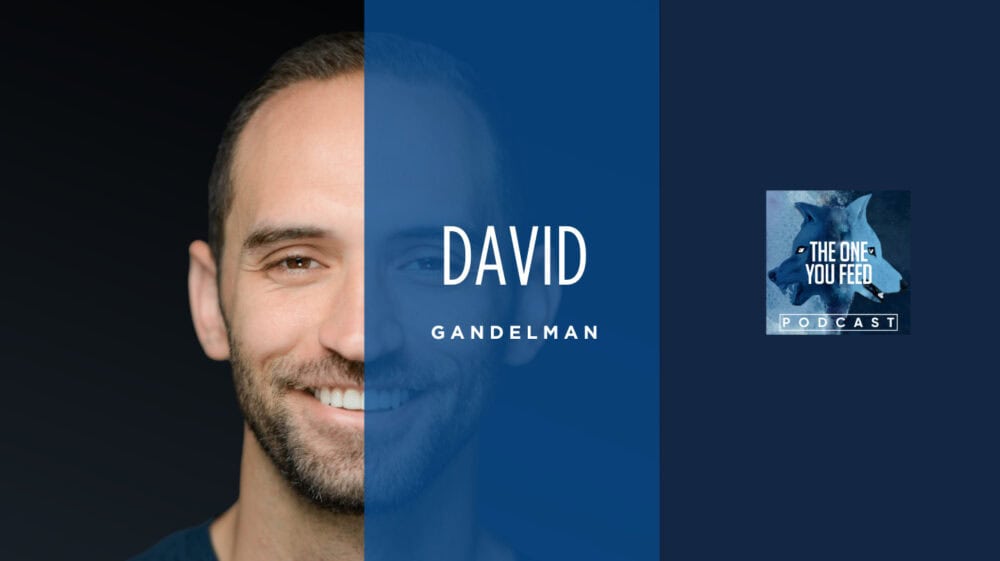
In this episode, David Gandelman explores how to tell the difference between intuition and anxiety and why learning to trust your inner voice requires more than simply “going with your gut.” David discusses how fear, desire, and resistance can masquerade as intuition, and why genuine intuition is something we develop through practice. He also explores how meditation can help us reclaim energy lost to rumination and worry, the tension between comfort and growth, and why acceptance isn’t a switch we flip but a process of working through what’s actually here.

Free Guide: Outsmart the Hidden Saboteurs of Self-Control. What’s been holding you back lately? In this free guide, Eric shares the six common saboteurs that quietly derail our best intentions—like autopilot behavior, self-doubt, and emotional escapism—and offers practical strategies to help you regain control and move forward. Download your free copy at oneyoufeed.net/ebook.
Key Takeaways:
- Why negative thoughts can be so seductive—and how meditation helps us stop feeding them
- How chasing pleasure and avoiding discomfort can actually increase suffering
- Using playfulness and perspective to loosen our grip on the stories we tell ourselves
- How rumination, worry, and unresolved experiences drain our energy
- The practice of “calling your energy back” to the present moment
- Why fear, desire, and resistance can easily be mistaken for intuition
- Why David believes intuition is earned and strengthened through practice
- How to work with the difficult question of what to accept and what to change
- Why acceptance happens layer by layer rather than all at once
- Building the inner resilience to experience the full range of being human
David Gandelman is the founder of Meditation School, the host of the Energy Matters podcast, and a meditation instructor at Cornell University. With over 10 years of teaching experience, David has cultivated a program that connects energetic experience, ancient wisdom traditions, and humor to create a safe atmosphere for people interested in developing their natural spiritual abilities and tapping into their creative potential through meditation. His book is The 7 Energies of the Soul: Awaken Your Inner Creator, Healer, Warrior, Lover, Artist, Explorer, and Master
Connect with David Gandelman: Website | Instagram | LinkedIn | YouTube
If you enjoyed this conversation with David Gandelman, check out these other episodes:
Embrace the Chaos: Finding Clarity Through Meditation with Henry Shukman (Part 1)
Embrace the Chaos: Finding Clarity Through Meditation with Henry Shukman (Part 2)
How to Find and Follow a Healing Path with Henry Shukman
This episode is sponsored by:
ZocDoc – Taking care of your health just got easier – start here with Zocdoc
Shopify – The commerce platform that helps you build, grow, and manage your business all in one place. Start your $1/month trial at shopify.com/feed.
Pebl – an AI-powered platform that helps companies hire and manage global teams in 185+ countries. Get a free estimate at hipebl.ai
Tiny Health‘s at-home gut health test provides science-backed insights into your microbiome, along with personalized recommendations to help you improve your digestion, energy, and overall well-being. Get $50 off your first test kit at tinyhealth.com/FEED
ButcherBox: Make dinnertime easier with ButcherBox, delivering high-quality 100% grass-fed beef, organic chicken, wild-caught seafood, and more, right to your door. Get $20 off your first box, plus your choice of free ground beef for life or free chicken thighs or top sirloins for a year, with free shipping always. Visit ButcherBox.com/FEED to claim your offer.
Talkiatry connects you with licensed psychiatrists for personalized, evidence-based mental health care, all online and covered by most major insurance plans. To get matched with an in-network psychiatrist in just a few minutes, visit Talkiatry.com/FEED.
Episode Transcript:
David Gandelman 00:00:00 In meditation. One of the tools that I teach is how to call your energy back from something or someone. Maybe half your energy is with an ex-partner, or an old job, or an unfinished project. Maybe a lot of your energy is locked up in ruminating thoughts, or in a recurring feeling, or in some PTSD. And so we start to recognize where our energy is, and then we bring it back so we can use it the way we want to use it.
Chris Forbes 00:00:32 Welcome to the one you feed. Throughout time, great thinkers have recognized the importance of the thoughts. We have quotes like garbage in, garbage out or you are what you think ring true. And yet for many of us, our thoughts don’t strengthen or empower us. We tend toward negativity, self-pity, jealousy, or fear. We see what we don’t have instead of what we do. We think things that hold us back and dampen our spirit. But it’s not just about thinking. Our actions matter. It takes conscious, consistent and creative effort to make a life worth living.
Chris Forbes 00:01:07 This podcast is about how other people keep themselves moving in the right direction, how they feed their good wolf.
Eric Zimmer 00:01:16 Plenty of guests on this show over the years have told me to trust my gut, but there have been times that I was absolutely certain and dead wrong. So I asked David Handelman how to tell intuition from anxiety, and his answer is different than a lot of what we hear out there. He says intuition is earned. Most of what we call a gut feeling is desire or fear masquerading as intuition. But the real thing is a muscle that’s built over thousands of hours of practice. David is a meditation teacher who spends his days helping people build that muscle. I’m Eric Zimmer, and this is the one you feed. Hey, David, welcome to the show.
David Gandelman 00:01:56 Good to see you, Eric.
Eric Zimmer 00:01:58 Happy to have you on. You are good friends with and teach retreats with one of my favorite people in the world, Scots to be old. You know he’s been on 3 or 4 times at this point, so he introduced us and we immediately hit it off.
Eric Zimmer 00:02:11 And I thought this would be a really fun conversation to have because we we’ve got a lot of overlapping interests. But before we get into all of it, we’ll start in the place that we always do, which is with the parable. And in the parable, there’s a grandparent who’s talking with a grandchild, and they say, in life there are two wolves inside of us that are always at battle. One is a good wolf, which represents things like kindness and bravery and love, and the other is a bad wolf, which represents things like greed and hatred and fear. And the grandchild stops and they think about it for a second. They look up at their grandparent and they say, well, which one wins? And the grandparent says, the one you feed. So I’d like to start off by asking you what that parable means to you in your life and in the work that you do.
David Gandelman 00:02:58 Sure. Actually, I was making a video today, a meditation on a topic similar to this, but it was related to overthinking.
David Gandelman 00:03:06 And so the meditation teacher. So the number one question I always get is how do I stop overthinking? Yeah, yeah. And so same with our thoughts. We can feed all the negative thoughts. We could feed all the anxiety, the stress, the intensity, the stories. Or we can start feeding that space of stillness. We could feed the intuition. We could feed the inspiration, the creativity. And it’s almost like seductive to go into the negative. It’s so easy it just pulls you in. Next thing you know, you’re halfway down the river. You’re still sitting on the couch, but your mind is a mile away. And I’ve always found with my students that the bigger the gap between where their body is and where their mind and energy goes, the more stress and anxiety and suffering that they experience. And so my job as a meditation teacher is to help bring them back here. And from this place we can start feeding that healthy, positive awakening energy.
Eric Zimmer 00:04:07 It is so seductive. I’m astounded by how seductive it is and how seductive it often remains.
Eric Zimmer 00:04:14 I mean, I’ve done a lot of meditation practice over the years. I’ve been doing it on and off for 30 plus years. I’ve stopped long retreats, I don’t think quite to the extent you have. And yet, like the negative just carries such an energy, the seductiveness of it. Is that really, without saying it out loud, implicitly it is saying I am important. You must pay attention to me. It’s really strong.
David Gandelman 00:04:43 Yeah. If I could share this brief story. When I was in college, I was in a class called Eastern Religions 101 freshman at Rutgers. I was studying philosophy and I’ll never forget it. It was back in the day, Eric, where we had green chalkboards and actual chalk. I don’t know if they still used that. And it was a huge haul. It was like 300 people, 300 students, and we had a guest teacher. He was a Zen teacher, and he walks up to this massive green chalkboard, and he draws a huge horizontal line across the chalkboard.
David Gandelman 00:05:13 And on one side he writes enlightenment, and on the other end he writes suicide. And then he puts a check mark in the middle and he goes, most of us are somewhere in between. And we swing from suicide to enlightenment, enlightenment to suicide, essentially saying we swing from, I don’t want to be here, which the extreme is I’m out to take my life or I fully accept this moment as it is the way it is. Enlightenment. And most human beings live in the middle. This kind of push and pull, this struggle. And a teacher I love would say, between the banks of pleasure and pain, is where the river of life flows. So we’re constantly in that seesaw, avoiding pain, chasing pleasure, and getting confused about what the heck we’re supposed to be doing and how we find peace and purpose in life. And I’ll never forget that moment, Eric, because I was 18 years old and it just it really hit me. And so I started going to his meditation classes and sitting.
David Gandelman 00:06:12 And I remember some of the meditations were so peaceful and still in others, there was a freaking storm raging. And I was like, man, I got a lot of work to do. If I cannot manage what’s happening in between my ears. And they are big ears. And so it’s a big project.
Eric Zimmer 00:06:29 Exactly. I think that is so true. And I do love that idea of, you know, between the banks of pain and pleasure in Buddhism, there’s this idea of greed. It’s phrased all kinds of different ways, but like greed, hatred and delusion, right? Which to me means I’m like you say, I’m constantly either wanting more of something. I’m grasping at something. I’m not wanting something else. It’s the hatred aspect of it. It’s again overstated, but aversion. And then, like you said, the confusion that thinks that I’m going to resolve that somehow, like I’m going to land on one side of that, I’m going to get on the pleasurable side of it, and I’m just going to be able to stay over there, which is just not what it means to be a human, unless you’re perhaps enlightenment enlightened.
Eric Zimmer 00:07:18 And we could talk about what that means. But, you know.
David Gandelman 00:07:22 Actually usually leads to more suffering. I don’t know if you’ve ever hung out with some wealthy people who have everything and are miserable. That’s what we’re going to go with this podcast. But sometimes I’ve noticed. So the temperature in the house has to be perfect all the time. Everything has to be totally clean. My schedule has to be just the way I want it. But wealthier we get, sometimes, the more we can control our environment, and then we get to a place where anything that I dislike or that hurts me, that bothers me. That makes me uncomfortable. I can pay to get it away from me and but then I end up being empty inside, not understanding what it means to grow. Because my whole chase has been comfort instead of growth. You don’t have to be rich, experienced that. But it’s just one example. And I bring this up because I just saw The Great Gatsby on Broadway, and you see all these super wealthy people miserable and being violent towards each other and jealous and angry, and they have everything and they’re more miserable than everyone else.
David Gandelman 00:08:21 And so that chasing of pleasure, that avoidance of pain is truly, in my experience, what leads to so much human suffering, and especially in the modern world, where we do have so much control over our environment, I could stay home, work from home, never leave the house, and just avoid anything I dislike. And then I start to feel terrible on the inside. And a lot of people experienced that, I think, especially during Covid.
Eric Zimmer 00:08:46 Yeah, I mean, I certainly have noticed this as I’ve gotten older, and I think it’s a combination of aging and the fact of what our modern environment is like, that I have to really work to not let comfort become value to which I subsume everything else to. And it’s not that there’s a reason. As humans, we want to be comfortable while it’s an evolutionary adaptation to a certain degree, but I don’t want that to be the value that orients my life and more comfortable I have to be the smaller my life has to get.
David Gandelman 00:09:25 That’s that’s right.
David Gandelman 00:09:26 The toothpaste always has to come out of the bottle. And so then the suffering. For most people in the West, instead of being physical, perhaps it starts to move into the emotional and mental suffering. And then we get into, I need to meditate. What’s going on inside me?
Eric Zimmer 00:09:42 Yeah. I mean, I’m always astounded by the persistence of the illusion that the next thing will make me happy. Kind of amazing how persistent that illusion is, even when I’ve seen through it hundreds of times. I know it to be an illusion. And yet, if I’m not occupying the wiser self of me, I can get caught up in it. And it doesn’t work like seeing The Great Gatsby. I mean, the one for me is I just look at like rich and famous people who do the work they love. They are universally adored. They have more money than God, and then they kill themselves. Which tells you that there’s a huge other ingredient in here that is missing.
David Gandelman 00:10:29 I’ve worked with some of those folks, and to help them navigate some of that kind of success and energy, and it’s difficult, whether it’s generational wealth or fame or some kind of success with your career, it really does happen.
David Gandelman 00:10:43 You get to the top of the mountain and then you feel empty and alone, and everyone else is jealous and you’re like, hey, yes, you shouldn’t be as jealous as you think. So at that point, then the question is, all right, well, what do I do now? And it does take a certain amount of suffering for most people to start to wake up and go, is there something else? Did I take the wrong path? Who am I? And maybe that’s where the spiritual journey begins. And in a way, that’s where it began. For the Buddha, he was a wealthy prince. He literally had everything and realized, Holy cow, there’s a lot of suffering here. I’m going to step into the forest and see what this is all about. So his journey is not that different, I think, than all of our journeys. It’s very symbolic.
Eric Zimmer 00:11:27 So this is what often motivates the beginning of what we might call a spiritual search. In your mind, what are the key ingredients in learning to not get pulled so violently between those two shores of pain and pleasure, and not to be so confused about it.
Eric Zimmer 00:11:50 What are the key broad areas that you would teach people like, hey, we want to we need to do some work here. Like meditation would obviously be one. But what are the other pillars in your mind that help us begin to be more grounded within all of this? Sure.
David Gandelman 00:12:09 Let me start with meditation, because I think what you learned on the mat, you can take off the mat and apply to almost everything. So when someone comes to me and invariably say, David, I have a problem, that I’m stuck on some things, some energy, some pain, some trauma, some fears, some work situations, some relationship thing. And I have them sit down and we start to work on that energy together. And so one of the things we start with is getting out of the story, which is almost everyone I’ve ever worked with. Eric, I’m sure you’ve had this experience. You ask them how they’re doing or what they’re up to, and they give you a pretty long form story.
David Gandelman 00:12:48 And all the characters, the villain, the hero, everybody in that story, and it becomes like a play. And so the first thing I like to do with them is to pull them out of the story and a little bit more into their sensations and into their body. So I’m not so interested in the story as I am. What are you experiencing as energy internally? And let’s start there, because the story will change, the characters will change. It’ll happen over and over. So I like to begin by drawing their attention inwards. What the feeling in the body is, what the energy actually feels like. Getting to a place of you know what, David? I’m actually just anxious or in grief or afraid. First thing always is what is the energy behind the suffering? If you could start to name it for me. So that’s where we start to bring some awareness. And then the second thing is can I begin to get neutral, more neutral to it, which is really freaking hard. That’s why I use a lot of amusement playfulness.
David Gandelman 00:13:48 My students tend to come to me because they want a less serious approach. When you get really serious, it’s like Homer in The Simpsons. He chokes Bart. It’s like you take the thing you want to fix and you squeeze it and you make it worse. And so a little playfulness, a little bit amusement, lightness. We come into some neutrality to have some perspective. So coming to the body, notice what the energy actually is. Find some neutrality to it. And then third let’s keep it to three. We’ll make it simple. Start to get some insight. So in meditation when we close our physical eyes we open our inner eyes. So we have two to see out, one to see in. And so when we look inwards we can start to have insight into what we’re struggling with, what questions we have about life, what our next step is, our path or relationship question, whatever it might be. So I like to teach my students how to find their own answers as they get through energy.
David Gandelman 00:14:43 And those tools become super powerful when you take them outside of your meditation practice as well, and apply them practically. So can I shift my energy on the inside? Start to find my answers and then take that and apply it to my life. That’s what I always find my job to be. When somebody comes to me with something heavy, I’m not there to solve their problem. I’m there to teach them the mechanics of how to heal through it, derive their answers, and then move forward. And I hope they at some point they leave me in the dust by.
Eric Zimmer 00:15:17 Yeah, I think that ability to laugh at the story is so powerful. I interviewed David White, and I think he called it the absurdity of the David White Project. And I just love that. Like if we look at our own lives, they are absurd in a sense. Like, I was thinking about me in the book and I was like, you know, I put all this work into this book and I’m putting it out there.
Eric Zimmer 00:15:38 and in the vast, vast, vast, vast, vast majority people simply don’t give a shit. Like, it is completely irrelevant to, you know, 99.99999% of the world’s population. Not to mention aliens, the rest of the universe, right? It’s just not important. And yet it comes to dominate 90% of my psychic space. That’s absurd.
David Gandelman 00:16:08 That’s right. And as my 101 Easter religions teacher said, he goes, you sit down at a movie, it starts, it pulls you in. You feel the emotions, you identify with the characters, and you lose yourself for two hours, and then it ends and you’re like, whoa, where have I been? I gotta pee. All of us are doing that. But just in our own heads, there’s a mental movie and we’re just losing ourselves to it over and over. And so in meditation, we pull back and we start to become aware of the subject rather than the object of our awareness. And that is the beginning of the shift, where there’s a space between the awareness and the thinker, or the pictures and thoughts that come into the awareness.
David Gandelman 00:16:48 And I mean, that’s meditation 101. But I also find, Eric, that a lot of people stop there. And I’ve worked with a lot of meditators who can be very cerebral. They’ll sit Zen style Vipassana meditation for decades, but there’s just an energy that isn’t processing. What started as liberation becomes a form of suppression. And so I like to walk them on the journey of let’s sense, feel, see some energy and start to get some answers and peel back the layers here, which I think some meditations, they don’t maybe take you that far.
Eric Zimmer 00:17:39 Part of why I think watching a good story or reading a good book is so enjoyable is that we get to live someone else’s story for a while, and it is a relief to not be living your own story for a period of time. However, that doesn’t actually transform anything. It just takes us somewhere else for a while, which has its own value. I’m not saying it doesn’t. It does. I want to come back to a word you keep using, and I’d like you to put a finer point on it for me, which is energy.
Eric Zimmer 00:18:10 Energy means a wide variety of things to a lot of different people. I could take it to mean the electricity that’s powering this room right now. I could take it to be the sort of thing that a Reiki teacher moves around. I mean, it’s all over the map. So what do you mean when you use that word?
David Gandelman 00:18:27 Yeah. Great question. And by the way, there is no such thing as raw energy without a form. At least we don’t physically experience that in the world. Physicists can’t find raw energy that doesn’t take some form, so I use it in a broad way. It often correlates to our feelings and our emotions, but it’s beyond them. It almost emanates in them and behind them. And it’s one of those things that is not physical in the way that I use it, or strictly physical. And so it’s very difficult to go. It’s purple or it has that shape. For example, in India they call certain forms of energy prana. In Hawaii they call it mana.
David Gandelman 00:19:07 In China they call it chi, right. In Japan Chi. So it can take forms. One of the ways I use it in my book is I work on the seven energies in life. I can go into that. But when the light of consciousness passes through the physical form in some way and manifest out into the world, it comes out in different forms. So there’s a part of us that’s a healer, a lover, a creator. So just on the personal human level. The energy emanates in different forms. And so we have the light of pure awareness. And then when it manifests into some form in the world, it has an energy behind it. So my thoughts have an energy, my feelings have an energy. My body has an energy, my inspirations, my creativity. They all have energy, but it needs a form to be experienced in the way you define awareness. It defines itself. It has no other characteristics. To me, energy takes the form of whatever it manifests into.
David Gandelman 00:20:07 And so stripping it of the form becomes impossible to describe.
Eric Zimmer 00:20:11 That’s interesting in that we often in the West talk about thoughts and we talk about feelings and emotions. We talk about them as if they are separate things. My theory is they’re not separate things. It’s useful to distinguish them from each other, because you can intervene and it gives you different avenues to kind of come in. But that we’re talking about essentially one thing. To me, you never see one without the other. Would that be a description of energy that it’s that everything kind of all together in there, or would you describe that differently?
David Gandelman 00:20:50 I think I would describe it a bit differently. So for example, if I was guiding someone in meditation and they said, David, I keep having this recurring ruminating thought over and over and over. Maybe it’s an image, a memory. I would actually have them freeze that thought for a moment and ask them to describe the energy that is emanating that thought. So when we go to the movies, we see the image on the screen, but the energy is coming from behind our heads, projecting onto the screen.
David Gandelman 00:21:18 So what is the light, the energy projecting that image in your mind? What is behind it? And so when they sit with that and meditate with it, they might go, oh, there’s anxiety there. There’s fear, there’s confusion, there’s doubt, there is serenity. Whatever it is, and yes, in the form perhaps of a feeling. But it is, as you said, maybe there is a mix of a feeling and a thought together and something beyond that. So when we get through an energy like we heal anxiety or release an old trauma, and my experience that almost energy takes a raw form and comes back to us and reintegrate, and then we can use it somewhere else. And so it might be emanating through anxiety, fear, an image, a memory, but then we can actually heal that, release it, and then and then we reintegrate it. I think a lot of people are tired all the time because they’re suppressing, managing, holding so much energy in the form of thought, in the form of emotion that they’re not fully healing and processing, and then they don’t have so much to use for creativity, inspiration, love, experience.
David Gandelman 00:22:24 And the tank is half empty. And so we need our energy back. And so in meditation, one of the tools that I teach is how to call your energy back from something or someone. Maybe half your energy is with an ex-partner, or an old job, or an unfinished project. Maybe a lot of your energy is locked up in ruminating thoughts, or in a recurring feeling, or in some PTSD. And so we start to recognize where our energy is, and then we bring it back so we can use it the way we want to use it. And that I always find a very powerful tool for my students. They realize, wow, so much of me and so much of my energy is just out there and not in here.
Eric Zimmer 00:23:02 Before we dive back into the conversation, let me ask you something. What’s one thing that has been holding you back lately? You know that it’s there. You’ve tried to push past it, but somehow it keeps getting in the way. You’re not alone in this, and I’ve identified six major saboteurs of self control.
Eric Zimmer 00:23:21 Things like autopilot behavior, self-doubt, emotional escapism that quietly derail our best intentions. But here’s the good news you can outsmart them. And I’ve put together a free guide to help you spot these hidden obstacles and give you simple, actionable strategies that you can use to regain control. Download the free guide. Now. At once you feel and take the first step towards getting back on track. So how do we start to bring it back? So let’s start with the basics of meditation, which is you sit down and via various means, you start to notice what’s actually here and arising, right. You notice a thought, you notice an emotion. Just are tuned in to what’s happening. Now. I know certain meditations are like, just stay on the breath, don’t go anywhere else. But at a certain point, all meditation starts to turn its interest a little bit into what’s the experience of being here? So let’s say I go, okay, I have an energy. It feels anxious And I think it might have something to do with.
Eric Zimmer 00:24:28 I’m scared that my kids are growing up in a dangerous world. So how do I start to use meditation to work on that?
David Gandelman 00:24:37 Great. So two interesting words you use Eric feeling and thinking. So before I even get into the answer. Often when I teach a class, I asked, hey, if you’re primarily a feeler, raise your hand. And if you’re primarily a thinker, I want you to raise your hand. And we all have. We all do both, obviously, but most people have a dominant side. They feel into their answers and some people think into their answers. So I thought it was interesting that you used those two words. When I’m teaching meditation, I’m actually teaching my students to learn how to see their answers and how to know them, and come out of all of the feeling and the thinking. So the first shift is learning to come out of the feeling and the thinking and learning how to see and to know. And a lot of folks never even get to that place.
David Gandelman 00:25:22 So that’s where I like to start. so thanks for sharing that. So for example, I’m super worried about my kids growing up. If we were doing some work together, I might ask you with your eyes closed. Imagine out of 100% of your energy that you have available to you. How much of it is out there in worrying about this topic? And then the person will sit and meditate on that and they might say, wow, 70%, 80% of my energy is out there worrying about that topic. We all know that sitting and worrying has never solved a single problem on this freaking planet. It’s just an expending energy in a useless way. And then we get back to being tired. And so what I like to do, perhaps a visualization, and I do this in different ways of helping them see their energy come back. So, for example, one of the tools I like to use, there’s kind of a light behind my head, like a golden ball of light above the head and then watching your energy come back from the place that’s been taking your attention, from worrying about the future.
David Gandelman 00:26:30 So often we’re either trying to fix the past or worry about the future. So another example might be if somebody comes to me with a lot of regret, a lot of anger, I might go, how much of your energy is locked in the past or in this one moment? If we want to get really specific, they go, 90% of my energy is locked in that relationship in that moment. And so obviously there’s many steps here and it can be complicated. We might need therapists and all the whole team, but just keeping it in the framework of meditation, can we get to a place where maybe 40% of your energy is locked in that memory in the past, and then we start to call that energy back into the body physically, viscerally, watch it, sense it, pour back into the body. We might do this dozens, hundreds of times and get better and better at bringing our attention back from all the places that keep pulling us all fantasies, the future isms, the stuckness in the past.
David Gandelman 00:27:32 I mean, that’s probably for most people, for better or worse. Eric. Like 80% of meditation of what they need before they can even go. What’s the question? What’s the answer? What’s the next step? Who am I? They can’t get to that because their energy is not here. Their tank is empty.
Eric Zimmer 00:28:07 So what does this actually look like? If I were going to spend five minutes doing this. Because one of the things I know about meditation is that very specific instructions are very helpful, but they stay very specific and that a lot of my learnings from meditations have been when it’s more of an open thing. The problem is, there are days that my attention is such that it can rest in an openness, and there are days it cannot. And that trying to do that is just like living the rest of my life in that. Right. So what is someone who’s trying to do this do when their mind inevitably zips off somewhere else? What are they coming back to?
David Gandelman 00:28:55 Great questions.
David Gandelman 00:28:56 Before I answer that, just to find two types of meditation, because you just mentioned two types of meditation. Yep. Dual meditation, non-dual meditation. So dual meditation. There’s a subject and there’s an object. I am doing something, focusing on my breath, visualizing seeing where my energy went, grounding, processing emotion, looking for a next step. I am doing something. Non-dual meditation is where you turn your awareness on to the awareness itself and go into, let’s say, a state of where there is no separation, there is no object, there’s no story, there’s just awareness. And that’s the path of Zen, of Vedanta, the path of enlightenment that teachers teach. And so what I’m hearing when you say that, Eric is you’re doing both, which is, I think what you should be doing, you should be able to sit in that stillness and you should be able to also go, hey, I got some freaking emotion I need to process. There’s some pain. This morning when I sat down, there’s a storm happening in my head.
David Gandelman 00:29:56 And so I try to be as prescriptive as possible with the person I’m looking at based on what I sense that they need. I’m not part of any guru lineage. I don’t have any agenda. I just want to give you the best tools for the scenario and situation you’re in that are going to be the most useful. Leave everything else. So that’s just, you know, how I approach it in my philosophy. And by the way, a dual meditation could lead to a non-dual meditation or state. Like if I process a crapload of pain and then I’m just relieved, and then maybe I just sit in stillness and just soak that up for a while. So I don’t even want to divorce those two.
Eric Zimmer 00:30:34 Right. Right. Flow in and out of each other. Yep. Yeah.
David Gandelman 00:30:37 So all of that being said, going back to our example, which would be a dual meditation, there’s a subject and an object and the object is my energy that’s out there that I want to pull back into the subject.
David Gandelman 00:30:49 Yep. Right. So for example, maybe in this visualization, I created a nice big golden ball of light above my head and I take inventory. I like by taking inventory how much of my energy is out there? Everyone’s always like, be at the moment I thought I was. And you sit and go, well, how much of my energy is not in my body? Oh, wow. It’s like 80%. So when I used to live in Hawaii, my nickname Eric was cosmic for about two years because I was so out there in the stars and everyone at the meditation school would make fun of me because I was just like, head in the stars. And it took me time to bring my energy back into my body and be here, because I much preferred to fantasize and to be out there than to be here. So at that time, I’m just making this up. Let’s say 88% of my energy was outside of my body somewhere else. And so in this meditation, I would call as much of that energy that’s willing to come back at the moment watching it almost passively.
David Gandelman 00:31:46 So becoming aware of like, wow, I can actually sense and see so much of me is out there. And then slowly, like beams of light coming back in. And when it feels full, which is either in five minutes or in 50 or whatever you’re doing, let it pour back into the body and almost like a body scan, but watching your energy come back into your body till you feel full. So visualization for some people like that works. Other people, they don’t need the visualization. They just sense their awareness coming back and both are okay.
Eric Zimmer 00:32:17 Yeah, some of us can’t visualize. I learned that I didn’t know there was a term for it until, I don’t know, a year ago, and I don’t remember what the term is, but because I can’t visualize what the term is. No stupid, stupid joke. People like me, we don’t form images in our mind. We do very little. I don’t think I’m like the absolute extreme of it, where there’s no imagery, but I can’t visualize things.
Eric Zimmer 00:32:43 If you tell me to envision a golden ball of light, it is, at its best, extraordinarily vague, because it’s just I don’t I don’t have that capacity. And so, you know, I think after, you know, this New Yorker article got published, a lot of people started going, That’s my experience. I’ve just never really known how to vocalize it before.
David Gandelman 00:33:05 Yes. So I do this all day for a living. I’ve worked with a lot of students who can’t see. I want to put them into two camps. the people whose third eye muscle is an atrophy, and they’re telling me they can’t see. And it’s like taking someone to the gym and they’re like, I can’t do pushups. I’m like, well, you can. We’re going to build up to that. We’re going to build the muscle.
Eric Zimmer 00:33:25 There.
David Gandelman 00:33:26 Okay. And then the other camp, which is a small slice of people that actually can’t see, they cognitively can’t see. And then with them, we work with feelings, with knowingness, with other senses, and it’s totally fine.
David Gandelman 00:33:38 So everyone is included. But if I was to ask you a question. Yeah. Can you see the face of someone you love?
Eric Zimmer 00:33:47 Vaguely.
David Gandelman 00:33:49 Okay.
Eric Zimmer 00:33:49 It’s more that I know what they look like than it is I see it. I don’t know how else to say it. It’s like I know what they look like, but there isn’t an image in my mind of them. Really?
David Gandelman 00:34:02 What about a memory? Like if I asked you a place that you were last week, or what your living room looks like.
Eric Zimmer 00:34:08 I can do it. It’s not that I can’t do it, but I don’t know how much of that is knowing. Like, I can think about my living room, and I know that there’s a table over there and that the wall is white and that the couch is green, but it doesn’t form what I would call what seems to me like an image.
David Gandelman 00:34:26 Okay. All right. So it’s hard to tell that fast, but you could be someone that doesn’t see images, or the muscle could be an atrophy.
Eric Zimmer 00:34:34 Extremely atrophied. In my case, it’s probably. What’s the term for a muscle that is almost completely atrophied?
David Gandelman 00:34:42 A wet noodle.
Eric Zimmer 00:34:43 A wet noodle? Yeah. It’s like a it’s like a wet noodle of a visualization capability. But I do think that it’s not new to me. Like I’ve never been somebody who’s really moved by any visual art. I can look at it, I can appreciate it. I can think I like the way that looks. I don’t like the way that looks, but it doesn’t do anything. It’s only when I know something about the piece. And again, I don’t know if these things are related or not, but.
David Gandelman 00:35:08 Well, I think they sound related to me. And so the people let me just talk to the people in the atrophy camp, which is most people, when we grow up, we’re given visions, right? We’re given images, storybooks for kids. Start with all pictures. Then you get a couple of words, right. Cat in the hat. And then more and more words and less and less images.
David Gandelman 00:35:29 So we become very cerebral. You know, kids are amazing at imagining they can see anything. Tell them a story. They see it. Obviously not the ones who can’t see. But most kids. And then we grow up less and less images. But now, with social media, with iPads and computers and phones, we are given endless images. So I never have to imagine anything AI or you or whoever’s giving me images all day long on my phone. So that actually creates a form of atrophy too, because I don’t ever have to try to see something or create an image. Yeah. So there’s so much atrophy from being given images. So I just want to say that for a lot of folks it is a muscle work in meditation class. Often we work that muscle and imagination becomes the bridge to seeing. So first we imagine and then we learn to actually see something more and more clearly, like seeing our own answers, seeing our next step. See, even seeing an emotion, seeing a thought.
David Gandelman 00:36:28 And if you cannot see, then you have a knowingness like you just described. I don’t see the room. I know the room. Totally workable that way too. And those two abilities often will work together.
Eric Zimmer 00:36:41 All right. I want to ask about intuition versus anxiety. This is something that I think a lot about, because I’ve had no shortage of people who have come on the show who’ve said some version of the inner you knows, you know, trust your gut. And while I actually feel like I know what that means today, There have been versions of me in the past that felt incredibly real and true, and my gut was dead wrong. I mean, catastrophically wrong. My heroin addiction is a great example of that. I mean, I was certain that was what I needed to do. That wasn’t me contemplating like, well, you know what? I think I should probably go and, you know, three grand felonies today and then go hide in a Friendly’s bathroom and shoot up. This sounds like a good idea.
Eric Zimmer 00:37:39 No, it’s a knowing it’s a half to. That is not intuition. So let’s assume you’re not in an extreme situation like that. We’re in a place where our fear and anxiety is a present thing. Or we could say our traumas still inform some of our life. How do we start to tell these things apart? Because again, I do think intuition is real. I think it is a source of knowing. I don’t think it’s the only source, but I think it can be very deceived.
David Gandelman 00:38:10 Absolutely. And my intuition is saying I should have ice cream for lunch, you know, so 100%.
Eric Zimmer 00:38:16 I mean, it’s it’s like a hundred degrees here. My intuition is right about this. Dairy Queen, here I come.
David Gandelman 00:38:23 I love that, by the way. Last time I went to Bali, I was teaching a retreat there with our buddy Scott. And, you know, there’s this spiritual thing. I’ve lived in Los Angeles. I’ve seen it. It’s like where someone always just goes, well, my truth is, I’m gonna do, like, the Valley girl voice, you know, like, like.
David Gandelman 00:38:39 So anyway, like, my truth is, and I’m hearing is what I want is using the words what my truth is. But all it masquerading desire or resistance, it’s masquerading as intuition.
Eric Zimmer 00:38:54 That’s fair, because I think it’s more than just desire. Because take a take a someone with an acute PTSD, take a soldier, right? They hear a car backfire. They think at a cellular level there is danger and there is not in that moment. Right? So it’s not just I want something. It’s also an aversion aspect. Like you we’ve talked about between those two banks of wanting and not wanting.
David Gandelman 00:39:20 And so intuition is neither bank. It is not the desire nor the resistance. And so that’s a place to start. Next thing is, as I mentioned earlier, most people are feelers and feeling is actually not in the beginning stages of the trainings that I do are reliable source of intuition because it is so mixed in with our feelings, other people’s feelings, what we want and what we don’t want.
David Gandelman 00:39:46 And so we kind of in the trainings I do, we learn to take the elevator up from the gut and learn how to see and or know our answers and energy. So as we were discussing a bit earlier, most people say I’m a feeler or I’m a thinker. That is not where intuition is. I mean, it does live somewhat in feelings. We have gut feelings. We do have instinctual intuition. I think it’s evolution, part of being a mammal that keeps us from danger. That is also kind of weird. And I’ve had many instances and friends of mine whose lives were saved by an instinctual intuition where nothing, no danger, was physically visible. So that exists. I want to separate that from maybe a more spiritual intuition that we can also have with visions, with the knowingness. Sometimes we call it inner voice. We might hear a word or a sentence. And there’s a real power in intuition. Most people’s intuition is not refined. The muscle is not strong. And so to say, just go with your gut or listen to your feelings is actually counterproductive because they’re going to go have ice cream or heroin, right?
Eric Zimmer 00:40:55 Except when you’re doing a heroin, you don’t have any money for ice cream.
Eric Zimmer 00:40:58 So they’re kind of mutually exclusive in that world. I mean, it’s true, it’s true.
David Gandelman 00:41:03 Oh my God. And, Eric, I’ve seen so many people like end relationships. I just have a feeling I’m like, no, you’re in pain. You’re not communicating. You’re in resistance. Slow down. And so intuition is earned. I think there’s this concept that it’s just given. It’s there. And most people, when I tell them what I do, they’ll go into some premonition of a dream they had that came true. Or one time nine years ago, they had an intuition that came true. I’m not interested in that. I’ve seen that a lot. What I’m interested in is in somebody building that muscle and using it every single day, where it becomes very practical and pragmatic in their life and becomes part of their decision making process and part of their being in a very healthy, grounded, reliable way. Not in some fantasy or hopes of what I want or avoidance of what I don’t want.
David Gandelman 00:41:56 And that takes 10,000 hours, just like anything. Good.
Eric Zimmer 00:42:00 Yeah, I love that idea of intuition being earned, because some of the stories of intuition that you hear are like the ones that you just described. Like, I had an intuition that x, y, or z. And again, there are certain danger situations which are intuition is actually really good to listen to. Again, if you have PTSD, it might not be good to listen to. Right. So it’s very affected. And the other type of intuition you hear about is and it’s probably from a Malcolm Gladwell book, but of the firefighter who intuitively knows exactly the thing to do that saves them in three other people. But that’s an earned intuition. They have all these hours in that circumstance that then allows them to process lots of information in an incredibly fast, what feels like intuitive way. And so I do like that intuition being earned. I also like that it’s not either of those banks pleasure or pain. For me, an intuition often doesn’t feel pushed or pulled.
Eric Zimmer 00:43:06 I don’t know how else to say it right. It’s a it’s an internal feeling. I know what things pull on me. I know what things push me away. And neither of those, although that’s useful information, is necessarily intuition. And so I like to think of it for me is I have lots of ways of making decisions, whether that be the small decision about whether I want to have David Handelman on or Gandalf on the show. Right. Trying to determine between those two. I have ways of making a decision about the fact that I’m going to be moving to Atlanta and that I inform those decisions lots of different ways. And intuition for me, is one of those ways. Would you say the same thing?
David Gandelman 00:43:53 Absolutely. And there’s a texture to it that is hard to describe, but there’s a sense of knowingness and certainty and groundedness and intuition, and that is what we start to get to. And I agree, you need the 10,000 hours, the Malcolm Gladwell thing that I always tell my students, your answers tend to be born out of your energy.
David Gandelman 00:44:13 So when somebody comes to me and they’re like, I want an answer to this question and they’re stuck, let’s say a relationship thing, they might be on step two out of ten. They haven’t learned about a lot of things before they get that real big, let’s say the big answer or insight. And you got to do the work for that answer to blossom. It’s not as simple as going, just give me the answer. I’m going to run with it like I’m playing the lottery numbers or something. I’m just going to win big. That’s not practical. And so most people don’t want to do the work. And I just wanted to share this quick story. I was teaching in Los Angeles years ago at a meditation studio, and my classes were, you know, pretty full. They were fine. But one day a Chandler came through town. It’s like an old western. One day, an old pastor came through town and he did exorcisms, so Chandler came through town. I have never seen that place so packed.
David Gandelman 00:45:04 Eric. I mean to the brim. Line out the door. You know, I do this work too, so it’s fine. But I was watching a group of people begging for someone to give them their answers. Yeah. And I was like, I don’t want to do the work. I want you to channel some entity and give me my answer. And I was like, I want to teach you how to build the muscle to get the answer 100%.
Eric Zimmer 00:45:25 So I want to change directions now back to where I had intended this conversation to start. And it is now actually the place that we are most likely going to more or less end it. And when you and I talked before we started talking about the Serenity Prayer, right. Courage to change the things you can, the serenity to accept the things you can’t change. You told me that a working title of your next book is I’m Here Now The Art of Accepting Hard Things. And for me, I think both changing things and accepting things is hard work.
Eric Zimmer 00:46:00 I think the hardest work is knowing the difference between the two, and I think it’s actually very nuanced. I sometimes think we’re doing both those things, but I’d love to take this idea on intuition and helping us make decisions about this. Like, I have a scenario in my life. I’m not going to go into details because it involves other people, but I live on this in-between point where I’m like, can this change? You know, this could change. And then the other part of me is like, just let that go. And I think those are often the really hard things in life. Like some things are very obvious. Like if I were to, God forbid, have my leg amputated, I would know I am not going to have that leg again. And I would go about accepting it and adapting. But if I’m in a case where perhaps my leg is somewhat damaged and I might be able to rehabilitate it, I might not. That’s the place that a lot of us get sucked into.
Eric Zimmer 00:47:09 And you talk about energy going somewhere. Those situations, they are the end. In my mind, those are often the energy hogs because you can’t cleanly delineate these things. So how do you think about that?
David Gandelman 00:47:23 So I would say you have to work through energy to get to the place of acceptance. So it’s not a switch. Wouldn’t that be so nice? Except not acceptance and acceptance.
Eric Zimmer 00:47:36 Like I say, accepting is hard. I’m not saying it’s not very difficult. It is. It is a process. It’s just knowing which tool to apply to. The job is often the part that I find most difficult.
David Gandelman 00:47:49 So yes. So if I had somebody come to me and go I just lost my leg. I’m freaking pissed off. I’m angry at God, angry at life. And I also am a meditator, and I know I have to accept it and move forward. Where I would start with them is, well, let’s sit with the actual energy that is arising first. And perhaps that’s like, I’m angry.
David Gandelman 00:48:10 I’m angry at the way my life is. Who am I to say, hey, accept, just accept things. Of course, of course. Yeah. So I would sit with them and work through each layer of energy, and then the acceptance becomes like the byproduct, the fragrance that comes off of their shift in consciousness and their shift in energy, which might take time and work. Same with a breakup. Same with someone passing away, with losing a job, with expectations not being met. Someone goes, what’s the recipe for acceptance? And for me, it is working through each layer of energy. So, for example, I’m really freaking angry and I don’t want to accept I lost my leg. Well, can we start with you accepting that you cannot accept this moment? That’s where I would start. And then tell me about the resistance in that. And can we accept that you’re so freaking pissed off? And then I would move from. And I would move from there. And in my experience, Eric, the closer we get to the truth, the more of a paradox it becomes.
David Gandelman 00:49:13 It’s like the more I accept things as they are, the more likely there is a change and a shift that will occur.
Eric Zimmer 00:49:20 Yeah, I think that is the fascinating thing. What I’ve sort of landed on myself after thinking about this a ton, is that most things don’t fall into one of those two categories. We want to file it. Either I accept it or I change it. And my experience is the things that are challenging. I’m actually doing both with my depression. There are things that I do that manage it. There are medicines I take, There are health routines that I do. There’s ways that I eat, there’s ways that I move. There’s ways that I talk to other people. There’s ways I work with my thoughts. There’s a lot that I can do, and sometimes I’m like a channel or rolling through town. It’s just like it kind of rolls into town and I’m like, oh, here it is. And for me, often then the best medicine for that moment is to accept it, to not make a big deal out of it, to go.
Eric Zimmer 00:50:17 All right, you know what? You’re here. That’s fine. You can hang out for a little while. No big deal. Doesn’t mean I stop trying to improve it, but I also am trying to change it. And I love what you said. Oftentimes that when acceptance occurs at a deeper level, we then can see what about the situation we can’t own or change. But this is where I think the intuition and discernment comes in. So much is like, okay, how much of my energy goes into accepting this thing versus how much of my energy goes into changing it? And again, I think the hard things are the ones where you don’t know. You just don’t know. It’s not cleanly, one or the other.
David Gandelman 00:50:57 There’s the same from Pima Sojourn, which I’m sure you’ve heard. Nothing goes away until it teaches us what we need to know. And if something is a persistent bastard. And it’s just like every morning I wake up. It’s there every lunchtime. Every night when I go to bed.
David Gandelman 00:51:13 Then what? I on a very kind of practical meditation level. I might put that into a bubble if you can see or just intuit that.
Eric Zimmer 00:51:22 I got it.
David Gandelman 00:51:22 Yep. And I would have it in front of me. And instead of trying to flip a switch of acceptance, I would go, what is the energy today? Like checking the weather? What is the energy on this thing today? And it’s like frustration, anger, confusion, doubt, seriousness, expectation, loss. All right. Let me work on that layer. Just the one step in front of me. I extend to extrapolate into something that’s too big. Like I lost my leg. I have to accept. I lost my leg. No, no, we gotta layer by layer by layer. Maybe we do it 1000 or 10,000 times, and spiritually, we become a master of that energy. So maybe you’ve been rejected a hundred times in relationship and you are becoming a master of invalidation and rejection. Are you becoming a master of grief and loss, or becoming a master of learning to let go of expectation or of other people’s judgment, whatever it is, maybe in this lifetime that is one of the big arcs for you.
David Gandelman 00:52:22 And then if you can accept that and sit with that 1000 or 10,000 times and work each layer one at a time, then your answers and your energy are born out of that shift. And that’s where I see the vast majority of spiritual work really be done. And that’s how we learn how to get our answers and know who we are. It’s not by any flip of a switch or even accepting an idea or a principle. And that’s where I feel my work always lands.
Eric Zimmer 00:52:50 Before we wrap up, I want you to think about this. Have you ever ended the day feeling like your choices didn’t quite match the person you wanted to be? Maybe it was autopilot mode or self-doubt that made it harder to stick to your goals. And that’s exactly why I created The Six Saboteurs of Self-control. It’s a free guide to help you recognize the hidden patterns that hold you back and give you simple, effective strategies to break through them. If you’re ready to take back control and start making lasting changes. Download your copy now at once.
Eric Zimmer 00:53:28 Let’s make those shifts happen starting today. When you get a book. There’s a quote from she’s a novelist, Sue Monk Kidd. She’s written a number of amazing novels. She was a guest on the show, but she also wrote a book about her spiritual journey. And I think it’s in this book where she said some version of this, which I have probably twisted into all kinds of weird shapes over the years, but I think I have the general contours of it. She basically said that letting go is a spiraling, winding process, and that we do ourselves wrong by thinking that it can be achieved by like one simple prayer or moment of letting go. And I love that idea. Like, it’s a winding, spiraling process. Like, we don’t just suddenly go. Generally we don’t just go, well, okay, except it done right. It is this process of just a little bit here and winding and living with it, and it takes time. And I just loved that quote for that reason.
Eric Zimmer 00:54:30 It’s basically what you are saying here is that there may be a lot to unravel here for you.
David Gandelman 00:54:37 Have you ever seen the statue of David, Michelangelo’s statue?
Eric Zimmer 00:54:41 Not in person.
David Gandelman 00:54:42 Okay. You know, he’s a stunning guy. Let’s say, well, chiseled. You know, we all have our physical form. What is your spiritual form like? Is that form healthy? Is it strong? Is it grounded? Is it resilient? Is it patient? Calm? Kind? Compassionate? Right. We can build an inner statue of David. Right? And and a lot of it, as I think Michelangelo said, is removing parts that weren’t him is what he did to carve it. And so a lot of the work is also kind of release other people’s judgment, expectation, external fear, whatever it is, until I find who I really am and start to chisel this really, you know, whatever it is for you, inner being that you want to bring out into this world and into form. And most people were never taught how to do that.
David Gandelman 00:55:33 And so we wake up in our 30s, 40s and 50s, 70s wherever, and we’re like, hey, I haven’t worked on myself nearly enough, and no wonder all of my creations are going sideways. No wonder I can’t accept a small slight at work. I haven’t done any work. What do you mean? My ego is so easily offended. I spin out into fear. I lose myself into fantasy. Well, yeah. You haven’t done the inner work. Why would you expect those muscles to be strong? And so we have to do that work. And the difference between the people I found that are successful and happy, and the ones who are not are the ones who have done the inner work, and they’ve built a sense of spiritual resilience, and they can accept the entire spectrum of the human condition. And it’s the last thing I’ll say about that is something that kind of perturbs me in spirituality is this idea that spirituality has a specific texture, like or color. Spirituality is purple and it’s soft and it’s lovely, whatever it is.
David Gandelman 00:56:32 And then, you know, that kind of woo woo vibe that makes people feel allergic to it and then they run away. And so that might not be who you are or what it is for you. I’ve worked with some grizzly dudes. There’s spirituality does not look like that. Yeah. And so I just wanted to say, for all those of you listening, it doesn’t have a single form. You’re however it takes form in you. Is that unique statue of David coming out? And I just find myself as, like the midwife to helping people along that path as I work on it forever.
Eric Zimmer 00:57:06 Well, that is a beautiful place for us to end with. Learning to carve our own David out of our spirit. You and I are going to continue in the post-show conversation, where we’re going to talk about our fathers and your father. Just to tease this up is a Russian engineer immigrant, 79, who now lives in Trump County, Florida. So this should be good. I’ll also get to talk about my dad, and we will talk about the family spiritual test, which I think Ram Dass famously said, if you think your spiritual go spend a day with your family.
Eric Zimmer 00:57:41 Listeners if you’d like access to that. Also post-show conversations. But most importantly, if you want to support a show that means a lot to you and a show that really needs your help in today’s changing podcast world, go to one UFI net. David, thanks so much. I’ve really enjoyed this.
David Gandelman 00:58:00 Such a pleasure, Eric. Thanks for having me.
Eric Zimmer 00:58:03 Thank you so much for listening to the show. If you found this conversation helpful, inspiring, or thought provoking, I’d love for you to share it with a friend. Share it from one person to another is the lifeblood of what we do. We don’t have a big budget, and I’m certainly not a celebrity. But we have something even better. And that’s you just hit the share button on your podcast app, or send a quick text with the episode link to someone who might enjoy it. Your support means the world, and together we can spread wisdom one episode at a time. Thank you for being part of the One You Feed community.