

In this episode, DJ DiDonna explores why a life-changing sabbatical might be more possible than you think. He explains why extended time away from our usual routines can offer something a vacation often can’t: the space to reconnect with who we are beyond work, gain perspective on what matters, and imagine what we want the next chapter of our lives to look like. DJ and Eric also discuss how planning years ahead can make a sabbatical feel more realistic, and how we can apply the same principles of stepping away and disrupting our routines even when taking months off isn’t possible.
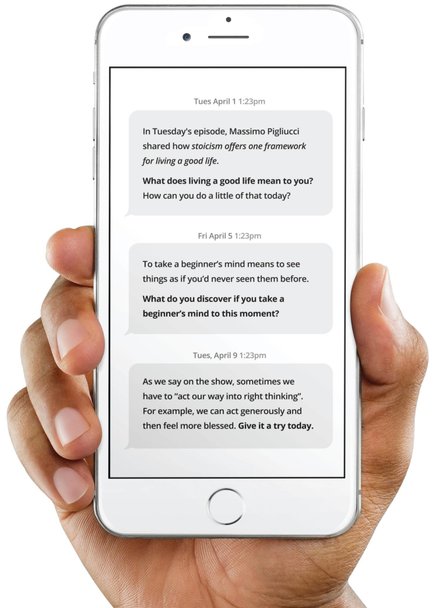
Good Wolf Reminders
A little wisdom, right when you need it. Start receiving free text reminders designed to help you pause, reflect, and take meaningful action. Sign up at oneyoufeed.net/sms.
Key Takeaways:
- Why even meaningful work can lead to burnout
- What makes a sabbatical different from a vacation
- How extended time off can bring clarity, creativity, and perspective
- Why planning years ahead can make a sabbatical more possible
- How stepping away helps you reconsider what you really want
- Why experimenting with new interests can reshape your sense of identity
- How sabbaticals can help you reconnect with life beyond work
- Ways to create meaningful breaks when a full sabbatical isn’t possible
DJ DiDonna is a senior lecturer at Harvard Business School, where he teaches entrepreneurship. In 2019, he founded The Sabbatical Project to define, explore, and research sabbaticals. DiDonna has advised over a dozen organizations on the creation of sabbatical policies, including Zappos, Google, and DaVita, and from nonprofits to Fortune 500 companies, both in the United States and around the world. He attended Harvard Business School and cofounded an international credit-scoring company, EFL Global (the Entrepreneurial Finance Lab), based in Lima, Peru.
Connect with DJ DiDonna: Website | The Sabbatical Project | LinkedIn
If you enjoyed this conversation with DJ Didonna, check out these other episodes:
How to Integrate Behavior Change with Your Values with Spencer Greenberg
Crafting a Meaningful Life with Emily Esfahani Smith
This episode is sponsored by:
Pebl – an AI-powered platform that helps companies hire and manage global teams in 185+ countries. Get a free estimate at hipebl.ai
Tiny Health‘s at-home gut health test provides science-backed insights into your microbiome, along with personalized recommendations to help you improve your digestion, energy, and overall well-being. Get $50 off your first test kit at tinyhealth.com/FEED
ButcherBox: Make dinnertime easier with ButcherBox, delivering high-quality 100% grass-fed beef, organic chicken, wild-caught seafood, and more, right to your door. Get $20 off your first box, plus your choice of free ground beef for life or free chicken thighs or top sirloins for a year, with free shipping always. Visit ButcherBox.com/FEED to claim your offer.
Monarch: Take control of your finances with Monarch, the all-in-one personal finance app that helps you budget, track spending, monitor investments, and work toward your financial goals. Get 50% off your first year of Monarch Core, go to https://www.monarch.com/ and enter Promo Code: FEED
Talkiatry connects you with licensed psychiatrists for personalized, evidence-based mental health care, all online and covered by most major insurance plans. To get matched with an in-network psychiatrist in just a few minutes, visit Talkiatry.com/FEED.
Quince: Refresh your wardrobe with Quince by going to Quince.com/feed for free shipping and 365-day returns. Now available in Canada, too.
ZocDoc – Taking care of your health just got easier – start here with Zocdoc
Episode Transcript:
Eric Zimmer 00:00:07 Welcome to the one you feed. I almost didn’t have DJ to Donna on the show. He wrote a book about sabbaticals, and my first thought was that I can’t take one and neither can most of you. But in his research, people talk about their sabbatical alongside their wedding day, in the birth of their kids, these really big moments. And that’s not what I expected a sabbatical to do for anyone. Then DJ asked a question that got around. My objection not can you take a sabbatical this year? But what are you doing in 2031? A five year window instead of a six month one and the whole thing stops being impossible? His book is called Big Time Off. I’m Eric Zimmer and this is the one you feed. Hi DJ, welcome to the show.
DJ DiDonna 00:00:54 Great to be here.
Eric Zimmer 00:00:55 I’m excited to talk about your book, which is called Big Time Off The transformative power of sabbaticals and how to take one. But before we get into that, we’ll start like we always do with the parable.
Eric Zimmer 00:01:07 And in the parable, there’s a grandparent who’s talking with her grandchild. And they say, in life there are two roles inside of us that are always at battle. One is a good wolf, which represents things like kindness and bravery and love, and the other is a bad wolf, which represents things like greed and hatred and fear. And the grandchild stops and they think about it for a second. They look up at their grandparent and they say, well, which one wins? And the grandparent says, the one you feed. So I’d like to start off by asking you what that parable means to you in your life and in the work that you do.
DJ DiDonna 00:01:45 I love that when I think about those two wolves, for me it was the urgent and the important. So it’s not quite, you know, a bad wolf or an evil wolf, but. Right. This like urgent tasks the day to day. Our line of sight is in weeks and months. Not like years and decades. And for me, I found myself seven years, eight years into running a startup.
DJ DiDonna 00:02:10 Just feeling like none of the really important stuff in my life had I done. I mean, I was really proud of my company. Loved the people. Loved the culture. Loved our impact. I’m talking things like the spiritual search, things like really investing heavily in relationships, both romantic and family. And so I think that Important Wolf was was winning. And that was kind of the thing that tipped me over into into sabbatical land, got this thing started.
Eric Zimmer 00:02:37 So I want to start with what you were talking about there, which is that there are going to be some people who are listening who go. My job is burning me out. I don’t like it. I really need a break. So there’s that category of people unhappy at work. But you’re addressing a whole nother category of people like you. People like me. Like I love the work that I do. I’m incredibly fortunate to be able to do what I do for a living. And as you say, even people in really meaningful roles can burn out.
Eric Zimmer 00:03:10 Talk to me about that.
DJ DiDonna 00:03:12 Well, I think that the term burnout in the history of it is around people that care a lot about their mission, right? It’s health care workers. And so in that world where you care about your mission, you care about what you’re doing, it’s so hard to put yourself first or whatever number on the priority list, because you think about who would you be letting down if you weren’t doing it? How come it wouldn’t be fair for you to take time off and other people couldn’t? And to me, I think it was about I felt as though I had created my dream job, which it sounds like you feel like as well. And to feel any sort of dissatisfaction with life, once you feel like you’ve created the exact thing that you would want to do. That’s a pretty destabilizing feeling, right? You get easy to cycle there from. If this doesn’t make me happy. Well it will. And so I think, like you have this the burnout crowd for whom they don’t feel like they can continue on.
DJ DiDonna 00:04:05 And I think in the middle is this group of what I call functional workaholics, where similar to functional alcoholism, you might be performing at seemingly a pretty high level to people on the outside, but your actual ability to perform the tasks, your health, your resources are going down and down. And I think that’s the way a lot of people feel, where they might not even feel like they need a break. But feeding that good wolf and getting into the stuff that they really want to do. Creativity outdoors family is when they realize like, oh my gosh, I was actually operating at not my peak. And even though I thought I was heading in the right direction. Turns out I needed to change course. And that’s the thing for me. When you have a dream job, when you have a life that you like, that’s working well for you, it’s hard to admit that over the course of our life, we grow and change. And how do you have a job and a life that is tacking towards the way that you want to become as opposed to just, you know, being in service to the inertia of where you’ve been? Even if that is a pretty fulfilling life, I think just at least giving a second chance to say, okay, can I zoom out and take a look at how things are, just to be sure that nothing else kind of tickles my fancy or spurs my creativity?
Eric Zimmer 00:05:20 Before we go on, I want to say to listeners my initial reaction to hearing this and my frankly, my initial hesitancy to have DJ on was, I can’t take a sabbatical.
Eric Zimmer 00:05:33 My listeners can’t take a sabbatical. And so I would just encourage you to kind of keep an open mind as we move along here, because it might be more possible than it seems. And I just kind of want to seed that into the conversation, because certainly was on my mind, is on my mind, etc.. First, let’s define what we mean by sabbatical, or what you mean by sabbatical, I should say.
DJ DiDonna 00:05:57 Yeah, it’s a slippery one. Which is why we had to come up with the definition. And to your point, you just made, I think this concept of if we feel permission or if we’ve heard the story, will we give ourselves the permission to do it is really important. So as we define sabbatical, as we talk about my experiences over the course of the episode, I would encourage people to think back to your parable. And so you’ve got your grandkid on your lap, and you’re describing the experiences in your life, the things you did, the things you didn’t get a chance to do.
DJ DiDonna 00:06:29 And so a sabbatical is a big, fancy term, but really it’s an open container. You’re creating space. You’re creating open space to to put into the story of your life things that you want to experience. It’s not about a productivity hack. It’s about like what memories can you create in your life and you have the ability to do so. So the reason why people use the word sabbatical, and I’m guilty of this when I took mine, is that it gives this kind of permission and a little bit of prestige to something that is not the normal story around life and work. I think we believe that you’re going to graduate from high school or college and just work kind of like straight through to retirement, and then you’re never going to work again and everything is going to go great. But so when you do step off that path, it can feel uncomfortable. It’s easier to say, I’m on sabbatical than I’m burnt out, or I’m going through a relationship crisis or whatever kind of is going on on the surface.
DJ DiDonna 00:07:26 So it lends us this permission and we get that from, you know, the root of the word Sabbath and Shabbat from the Old Testament, and then also from academia, where, you know, the first academic sabbatical policy was put into place late 19th century. And the purpose was to give health, rest and the pursuit of academics. So they were giving themselves permission to rest. Now, you know I think about it for non academics it’s extended leave from your routine job on purpose. So breaking that down extended ideally is counted in months, not weeks or days. Your routine job. So a lot of people want to do some sort of work that’s important to them on their sabbatical. And that’s okay. But you have to make sure that it doesn’t look like your existing work. So you’ve always wanted to write a book or, you know, become certified and scuba or yoga teacher, become fluent in a language. I remodeled my kitchen myself. You know, that doesn’t sound fun, but it was something that was important to me that I was choosing intrinsically, which makes it actually have like a healing and restorative effect.
DJ DiDonna 00:08:31 And then intentionality is key. It’s not that you choose to go on sabbatical necessarily, because most people have sabbatical foisted upon them by some health or relationship or job crisis, but rather that when you leave a job, you think about your next job is finding a job. What I’m asking folks to do is create space between leaving a job and starting the next one to actually do some reflection and experimentation. Otherwise, it’s kind of like grocery shopping while hungry, like you’re just kind of reaching for a job that was similar to the last one, networking from the people you know, as opposed to really taking up that pause to say, who am I? Who do I want to be next? What skills, talents, and interests do I have to bring to the world?
Eric Zimmer 00:09:15 I got to start with fellow drug addicts out there. You now have a new term for going to treatment. It’s called being on sabbatical. Kidding. There are people in my audience that will resonate with. I love that idea of extended time break from your routine job on purpose.
Eric Zimmer 00:09:35 So let’s talk about then what are the benefits of doing this? Because it’s certainly a big change. Now again, to your point, I think some of the sabbaticals, like you said, are foisted upon us. And I think being intentional, like all of a sudden there’s a space here. How do I want to use that space? But talk to me about like the benefit of saying, you know what, I’m not going to just immediately search for the next job or I’m not well. And so what I’m going to try and do is, you know, work part time to keep going. Like, what are the benefits of this break?
DJ DiDonna 00:10:14 So I spent a few years doing academic research on this, and I’ll tell you the outcome of that. But back to your point about addiction. And you know, this label that we face. I think addiction is a great way to think about the sabbatical. It’s you’re addicted to a way of life, and you can’t get rid of it in 15 minutes or a weekend, right? This is why you have longer term, as you know, recovery programs.
DJ DiDonna 00:10:39 So I do think it’s a good analogy. And though we often feel like work is something that’s giving us life, and work does give us meaning and life and energy and community. There’s a reason why it takes an extended amount of time to to break free from that and be able to picture a life for ourselves differently, not to minimize the difficulty of detoxing on active chemical. So what we found was, first of all, from an overarching perspective, the experiences, the lessons, the impact that it has on someone’s life is talked to in the same way as key moments in people’s lives. So we call it peak life experiences. So people describe the impact of their sabbatical, how it changed their perspective on par with the birth of their child, their wedding day. I can tell you, for me, I took my nine years ago. I can tell you exactly what I did and what impact those 3 to 4 months had nine years ago. I know what I was doing from March to June. I have no idea what I was doing from March to June. Three years ago. Many other.
Eric Zimmer 00:11:40 Years ago. Yep, yep.
DJ DiDonna 00:11:41 Yeah. So it creates this, like density of memories that will stick with you for your entire life. And you know, by virtue of it being an extended period of time, you’re getting healing like physical healing ailments like eczema, trigger finger, ulcers, all these things that that people’s doctors will say, like this is related to work stress. And people will say, I’ve powered through it before. I will just kind of grit through and power again. Those are alleviated. But then, you know, in the next steps of sabbaticals after kind of like detoxing is really experimenting, following your curiosities, doing archaeology on on who you were in the past. Like for me, it was picking up a musical instrument again, going outside. And those things are they’re kind of giving you perspective. People describe it as a near-death experience where you’re kind of like zooming up and being able to take that pause in your life and say, how have I been living? How am I living now? And how do I want to live in the future? So you get perspective on what’s important.
DJ DiDonna 00:12:42 On who you are. You also get creativity because you’re probably doing little projects, whether if they’re work like or, you know, for no purpose at all. Some of the research I talk about in the book is around identity play. So we think about identity work as like who you’re becoming. How that changes over time. You know, we’re in our adolescence into adulthood, but being able to like, play our way into new identities, fool around with different ways of being live in different places, things that really have no purpose other than like fun and interest. And then people come back with increased confidence because from a macro perspective, they’ve done something that feels pretty risky, that’s uncertain, unknowable on the other side. And they came back better than they were before. And they also probably tried some things that pushed them a little, like whether it’s a big kind of physical outing or something that just feels a little bit out of character for them. And so that allows them to come back and say, you know what, I have more clarity as to what I want, and I’m willing to push for it, whether it’s at work or, you know, setting boundaries around work at home, that kind of thing.
Eric Zimmer 00:13:50 So this idea of sabbatical is kind of very different than my book, which is over my shoulder there, which is the Art of Small Changes for a more Meaningful life. And you said earlier, you can’t 15 minute it away. And I want to later in the conversation, see if we can explore how we might apply the idea of sabbatical to people who can’t take a sabbatical, like there are people economically not possible. So I want to think about it from that lens. But before we do that, let’s talk about the difference between a sabbatical and a vacation. Before you and I came on, you asked me about a sabbatical, and what I said was I took a month off. It was actually about 37 days off and went to Europe, and 37 days off was unheard of in my life. Up until a couple of years before that, I’d never taken more than a week off since I was like 12 because I had a job in a restaurant. So it was unheard of for me to get that kind of space.
Eric Zimmer 00:14:50 But it was framed in a vacation lens, right? We were here, and then we were going there, and then we were going there, right? We moved around. So talk to me about, does that qualify as sabbatical or is that something different? How would you think of it?
DJ DiDonna 00:15:05 So every person who has ever taken a sabbatical has taken a vacation. And all of those people are saying there’s something different going on here. And and it’s something about the duration, which gives you an easier way to pivot the amount of time it takes. I don’t know how you felt at the end of that. How did you feel at the end of that?
Eric Zimmer 00:15:25 I felt great. Yeah, I felt.
DJ DiDonna 00:15:28 Were you ready to go back?
Eric Zimmer 00:15:29 I mean, anytime I come back from any time off, there is a little dread factor that kind of creeps in and I don’t really know what it is. It’s more, I think, a change state, like I’m in this state and I’m enjoying it. I’m going to go back to a different state. And so there was a little of that and me not wanting it to end for sure. Yeah. And what I noticed on the other side was I was more energized, I was more creative, I was more myself again.
DJ DiDonna 00:15:56 Yeah. Did you feel like it was longer than you expected or shorter than you expected? I mean, it was way more than you’d ever take. How fast did it go?
Eric Zimmer 00:16:05 It felt about right. I mean, there were moments, of course, where it felt long. I’m like, oh my God, what am I going to do with myself? Yeah. And then there were moments, of course, where it’s like, where did three weeks go, you know? So I had both moments.
DJ DiDonna 00:16:17 Yeah. One difference I find is that in a vacation, you know, that the work is piling up and then it has to be done and you’re coming back to a big mound on your desk and a sabbatical, especially when you’re at a company. The company, just like parental leave, has to make a plan for the work to get done in your absence, you’re gone too long.
Whereas a vacation, I think there’s like a program running in the back of your head saying like, oh my God, like, I got this proposal to do, like what happened? Yeah. And so I think part of the difference between a sabbatical and a vacation is that programming is shut down. You just know that the only thing you need to do is be present and enjoy this time. And things are taken care of when you’re gone. And we can talk about the benefits to an organization of actually practicing that, of relieving people of their responsibilities, training other people. Right. Re incorporating you’re also gone long enough, you know, in the research what people said was it takes up to 6 or 8 weeks just to fully take that identity off, to feel like themselves again. You mentioned that you were writing while you were off, right?
Eric Zimmer 00:17:21 No, no, not that 36 different ways. I was off, off like I mean, no email, no nothing. My assistant knew, like, if the house is on fire, you text me.
Eric Zimmer 00:17:32 But in general it was do not disturb for that time.
DJ DiDonna 00:17:35 And that’s you know, that’s a European vacation like imagine. Right.
Eric Zimmer 00:17:39 So it was a dream. Yeah. I mean, I still feel like how could I how do I pull that off? Like, it just feels. It feels amazing.
DJ DiDonna 00:17:47 Yeah. And so I think that, you know, my experience there is that most people’s initial reaction to a sabbatical. And to be clear, it’s not available to most folks. Right. It is a privilege, either a financial privilege or a psychological privilege, where you work for a company that has a policy and then you don’t have to think about the consequences. Right. And that’s the world that we’re aiming towards. But most people think that just because they can’t take it now or in a year or next year, that it’s not possible for them. And one message I want to try to get out there is listen, what are you doing in 2031? Like make a plan. Set it up so that you’re taking two months off in the summer.
DJ DiDonna 00:18:27 Record extra podcast interviews. You know, for someone like you, which is going to be painful, but then you get that kind of space. Yeah. Let your employer know. Hey, in five years, I would like to take two months off so I can travel with my family. And just, like, parental leave, or just like when someone leaves the organization, the work gets done, it flows a different direction. But you have to kind of put that stake in the ground to say, this is important. I want to work towards it. Then you’re saving up 5% of your salary a year. If it takes five, seven, ten years, this is an experience and a memory that you will have for the rest of your life. Do what needs to be done accordingly.
Eric Zimmer 00:19:04 So that’s a really interesting and good point, because I did spend a fair amount of time figuring out how do I architect this thing that is my business in a way that it can do without me for big chunks of time? I haven’t cracked the code on more than a month yet, although I was.
Eric Zimmer 00:19:25 I spent three months in Europe a couple of years ago, and I still would like. In one week I would record a bunch of podcast episodes, and then I wouldn’t do any for a while. But the point is, it took a lot of planning and thinking and strategizing to get to the place that was possible and what I was saying earlier, like, I can’t figure out how I would get more time off with podcasts all of a sudden. If I frame it in three years from now, I’m like, okay, that’s a different window than in six months from now. I need to have enough episodes totally to keep the show running because that six months would be not miserable. I love what I’m doing, but it’s taxing to do five interviews in a week. As an example, I have done it. Yeah, it’s taxing, but if I go out over a larger time horizon, I think that yeah, that that sounds a lot more doable.
DJ DiDonna 00:20:19 I think the tension here is can you identify something that’s important enough to strive for? Right.
DJ DiDonna 00:20:26 By journaling, reflecting, taking like the eulogy. Perspective of what would you like your life to have been like? And then can you reframe it so that it’s something in the future you’re investing in, as opposed to some kind of like emergency pull that you have to do when something gets difficult? And in reality, two thirds of sabbaticals in my study are catalyzed by a profoundly negative event health crisis, relationship crisis, work crisis. So we just are not good as a species, I think. Planning ahead, changing. Being comfortable with uncertainty. And so we try to avoid it at all costs. And that just kind of runs us headlong into an emergency.
Eric Zimmer 00:21:05 Yeah, that makes a lot of sense. So two thirds just happened to us. But totally the point that you’re making is they can happen to us and we can respond a few different ways. And one way to respond is to say, okay, this is a moment that I could ideally step back for a little while and get some space so that when I reemerge from whatever this thing is, I know where I want to go. It’s one of the things I noticed about your talk on sabbaticals was how often it gave people the ability to really see something that they couldn’t have seen before. And I think that’s really interesting. I make an analogy often about, like, if you’re standing at the edge of a forest and ten feet up, there’s a bend and you want to know what’s around it, you’ll never find it standing there. You just simply cannot see it. And I think a sabbatical, you are now at a vantage point you could never get otherwise, to allow you to see things in a way that you that we’re incapable of seeing right now. All of us.
DJ DiDonna 00:22:17 Yeah. I talk about in the book as wayfinding. There’s a, a coach who was a part of my research named Alice Chen, who talks about your career in your life as if you want to kind of get to one place. You have to have places to recalibrate, to re-navigate.. And, you know, the second piece is there’s this Aristotelian concept of Metis, which is knowledge that you can only get by experience.
DJ DiDonna 00:22:40 So a sailor, right? I mean, you can read a bunch of books on what it’s like to be at sea and tying knots and things like that. But you have to learn that kind of in an embodied way. So that’s why it’s tricky, because I want to make this available to everyone. And the goal of the movement and the book is to create enabling policies at our companies and among our government that would allow people to do that. But it really requires like experiencing it to see how impactful it can be, and then you can tell other people about it. Then it becomes a bit of a movement where people feel like it’s possible, but it requires changing the narrative around, what do we think is a successful life or a reasonable career? And right now taking, you know, six months off every ten years, even though that’s less than 5%, it just feels not doable.
Eric Zimmer 00:23:29 Right? And as we said, we’ll get to that in a minute. For some people, it is simply not doable financially.
Eric Zimmer 00:23:35 But again, if you plan out ten years, maybe that changes. All right. So let’s move into how to do a sabbatical. Assuming that we find our way we think it’s valuable. The first phase you talk about is planning. So what might someone in the planning stage be doing?
DJ DiDonna 00:23:57 If you don’t mind me creating another phase, which is pre-planning? I think a lot of listeners, if they’re thinking about this for the first time, I’m trying to get past this. Like gut reaction of this is not possible. This isn’t for me. Into just the pre-planning is creating a seed of an idea of going to a cafe for an hour. No phone, no company, just journaling about like, what is it that I would want to do in my life before I die. And having an honest reflection of are these possible given the current constraints? Have I made room for this? What makes me think I will make room for this? Am I kicking the can to retirement? Which is not a great bet.
DJ DiDonna 00:24:38 You know, like if the odds of both you and your partner make it to retirement and can fulfill all the physical and mental things you want is unfortunately low. And so once you have that and it’s planted as a seed of an idea, then it becomes something that is actually valuable enough to do the real planning for. Right. So for a lot of listeners, I expect they’re going to come away from this thinking, not for me, but I would like to walk the Camino de Santiago. And then a year later, they might say, that takes seven weeks. How am I going to do that in the new year? Where am I doing in 2035?
Eric Zimmer 00:25:10 It’s fascinating you bring that up because one of the best known models of change out there is called the stages of change model. And, you know, we always think that it’s action. You just think about something, you do it. That’s how things change. But the model is very clear that there’s like a pre contemplation stage where you are just beginning to possibly even think about it. It’s in your mind, but very vague. And then ideally you move into what’s called a contemplation stage, which is what you’re describing. Where I start really actively thinking a little bit more about it and going, oh yeah, well, that would be beneficial. Or could I do this? Could I do that? And then after that comes planning which then leads to action. So change is a process through all these stages.
DJ DiDonna 00:25:56 I love that that reminds me of when I first started on this research. I’m not an academic, I’m an entrepreneur. And all of these things that I experienced around my sabbatical and everyone I spoke to, I was like, man, this is transformational. I feel like my identity is shifting and changing from being a person who’s defined by work to like a human again. And then of course, I talked to psychologists and sociologists and their like. We have names and studies for all of this stuff. It’s not a unique human experience that you had. And so I love that framework.
DJ DiDonna 00:26:27 So yeah, there’s this idea and actually making it tangible in your head. And then I think it’s about setting the preconditions for success. One of the main reasons sabbaticals get derailed is people haven’t set sufficient boundaries so that they’re disconnected. You know, ideally, if you can get geographically disconnected, that helps just because it really cuts off your routines and all of that kind of traps that you would get in. But at the very least, making sure that your work life is totally separate, right? Deactivate the apps. Have a person at work that is kind of fielding some of their requests, and there’s an actual break the glass moment to contact you. As you said, if there’s like an emergency emergency. And I think what you’ll find is that there usually aren’t
Eric Zimmer 00:27:10 There were none.
DJ DiDonna 00:27:10 And people, especially if it’s like a policy that’s available in your company and it feels like possible for them to take one. They want to honor this space for you and make it uninterrupted, right? So there’s this disconnection piece. There’s duration. So trying to make sure that can you make an amount of time. Can you carve out an amount of time that is sufficient for this thing. Right. So is it a month. Is it two months? I like to say that like a kind of starter sabbatical would be, can you just take a summer off like you did when you were a kid? You have a family. It can align better with your schedule five years from now. Can you take a summer off? So making sure you have enough duration as much as possible, and then making sure that in that container of time you take off, you have some experiments that you’re running. So are you making sure to heal and detox at the beginning? Get out of your head and into your body. Do something physical. Do something tactile like pottery or a hike. Because we spend so much time in our heads that a lot of people want to swap that out for, like learning a foreign language or writing a book or something, which is great, but give your head a break a little bit and get into your bodies would be my suggestion.
DJ DiDonna 00:28:21 Is that like plan that kind of first chunk to be something like that with healing and then plan some kind of experiments? What are things I’m curious about? What identities would I like to try on? Is it taking art classes, getting certified and scuba or yoga or whatnot, learning how to fly and just make sure that you’re kind of trying things on. And then if they’re not working, moving on because it is long enough that one kind of speed bump doesn’t derail the whole trip. Whereas on a vacation, you know, things can kind of like domino effect and we all have such limited time that that can be the case.
Eric Zimmer 00:28:53 You make the point in the book. And I noticed this in the coaching work that I’ve done with people, is that sometimes what you learn by doing the thing is that it’s not the thing you actually want to do, after all, which sounds like a problem, but it’s actually not. My experience has been it’s been a great relief if there’s like people or like I’ve just I’ve always wanted to write a book. I’ve always wanted to write a book, and we get them writing, and a little while later they go, I don’t really even like doing this. And the fact that that thing that has taken up a certain amount of psychic energy all these years is now cleared out is a positive outcome.
DJ DiDonna 00:29:30 Yeah, yeah. Talk about sabbaticals, regret insurance. So being able to do things you might never have a chance to otherwise. Then also getting on to to try things on for size that you always felt like would be part of your identity. I mean, for me, I was under no illusions that I would be a monk, but I did this pilgrimage because I wanted to, you know, explore spirituality and Buddhism. And I got a lot out of it. But I certainly wasn’t dedicating my life towards that spiritual practice. Right. And so oftentimes it’s about knowing what you don’t want to do and rewarding yourself for having the courage to try it, because then that gives you more courage to return back to your routine life and say, like, actually, it seems like a lot of things are up for offer. I thought that there was kind of one path, but there’s many.
Eric Zimmer 00:30:18 Yeah. Tell me about your pilgrimage through Japan. I’m a long-time Zen practitioner, so that idea has a lot of resonance with me. Tell me about what you did.
DJ DiDonna 00:30:29 Basically, there’s this set of 88 temples on the island of Shikoku where Kobayashi, the monk who brought Buddhism from mainland China to Japan, walked and kind of like, brought the message to these temples. And so, you know, I walked close to 900 miles. Some of the temples have pilgrim lodging. You have these huts that that the locals on the island build for pilgrims to stay in. So it’s a pretty rustic affair. And, you know, I was able to not spend much money in one of the most expensive places on earth to travel to. I spent a lot of time contemplating in your head. Right. And, you know, for me, I was kind of mourning the life that I left, knowing that I couldn’t return back to it.
DJ DiDonna 00:31:11 Like, I knew that. the way I was working, which would not align with how I wanted to live and work going forward. But I had to I had to kind of mourn that. Right? Because you you have your dream job, and then you need to figure out what you go to next. And does that mean I was wrong? Does that mean I’ll find it next time? And then it was a lot of like empowerment, saying I could do something difficult physically. I could, you know, wrestle with a lot of things inside my mind. Meditation was a huge part of it, and a way to kind of quiet those voices and also go back to I felt like who I was at my essence, which is nothing to do with work. I don’t care how much you love anyone loves their work. That’s not who we are at our core, right? So I think practicing going into that space and then coming back out because work does give us a lot, but kind of returning to what’s actually true and the essence.
Eric Zimmer 00:32:02 I particularly love about that, that there was a combination of what you might consider head oriented stuff like meditation. I know it’s an embodied experience best, but it’s also working with your what’s going on in your brain. So you had that, but it was combined with probably a fair amount of physical walking, moving, you know, not getting up every 30 minutes and walking around the room a couple times, like happens in a Zen temple, but actually out there hiking, and it feels like it would bring those two things together in a really cool way.
DJ DiDonna 00:32:35 Totally. Yeah, I think a pilgrimage is a great metaphor for a sabbatical, because I think all pilgrimages are pretty long, serious endeavors. Either what you’re doing or how to get there, and it’s a bit of a recipe if you spend enough time outside of routine life dedicated towards something that’s important to you. I think changes happen, right? This combination of using meditation to quiet your mind and then also walking and just the contemplation and the creative energy and the soothing that that walking does. All great thinkers, you know, stretching in the past have come up with, you know, ideas, walking and helps you synthesize things. So it’s not so difficult. You know that it’s distracting, that your body is distracting. It’s just more like a monotonous rhythm that helps you, I think get into get into a mode.
Eric Zimmer 00:33:22 How long did it take to do the actual pilgrimage?
DJ DiDonna 00:33:25 It took about six weeks.
Eric Zimmer 00:33:26 Okay.
DJ DiDonna 00:33:27 Your only job like you wake up, your job is to walk. You have no other job. It’s like.
Eric Zimmer 00:33:32 Unless you make sure you stay in and meditate with the morning thing and.
DJ DiDonna 00:33:37 Yeah. Yeah, exactly. So it’s a totally different way of life. I mean, your job is to get from one place to another to try to do as good of a job in the temples as you can. Being a foreigner and, you know, keep good spirits when it’s raining for three days in a row and that kind of thing.
Eric Zimmer 00:33:52 There are a few things more miserable than backpacking in the rain. Now, I know you actually had places to go stay at, which makes a big difference. It’s the taking the tent down in the rain and putting it back up in the rain. That is really the the soul breaking activity for me, but I guess if I did it often enough for you’d get used to it. And you know.
DJ DiDonna 00:34:13 Yeah, I spent the month before on a motorcycle in New Zealand and it rained a lot. And so it’s both the traveling in the rain and the packing up the tent and the rain in Japan, I brought a tent as well. You know, there’s like a lesson there where you could be so miserable. And then the rain stops and you walk for another hour and you’re completely dry. And it’s amazing. I think it’s given me a superpower with kind of withstanding it in normal life, because in normal life you have an option. You have like an umbrella, you have a jacket. When you’re just out walking, there’s no option. But I think it also did a thing which it cured me of this like maniacal way of being outdoors that I had.
Eric Zimmer 00:34:54 Of controlling everything.
DJ DiDonna 00:34:56 Yeah. Like you got to be ultra light and not carry this and not carry that. And now I’m like, man, I’ll go van camping any day. Like, I don’t need to prove anything to anyone about about conditions. I’ve walked through it all.
Eric Zimmer 00:35:07 Yeah, yeah, I did a 75 mile hike over four days last fall, backpacking, and that was a great experience. Yeah, it was just the distance every day. That was the the real challenge in that. Okay. There’s another benefit of sabbaticals that came up again and again in your research, which was feeling human again as the thing people reported as a benefit of the sabbatical. Say a little more about that.
DJ DiDonna 00:35:38 Feeling human was an interesting thing. It’s not like most people would say, I’m not feeling so human these days. I want to go feel more human. But it just kept coming up. In research. I think we forget that one way of living can be, and I’m recalling a story from the interviews, which was it was a consultant, and she she would work all day and then go to like a work meeting at dinner and then work out in order to keep herself up long enough to work some more and then go to sleep. And she looked at herself in the mirror one day, and it was just like, I am a robot, like I am a robot. And the only thing that I do is work, right? And so what are things that we think of that are part of our humanity? It’s like creativity and love and and family and eating good food. I don’t know what what comes up for you, but those are just things that you can fully indulge in for a period of time. And you’re not going on sabbatical forever, right? But you’re just kind of rewarding yourself for the journey that you’ve walked so far metaphorically, and indulging in these things that aren’t, like, productive in any way, in and of themselves.
DJ DiDonna 00:36:47 But not being productive, I think, is a very human quality. I don’t think we are born and made just to like, produce over the course of our lives, especially not in like a business output type way. Right. So I think it just reminds us of the other ways in which we can live, and we might want to lean further into some of those after we get back. Or we might say, I’m good. I don’t want to hike that much anymore. I’m ready to get back to the office, which is fine too. We’re talking about a relatively small sliver over the course of our life. You know, being off, you know, 1%. If we take six months off over the course of a 40 or 50 year career.
Eric Zimmer 00:37:25 You make a really good point about that in the book. And it’s sort of where you are today. You say your writing kind of at the end of your rope. Right now, eight years after your pilgrimage, you barreled through major life changes and your job moves. Marriage, a baby with no reflection. You could use another sabbatical. And I love this idea that you go on to say the gift of a sabbatical isn’t permanent balance, it’s the capacity to regain it. And I really love this idea that, like, it will be a core memory and it will be a thing that changes lots of things. And it’s not a it’s not a magic pill that solves all of life’s challenges. Sometimes I feel like ayahuasca is presented that way. Like, just go do ice. Go on. Set. All your problems in life will disappear. Which is nonsense, right? I love that you steer away from that kind of magical thinking in relation to a sabbatical.
DJ DiDonna 00:38:22 Yeah, I actually think that the ayahuasca I talked about psychedelics as a metaphor is good in one sense, where you can always hearken back to it. Right? So it can be a teacher that you hearken back to for the rest of your life. But it’s not necessarily this thing that that changes you forever without ongoing effort. So yeah, I totally broke my own promise to go every seven years. Yeah, but seasons of life give us some and they give us some opportunities and, you know, not others. And so I feel like I know what it’s like. I know that I’m not operating at my peak, but I also have found an amazing thing to invest in for this time, so I’m more committed than ever to when the time comes to take my next sabbatical. Just don’t ask me when it is, but 2031 sounded pretty good.
Eric Zimmer 00:39:11 2031 I think that seasonality of life thing is so critical, right? There are seasons in life. I was able to start a podcast, and while I kept a full time job for five years and grow that podcast and grow a coaching business and do all of that because my kids were teenagers, right, I that wouldn’t have been possible in the same way with a five year old. I guess it would have been possible, but that would go against everything I valued.
Eric Zimmer 00:39:40 And I sometimes think that being able to see things that way like, okay, I’m in this season, but that season will change. What might I want to do in this next season? Or even as you talk about what what pause might I want to put in between these seasons, even as a way of reflecting about what the next season of my life looks like.
DJ DiDonna 00:40:01 Yeah. And what celebration do you want to have during that shift? Right. I think about, like in the book, I talk about different occasions for sabbatical. Right. Everything from a gap year before you start your career to like a twilight career examination of of whether you want to continue to work or what you want to work on. So I imagine celebrating the fact that your kids get to a certain age where you feel like they would benefit from living abroad for a year, or, you know, living abroad for a summer. Or that moment when your kids leave the nest and like really being present and celebrating with your partner, all the all of that which you accomplished, you know, together and then what this next phase looks like.
DJ DiDonna 00:40:44 And so there’s like a productivity angle, but there’s also like a we’re on this journey. It’s a long journey. And we have to stop to celebrate some of the inflection points. Otherwise we just kind of keep our head down and we look up and it’s too late. Right. So like the celebration angle of that as well.
Eric Zimmer 00:40:59 You talk about certain sabbaticals hiding in plain sight. The one that you use most often is the MBA. Talk to me about what the MBA is like or why that’s a sabbatical. Hiding in plain sight.
DJ DiDonna 00:41:13 I use the MBA because there’s no job that requires an MBA that I know of. It’s like a voluntary degree that can completely enhance. I teach here, I have one, I think it can absolutely enhance your self professionally. It can accelerate your career. But at the end of the day, you’re getting to step back from your routine life, from your routine job. You take on another job, which at times is tough and time consuming. With classes, at times it’s a lot more of kind of intrinsic and freedom to choose, like activities and clubs and conferences.
DJ DiDonna 00:41:46 And at times it’s more whimsical, like traveling, you know, meeting people from all over the world and learning about about their lives. For me, it opened the aperture of what jobs there were out there. How many different jobs do you get exposed to? You might go to a career fair in college or meet your parents friends. You know, when you’re growing up and then you get to try some of those identities on for size. You have internships over the summer, you have independent projects you can do during the semesters, and at the end of it, you get another job or you get promoted, or you go back to doing the same thing and society says, congratulations, you graduated. But really what you were doing is going through like an intensive two years of experimenting and figuring out who you want to be and getting better and stronger. And so if you just took two years away and spent $150,000 on yourself traveling and taking online classes, I think the benefits might be, you know, in the same ballpark, but people would think you’re crazy, right? I think having like a label to say, like, I’m on sabbatical, I’m doing this graduate degree, you know, they have executive education.
DJ DiDonna 00:42:52 You can volunteer and join the Peace Corps. Do a Fulbright fellowship. All of these things that are not your routine life, but gives you a little bit of credibility and kind of an excuse to be doing something a little bit different. So I think in the world that we currently live in, where you have to have an excuse for what you do in an identity over each kind of chapter of your life. Having something like a sabbatical in plain sight can be helpful.
Eric Zimmer 00:43:18 For most people. They have a job, they’re employed by someone else and then take a sabbatical. They’re going to ideally have that employer endorse, help with, sign off, allow whatever word you want to use. My first question is, are you seeing more employers actually offer this sort of thing? Like, what are you seeing out there? And then secondly, how does someone even start to tee up a conversation like that with their employer without them being labeled as a lunatic?
DJ DiDonna 00:43:50 Yeah, I think that there has been a steady upward trend of employers offering sabbaticals. You have some really famous, like a long standing companies that have offered them, like Adobe and Genentech. Automattic, the company behind WordPress. McDonald’s has had a sabbatical policy for its managers since 1977.
Eric Zimmer 00:44:09 Really?
DJ DiDonna 00:44:10 And so it’s increasing, I think, you know, depending on the kind of wins of do employers have the power or employees? You know, we saw after the pandemic where people are worried about keeping their job, we saw, like the great Resignation, where folks felt empowered to quit. So I think there’s deviations in feeling as though it is possible, but it’s increasing over time as far as how to do it. Listen, I think in order to be cautious, because there still is a bit of a work devotion norm that exists around me. Like if you’re asking for time off, does that mean you’re not committed? I would try to find people in the organization that have taken a sabbatical, or that know of folks that have taken extended leave from the company and try to figure out, is there a precedent? right? Oftentimes, employers will carve out special exceptions to keep extraordinary employees.
DJ DiDonna 00:44:58 Right. And so someone says they’re going to quit because they’re burnt out. And they say, actually, why don’t you take, you know, a few months off and we’ll keep your health insurance going. So I would I start kind of seeing if there’s other stories around people who are at the company who’ve done it, talk to an ombudsperson or an HR person just to see what’s possible. We live in a world where you could burn out and take disability leave as part of a way to take a sabbatical, which is something that I heard from a consulting firm leader. But oftentimes the smart companies are saying, how can I think about keeping a good person for longer than, you know, two and a half years is, I think, the median tenure in Silicon Valley, Four years, when they have these kind of like equity, burnout, cliffs. Like, how can I think about keeping the right people longer? Because, you know, Warren Buffett talks about how time is the enemy of the mediocre company, but the friend of the great company.
DJ DiDonna 00:45:53 So I would start by by asking those questions and really figuring out in your life, are there people that you can look to as an example, as an exemplar, who have taken a sabbatical and have come back better off? And that gives you the kind of story to anchor around. Because if you have to leave your company, realizing that it’s actually probably a good career move for you to do so.
Eric Zimmer 00:46:15 Is this very different in Europe?
DJ DiDonna 00:46:17 Absolutely. I mean, as we talked about your European vacation, like, looks like a regular vacation to Europeans, right? And so that would be right.
Eric Zimmer 00:46:24 Of course.
DJ DiDonna 00:46:25 It’d be very confusing for folks to be like, yeah, you had a vacation, you know, in the last 30 years. Great. Yeah. A culturally, you know, Sweden people take off August to go kind of up country. They call it summer. In Sweden you get six months paid time off from the government if you want to start a business. France has kind of sabbatical policies.
DJ DiDonna 00:46:46 People in Australia and Israel. Kind of take a year off to backpack before they join the workforce is kind of like a rite of passage. So I feel like it’s it’s growing everywhere. You know, gap years in the UK are huge. So, you know, when it’s a part of culture, again, you don’t have to use that term sabbatical. It’s just I’m spending more time with family this year or I’m going on an extended trip. So I think that’s a way to look towards.
Eric Zimmer 00:47:13 Let’s talk about modest sabbaticals, which I assume you mean you can’t get three months off. Talk to me about how someone who can get two weeks off or a month off, or how is that time used? Well, is it primarily just to do the healing that you talk about? Because, as you say, it takes 6 to 8 weeks to even decompress? Like, are there principles that you would take into a good sabbatical that fit in other areas of life?
DJ DiDonna 00:47:45 Yeah, I think the same principles fit right where it’s like, how much duration can you get in one chunk? You know, there’s a difference between taking half days on Fridays for the entire summer versus taking two weeks straight. And so can you kind of batch your vacation days, add on kind of unpaid leave to get yourself to a place where it feels like something more substantial and something that is so out of character that it transports you into, like, a different way of thinking. I think can you disconnect? Right. Can you set firm boundaries from your prior life, even though you might know that work is piling up, having someone that’s kind of copied on all your emails or like a really solid away message that that directs people what to do. And then I think, you know, one thing that people kind of get wrong with a sabbatical is that you assume because you have all this time and space that you have to, like, go all the way to the other side of the world and do something outrageous, where some of the most interesting and compelling sabbatical stories happen much closer to home. So folks, that they take the opportunity to to travel and have like a weekend vacation with one of their kids instead of the whole family to to make something like that special and live in like a different way for a while, volunteering with a civic organization or nonprofit in your community that you’ve never seen.
DJ DiDonna 00:49:04 You’re getting to see like a different set of people do something very different that you wouldn’t do in routine life. I think another suggestion I would have is look for these kind of concentrated bursts where it’s a really intensive program, right? Like a week of yoga teacher training. Where are you doing it like six hours a day. That’s always going to feel different than going to yoga once a week for six months. Both are great, but I think the intensity will, like, take you out of your everyday life and you’ll feel like you’re living more of a different life for a while.
Eric Zimmer 00:49:35 Yeah, I love that idea. That part of what you say is a sabbatical is a break from our ordinary life, and it’s very easy to be off work and yet spending your time very similar to how you might if you were working, which is primarily in front of a screen of some sort. I’ve noticed this with myself, right? I’m not at work, but it’s not that different than being at work. I’m just doing whatever I want more casually in that way. This is a different example. But like if I try and get up every 30 minutes or so and move around for five minutes, if I take that break and just use it to quickly check my email or hop on a social media, it’s very different than if I use that break to get up and walk around outside for five minutes. And I think the principle holds here, which is in what ways can we interrupt our ordinary life? And we have the ability to interrupt our ordinary life in lots of ways. We can change how we spend our evenings. Again, it’s not a sabbatical, but you’re taking the principle of changing the ordinary so that you see things differently and have different perspectives.
DJ DiDonna 00:50:45 Zooming out to say, if you do that, you know five minutes every 30 minutes, can you zoom out and say five months every 30 months? Right. Every every 6 or 7 years. That sounds like a lot. Right? But what if it’s five months over the course of a 40 year career? It’s just it’s not that much time. And so sprinkle it in a way that makes sense. Try to aim for a smaller one, like a month or a summer, you know, apart five years from now. And then after that experience, see if it blossoms or if you’re like, that was too difficult. Not worth it. I have a suspicion which way it’ll go, but I’ll let you figure it out yourself.
Eric Zimmer 00:51:25 So you talk about stepping away as a radical act of self-assertion. Tell us more about that.
DJ DiDonna 00:51:32 So it’s radical because the main story that we hear about work and life is a straight line from graduation until retirement. That’s not actually what happens, but that’s the story that we’ve been told that the way to be productive, the way to live a life, is to work as hard as you can. You know, sleep under your desk, that kind of thing. So you’re departing from this, like, common thread that you’ve heard and self-assertion, because when you take away the excuse of work where you can’t pick your kids up from school, or you don’t have enough time off to travel where you want to. All that’s left and all that we remain with is who we are, who we dreamt of, what we want it to be, how that’s going, and really investing in yourself that you can be whoever you want to be over the course of your life. If you actually put your mind to it and are intentional about it. So hopefully we’re getting to a place where stepping away and investing in yourself isn’t a radical act. But for now, it’s a little bit of one.
Eric Zimmer 00:52:30 Well, DJ, thank you so much for coming on. I’ve really enjoyed this conversation. I loved your book again. It’s called Big Time Off the Transformative power of sabbaticals and how to take one. Thanks for spending some time with us.
DJ DiDonna 00:52:43 Great to meet you.
Eric Zimmer 00:53:00 If what you just heard was helpful to you, please consider making a monthly donation to support the One You Feed podcast. When you join our membership community with this monthly pledge, you get lots of exclusive members only benefits. It’s our way of saying thank you for your support. Now we are so grateful for the members of our community. We wouldn’t be able to do what we do without their support, and we don’t take a single dollar for granted. To learn more, make a donation at any level and become a member of the one you Feed community. Go to one you feed.net. Join the One you Feed podcast. Would like to sincerely thank our sponsors for supporting the show.
Leave a Reply