
In this episode, Jonah Berger explains why we fight the changes we know we need. Jonah explains why pushing harder, piling on more reasons, or simply telling ourselves what we “should” do can actually create more resistance. Instead, he shares how identifying and removing the barriers to change can make transformation easier and more sustainable. They explore why small steps are often more effective than dramatic ones, how to work with our natural resistance, the hidden cost of staying with what’s “good enough,” and how the people around us quietly shape our choices.
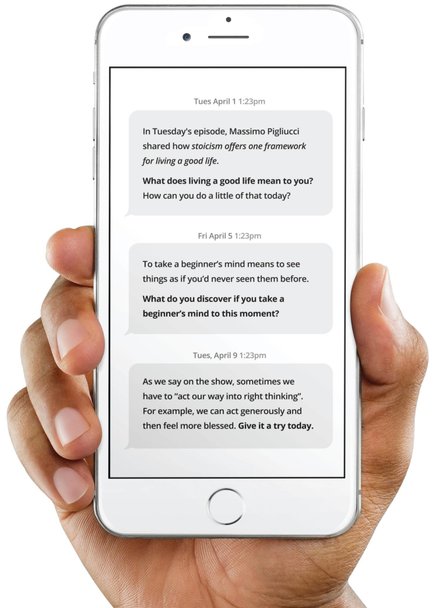
Good Wolf Reminders
A little wisdom, right when you need it. Start receiving free text reminders designed to help you pause, reflect, and take meaningful action. Sign up at oneyoufeed.net/sms.
Key Takeaways:
- Why pushing harder can actually make change more difficult
- How identifying barriers can make change easier
- Why giving ourselves choices reduces resistance
- How to turn a “should” into something we actually want to do
- Why starting small can be more effective than making a dramatic change
- How noticing the gap between what we say and what we do can motivate change
- Why “good enough” can keep us stuck longer than something that’s clearly bad
- How the immediate costs of change can overshadow its long-term benefits
- Why other people influence our choices more than we realize
- How becoming aware of those influences helps us choose them more intentionally
Dr. Berger is a world-renowned expert on why things catch on, change, influence, social media, and consumer behavior. He has published almost 100 articles in top‐tier academic journals, teaches one of the world’s most popular online courses, and popular outlets like The New York Times and Harvard Business Review often cover his work. He is the author of The Catalyst: How to Change Anyone’s Mind.
Connect with Jonah Berger: Website
If you enjoyed this conversation with Jonah Berger, you might also enjoy these other episodes:
Mimetic Desires in Everyday Life with Luke Burgis
Effectively Thinking Ahead with Bina Venkataraman
This episode is sponsored by:
Monarch: Take control of your finances with Monarch, the all-in-one personal finance app that helps you budget, track spending, monitor investments, and work toward your financial goals. Get 50% off your first year of Monarch Core, go to https://www.monarch.com/ and enter Promo Code: FEED
Talkiatry connects you with licensed psychiatrists for personalized, evidence-based mental health care, all online and covered by most major insurance plans. To get matched with an in-network psychiatrist in just a few minutes, visit Talkiatry.com/FEED.
David Protein bars deliver up to 28g of protein for just 150 calories—without sacrificing taste! For a limited time, our listeners can receive this special deal: buy 4 cartons and get the 5th free when you go to www.davidprotein.com/FEED
Quince: Refresh your wardrobe with Quince by going to Quince.com/feed for free shipping and 365-day returns. Now available in Canada, too.
ZocDoc – Taking care of your health just got easier – start here with Zocdoc
Shopify – The commerce platform that helps you build, grow, and manage your business all in one place. Start your $1/month trial at shopify.com/feed.
Pebl – an AI-powered platform that helps companies hire and manage global teams in 185+ countries. Get a free estimate at hipebl.ai
Tiny Health‘s at-home gut health test provides science-backed insights into your microbiome, along with personalized recommendations to help you improve your digestion, energy, and overall well-being. Get $50 off your first test kit at tinyhealth.com/FEED
ButcherBox: Make dinnertime easier with ButcherBox, delivering high-quality 100% grass-fed beef, organic chicken, wild-caught seafood, and more, right to your door. Get $20 off your first box, plus your choice of free ground beef for life or free chicken thighs or top sirloins for a year, with free shipping always. Visit ButcherBox.com/FEED to claim your offer.
Episode Transcript:
Jonah Berger 00:00:00 I say that I want to be more diligent at work and achieve this particular goal, yet I’m doing this other thing that’s inconsistent with it. Drawing attention to those inconsistencies encourages us to do the work to change them.
Chris Forbes 00:00:18 Welcome to the one you feed. Throughout time, great thinkers have recognized the importance of the thoughts. We have quotes like garbage in, garbage out or you are what you think ring true. And yet for many of us, our thoughts don’t strengthen or empower us. We tend toward negativity, self-pity, jealousy, or fear. We see what we don’t have instead of what we do. We think things that hold us back and dampen our spirit. But it’s not just about thinking our actions matter. It takes conscious, consistent, and creative effort to make a life worth living. This podcast is about how other people keep themselves moving in the right direction, how they feed their good wolf.
Eric Zimmer 00:01:03 Jonah Berger asked thousands of people to name something they wanted to change and what they had tried. 98% described some version of pushing, trying harder. More facts, more reasons. One more email, one more lecture to yourself. Pushing works on a chair. It slides across the floor, but people dig in their heels. Jonah teaches at Wharton, and his book The Catalyst asks a different question why hasn’t this changed already? What is in the way? It’s a question that I use with coaching clients all the time and on myself, and it always opens up things the pushing never did. I’m Eric Zimmer and this is the one you feed. Hi Jonah, welcome to the show.
Jonah Berger 00:01:47 Thanks so much for having me.
Eric Zimmer 00:01:49 It is a pleasure to have you on. We are going to be discussing your book, The Catalyst How to Change Anyone’s Mind, and we might even get into a little of your previous book, Invisible Influence, because there’s some great things in there also. But we’ll start, like we always do, with the parable. There’s a grandfather who’s talking with his grandson. He said, in life there are two wolves inside of us that are always at battle.
Eric Zimmer 00:02:11 One is a good wolf, which represents things like kindness and bravery and love, and the other is a bad wolf, which represents things like greed and hatred and fear. And the grandson stops, and he thinks about it for a second, and he looks up at his grandfather and says, well, grandfather, which one wins? And the grandfather says, the one you feed. So I’d like to start off by asking you what that parable means to you in your life and in the work that you do.
Jonah Berger 00:02:35 I like this parable a lot. I think we always have a choice about how to spend our time, what we spend it doing, who we spend it with, and how we use the limited amount of time we have every day and every week. And I think the more we spend time in good areas of our life, as I think the parable sort of says, we feed that aspect, it becomes more focal to us, more central to us. It becomes what we think about and where we devote more attention.
Jonah Berger 00:03:00 At the same time, the more we feed that other side of us, whether it’s greed per se or other other aspects, the more it becomes focal, the more it becomes what we think about, and the more it becomes the way we orient ourselves. And so it’s a good reminder to make sure to feed the thing you want to orient yourself towards, I think.
Eric Zimmer 00:03:16 Yeah. Makes sense. I want to start very broadly with you, because you’re talking about in your work how people change. And an underlying element, I think, through all of it is the extent to which the people around us, in the environments around us are shaped by that. And you know, which of the decisions that we make in life are shaped by other people.
Jonah Berger 00:03:42 I think an interesting question to ask is which decisions we make are not shaped by by other people. You know, it’s hard to think about it. And there are some. Right. But but it’s hard to think about something that isn’t shaped in some way, shape or form by others.
Jonah Berger 00:03:57 You know, our product choices, obviously, but even think about more consequential things like who we end up marrying, what jobs we end up taking, or really not important things like what toilet paper we buy at the grocery store. In all these diverse aspects of our life, I think others often shine through. Does that mean that others shape our entire behavior? No, but they do have an impact. But most importantly, I think we’re often unaware of that impact, right? We’re not aware of the fact that, you know, the person in front of us on the toilet paper aisle, whatever they do, shapes kind of what we think about. We’re not aware of the fact that that potential romantic partner we’re thinking about or potential job we’re thinking about how good or bad it seems is shaped by social influences. And so I think influence is often invisible, as we may talk about today. And that was sort of the focus of my second book, often invisible. And so I think it’s less about where influence happens and more about kind of, you know, where and if it ever doesn’t.
Eric Zimmer 00:04:54 And it was a little bit of a leading question because, you know, the leading question I got was, you know, why is it so hard for us to see this? Because so much of it is we are in reaction to everything. I wanted to start broadly so that we could sort of swing back up to your new book, which is called catalysts, and it’s about how we change other people’s minds. But I think some of it also applies to how we work with ourselves. So I’d like to start with, what’s the major mistake that most of us make when it comes to trying to change behavior in ourselves or others?
Jonah Berger 00:05:27 Yeah. So so think about the last time we tried to change something. It might have been someone else, a boss, a colleague. It might have been ourselves. Maybe we want to get in better shape, or maybe we want to spend less time on social media. Or maybe we want to spend more time on the phone and connecting with loved ones. We have these goals, these things that we want to change, whether internal within ourselves or external with others.
Jonah Berger 00:05:52 And we often take a particular approach to those type of goals. And so I interviewed thousands of people, both executives in a business context, but also individuals about personal change. And I asked them to write down what’s something you want to change and what’s something you’ve done to try to change that thing. And over 98% of the time, people list some version of of what I’d call pushing. And what do I mean by pushing? Well, add more facts, more figures, more reasons, more information. When we’re trying to change others minds, make one more phone call, one more PowerPoint presentation, send one more email. When we’re trying to change our own behavior, you know, think of reasons why we should do something or kind of emotional appeals that move us in that direction. We focus a lot on forces that could compel us or someone else to do something, and it’s clear why we think that, right? If there’s a chair in the middle of a room, a physical object, and you want to move that physical object, pushing it is a great way to get it to go right.
Jonah Berger 00:06:48 We push the chair in the direction we want it to go and it slides across the floor. And so we often apply that same intuition to people, whether those people are ourselves or others. We assume if if I just push that person, myself or someone else in the right direction, they’ll go. But the challenge, as I think we often think about, is, well, what happens when others push us? Do we just slide across the floor? What happens when we push others? Do others just slide across the floor? No, they often resist. They often dig in their heels and we do the same thing even when we’re trying to change ourselves. And so it turns out we need a different approach to change. There’s a nice analogy to be made to chemistry, actually. And if you look in chemistry, obviously chemical change is hard. Think about how long it takes, you know, carbon to be squeezed into a diamond eons. And so chemists in the lab often add temperature and pressure.
Jonah Berger 00:07:33 They heat things up. They squeeze them together with the idea that that extra energy will create change. But there’s a special set of substances that chemists often add that don’t require more energy. They actually create change with less energy rather than more. These substances clean the grime on our contact lenses or our car’s engine. And very simply, they’re called catalysts. Right. And what’s interesting about catalysts in the chemical world is they reduce the barrier to change. They lower the amount of energy required to create change. And it turns out we can learn a lot about that. That analogy in the social world, when we’re trying to create change, whether in ourselves or others, we need to think less about, well, what could I do to get that person to change? And more about why haven’t they changed already? So if I’m thinking about myself, thinking about, oh, you know, I need to exercise more, well, maybe I should remind myself to exercise more. Tell myself about all the reasons to exercise.
Jonah Berger 00:08:25 Well, why don’t I step back for a second and say, well, why aren’t you exercising more? Ready? Right. If I’m trying to spend less time on social media or connect more with with friends, why hasn’t that happened already? What are the obstacles or barriers getting in the way? And same with others, right? Whoever’s mind I’m trying to change, what are the obstacles or barriers that are preventing action and how? By identifying them, can I make change more likely? And so it’s a subtle shift, but a really important one. Focus less on pushing, less on things we could do, and more about things that are already there that might be getting in the way.
Eric Zimmer 00:08:55 I think that’s a great way for us to get started here and move into this. The first of those barriers to change is called the strategy is reduced. But you talk about reactance. This is what you talked a little bit about. People push back. When we push on people they push back. We all know this phenomenon in our own lives.
Eric Zimmer 00:09:13 I’m kind of curious, though, what causes pushback some of the time versus others? The pandemic is a great example, I think, of where we can see reactants in effect, because there’s wear a mask and people start pushing back against it, and yet an awful lot of people just put on the mask. What is it that’s causing? You know, broadly, I’m not asking you. You don’t have to comment necessarily on this issue, although you’re certainly welcome to and I would value your opinion on it. But what is it that causes us in certain cases when there’s a slight push in a direction to go. Yeah, that’s a good direction to go. I think I ought to go that way and we go that direction versus other times we just, as you say, dig in our heels.
Jonah Berger 00:09:56 Yeah. I think this is a great discussion about the pandemic and more generally, you know, the catalyst actually came out the same week as the pandemic. So I’ve thought a lot about it, talking about the book, and I wrote a piece for HBR at some point last year, talking about sort of applying the ideas of reactants to things like mask wearing and vaccines and things along those lines.
Jonah Berger 00:10:17 You know, I think there are a few answers to your question. So first, there are individual differences, right? Some people feel reactants more than others. But second, you know, when there’s an action to be taken, I think that there are ways and times to make it feel more like someone’s own idea versus to make it feel like someone else is pushing you on that idea. So let me give you a simple example. Right. Imagine you have kids and you want to get your kids to put their pajamas on, right? Let’s pick something simple, really easy. It’s bedtime. You got to put your pajamas on. If you say, hey, put your pajamas on, the kids will often say, no, I don’t want to. You know, if you say, hey, do this, I don’t want to, you know, eat your vegetables. I don’t want to, you know. They don’t even necessarily know why they’re saying no, but they really just want to assert their autonomy.
Jonah Berger 00:11:01 Right. I have my own identity. If instead you say, hey, you know, which pajamas do you want to wear tonight? Or, hey, what do you want to put on first, your pajama top or your pajama bottom? They’re going to be more likely to put on their pajamas, not because you didn’t encourage them to, but because you didn’t tell them to write. You encourage them to, but you set it up more as a choice, more as a guided choice than a forced action. And so I think if you looked at a mask wearing, if you look at vaccinations, if you look at personal change, if you look at social change more generally, it tends to work better when people feel like they came to it themselves. And that doesn’t mean being completely hands off, right? You know, I’m not sitting there hoping that my son magically decides to put on his pajamas himself. Sometimes he does. On his own, on his own volition. But I am smart enough to rise.
Jonah Berger 00:11:49 Maybe I need to help him move in that direction, but not force him to go in that direction. Right. Set it up. That that is the area he’s focusing his attention on without forcing him to take a particular action there. But by focusing his attention, guiding that journey and moving it in the right direction. And I think the same thing is true whether you’re trying to get your kids to put on your pajamas, change yourself, or change others, really reducing reactance and allowing for agency, making people feel like they are part of that process. And it’s not your idea, but they have a role in it as well.
Eric Zimmer 00:12:20 Yeah, I want to come back to mask wearing in the pandemic for a second, but I want to take reactance, what you just said and sort of feeling like it’s our own idea and apply it to personal change for a second. I do a lot of work with clients on changing behavior, and one of the things that I will often hear a client say something to the effect of is, I just was rebelling against myself, my own rule, you know, I decided I wanted to do this thing and yet that that natural.
Eric Zimmer 00:12:47 We all have it. Like you can’t tell me what to do. Seems to come up even when we’re the one doing the telling. Yeah. Do you have any thought or insight on that? I just I’m always kind of curious. Like what I do is remind people like, well, no one’s telling you what to do. You are you you always have the choice. And so to sort of to your point, to try and ease reactants is to say like this is not being imposed by someone else. This is what you decided and to remember that. But I’m curious if you’ve got any thoughts on that.
Jonah Berger 00:13:15 I like the way you framed it a lot, and we can think about motivation, the motivation to take an action to do something as being internal or external, being more kind of intrinsic within the self or being more extrinsic outside of the self, and even take something like exercise, right? I may be exercising because I want to exercise. I love exercising, so I’ll talk about me personally.
Jonah Berger 00:13:35 I love playing basketball. Like it’s a lot of fun for me. I enjoy playing it. I’m terrible at it, but I just enjoy doing it. It’s fun, you know? I love it. I like it a lot of run around outside. Don’t care whether I win or lose. I just care whether I get a chance to play. And so that’s intrinsically motivated. I’m not doing it as a means to any end. I’m just doing it as a as an end itself. I enjoy the process of doing it. Yeah. Contrast that with how I feel sometimes about running or how some other people may feel about exercise in general, where I feel like, man, you know, I’m not doing this, maybe because it’s the most fun, but I’m doing this because I feel like I should do it because it’s a good way to get exercise, because it would be smart to get out there and do something. And so it’s still coming from me in some sense, but it’s also not right.
Jonah Berger 00:14:17 There’s a should rather than a than a want. And so I think I really like the way you framed it. You know, I don’t think we need a lot of encouragement if we want to do something, but I think we feel like if we should do something, then there’s that external thing where it’s not an end in itself. It’s a means to something else. I should exercise because that will help me do something else. I should do this thing because that will help me achieve something else. And the more it’s a should rather than a want, the more we may not feel like it’s coming from from within. And so I think, just as you nicely said, you know, encouraging us to realize, well, hey, this is coming from within or finding an intrinsic reason to do it, right. Maybe you don’t love running, but you love being outside. Well, great. That’s an opportunity to do something you want and allow you to do that thing you want and mix it with something else.
Jonah Berger 00:15:01 You know, people talk about temptation bundling sometimes if you want to do something but you don’t want to do something else, you link the two together. So, you know, this is an opportunity to do the thing that you want while also doing something else. And so I think that can be a great way to motivate ourselves, to help us realize that, yes, we are in control and even something that seems like a should, if we can make it more of a want, will be more effective.
Eric Zimmer 00:15:23 Excellent. So going back to the pandemic and mask wearing and vaccine, I think as you were saying, you know, reactance is one of it. But if I jump down to another of your catalysts, one of them is distance, right. And this seems to really, for me, be framing up what a lot of the pandemic is. You know, you talk about the zone of acceptance or rejection. Can you share a little bit about that? And do you think that’s what’s playing in here? Is is where vaccine and mask wearing is falling into people’s zone of acceptance or rejection.
Jonah Berger 00:15:57 So let’s start with a simple example. And then we can make it more complicated. So so basically anything we do, any attitude, any behavior, any domain of our life, we can array our beliefs, our opinions, our thoughts towards it on a football field. So let’s take politics for a second because it’s really easy to see, right? We know some people are staunch conservatives, others are strongly liberal. We can imagine putting those in two ends of a football field. Let’s make the conservatives the far right and let’s make the liberals, you know, on the left. And then you can put yourself anywhere on that field. So you might be the five yard line of the conservatives, you might be the 15 yard line of the liberals, or you might be midfield 50 yard line. You’re exactly moderate in between the two. And so it turns out that while we have a position on the field where we put ourselves, there’s also what’s called the zone of acceptance, which is around where we are.
Jonah Berger 00:16:42 That we’re willing to consider. So let’s say I’m on the 50 yard line. For example. I’m willing to listen to things that are 50 yard line. Exactly moderate. But I’m also willing to listen to things that are 5 or 10 yards in each direction, but 30 yards in each direction. Probably not. And that’s called the region of rejection. When we get too far from where someone is currently, it’s so far from where they are that they’re unwilling to even listen to the possibility of being changed, because that information is so different from how they see themselves at the moment. You know, your listeners may be familiar with the idea of the confirmation bias, but, you know, not only do we look for information that confirms our existing belief, but we filter new information based on those existing beliefs. And so if I’m on the 50 yard line of the field versus let’s say the five yard line of the field, information that’s on the 25 yard line looks very, very different, right? How I see that same information, while it’s objectively the same information, how I see it may be quite different.
Jonah Berger 00:17:37 And so let’s take that to the vaccine and personal change as well. You know, I think part of the challenge is if you come up and ask someone to do something that’s so far from where they are currently, they’re unwilling to even listen to the possibility of being changed. If I’m vaccine worried, but I’m close, then I’m willing to move because it’s in the zone of acceptance. But if if you’re asking me if I’m a, you know, staunch, staunch conservative and you’re asking me to get vaccinated, which maybe seems like somehow more on the liberal side for some reason, if that falls in the region of rejection, I’m unwilling to listen, and it may even push me back in the opposite direction. And so often what we need to do is we need to kind of ask for less and then ask for more. We need to start closer to where people are already. Start with an ass that’s within that region of acceptance. Move them a couple of yards down the field and then ask for more.
Jonah Berger 00:18:22 There was a doctor I was talking about that was dealing with an obese patient, was a trucker who was drinking three liters of Mountain Dew a day. Morbidly obese. Right. And the tendency there is to say, stop drinking Mountain Dew. Right. Quit cold turkey. Makes a lot of sense, right? You know, quit cold turkey, be better for you. But the problem is that ask is so far from where that person is currently. It’s so far it’s in the region of rejection. They’re going to be unwilling to listen, even the possibility of changing. And so what does she do? Well, rather than telling him to quit cold turkey, she says, hey, you know, I know you love Mountain Dew. I’m not going to ask you to quit, but would you mind going from 3l to 2l a day? And he grumbles. He doesn’t want to do it, of course, but he goes, okay, you know, I’ll give it a shot and comes back a few weeks later and is able to do it.
Jonah Berger 00:19:06 Then she says, great, good job. Now go to one right? And he grumbles again, doesn’t want to do it, but he ends up doing it. And months later he comes back and she says, now go from 1 to 0 and the guy loses over £30, right? Not because she went right away for what he wanted, what she wanted, but because she asked for less and then asked for more. She kind of took that big change, broke it down into more manageable chunks, and helped him move down the field in the right direction. And so I think the same thing is true for personal change, right? So, you know, if I’m a writer and I want to write something that’s really big. And I go, okay, well, I got to start by writing, you know, 5000 words a day. Not only is that a lot, period, but particularly if I’m starting from zero, it’s going to be really hard to achieve. Same with exercise. I want to exercise more.
Jonah Berger 00:19:49 Okay. But you know, if I try to go from 0 to 7 days a week, it’s probably going to get overwhelming and I’m going to give up. We sort of shoot for intensity. Some research shows we kind of go quickly to intense ways to achieve our goals, but because we go for intense ways, we often fail. They’re so intense that we give up because we can’t hit them. And so what’s often better is to start with something small. Say, look, I’m going to exercise two days a week, right? And then I’m going to go from 2 to 3. I’m gonna exercise ten minutes a day. I’m gonna go from 10 to 15 and 15 to 20. I’m going to move myself there in kind of in some sense, it’s stepping stones, breaking big change down into small stepping stones, moving in the right direction step by step, eventually getting there. It may take more time, but it’s going to be more effective.
Eric Zimmer 00:20:48 Hey, friend, before we dive back in, I want you to take a second and think about what you’ve been listening to.
Eric Zimmer 00:20:54 What’s one thing that really landed, and what’s one tiny action you could take today to live it out? Those little moments of reflection. That’s exactly why I started good wolf reminders. Short, free text messages that land in your phone once or twice a week. Nearly 5000 people already get them and say the quick bursts of insight help them shift out of autopilot and stay intentional in their lives. If that sounds like your kind of thing, head to one you feed, net, slash SMS and sign up. It’s free. No spam and easy to opt out of any time. Again, that’s one you feed net. SMS, tiny nudges, real change. All right. Back to the show. We end up talking on this show in so many different ways about that idea of small steps. If we circle back to reactants for a minute, I want to talk about one strategy for reducing reactants, which is highlighting a gap. So I was wondering if you could share a little bit about what highlighting the gap means.
Eric Zimmer 00:22:00 And there’s a great story about smokers in Thailand that I think just sums this up so, so well.
Jonah Berger 00:22:05 Yeah. So maybe I’ll tell the story and then I’ll explain the broader principle. So yeah, this goes back to the idea of, you know, the best way to change someone is not by telling them to change, but is encouraging them to want to change themselves. And so this is what a group called the Thai Health Promotion Foundation was dealing with a few years ago. So they were trying to get people to quit smoking. They’re kind of a pro-social group to encourage people to quit smoking, and they’re having trouble. People aren’t calling the quit line. And so they think, okay, well, let’s give people information. Let’s tell them all the reasons why they should quit. But what they realize is if they push smokers, smokers are going to push back, right? Stop telling me what to do. And this is often true. More generally, not just about smokers, right. We tend to think that problems or information problems, we tend to think that if we just give people more information, they’ll come around.
Jonah Berger 00:22:50 Rarely are problems, information problems, often there’s something else going on that we don’t realize we’re so egocentric. We just think, oh, if people had access to the information we had, they would change. But often people have a different perspective on that same information. And so the Health Promotion Foundation ended up doing something really, really clever. Rather than telling smokers to quit or giving smokers information, they had little kids walk around the city and asked smokers for a light. Okay, so imagine you’re smoking on the street. You’re watching a smoker smoking on the street, and an eight year old kid comes up to that smoker and says, can I get a light? The smoker looks at the kid and goes, what are you talking about? No, no, I’m not going to give you a light, right? Of course not. And not only do they say no, but they say why. Look, don’t you know that smoking causes lung cancer and emphysema and strokes? Don’t you want to run and play? Right? You’re so young.
Jonah Berger 00:23:36 Why would you want to do this to your body? All these different things. And so as the smokers are talking, the kids are sitting there going, okay, yeah, that’s a good point. That’s a good point. And at the end of the interaction they say, okay, thanks. Thanks a lot. And by the way here’s a sheet of paper. And on that sheet of paper it says you worry about me. Why not yourself? If you’re interested in learning more about quitting smoking, call this quit line doesn’t tell people to quit. It just highlights a gap between attitudes and actions. And this is true more broadly, right? We want our attitudes and actions to line up. If I say I care about the environment, I better recycle. If I say I’m a big fan of a certain sports team, I better watch their games. Whatever I say, I should do the same thing. And if my attitudes and actions don’t line up, a negative emotional reaction cause cognitive dissonance occurs, right? And I do work to reduce that dissonance.
Jonah Berger 00:24:21 I either have to say I don’t care as much about the environment. I’ve got to do more work recycling. And that’s exactly what the Health Promotion Foundation did to smokers, right? They’ve incurred smokers realize. Wait, I just told this kid not to smoke, but I’m smoking myself. Maybe I should think about doing something about that. Which is exactly what people did, right? They, you know, tell the kid to smoke. No you’re not. Are you going to quit smoking? Which 40% of the people who got this piece of information did, 40% of them ended up calling the quit line big increase in calls to the quit line. Videos of the campaign go viral, but I think the insight is a powerful one, right? We don’t often realize that we’re being inconsistent. We are inconsistent all the time, right? Things we say and things we do often don’t match up, but we don’t see that they don’t match up right. But if someone highlights that gap, or we encourage ourselves to highlight that gap, well, I say I care about getting in better shape.
Jonah Berger 00:25:14 Yet every time I go to the grocery store, you know, I’m buying a bunch of unhealthy food. Like, what do I think? I’m not going to eat the unhealthy food. Well, why? Why am I buying it then? Right? Or, you know, I say that I want to spend less time on social media, yet I’m still doing this thing. Or I say that I want to be more diligent at work and achieve this particular goal, yet I’m doing this other thing that’s inconsistent with it. Drawing attention to those inconsistencies encourages us to do the work to change them, right. Because it puts sort of attitudes and actions next to one another. And highlighting that gap encourages folks to change. And so just since we talked about the pandemic, you can apply that same idea that the pandemic, right? I mean, imagine you’re trying to talk to a vaccine skeptic or someone who’s not wearing a mask. We often come across in some, you know, public place. There’s someone who should be wearing a mask but isn’t.
Jonah Berger 00:25:58 And I think a tendency to tell them, wear a mask. Why aren’t you wearing a mask? Wear a mask or a person who’s not vaccinated? You should get vaccinated. But if we do that, they’re going to push back, right? There’s obviously reasons they feel like that’s not for them. But what if instead we imagine saying, okay, hey, you know, I notice you’re not wearing a mask or I heard you don’t want to get vaccinated. You know, let’s say you’re elderly grandparent was around or your young kids were around. Would you want people around them not to be vaccinated? Would you want people around them not to wear masks? Or if you’d say, well, yeah, you know, I would like people around my young, unvaccinated kids to be wearing masks or vaccinated. Okay, interesting. Do you think you might want to get vaccinated then encouraging them to go, oh wait, I’m saying that I want people around my kids to be careful, yet I am not being careful.
Jonah Berger 00:26:39 Maybe I should think twice about being careful and so you can bring a horse to water, but you can’t force them to drink. But if you show them some really nice water, you encourage them to think about making the decision that they should have made all all along.
Eric Zimmer 00:26:50 Yeah, I think there’s so much subtlety in how we do that because highlighting the gap is great, except we all know situations where someone highlights the gap for us and we move in to react. And so that’s why I love that Ty story. I also would love to know somewhere sooner or later somebody had to be like, yeah, kid, here’s a, here’s a light, here’s a cigarette. Like you’re going to run into somebody who’s a character out there. But it’s such a beautiful idea.
Jonah Berger 00:27:16 Yeah. And so I didn’t run this campaign, but I’ve heard that nobody, nobody gave the kids cigarettes and and also everyone threw away their cigarette, but they kept the piece of paper. I think it was what you highlight though.
Jonah Berger 00:27:28 Which is important is it has to be done the right way. Right. So I talk a lot about asking questions. I talk a lot about highlighting a gap. I talk a lot about giving people choices. But like let’s go back to the, you know, given your kid choices, right? It’s not about just giving them choices, right? If you say, hey, do you want to, you know, eat ice cream for dessert or eat your broccoli, they’re going to go, oh, it’s a no brainer. I want to eat ice cream dessert. Right. And so it’s not just about choice. It’s about the right choices. It’s not just about questions. It’s about the right questions. Yeah. And so as with any strategy, we have to think about the right way of doing it. But the goal is key right. What am I trying to encourage someone to do. How can I lead them there or guide them there, but help them feel like they got there on their own, directing their attention but not forcing them down a particular path?
Eric Zimmer 00:28:11 Yep.
Eric Zimmer 00:28:11 Doing coaching work, you just realize how powerful questions are. Like you have to really work on questions. Yes, a big part of the art. I think the other thing that gets in the way of change, another barrier to change that you point out is something known as endowment. Share a little bit about what that is.
Jonah Berger 00:28:27 Yeah, I think a good way to talk about endowment is actually to talk about a study that was done a number of years ago. They ask people, they say, hey, which do you think hurts more? A minor injury or a major one? A minor injury being like, you sprain a finger, you have a lower back injury, you have sort of a little bit of a problem with your knee that flares up once in a while. And a major injury would be like, you know, you shatter your kneecap, you have a heart attack, you break your arm, something like that. And people think about it and they go, oh man, that’s obvious.
Jonah Berger 00:28:56 I mean, a major injury hurts a lot. Minor injuries don’t hurt very much at all. So major injury must be a lot more painful. And it’s clear why we think that. Right. Major injuries do hurt a lot, but it actually ends up that our intuition is is wrong. Minor injuries end up causing us more pain than major ones. And the reason is because we never get minor injuries fixed. Right? So so major injuries you get, you shatter your kneecap, you’re going to go and get a cast on it. And physical therapy and all the things you get a heart attack. you see a specialist, you put a stent, put in whatever it might be. You do the work to fix it. But if there’s a minor injury, if it’s just a little bit below the threshold for action, we never make the change right? We end up sticking with something that’s not great, but then it causes us a lot of pain over time. It’s only a small amount each period.
Eric Zimmer 00:29:40 But it adds.
Jonah Berger 00:29:41 Up. But add up those periods over a lot of time, and it causes us more pain than the major pain over just one period or two. And so that same intuition taps into what I would call endowment, right? We are attached to old things, in part because old things aren’t terrible, because if old things were terrible, we would get rid of them, right? If your job was terrible, you’d get rid of it. If you’re dating someone and they’re terrible, you would stop dating them, right? If you’re married to them and it’s terrible, you get divorced. Right. If something’s terrible, we fix it. But if something’s just not great, we never end up getting it fixed. Right? You can almost think about this as, like, you know, if your house is infested with cockroaches, you call an exterminator. But if, like, every week you get a couple of ants, or once a month you get a cockroach, you never end up calling because it’s not above the threshold for change, but you end up stuck with that problem for a long time.
Jonah Berger 00:30:26 And so this is kind of the challenge of change. If something is terrible, it would have been changed. Ready. But if something’s just okay it’s never, never changed. And so Jim Collins talks about this a lot in good to great. He talks about you know why do we have good schools. Why don’t we have great schools. Because we have good schools. Why don’t we have great this. Because we have good this. And in some sense their good is the enemy of the great. And so I don’t want to say that, you know, the person someone is dating is good. And that’s not good enough for a job is good. And that’s not good enough. But I think the key insight is things that are okay can get in the way of better things. And so one thing we need to encourage people to do is to highlight the costs of inaction, right them to make them realize that, yes, over one period that bad, that minor injury doesn’t hurt. But over a long time it would probably be worth getting it fixed.
Jonah Berger 00:31:09 And so I’ll give you just an example of this. I had a cousin. Every time he would send an email, I would basically type out his email signature. So he would say, you know, best, Charles, or whatever it is in his email signature. And and this frustrated me forever, right? I was like, God. You know, everyone has an automated email signature. Now, why don’t you just automate your email signature? It’s like, what are you talking about? I don’t know how to do that. And it doesn’t take that long to write best, Charles. I just throw it at the bottom of the email, right? It’s no work at all. And so to him, right. Think about it. It’s good. Not great. It’s the couple bugs once in a while. It’s not a house infested with cockroaches. And the work to do the new thing is hard, right? The work to figure out how to install that email signature is going to take 10 or 15 minutes.
Jonah Berger 00:31:48 And so the cost today is bigger than the benefit today. So we don’t take action. So what did I do. So I said okay interesting I got it. It takes a long time. How many emails do you write a week. He said I don’t know a few hundred emails. How many seconds does it take you each time that you write your email signature goes, I don’t know, you know, a few seconds. Okay, so how many minutes a week do you spend writing your email signature? And he thinks about it. And then he types in right how to automate an email signature because he’s just realized, right. What I’ve done is I’ve highlighted the cost of action. I’ve made him realize, yes, in the moment, today’s moment, The cost of change is bigger than the benefit of change. You’re right. But even if we go a week, the cost of change becomes less than the benefit of change. And so it’s about encouraging people to realise that doing nothing that good, it may be the enemy of the great, that doing nothing may not be as cost as it seems encouraging to realise that yes, in a given moment it may be hard to change, but in the long run they are better off in making that change.
Eric Zimmer 00:33:10 As humans were so bad at present cost versus future cost or present benefit versus future benefit, it’s why it makes so many of these changes so hard because we are wired to do what is easier feels better now, even though we know the long term. And so I love that idea of highlighting the costs over the long term, thinking about like, what does this really mean over a period of time? Often what happens is those costs are adding up and we get the bill at the end. Yes. And then we go, oh shit, I should have changed, right? Yes. So but if we got an invoice each week that showed the costs on it, right. Like we’d be like, oh boy, this is really adding up. I might want to do something.
Jonah Berger 00:33:48 I like the way you.
Eric Zimmer 00:33:49 Said that instead of just like getting the total bill at the end and you’re like, oh, I can’t pay this.
Jonah Berger 00:33:53 Yes, we are focused on the invoice at the moment of change, right.
Jonah Berger 00:33:56 And by the way, I talk about in the book the cost benefit timing gap, what do I mean by that? The cost of change almost always come due before the benefits of change. Yeah, right. I love the way you phrased it as an invoice. Right. So, you know, let’s take a simple example. I want to buy something. I want to buy a new lawnmower or I don’t know, you know, a new computer. I got to pay that money up front. I want to learn a new skill. I want to take one dough class, or learn to cook or learn a language, or install a new software package. It’s going to take a lot of time and effort to do those things. There’s a benefit to those things, right? I have a better lawn mower or a better computer. I’ve learned a language. I get in shape, I do all these things. But those benefits are often in the future, and they’re uncertain. And the costs are often now and they’re certain.
Jonah Berger 00:34:38 And so we just end up saying, well, look, I’ll just stick with what I’m doing because it’s easier, right? Those moment to moment costs and benefits are misaligned. And so, as you nicely said, by encouraging us to take a longer viewpoint, making those invoices at the weekly level rather than at the daily level, but also not at the six month level, it encourages us to realize maybe actually I should change. The benefits are going to be bigger than the costs over that period.
Eric Zimmer 00:34:59 Yep. And as I was reading that section in your book, I could not help but think about, like, the injuries in my life and which of them actually prompt me to to go get help. Yeah. You know, and it’s usually after I have ignored it just as long as I can. And then I’m finally like, all right, this just isn’t working. You know, I’ve had. I’ve got a shoulder thing, and I know how to fix the shoulder. And I will stop doing the exercises until I feel the shoulder twinge again.
Eric Zimmer 00:35:25 Now, luckily, I’ve gotten a little bit wiser that when I feel it, I’m like, okay, I know what to do, and I start doing them and it never gets really bad again. But that is such a true statement. You know, when is it bad enough to do something about it?
Jonah Berger 00:35:36 Yeah. Yeah. It’s almost like, you know, we should do preventative maintenance, but we never do, right? Because, oh, you know, I don’t need to do it. And then, well, it ends up you’d be better off if you’ve done it.
Eric Zimmer 00:35:44 Yep. I want to talk about something. Now, I’m sort of shifting into invisible influence for a second, but I want to talk about this idea of identification and differentiation. How as people, sometimes we really want to identify with a certain group, or sometimes we want to differentiate ourselves from a certain group. And I’ve always found this fascinating to be like, what is it that causes people in some cases to identify or differentiate? And then often, right, I’m identifying with one group while I’m differentiating from another group, and you talk eloquently about some of the factors that go into that.
Eric Zimmer 00:36:19 And I just thought that was really fascinating.
Jonah Berger 00:36:21 Yeah, sure. So so I think as you very nicely pointed out, it’s not that we do one or the other. We’re constantly doing both. Right. We are constantly looking to identities that we want to hold. People would often call these aspiration groups or aspirational identities. It may be a person. It may be a group of people. You know, we look to them and go, God, I would love to be like them. And so I’m going to engage in things that will make me more like that and like them, maybe I see an ad and, you know, the product, the people using. It just looks so cool and fun. And so I maybe buy that product so I can be more like them. Or, you know, I see an action that someone’s taking. And so I want to do something like them to, you know, be part of that group. At the same time, they’re also called sort of dissociative groups or avoidance groups, identities that we want to avoid.
Jonah Berger 00:37:04 Right. We look at them and go, God, you know, I don’t I don’t want to be like that. And so well, maybe I should avoid doing things that those type of people are doing. And so we constantly have sort of these poles we’re oscillating between between how does what I’m doing make me look? And really, who does it make me look like? If it makes me look like the type of person I want to look like, I’m more likely to do it. And if it makes me look like the type of person I don’t want to look like, I’m less likely to do it. So we ran a study, for example, many years ago. Your listeners maybe remember these famous bands, Livestrong bands, these yellow wristbands were popular. And so right at the moment they became popular. We sold them on. I was a PhD student at Stanford. We sold them to a group of students at Stanford, a dorm of Stanford students, and looked at whether they wore them or not.
Jonah Berger 00:37:48 And they did. And then we sold them to another group of people. And if the idea is, look, more is better, you know, people just want other people to be doing something. They should be happy to continue wearing them. And they they like the wristband. So the fact that other people are wearing doesn’t give them more information about the bands. But we picked the group, we told through second on purpose. We picked sort of the geeks on campus. So imagine sort of an academic focused dorm. They take extra classes, they do extra work, and we wondered what would happen to the initial group of wristband wearers when the geeks started wearing it. And what we found. Sure enough, is when the geek started wearing it, those initial people stopped doing it right. It’s not that the band is actually any better or worse. Functionally, it’s still the same, but because it’s associated with a group, they don’t want to look like they stop doing it. And so you see these motivations working together all the time.
Jonah Berger 00:38:32 Right. I want to be like these people and not like the others. And even if I want to be like a certain group, I don’t want to be identical to them. Right. So, you know, look at a group of, I don’t know, I’m going to I’m going to stereotype here. But 14 to 18 year old girls or boys, right. You often see groups of friends that are dressed very similarly. Now they’re not dressed identically. Right. But they’re wearing the same brands or the same styles of clothes. They’re not running literally the same shirt and literally the same pants. But you can figure out what group someone belongs to based on their choices. But you can also get a sense of how much they care about standing out of that group. And so we simultaneously have these motives to fit in and stand out, to signal desired identities and avoid signaling undesired ones and the choices we make are based on those motivations, allowing us to communicate desired identities to ourselves and and to others.
Eric Zimmer 00:39:18 As we wrap up, take one thing from today and ask yourself, how will I practice this before the end of the day? For another gentle nudge, join good Wolf Reminders text list. It’s a short message or two each week, packed with guest wisdom and a soft push towards action. Nearly 5000 listeners are already loving it. Sign up for free at once. Net us no noise, no spam, just steady encouragement to feed your good wolf. We had an author on Luke Burgess who wrote a book about a concept of mimetic desire. You know, the desire is imitative, which is, I think, obvious that it is. But the question of what causes us to imitate certain ones versus others, I find really fascinating. And when you start unwinding this back to kind of where we started, which is that so much of what we do is influenced by others. How do we know what we really want? You know, what does that even mean? If I’ve been being influenced since the moment I was born by what’s around me.
Eric Zimmer 00:40:25 Whether it’s identifying or differentiating from everything, you know, how do we get to what is for us? And I’m just kind of curious, how do you think about trying to unravel that enough. I mean, I don’t think you can completely unravel it to my point, but how do you unravel it enough to start to go, okay, I think I’m making decisions based on what I want, not without so much influence.
Jonah Berger 00:40:47 Yeah. So imagine you took a business trip to a city you’ve never been to before, and your plane touches down and you go to the hotel and it’s dinner time. You don’t know anybody there, but you want to figure out where to go out for dinner. Imagine you couldn’t use something like Yelp. Imagine you couldn’t ask the concierge for advice. Imagine you just had to walk around and find a place on your own and you couldn’t even use. By the way, the time tested trick we often uses. How many people are in the restaurant? You couldn’t even use that as information.
Jonah Berger 00:41:15 Right? Think about how difficult it would be to pick a good place to go for dinner. It’d be super difficult, right? You have no idea if the place is good or not. It would be bad. And so you talk about, well, you know, we want to make our own choices, but we don’t always want to make our own choices, right? A lot of times, you know, our own choices. I want to end up at a good Thai restaurant, and I want to use other people as a way to help me figure out which is the good Thai restaurant to go to. And so influence by itself isn’t bad. You know, I think influence is often a four letter word in some people’s mind. They say, I don’t want to be influenced, particularly in American culture. You know, we see ourselves as individual special people. You know, we go to Burger King, we have it our way. We go to Starbucks, they make our latte exactly how we want.
Jonah Berger 00:41:55 You know, we are completely different from everyone else. It’s okay to be like other people, right? It’s okay to be part of a group. It’s okay to rely on others for information. I think what I do agree with very much with what you said is, is we want to be more aware of influences so we can choose our influence. It’s one thing to be influenced, it’s another thing to be influenced negatively. And so I think we need to be more aware of how influence works so we can pick our head up and go, wow, you know, I didn’t realize that the fact that I often compare myself, you know, I’m often on social media and I’m looking at my friends and by looking at my friends, you know, I’m making myself unhappy because I’m looking at, you know, a varnished perspective in their lives, which is not what happens them every day. But the best moment. I’m looking at their greatest hits, and I’m comparing my average life to their greatest hits.
Jonah Berger 00:42:42 And no one’s average life compares to someone else great as greatest hits, right? That’s why they’re greatest hits. But if I don’t realize that, I’m sitting there going, man, you know, my life just isn’t as exciting when in reality, all our lives are filled with both exciting moments and less exciting moments. And so I think that’s really what the goal of Invisible Influence is all about, is to help us be more aware of what those influences are so we can choose our influence so we can decide, look, you know, I’m going to do this because I am choosing to be influenced by others. Or, you know, I’m going to shut off these channels because I want to make a completely independent decision, but recognizing that that requires more work.
Eric Zimmer 00:43:16 Yeah, yeah. I think that’s so true that it’s inescapable. So to your point, I think it’s it’s about not being influenced in ways we don’t want to be, or I think the other is just not to have it happening. So sort of subconsciously, you know, it’s to have the awareness of like, okay, as a human being, I’m going to react whether I identify or differentiate to everything that’s around me all the time.
Eric Zimmer 00:43:40 It just happens. And, you know, all that makes me think about sort of all the way back to where we started, kind of about the wolf parable. Right? That feeding the good wolf is often about, are we surrounding ourselves and being influenced by people who are doing something similar?
Jonah Berger 00:43:54 Yeah. And, you know, someone said it very nicely. They said, you know, you are the sum of your five closest others, whether that’s a spouse, whether that’s your kids, whether that’s, you know, your best friends. And so pick your influence carefully. Right. Think about who you are surrounding yourself with. If those are the types of people that you want to be surrounded with, great. But recognize that those folks are going to influence you and make sure you’re choosing them carefully.
Eric Zimmer 00:44:18 Yeah. Well, Jonah, thanks so much for taking the time to come on. It has been a real pleasure talking with you, and I really enjoyed both the books, and I find your work just fascinating.
Jonah Berger 00:44:27 Well, thanks so much.
Eric Zimmer 00:44:29 Thank you so much for listening to the show. If you found this conversation helpful, inspiring, or thought provoking, I’d love for you to share it with a friend. Share it from one person to another is the lifeblood of what we do. We don’t have a big budget, and I’m certainly not a celebrity. But we have something even better. And that’s you just hit the share button on your podcast app, or send a quick text with the episode link to someone who might enjoy it. Your support means the world, and together we can spread wisdom one episode at a time. Thank you for being part of the One You Feed community.
Leave a Reply