

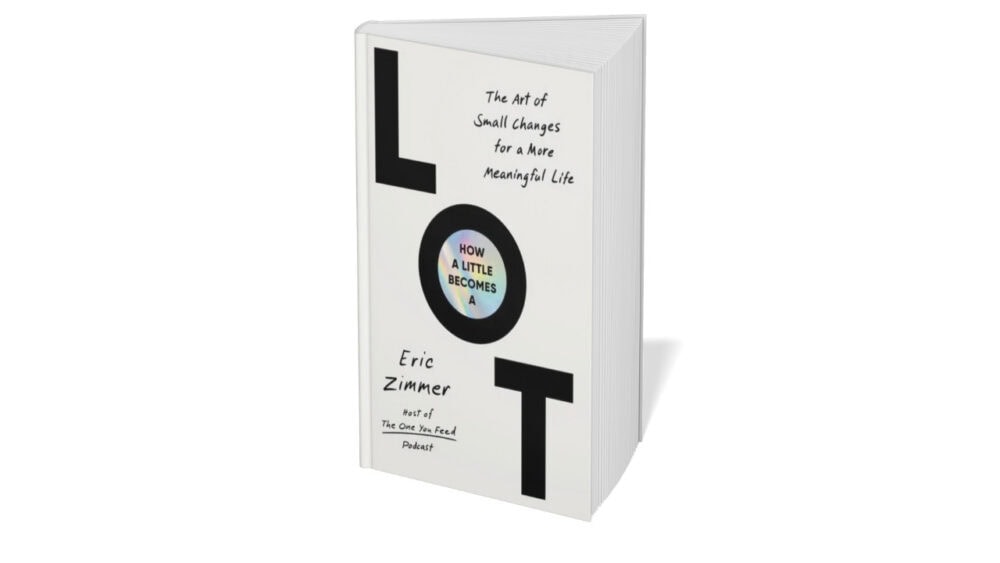
In this special solo episode, Eric Zimmer shares five powerful insights from his book How a Little Becomes a Lot. Rather than offering quick fixes or surface-level advice, Eric explores the deeper mechanics of real, lasting change. He unpacks why small, consistent actions outperform bursts of motivation… how to shift from self-judgment to skill-building… and why the stories we tell ourselves shape everything from our habits to our happiness. You’ll also learn a practical, compassionate approach to working with your inner critic, not by silencing it, but by understanding it.
If you’ve ever felt stuck, overwhelmed, or frustrated by your inability to follow through, this episode offers a grounded, actionable path forward, one small step at a time.
Key Takeaways:
- Small actions create big change; if they’re low resistance and consistent.
- Real transformation isn’t about intensity. It’s about doing what you can actually sustain over time. Change is not a character trait, it’s a skill.
- If something isn’t working, it’s not because you’re broken. It’s because you haven’t found the right strategy yet. Most of our struggles happen at “choice points.”
- The tension between what we want now and what we want most determines the direction of our lives. Your mind is constantly creating meaning, and it’s often wrong.
- Learning to question your interpretations can dramatically reduce unnecessary suffering. The inner critic isn’t the enemy, it’s a misguided protector.
- When you learn to relate to it with curiosity instead of resistance, it loses its power. The language you use shapes your emotional reality.
- Extreme language (“always,” “never,” “this is unbearable”) intensifies distress more than the situation itself.
Eric Zimmer is an author, teacher, speaker, and the creator of The One You Feed podcast—an award-winning show with over 50 million downloads across 800+ conversations exploring meaningful living. At 24, Eric was homeless, addicted to heroin, and facing prison. His journey from those depths sparked his lifelong inquiry into human transformation and resilience. Through his behavior coaching, workshops, and mentorship, he has guided thousands worldwide in creating sustainable habits that last—not through willpower or epiphany, but through steady change. His approach combines cutting-edge science with timeless wisdom, providing practical pathways to greater integrity and deeper meaning.
Connect with Eric Zimmer: Website | Instagram | LinkedIn
If you enjoyed this conversation with Eric Zimmer, check out these other episodes:
Why Willpower Isn’t Enough: The Tiny Habits Method Explained with Dr. BJ Fogg
How to Make Lasting Changes with John Norcross
This episode is sponsored by:
Rocket Money Let Rocket Money help you reach your financial goals faster. Join at rocketmoney.com/feed.
Pebl – an AI-powered platform that helps companies hire and manage global teams in 185+ countries. Get a free estimate at hipebl.ai
David Protein bars deliver up to 28g of protein for just 150 calories—without sacrificing taste! For a limited time, our listeners can receive this special deal: buy 4 cartons and get the 5th free when you go to www.davidprotein.com/FEED
Brodo Broth: Shop the best broth on the planet with Brodo. Head to Brodo.com/TOYF for 20% off your first subscription order and use code TOYF for an additional $10 off.
By purchasing products and/or services from our sponsors, you are helping to support The One You Feed, and we greatly appreciate it. Thank you!
If you enjoy our podcast and find value in our content, please consider supporting the show. By joining our Patreon Community, you’ll receive exclusive content only available on Patreon! Click here to learn more!!
Episode Transcript:
Eric Zimmer 00:00
The inner critic is usually, though not always, inhibitory. It’s trying to stop you from doing something. When my inner critic whispers that I’m not good enough to write this book, the action that naturally follows from that belief is not to write at all. A wise response is to take the action that aligns with what you believe in and know is good for you, regardless of what the critic is saying.
Chris Forbes 00:34
Welcome to the one you feed throughout time, great thinkers have recognized the importance of the thoughts we have quotes like garbage in, garbage out, or you are what you think ring true, and yet, for many of us, our thoughts don’t strengthen or empower us. We tend toward negativity, self pity, jealousy or fear. We see what we don’t have instead of what we do. We think things that hold us back and dampen our spirit. But it’s not just about thinking our actions matter. It takes conscious, consistent and creative effort to make a life worth living. This podcast is about how other people keep themselves moving in the right direction, how they feed their good wolf.
Eric Zimmer 01:18
Hello, everyone. This is a special book edition of the one you feed. And we’re going to do something different here, something I have not done in a long time, which is going to be a solo episode for those of you who’ve been around with us for way back when, I used to do these more often, and I don’t quite know why I fully got away from them, but I haven’t done one in a while, but I’m just going to talk for the next period of time about ideas from my book. Now, one thing I will say about my book is that it is packed full of ideas. For better and worse, lots of people advise me that I’m trying to say too much in one book that I should make it about one simple little thing and do that. And my experience is, I’ve read a lot of books like that, and I’ve come across a lot of these. They are books that could have been said in an essay. There’s no reason for them to be all the pages they are. I think this book is very different than that, and I think that that is good for the type of person listening to this show, someone who cares about ideas, who cares about nuance, who doesn’t believe in easy answers and cliches, because life does not reduce down to those and this book does not do that either. It resists tidy and easy answers, which is part of what I think makes it such a good book. And again, my friends who told me the thing to do probably sell more books because it’s easier to market, as you can tell by the way I’m talking about this. But what I wanted to do here is highlight five insights that come out of the book. I think there are a whole lot more. There’s a whole lot of subtlety in here, but these are five, let’s call them things I could just pluck out and talk about in isolation. So I thought I would do that these ideas I had to really think about because the book was chosen as part of the next big idea club, Book Club, which is something that Susan Cain Malcolm Gladwell and Adam Grant do, where they select books each month that they
Eric Zimmer 03:30
think are valuable. And they chose my book, and I had to create a little something for them about some of the insights from the book. And so this is that, but a lot more casual. Me just kind of talking about it. And the first insight is that little by little, a little becomes a lot. You’ve heard me say that so many times, the title of the book is obviously how a little becomes a lot. And that makes this the first idea. Now you’ve heard some version of this idea, probably from me, but we hear it in popular culture all the time. Rome wasn’t built in the day. Slow and steady wins the race. You eat an elephant one bite at a time. And yet, when we try and make change in our own lives, we can’t help but hope for faster results. But the good news is that meaningful, lasting transformation doesn’t take a lightning strike miracle or a willpower of steel or some huge epiphany. It takes the simple idea above. But when I say little by little, I do mean something very specific. I mean low resistance, actions done consistently over time in the same direction. Low resistance is about choosing something that we will actually do. Consistency is about repetition. And in the same direction means that all the little steps are headed towards the same thing. So I want to talk. Talk about each of those aspects, because I think they’re important. Low resistance actions. These are actions that you can get yourself to do. They’re going to be different person to person. So this is not a repeat of bj fogg’s idea of tiny habits or get 1% better. What it means is we’ve got to find the behaviors that we are able to get ourselves to do consistently. An example I often give of this is meditation. When I started trying to meditate, it was really hard for me. I was trying to do it for 30 minutes, because that’s what all the books I was reading said you need to do 30 minutes or 45 minutes or an hour, there was no internet. There was some weird guy who taught TM. That’s a fun story. Actually, on my way to my first transcendental meditation class when I was 18, we had to bring white handkerchiefs. And I have, I mean, I’m an 18 year old kid in 1988 it’s not like I’m carrying around handkerchiefs in my sport coat. So I went to a department store that if you are old enough and you lived in the Midwest, is a name you will not have heard in a while, which is gold circle. And I went to gold circle, and I did what I was prone to do in those days, which was shoplift. So I shoplifted my white handkerchiefs on my way to my great spiritual awakening. And I got arrested. Luckily, they let me go, and I still made it to Transcendental Meditation, where we put some fruit and flowers on my white handkerchief, and I was given the secrets of the universe.
Eric Zimmer 06:36
Not not actually I was taught to do TM, but meditation was really hard for me, and doing it for 30 minutes or 45 minutes or an hour was incredibly difficult because it was like pandemonium in my brain. I’ve joked before on the show, it was like the dark circus came to town. I would sit down to try and do it, and it was so hard to do, and I could only stay with it for a few days or maybe a week or maybe a month at the longest, but then it was too hard and I would give up. Now there are other people who sit down to meditate and find it to be a somewhat peaceful experience. So for them, sitting for 30 minutes in meditation might not have been that hard, but it was incredibly hard for me, so low resistance is going to look really different for me versus them. Same with you, depending on the thing you’re doing, low resistance might look very different from you, from your neighbor, from someone else. We have to find what is low resistance for us, done consistently over time, means we just keep doing it. That’s how a little becomes a lot. These things accumulate and then in the same direction is really important, because I believe that we are in a world right now where we are given more ideas about the way we should change our life in an hour than most people would have encountered in five years before get on Instagram, if you follow this kind of stuff, and you’re gonna see a load of them, you should be meditating. You should be doing yoga. You should be doing strength training. You should also be getting enough protein cold plunging. You should be journaling, doing morning pages. The list goes on and on, and I’m not even naming all the weird stuff, right? That’s just the common stuff. It’s a massive list. And the problem for a lot of us is that we try one of these things for a very short period of time, and then we quit, and then we do something else, and then we stop doing that, and then we do something else, and we’re all over the place that does not work. Lots of little things scattered. All over does not lead to a lot. It leads to feeling scattered and feeling like you failed at 50 things instead of just one thing. So going in the same direction is important. Now there’s a reason that little by little works, and I want to explain it in a little bit more detail. The harder something is to do, the more motivation we need to do it, the easier it is, the less motivation we need. So we can think of the challenge of difficulty and motivation as sort of an overall resistance to a given action. Right? The more hard it is, and the less we’re motivated, the more resistance we face. So there are two ways we could lower that resistance. The first is we can raise our motivation level, which is a little bit easier to say than it is to do. Motivation is more a feeling than it is anything else, and feelings don’t have levers that we can pull. The other way we can do is make the behavior easier, to make it smaller is often the way to do that. And then an interesting thing happens when we do this and when we succeed at doing it. So we pick our little thing, we do it for a few days in a row, something happens. And what happens is that our motivation goes up. Because motivation goes up when we feel good about. Ourselves and our chances of success, and it goes down when we feel bad about ourselves and when we think we can’t do something. So by doing something low resistance that we’re able to do, we get more motivated. The other thing that happens is that we get better at doing the thing, so we can do more of it with the same level of difficulty as I got used to meditating for just a couple minutes a day. I got better at it, and it became less hard. So now I could do five minutes instead of the three I started at. And then over time, I could do 10 minutes, and it still felt about the same level of difficult, because I was getting better, and that’s really the key here. That’s why this works. The success that we have of Little by little, leads to us feeling better about ourselves, which drives up our motivation, and we get better so we’re able to do more difficult things, which makes us feel better. It’s an upward spiral versus the normal downward spiral, which is, we say we’re going to do something. We do it some of the time, but we don’t do it all the time, and we end up feeling bad about ourselves that we’re not doing it more often. And then we give up, and we start to tell ourselves stories about why we can’t make change, which drives our motivation down further. And so that’s why little by little actually works. It’s not a cute saying. There’s real, tangible reasons that emerge from behavioral science about why this works. So that’s insight, one you
Eric Zimmer 11:40
an insight too, is that change is a skill that you can learn, and this is really, really important. We think when we are unable to make a change, whether it’s adding a positive behavior to our life, or to stop doing a negative behavior, we think it’s because there’s something wrong with us. We think that we are lazy, that we are undisciplined, that we don’t have motivation, that we have some other character flaw that is at the heart of it, and when we treat change like it’s a character issue, we’re already halfway to quitting. As a coach, I heard that sort of thing all the time. I’m just the kind of person who can’t stick with anything, or I’m the kind of person who has no willpower, or I’m the kind of person who never finishes what I start. And those beliefs get ingrained, and they start to feel like facts, and once they feel like facts, we behave like they’re true. This reframe makes it not a character issue, not something that you either do or don’t have that’s inside you, but it’s about skills, and we all know that we can learn skills in many ways. Getting sober, for me was a matter of getting the right skills aligned. I didn’t know how to not pick up a drink and do it. It’s not like I suddenly became a different person overnight, and suddenly I could do it. It was that I started to learn the skills. Oh, when I go to meetings, this becomes easier. Oh, if I call my sponsor, this becomes better. Oh, if I don’t walk past the bar on my way home. This is a little bit easier. It’s skill acquisition, and that’s really, really important. So what do we do with this? How do we orient? And one way of orienting towards it is we shift how we label obstacles. AJ Jacobs once told me that he loved a quote he heard from Quincy Jones, which is, I don’t have problems. I have puzzles. A problem feels heavy. It feels final. A puzzle is an invitation. You assume there’s a way through, even if you just don’t see it yet. And that’s what I used to say to coaching clients all the time. This is a puzzle. We’re going to get the right pieces gathered, then we’re going to put them in the right order, and this will then work. We are solving a puzzle. We’re not solving a problem being you as a person. When I was writing this book, I faced levels of self doubt I had not faced in a long, long time. With each new page, my brain would basically say to me, either Who are you to offer wisdom to anyone? Or could you write a more boring sentence? That is the most boring sentence outside of an accounting textbook that I’ve ever read, and that’s hard to work with. So what did I do with that? Well, first, I learned to work with negative self talk, not against it. A lot of self help veers into positive thinking, but this full cheerleader mode has never worked for me. I find it easier and almost just as effective to aim for neutral. So instead of saying to myself, I can write a great book, I know I. Can, you know, I’m the next John Steinbeck, you know, look out. Hemingway. Here comes Zimmer, which is BS, I wouldn’t have believed it. I could get to something like, you know, do I know that I can’t do this? And my most pessimistic self has to admit that the answer is no. I don’t know that. I might not yet believe I fully can, but I no longer believe I can’t. Which is a place to start. The other thing was also to really think about the fact that it’s not that I either can write well or I can’t write well. It’s a question of me being able to get better at writing. So I could say, well, I don’t know how to make this chapter good. Yet, I’m back to a puzzle. How do I make this better? What things can I do that are going to make me a better writer? And I kept the door open to keep trying, which is what really matters. So if you’ve struggled to change, the most accurate conclusion isn’t something is wrong with me. It’s I’ve been using the wrong strategy. I’m missing a few skills, and as I said before, we can always learn new skills. Insight number three is a question that I come back to again and again, and it’s a question of, what do I want now versus what do I want most? And for many of us, what we are doing on a regular basis is we are trading what we want most for what we want now. Or to say it slightly differently, we’re trading what we value, what’s really important for us for what we want right now. And in the book, I talk a lot about values. I define values as the thing that our wisest, truest self thinks is worth wanting, and our desires are what just show up whether we want them or not, and the gap between them is where a lot of our struggle lives. In the book, I make a point that change comes down to sort of two fundamental things we need to figure out how to do. The first are structural. It’s knowing what we want. It’s knowing exactly what we’re doing, when we’re doing it, how we’re doing it, where we’re doing it. It’s setting up our environment to support us. It’s enlisting people to help support us. It’s all these things that we do that make it more likely that when the moment comes, we make the right choice, and by doing the structural things we find ourselves at clear choice points. And a clear choice point is where we are choosing to either go right or go left, to go in the direction of what we want most, or to go in the direction of what we want now. And in the book, I identified what I call six saboteurs of self control that are these things that show up at those choice points. Some of you may have seen it’s a lead magnet that was out there and is still available on the website that identifies these. And I want to talk about one of them right now. There’s six of them, and I lay out what they are and strategies for working with all of them in the book, but the one right now is what I call the short sighted stumble, and it means that all we see is what we want. Now researchers call this delay discounting, which is a fancy way of saying we value what’s present over what’s in the future. We’re not very good at seeing the future versus the present. In the book, I talk about an episode of The Simpsons where Marge is talking to Homer, and she says, someday you’re going to regret not spending more time with the kids. Homer replies, that’s a problem for future Homer boy, I don’t envy that guy. Before he pours vodka into a mayonnaise jar, shakes it up and slugs it down. And I have to say, that’s disgusting. Now I drank some of the worst shit out there. Chris and I used to drink this bargain basement whiskey that you could buy at a convenience store that was called Old Dan Tucker. We called it old Dan fucker because it was
Eric Zimmer 19:17
truly disgusting. But I drank it wild Irish rose Mad Dog, Alabama, Alabama, slammer. I mean, this is the bottom shelf rot gut stuff, and I am still, I feel confident in this. I’m wary of saying never to things, but I’m gonna go out on a limb and say I am not ever pouring vodka into a mayonnaise jar and shaking it up and drinking it. Homer promptly collapses after he does it, which is all we need to know. It’s not a good idea. But the scene gets to the core of the pitfall. He’s not even thinking of his future self, or really of the future at all. The technique from recovery is called playing the tape all the way through. We can’t stop a. The first frame, you know how good it would feel to do the easy thing. We have to keep going. So if I, in the early days, had a craving to get high, I couldn’t just think about how good it would feel. My brain was very good at doing that. Just focused on that. I had to say, like, what comes after? Well, in my case, what comes after is I feel good for a very short bit, and then I know that despair is going to come rushing in. I know a crushing sense of shame is going to come rushing in, and I know that I’m going to want to use even worse than I did, and I didn’t have any money, which means I would have to steal, and I had all sorts of prison time hanging over my head, right? I played it through. Now, most of our situations are not that dramatic, but there are consequences, and we want to find a way to make those feel real. We have to pause long enough and envision, try and see it in your mind, try and feel the feeling. If you have a problem where you stay up too late at night, you have to put yourself in the morning. What does that feel like in the morning? How lousy do you feel, and how bad do you feel about yourself? You’re just like, Oh, I did it again. What’s wrong with me? All of that. That is how we make the future seem more present, and it allows us to then say, Okay, well, what do I want Most, versus what do I want now?
Eric Zimmer 21:42
The next insight is that we are meaning making machines. I think if there is any one thing I would instill in people, if I could give one gift to people who didn’t have it, it would be this. It would be recognizing that we do not see things as they are, we see them as we are. Niacin said that it comes from a Talmud phrase. Stephen Covey quotes it in his book, The Seven Habits of Highly Effective People. We don’t see things as they are. We see them as they are. Now I am not saying there’s no reality out there. I actually think we co create reality, and there’s two parts of that, there’s what actually happens, there are facts, and then there’s interpretation. And a lot of what we would call a fact is really, indeed interpretation. A fact is something that you could almost capture on a video camera or on an audio camera. Somebody actually said X, Y and Z. That’s a fact, somebody actually did X, Y and Z, but then everything after that becomes interpretation, and one of the most dangerous interpretations we do is that we say we know why they did it. This gets us into all kinds of trouble, but there is simply no such thing as a truly objective view of reality. Even when we think we’re seeing all the facts, we are always seeing them through the colored lens of our own perspective. I say often there is no view from nowhere, meaning there is no perfectly removed perch from which we can see all angles at once, and when we forget that, when we assume the way we’re seeing the world is just the way it is, rather than the way it looks to us, we cause ourselves and others a lot of needless suffering. And that part about we see it as we are is really important, because we are projecting a story whose Plot Characters, even the genre, are shaped by our past experiences, our cultural backgrounds, our emotional state, our personality traits, how well we slept last night, so many things someone else watching the same screen might see a completely different movie. And I wish it was possible to just take those glasses off completely. Sometimes I think that that’s what enlightenment is. My moments where I’ve experienced what I would call enlightenment moments, Satori moments, feel a little bit like that, where I see things without so many of the filters. But again, even then, I’m sure I’m still seeing through filters. I don’t think we take them off, but what we can do is we can sort of imagine, like, if we’re looking through tinted sunglasses, we can slide the sunglasses down our nose a little ways, just so that we can go, oh yeah, the whole world isn’t slightly green. You know, there’s other stuff out there we see around the edges, sometimes I think that’s the best we can do. But there are three questions that I think are enormously valuable and useful. And the first one is, what am I making this mean? And this is so important because it makes us aware that we’re actively creating meaning, because it happens automatically. And subconsciously. So this question makes us recognize we’re doing it and think about it. And sometimes that question alone is enough to make us reconsider our conclusions, but then we want to go on to like, what else could it mean? And the could is key. The goal isn’t to necessarily replace your interpretation. It’s to recognize that other interpretations are possible. And then finally, which meaning is most useful. We have to act. Life requires us to act without having all the facts, and we never have all the facts. But if I’m creating the meaning and several meanings could fit, why not choose the one that empowers me and reduces suffering? I talked with Nir Eyal about his recent book beyond belief, and he says something in there, I think that’s really important. He says that beliefs are tools. And he’s getting at the same thing here. He’s saying that the things that we believe about reality are tools, and that we can be conscious about what tools we pull out and what we use again. This is not denying facts, but when you really get into it, when I really get into it, and I realize how much of every day what’s swirling around my brain is meaning making. It’s pretty sobering. I’ve got a lot of meaning making going on as I get ready to launch this book. As I’m recording this, the book is not out yet. By the time you hear it, the book will have been out, and there’s a lot of meaning making happening. There are people that I thought for sure
Eric Zimmer 26:39
would support me, and they don’t. There are people that I didn’t expect to support me who are stepping up in big ways. There’s a ton of people that are buying the book and telling me about it. There’s a lot of people that are not saying anything, that are indifferent. I have no idea what’s going on out there, right? I don’t know what’s going to happen with this book, but I can start to tell myself a story about it, the colors my thing. I was having a day recently where I thought I’m just not getting, you know, the kind of publicity that I want for this book. And then I talked to a friend. He’s in this space. He’s written books, he’s he knows all this stuff. He goes, I cannot believe all the amazing things that you got lined up. Which of us is right? I don’t know, because we’re both interpreting this. We’re making a meaning out of a certain amount of facts. Here are the places I’ve been booked. Is that good? Is that bad? I don’t know, but I do know that when I think I’m doing good and that I’ve made progress, it encourages me to want to do more, versus me feeling like nobody pays any attention. Nobody cares. Why am I wasting my time? Right? You can see how the fact, which is unequivocal, like here’s who booked me to talk on their show. There’s the fact the meaning that I made and he made are very different, and it turns out his meaning for me is a lot more useful. So this is a profound and deep truth that I live into all the time, even quote, unquote, knowing this, I’m still always having to question meaning, because the mind just does it. And it seems true. All right. The last one is extreme language produces extreme emotions and behavior. I’ve mentioned on the show many times. I have back pain, and I had it this morning. I woke up, and as I was walking through the kitchen, getting my coffee ready, getting ready to unload the dishwasher, my brain is saying what it always says in these situations, which is my back is killing me. And then I don’t question it, just says that. And then I go about the next thing, and I bend over to get a dish out of the dishwasher. Oh, my back is killing me. I’m going about my morning doing this. Well, if I pause and I actually pay attention to my back, I notice, oh, my left hip is a little bit tight, and there’s a small ache radiating from it that is a far cry from my back is killing me. I’m not denying that my back hurts. I’m just trying to be a little more nuanced in how I talk about it. And we might not think this matters, but my experience is it matters a lot. There’s all sorts of ways we can apply this. We describe things in extremes. If you want to start a fight, the best way to do it this is a guaranteed walk up to someone and accuse them of always or never doing something. It works like a charm. The minute I say, Chris, you never do X, Y and Z, Chris is going to immediately say, that’s not true. Sometimes I do that thing and we’re going to be arguing. So this works in our external conversations also, but internally. If I’m saying to myself, Ginny always does x, that is going to cause me to feel very strong about something that I might feel less strong about if I were to say to myself, Oh, sometimes Ginny. He does. Why? Let’s pretend I’m like, Ginny never listens to me, which is not true, by the way, but let’s just pretend Jenny never listens to me. That would be very different than me saying something like, sometimes I feel like Jenny’s not hearing what I say. You can feel the difference there. I tease my mom about this, because my mom says about everything, it’s horrible, it’s horrible, and the truth is, not everything is horrible, but the way she describes it creates her reality. There are some other ones. This is one I love. I can’t believe they did that. Now let’s examine that really. Can you really not believe it? Or you just wish they would have chosen to do something different. If we try and rephrase it to something like, I wish they hadn’t done that. That’s different than I can’t believe they did that. Now, if you’re auditioning for The Real Housewives, stick with the original but since you listen to this podcast, I’m assuming you want a calmer existence. You’re going to do better with a more subtle reframe. There’s some other ones, horrible. Disastrous is a good one. This is disastrous. This is unbearable. I can’t, you know, I can’t take it pronouns and absolutes like everyone and no one, no one loves me. Everybody thinks I’m stupid. After you gave a presentation at work to five people that didn’t go quite as well as what you wanted. The goal is not to gloss over what’s hard. It’s to remind ourselves that reality is rarely black and white, and that there are real benefits to seeing things in more color and in more nuance. You
Eric Zimmer 31:54
all right, the next thing I would like to do here is just read you a section of the book. And this comes from the chapter on, be a friend to ourselves. It’s about self compassion. It’s about an inner critic. And so I come up with a method in here of a better way of engaging with our inner critic. I’m going to offer you a three step guide for engaging with your inner critic in any situation, just like you would with a friend in pain, you’re first going to greet your critic by name and make space and time for a heart to heart. Next, you’ll listen to what they’re saying from a healthy distance underneath their monolog of complaints. What are their real fears and desires going on? What’s holding them you back. What’s keeping them stuck? Finally, you’re going to respond wisely, interrupting the cycle of self loathing, with a response that combines love, loyalty and your best guidance for moving forward. Greeting your critic. Naming your inner critic is a simple way to take away some of their power when that list of your supposed failing starts playing in your mind, picture this newly ideaed character as the one talking if the image is kind of ridiculous, all the better. My inner critic these days is less angry. Tom Zimmer, that’s referring to my father, and the chapter starts with my father and I on the golf course, and sort of how I learned to be my own worst critic. My inner critic these days is less angry Tom Zimmer than Eeyore from the Winnie the Pooh books known for his chronic pessimism and air of gloom. He’s a gray stuffed donkey with a pink bow on his detachable tail in a scene from pooh’s grand adventure the search for Christopher Robin Eeyore says, as he puts the finishing touches on a house he has been building, not much of a house just right for not much of a donkey. By hearing my most morose thoughts in Eeyore’s voice, I suddenly see them as simply that, a cartoonishly glum voice, not the truth, not reality. As a bonus, I very often make myself laugh. Ginny named her critic, the Evil Queen from Snow White, not the queen in all her mirror obsessed splendor, specifically the old hag she becomes to tempt Snow White, imagining her anxieties in the voice of a gnarled wart nosed crone brandishing a suspiciously shiny apple makes Ginny laugh too. Her critic thinks she’s so intimidating when she’s really just so extra. Identifying your critic as a separate entity is key in getting the distance necessary to engage with it in a healthy way. We need to be willing to turn toward our pain to look at it and say, Yes, I see you there. But we also need to avoid falling into its gravitational pull, becoming so consumed that we lose all perspective. Dr Kristin Neff, a researcher of Psychology at the University of Texas, who is going to, I believe, come to my. Book event in Austin on April 23 which, if you are hearing this, I would be thrilled to see you there as well. Anyway, she refers to this safely distanced awareness as mindfulness. It’s the type of consciousness that doesn’t shy away from discomfort, but also doesn’t blow it out of proportion without it. She argues, self compassion becomes a Herculean task. How can we be a friend to ourselves if we’re in denial about our suffering? On the other hand, if we’re so entangled in our pain that we can’t see beyond it, how can we step back and offer ourselves the care we need mindfulness, which we can prompt by saying, hey, Eeyore, or whoever allows us to recognize our thoughts and feelings for what they are. Thoughts and feelings, not irrefutable facts, not permanent states of being, but the day’s grumbles from an animated donkey next step, listening with distance. Once we’ve identified our inner party pooper, our interactions with them still tend to go one of two less than compassionate ways. We either argue or we agree. I’m standing in front of Amir rehearsing a presentation. It’s a TEDx talk in front of more than 1000 people. My reflection stares back at me a mix of hope and fear in his eyes, right on cue, that familiar voice pipes up in my head, your presentation sucks, and so do you? My response is a dejected sigh followed
Eric Zimmer 36:29
by a mumbled Yeah, you’re right. Who am I kidding? To try this? It’s terrible. It’s funny to see it written out like that. This toxic Oracle suddenly gets treated as if he has profound, exclusive insight into the situation, I don’t like what he has to say, which must mean he’s dishing hard facts. You could replace my presentation with any challenge you’re facing right now. Maybe it’s a job interview, a first date, or your attempt to kick a bad habit. The critic’s script changes, but the essence remains the same. Critic, you’re not good enough us. Makes sense. No further questions. If we ever want to get on that stage, go on that date or create a better habit cycle, we can’t blindly agree with the critic. Maybe we should argue with it then, hey, now that’s not true. I told my inner heckler that day pacing the green room. I’m intelligent and articulate. My speech is clear and effective. It’s gonna be great. So far so good. According to plenty of cognitive behavioral therapy I’ve encountered, I’d used positive self talk and given a rational response to the biased distortions of my critic. Undeterred, he came back swinging. How do you know that? Are you sure? Okay, maybe you’re not a total disaster, but let’s be real. Everyone else here is great. You need to be better than you are for anyone to even notice you with a thought loop like this, it’s like trying to reason with a toddler having a tantrum. You can present all the logical arguments you want, but the toddler is still going to scream and throw their toys. So what’s the alternative? Remember, the best way to be a friend to ourselves is to treat our inner critic like someone else we care about. If you’re sitting down with a loved one in distress, your first instinct probably isn’t going to be to shut them up, nor is it going to be to tell them they’re not making any sense. Your first move is going to be to listen to what’s wrong. The same thing applies with our self talk. The goal should not be to immediately silence the critic or win arguments against it. The goal is to change our relationship with it entirely. We need to recognize it for what it is, a part of us that feels threatened, to find the fears behind the flailing, we need to listen with genuine curiosity. What is the propaganda campaign of your critic asked Dr Aziz gazaporo, author of the wonderful book on my own side, in a conversation on my podcast, what is it steering you toward? It’s telling you you can’t do that. You’re not attractive enough. You mess that up, what’s wrong with you? And usually it’s steering you toward something by getting curious about what that something is. Gezipura says we can start to notice patterns. Maybe your critic is trying to keep you safe by lowering your expectations before anyone else can disappoint you, or maybe by convincing you that everything is your fault. It’s preserving the fantasy that if you just stopped messing up, you’d be free from all emotional complications, whatever your critic’s emphasis argues gazipura. Its function is to primarily keep you safe from harm, safe from pain, safe from emotion. The critic is just trying to stop it all. All this often means discouraging you from taking action entirely, because why risk something you’ll
Eric Zimmer 40:07
just mess up? In case you haven’t spotted the flaw in this logic, your critic is trying to shut down the whole experience of having a life not ideal, but by understanding where it’s coming from, we can put ourselves in a better position to work with the underlying negative emotions with my TEDx speech. I could have chosen to acknowledge my critics presence without either buying into its story or shouting it down with affirmations. I could have said, I hear you’re worried about the presentation. Thanks for trying to protect me, but I’ve got this that might have averted at least a little bit of angsty pacing. Turning down the volume of your critic is ultimately not about positive thinking or about rational responses. It’s about empathy. Third step, respond wisely once you understand the hurt and rationale beneath your critics nagging voice, it’s time to make a game plan for feeling and doing better. This could mean prompting a behavioral habit. Hey, I know you’re feeling depressed, and I love you regardless, and I promise exercise is going to make you feel better than sleeping until noon would. Or it could be merely in the realm of thought letting some mental daylight into a spiral of negativity. It’s here, in the role of self advisor, that all your previous introspective work, identifying your values, making plans about what you want to do, will act as your compass. The inner critic is usually, though not always inhibitory. It’s trying to stop you from doing something. When my inner critic whispers that I’m not good enough to write this book, the action that naturally follows from that belief is not to write at all. A wise response is to take the action that aligns with what you believe in and know is good for you regardless of what the critic is saying. So for me, that means keep writing wise responding may at times consist of correcting distorted thinking. I’m not failing at everything. I’m struggling with this one thing right now, at other times, it means acknowledging the fear behind the criticism I hear that you’re worried I’ll get hurt by putting myself out there, but I’m strong enough to handle whatever comes my way. The beauty of responding wisely is it doesn’t silence your inner critic. It changes your relationship with it. Over time, that voice becomes less of a demon and more of a nervous companion that you’ve learned to reassure it might never fully disappear, but it no longer has the power to thwart you from living the life you want to live. All right, friends, that is going to be a wrap on this episode. I have taught you some important things from the book, but a very, very far cry from everything that is in the book, which, as I mentioned earlier, is stacked with great ideas and insights, and I think is also a really good read. So I would be thrilled if you would check it out by buying it, Amazon, your local bookstore, wherever you want, or literally checking it out. Go to your local library, check it out or put a holder request on it. It all matters. What I want is people to read the book. So whatever way will get you involved with reading it is wonderful, and then I would love to hear what you think about it, honest, true reviews, the kind I actually love also are when people write me and say, Yeah, but this because that’s really helpful, because then I can say, Oh yes, well, I’ve worked with people, and here’s how we overcame that. Or you might be making a really valid point that’s going to help me refine how I think about something. Because what I want is my ideas to prove actionable in the real world. I want them to make real difference to real people, and the way I do that is by hearing from you. So thank you, as always, for listening. Thank you for your support, and until next time, take care. Thank you so much for listening to the show. If you found this conversation helpful, inspiring or thought provoking, I’d love for you to share it with a friend. Sharing from one person to another is the lifeblood of what we do. We don’t have a big budget, and I’m certainly not a celebrity, but we have something even better, and that’s you just hit the share button on your podcast app or send a quick text with the episode link to someone who might enjoy it. Your support means the world, and together, we can spread wisdom one episode at a time. Thank you for being part of the one you feed community you.
Leave a Reply