
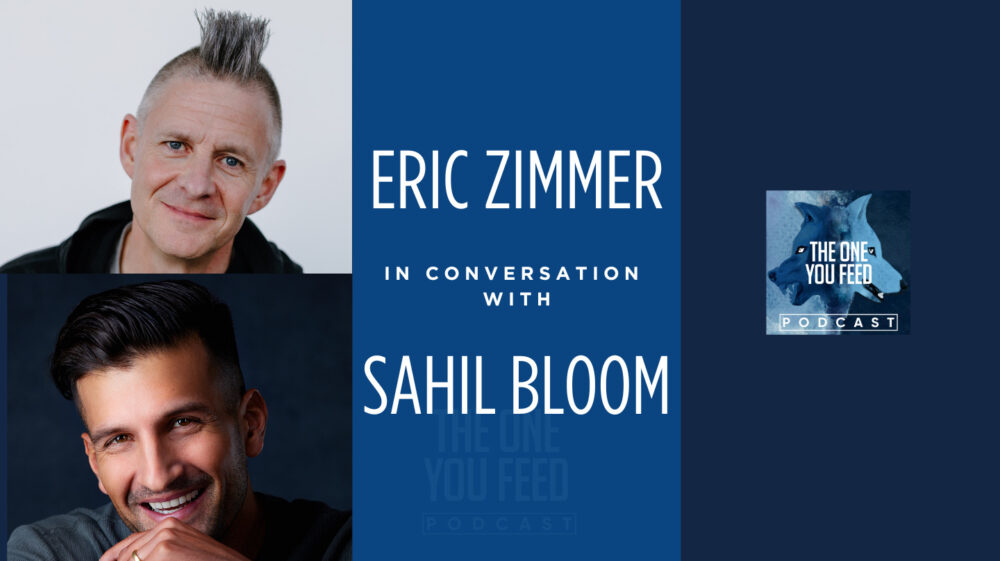
In this special episode, Eric Zimmer is interviewed by friend and former guest of show, Sahil Bloom, as they discuss Eric’s new book, How a Little Becomes a Lot: The Art of Small Changes for a More Meaningful life. Their conversation explores how small, consistent actions, not dramatic moments, lead to lasting transformation. Eric shares personal stories of addiction and recovery, discusses the complexity of motivation, and introduces practical frameworks like the SPAR method. They emphasize self-compassion, resilience, and the importance of aligning actions with values, while critiquing the pressure to be extraordinary. The episode offers actionable strategies and thoughtful insights for building positive habits and embracing change with kindness.
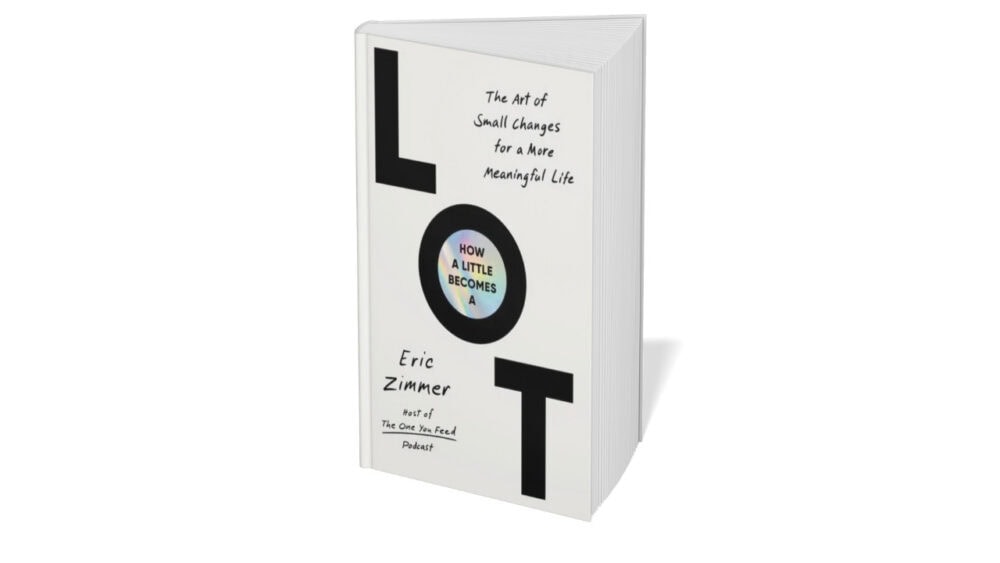
Exciting News!!! Coming my new book, How a Little Becomes a Lot: The Art of Small Changes for a More Meaningful Life is out NOW! Order today!
Key Takeaways:
- Behavior change and its complexities
- The role of motivation and willpower in personal transformation
- The significance of small, consistent actions leading to meaningful change
- The distinction between values and desires in decision-making
- The importance of self-compassion in the process of change
- Practical frameworks for behavior change, including the SPA method
- The impact of social media and comparison culture on self-perception
- Strategies for visualizing consequences to aid in decision-making
- The concept of “still points” for cultivating new habits of thought
- The balance between striving for improvement and practicing acceptance in life
Eric Zimmer is an author, teacher, speaker, and the creator of The One You Feed podcast—an award-winning show with more than 75 million downloads. At twenty-four, Eric was homeless, addicted to heroin, and facing prison. His journey from those depths sparked his lifelong inquiry into human transformation and resilience. Over two decades into recovery, he’s become a sought-after teacher and speaker on how to make profound change that leads to more meaning and fulfillment. Through his coaching practice and workshops, he’s worked with thousands of people worldwide who want to stop fighting themselves and start moving forward. His new book is How a Little Becomes a Lot: The Art of Small Changes for a More Meaningful Life.
Connect with Eric Zimmer: Website | Instagram | LinkedIn
Connect with Sahil Bloom Website | Instagram | LinkedIn
If you enjoyed this conversation with Eric Zimmer and Sahil Bloom, check out these other episodes:
Redefining Wealth: The Truth About Money & Happiness with Sahil Bloom
Why Willpower Isn’t Enough: The Tiny Habits Method Explained with Dr. BJ Fogg
This episode is sponsored by:
David Protein bars deliver up to 28g of protein for just 150 calories—without sacrificing taste! For a limited time, our listeners can receive this special deal: buy 4 cartons and get the 5th free when you go to www.davidprotein.com/FEED
Shopify – The commerce platform that helps you build, grow, and manage your business all in one place. Start your $1/month trial at shopify.com/feed.
Pebl – an AI-powered platform that helps companies hire and manage global teams in 185+ countries. Get a free estimate at hipebl.ai
Brodo Broth: Shop the best broth on the planet with Brodo. Head to Brodo.com/TOYF for 20% off your first subscription order and use code TOYF for an additional $10 off.
Alma is on a mission to simplify access to high-quality, affordable mental health care. Visit helloalma.com to learn more!
By purchasing products and/or services from our sponsors, you are helping to support The One You Feed, and we greatly appreciate it. Thank you!

If you enjoy our podcast and find value in our content, please consider supporting the show. By joining our Patreon Community, you’ll receive exclusive content only available on Patreon! Click here to learn more!!
Episode Transcript:
Eric 00:00:00 Specificity, particularly in the beginning, is always our friend what am I doing? Where am I doing it? How am I doing it? Any unknown about it? Get it out of there. Because if we’re trying to figure out what to do and motivate ourselves to do it at the same time, we’re in trouble.
Chris 00:00:22 Welcome to the one you feed. Throughout time, great thinkers have recognized the importance of the thoughts. We have quotes like garbage in, garbage out or you are what you think ring true. And yet for many of us, our thoughts don’t strengthen or empower us. We tend toward negativity, self-pity, jealousy, or fear. We see what we don’t have instead of what we do. We think things that hold us back and dampen our spirit. But it’s not just about thinking our actions matter. It takes conscious, consistent, and creative effort to make a life worth living. This podcast is about how other people keep themselves moving in the right direction, how they feed their good wolf.
Eric 00:01:07 Okay, so this is a slightly different type of episode. I am being interviewed about my book, and as I thought about who I wanted to interview me for my book, I first thought of Chris and then I realized he is largely incoherent. So he was out. Don’t anybody get upset. Chris and I are still great friends. It’s a joke. And then I thought about somebody that was on the show over the last year named Sahil Bloom. When I talked to him, I was really struck by his clarity of thought. He’s both very rational, but also really contemplative and thinks really deeply. He’s also very kind. He seemed like the perfect person to interview me about my book, and it was really fun to see the parts of the book that he chose to pull out and focus on, because they might not have been what I would have chosen. It’s a great conversation back and forth, and there’s a lot of things that get featured about my book that I’m hoping will be really useful to you.
Eric 00:02:07 Here’s Sahil and I discussing how a little becomes a lot the art of small changes for a more meaningful life.
Sahil 00:02:17 Eric, what a pleasure to get to do this. How are you doing?
Eric 00:02:20 I’m good. Sahil, thank you so much for doing it. This is really fun for me, and I appreciate you doing this.
Sahil 00:02:26 Well, it’s an honor for me. So without belaboring it too much, I do want to just dive right in. And where I want to begin this conversation is with with a quote from the book which just said, when we think about life changing events, we tend to think in the singular the epiphany, the miracle, the watershed choice that will put us on a new trajectory for good. But that’s not how real change happens for most people. Most of the time, it happens little by little bit, with a thousand chances to do A or B, each choice a thread woven into the fabric of who we become. Could you speak to that?
Eric 00:03:02 Yeah. I mean, I think the tail end of that.
Eric 00:03:04 That each choice gets woven into the fabric of who we become is a metaphor that makes a lot of sense to me. Or is it a simile or an analogy? I don’t know, I never can keep those three straight, but because that’s how our life does get formed, it gets formed by one little thread at a time, over and over and over. And so. Yeah, we’re thinking about big things, and big moments matter in a way, but they’re anything but the full story. I start the book by sharing. If you were going to film the movie of my life, that it would show me walking into a treatment center in Columbus, Ohio, in the dead of winter in 1994 as a homeless heroin addict weighing £100, yellow and jaundiced from hepatitis C, prosecutor telling me I had up to 50 years. And I went in and they said to me, we think you need to go to long term treatment. And I said no thank you and went back to my room. It still cracks me up to think of what was that guy thinking? And I in my room, I had one of those we call moments of clarity where I saw so clearly, like, if I leave here, I’m going to die or go to jail.
Eric 00:04:13 And so I walked back out and I said to them, okay, I’ll go to treatment. And in the movie that would be the pivotal moment, right? If we get a lot of time and it is an important moment in my story, but it is not the whole story, because it would only have meaning based on the thousands of choices that I made afterwards. And so that’s kind of what that section of the book is speaking to. We can have an epiphany. We can have an insight. We can have a moment where it appears that things turn, but those have to be lived into. I had plenty of moments before that where I said, I’m going to get sober, and I didn’t because I wasn’t quite ready to make those changes. And so those moments seemed significant in the moment, but they weren’t because I was unable to do all the things after that kept them significant.
Sahil 00:05:01 I guess what you’re speaking to, which is a really important point for all of us, is this idea that epiphanies rarely feel like epiphanies in the moment.
Sahil 00:05:11 In some way, they may feel significant in some way, but an epiphany is really something that we denote with the benefit of hindsight. And in this context, this epiphany moment for you, which was extremely powerful to read right at the heart of the book, right at the beginning, this gut punch, it is very clear that it is only an epiphany because of the millions, I would argue, of tiny actions that you have made since that have led you to this point where you are here, releasing this book into the world. What about that moment with the benefit of hindsight, acknowledging it made it the one that you felt started this snowball or this ripple that allowed you to start taking and start threading these tiny threads that have led you to here today?
Eric 00:05:58 That’s a question that can best be answered with some degree of speculation. It was certainly a culmination of all the little moments before that that led up to it. The times that I tried to get sober before and didn’t, those were those were important, I learned something.
Eric 00:06:15 We talk a lot about a bottom in recovery, you know, hitting rock bottom. And in many ways I was at a rock bottom. But I’ve seen people continue digging far beyond any kind of bottom. That makes sense. So I think, yeah, there has to be some degree of consequence, like there’s got to be a reason to change, and at the same moment there has to be hope. It’s like a mixture of despair and hope coming together at the same time. And somehow I got that when I was there, somewhere in there, hope started to take root. And I think it was borrowed hope, certainly for a long time, because I didn’t have faith in myself, but I saw enough people saying I was just like you and they could talk about it. And I was like, yeah, they are just like me. And they were sober. And so I went, oh, well, maybe this is possible. Yeah. I think that’s the main piece.
Speaker 4 00:07:07 You know, the thing that I.
Sahil 00:07:08 Think is so powerful about this book in particular, and I was saying this to you before we started recording, but I think it bears repeating here is I’ve read hundreds of books within this category of, you know, self-improvement, personal improvement broadly. I obviously wrote a book in this category. The thing that I think most suffer from that we often fail to acknowledge is they are about efficiency at all costs, productivity at all costs, productivity, maxing right, optimizing all areas of your life. And in particular when it comes to habit formation, behavior change. You lose something. If you focus on productivity at all costs, it is possible to optimize the life out of your life. And what I felt came across so powerfully in your words and in your book and in your story and in the frameworks that you offer. Is this idea that the behavior change and the actions you are taking in those threads, you are starting to weave together, all flow alongside this pursuit of meaning, this pursuit of mattering, of significance, of actually figuring out who you want to be just as much as what you want to do along that journey.
Sahil 00:08:25 Was that intentional? Where did that come from in your own journey, and why do you think that’s so important?
Eric 00:08:32 It was intentional, and it started in a program I started a number of years ago that I called Spiritual Habits. And the idea that I was interested in is, can we use the science of behavior change to help us become better people? You know, to not just optimize for productivity for an exercise habit, but can we use it to change how we think and how we relate to the world? And so that was what I tried to do. And and those were my two interests. I looked at the podcast over the years. I kept going, what are the two things I come back to? And I kept going. I keep coming back to the science of behavior change because I’m fascinated by how and why people change. And then I keep coming back to what does it mean to live a good life? What’s a meaningful life? And so, yes, it was very intentional to try and thread those two together.
Eric 00:09:24 And I do think that’s one of the things, and I’m glad you’re calling it out. That does differentiate the book.
Speaker 4 00:09:29 You know, the other.
Sahil 00:09:30 Area that jumped out to me was how clearly you address the struggles of like, motivation or willpower when it comes to behavior change. I think that so much advice that you see in this space comes down to like, hey, you know, just grind it out, get the thing done. You know, just put push through it, you know. Wake up. Rise and grind, whatever it might be. Right at 4 a.m.. The cold plunges, like, whatever the thing is. Hey, I’m just going to grind it out. And we know if that were what it took, everyone would have six packs and be rich. It’s not enough willpower, motivation. It fails and it fails spectacularly and very quickly for the vast majority of people, myself included, by the way. And I consider myself to be an extraordinarily disciplined person. I recently tried to, you know, cut my phone addiction like this was a big thing that I was trying to do this year.
Sahil 00:10:21 And the first month that I tried to do it, I completely failed. And the reason was because there was a lot more to the motivation around it than met the eye. It was not so simple as to say like, well, my motivation is there. You talk about motivational complexity, explain that idea, what you mean by it, and sort of how we should really think about the role of motivation, the role of willpower when it comes to these changes.
Eric 00:10:43 Yeah, I think there’s a few questions embedded in that one. The first thing I’ll say is for the people that can get up and grind, go to it. This book is for the other people, right? This book is for the other people who are like, I try to make changes and maybe I do okay at it, but then I slip back there, slightly frustrated. That’s who the book is for. This question of motivational complexity, I think, is important because we are a soup of competing motivations inside of ourselves, and we need to acknowledge that.
Eric 00:11:16 That’s part of why I the parable that I use to start this show, I have used for so long, because it speaks to that, it speaks to like there are these there are these competing forces within us. It’d be nice if it was as simple as two of them. There’s a whole bunch of them. I simplified it down for the purposes of the book, and it’s an oversimplification of our inner world, but sometimes oversimplification is useful into values and desires. Values are the things that, like the best, wisest part of us have decided are worth wanting. desires are the things that you just want. They just show up. There’s a whole bunch of them. I’ll have 50 of them in a day that are all over the place. And so we all do that. And so the first type of thing that most of us struggle with is, I phrase it as a simple question. It’s what do I want most? Versus what do I want now? What I want most are my values.
Eric 00:12:08 What I want now are my desires. And not that my desires are bad because they’re part of the energy that drives us. But we want to start to start to sort these things out.
Sahil 00:12:19 So would you recommend to someone that they actually just sit down and go through that exercise like, you know, get a blank sheet of paper in front of you and split it in two and just start writing down on one side. What do I want most? You know, what is that life that I’m actually trying to create?
Eric 00:12:36 Yeah, there’s one exercise in the chapter itself, and then there’s a whole bunch of exercises in the appendix, which has all the chapter exercises that people can do to start to get in touch with their values and figure that out. But as you said, there’s a very simple way to do it is just to start to identify like, where am I trading what I want most for what I want now? And most of us will know the answer to that fairly quickly.
Speaker 4 00:13:03 It is such.
Sahil 00:13:03 An interesting thing that knowing something and doing something about it are very different. Yes, I perceive that the most disciplined people that I know, and I would put myself into this bucket a lot of times in my life. I think there’s a wiring that I just have around this, have this ability to what I would say is bring the after into the before. So you sort of, you know, you’re sitting where you are and there might be something hard that you have to do, but, you know, you feel good after doing that thing, whether it’s working out or waking up early or doing the work that you didn’t want to do, whatever it might be, they have sort of like a time traveler’s ability to, like, pull that feeling from the after into the before so that they can go and endure whatever that that struggle is. Is that something that you have seen in your own pursuit, in your own learning and research?
Eric 00:13:54 Absolutely. The term we used in recovery was play the tape all the way through.
Eric 00:14:00 The problem is we all stop at the first scene. We stop at the scene where we know how it would feel to get high. We know what that cupcake would taste like. We know how comfortable it is sitting here on the couch reading Substack. Whatever our thing is, we see that. But that’s all we tend to see. And so the playing the tape through is exactly what you said. Bringing the after into the before. I see what comes next, both in positive changes and negatives. So an example I use in the book is imagine your thing as you scroll Instagram in the morning, you end up being late for work regularly. If you’re sitting there, you got to play that through. But it’s not enough to just go like, oh, I’ll be late. What we have to do is see and visualize and feel That. So if you do that and you look at oh, and then is going to come the frantic scramble out the door with the drive where I’m angry at everybody because they’re not going fast enough.
Eric 00:14:56 And then I got to do that awkward shuffle past my boss’s office, and then I’m going to all morning, have that low burn of fear. Like, did I screw up again? Or self-criticism like, how could you do this again? If we can see and feel that we’re a whole lot more likely then to be able to set Instagram down, get ready for work. And that’s the trick, is doing that, walking through that process, it’s not the only thing that happens. I mean, part of what the book tries to address is the idea of a choice point. And there are things that we can do before the choice point to stack the deck in our favor. And then there are ways that we can examine that choice point, and we can learn to rescript what we’re saying and feeling to ourselves in that moment. Because if we know what we should do, for example, it’s like, all right, I know I need to leave the house by 830 to get to work. And 825 comes and we we don’t respond.
Eric 00:15:57 It’s because something was happening inside of us in that moment. I call them the six saboteurs of self-control that hung us up at that time. And the good news is, we can just examine that choice point very closely, and we can learn how to change that. We don’t need to do Jungian analysis on our entire life. We simply need to say, what am I thinking, feeling, and saying to myself when I make the choice I wish I didn’t.
Sahil 00:16:23 It reminds me of this like general process that I’ve heard in the past of sort of the key to all of this being make the pain of not doing the thing greater than the pain of doing it. And so like when you when I hear you speak through the, you know, you think about shuffling past your boss and think about the drive when you’re angry and all these things. A lot of what that is, is like make that pain feel much more visceral. Yeah. Because, you know, the pain of of doing the thing which is like, it’s gonna hurt.
Sahil 00:16:49 I really want to be procrastinating and scrolling Instagram now, so I have to put it down that I know that pain. I know what that is because it’s right in front of me. Let me make the pain of not doing that thing that I should do just as bad right in front of me.
Eric 00:17:01 Yeah, and it’s hard. I mean, researchers call it delay discounting, which essentially means we value what’s right in front of us far more than we value things in the future, because the future is an imaginative exercise, whereas present is very clear. And so there’s a whole bunch of different strategies. The book covers a lot of them of of how do we do that? But that’s the big piece of it is, as you said, is really trying to visualize and feel the future make it more real somehow, some way.
Sahil 00:17:55 You speak to BJ Fogg’s behavior model in the book? Could you just briefly lay that out and then I want to you sort of use that as a transition point into your spa method and talking through, you know, sort of your core framework around this.
Eric 00:18:12 Yeah, people can look it up online or it’s in the book of visual of it because it works better as a visual, but it’s a graph and it’s axes are one is motivation vertically and the other is effort going horizontally. And his point is that an action happens when behavior and motivation and a prompt, an ability to remember something, come together at the same time. The key insight of the chart, though, is that the harder something is to do, the more motivation you need. The easier something is to do, the less motivation you need. And we know motivation goes up and down. So what we’re trying to aim at is how can we find a task that is easy enough that we’ll do it when we know our motivation is going to be fluctuating? So that’s the core idea.
Sahil 00:19:01 You bring up an example of your own experience with meditation. Talk about that. Like for me personally, that one slapped me in the face just because of my own experience with this exact challenge that you’re referencing.
Sahil 00:19:14 So just talk a little bit about that and how it relates to all of this.
Eric 00:19:18 Yeah, I tried to get a regular meditation practice for a long time. I got interested in meditation when I was 18 in Columbus, Ohio. There was no internet, there were books and some weird guy teaching transcendental meditation. Once in a while. That was that was it. That was all that was available if you wanted to know anything about meditation. And so what I was reading were books by Buddhist teachers, and they would say in the book, you should meditate 30 minutes to an hour a day. So that’s what I would try and do. And I could do it maybe for a day or a week, maybe a month. It was really hard for me, which meant I had to have sky high motivation. The reason it was hard for me is that I would sit down and it was pandemonium in my brain, like the dark circus rolled into town. I did not like it. It was very hard.
Eric 00:20:05 I didn’t settle easy. And so eventually what I did is I shrunk the the task down far enough. I started at three minutes that I could do it. And the good news about that approach, and this is the little by little approach, is that by doing it successfully, I felt better about myself. And as I felt better about myself, my motivation went up. Because motivation goes up when we feel good about our chances of success, when we believe in ourselves and it goes down when we don’t believe in ourselves or we don’t think we can do something. And so by succeeding at my little thing, I was able to build, I was able to do harder things, i.e. more meditation, with the perceived difficulty staying about the same because I was easing into it and my motivation was going up versus what would be a sporadic, longer meditation, but twice a week or something. And all I would do is berate myself about the five days a week that I didn’t do it. So that’s how I got into meditation.
Eric 00:21:09 I think it’s a good example of the motivation and the effort that’s in the fog model, and why this little by little approach works.
Speaker 4 00:21:17 And it also.
Sahil 00:21:18 Just creates profound ripple effects into every other area of life. You know, one of the things that I have certainly seen that I think you allude to frequently is motivation doesn’t exist in a silo, like when you’re talking about your life, the motivation that you can build as a result of doing this tiny thing, whether it’s meditation or something else. The three minutes, that winning sensation that it starts to create. Yes, that has ripple effects into every other area of life. And so not only do you start to feel a little bit more motivation for this one action and doing it a bit more and showing up on a daily basis, but you also start seeing yourself a little bit differently in terms of the type of person that you actually are. That who you become in the process. And so you show up a.
Speaker 4 00:22:05 Slightly.
Sahil 00:22:06 Little bit better at work maybe that day, or you show up a little bit more present with the people you love, or a little bit more energy for whatever it is that you’re taking on.
Sahil 00:22:15 And that is this profound ripple effect that you’ve just created through this tiny action that you just happen to show up for.
Eric 00:22:25 Yeah, I don’t remember quite where it is in the book, but I have a little section that I call The Stakes of Change. And there are two core things if we’re trying to do something. So let’s imagine we’re trying to build an exercise habit. There’s the benefit that we get from doing the exercise habit. There’s a reason we’re doing it. We want to be healthier. We want to live longer. We want to have more energy, whatever your thing is. And if you’re not doing that successfully, you’re not getting the benefit of that thing. So that’s a problem. The deeper problem is that we start to not believe in ourselves. The deeper problem is we start to think that we can’t make changes. And when we feel that we lose a sense of agency in our own life, we lose a sense of us being the author of our own life. And so a lot of what I’m trying to do is help people get to a point where they can make and keep promises to themselves, because that is so foundational to how we see ourselves and our ability, as you say, that ripples into all aspects of life.
Sahil 00:23:27 Yeah. You summarized it well. You said, we believe we get motivated and then act, but often it works the other way around. We act and motivation follows. Motivation is a byproduct of movement, right? So just start moving.
Eric 00:23:40 Yes, that’s my general strategy is get moving in any way I can, ideally towards the thing I’m trying to do.
Sahil 00:23:49 I want to transition or at least extend this thought into your Spa method. Specificity prompts alignment, resilience. Can you speak to that? I know obviously if if a reader which they should gets deeper into this, they’ll they’ll be well versed. But I would love to have you just sort of lay out the high level idea around the framework.
Eric 00:24:10 Yeah. The first thing I’ll say is that I think change needs two core competencies from us. One I call structural. And this is what the Spa method, it’s all structural. It’s what am I doing? When am I doing it? How am I doing it? Why am I doing it? Who’s supporting me and doing it? And I’ll go into more detail in that in a second.
Eric 00:24:32 That’s really important, and it solves a lot of what we think are motivational problems. And then even when we know what we should do, when we should do it, we’ve got the plan. There’s then that moment we talked about before where we have to make the right choice, but the structural is where we start, and the Spa method is a way of going through that. And so we take a behavior that we want to create and we first we get specific about it. Ambiguity is often the mother of procrastination. The things that sit on my task list the longest are the ones that are semi ambiguous. I don’t know exactly what the first step is. You know it’s get video done when that’s actually a six step process. So specificity, particularly in the beginning, is always our friend what am I doing? Where am I doing it. How am I doing it. Drive it. Just any unknown about it. Get it out of there. Because if we’re trying to figure out what to do and motivate ourselves to do it, at the same time, we’re in trouble.
Eric 00:25:30 So Specificity. The P stands for prompts. It’s how do I get reminded to do it? That sounds obvious, but it’s not always for me. In the morning, I need a prompt to tell me it’s time to put Substack down and get on the bike like I need my alarm to go off on my phone. That’s what wakes me up. So we need a prompt. The A stands for alignment, and it’s about structuring our environment in whatever way we can to make it easier for us to do the thing. It’s who is supporting us. You know, James Clear. We both know James. He he talks about this in his book. He talks about making something easy and attractive. You’re doing everything you can to have the thing be as easy for you to do as possible. And then finally, the R stands for resilience. And I used to do this with coaching clients. We’d work through a plan and then I’d say, okay, what’s going to go wrong? Right. Because something’s going to come up.
Eric 00:26:26 Like, let’s think through your plan to meditate in the morning after the kids get on the school bus. Well, what are we doing on mornings that the kids don’t get on the school bus? That’s something we can predict and plan for. The answer might be, on those days, I just let it go. It’s fine. I didn’t meditate today. Or it might be. You know what? I’m just going to sit in the room where they are, and I’m just going to spend three minutes watching my breath. But I have a fallback for what I do in those situations. And so that’s the Spa method is it gives us a way of creating a framework for the behavior. And if you look at one of the best known models for change, it’s quickly called the trans theoretical model of change. Often the stages of change model, you realize that there are three full steps in it before you ever do anything, and that the Spa method is helping us with some of those.
Sahil 00:27:17 The thing that I love about this spa method in particular is, is the r, the resilience, and the reason I find it so important and worth reiterating is my own experience in my own life, and also with the thousands of people that I’ve interacted with.
Sahil 00:27:32 Around behavior change is that the ambitious mind is particularly bad with resilience for one reason when they miss, which inevitably you are going to miss with whatever behavior change you’re trying to create, their bias is to try to make up for a miss. I’m going to say make up for in quotes. And what that means is like, you know, let’s just use an example to actually bring it to life. Hey, I’m going to do, you know, 30 minutes of cardio every single day because I’m trying to get healthier. I’m going to walk for 30 minutes every day. Well, something happened. Chaos. My kid was up all night, I didn’t sleep, I had to get straight to work. So I missed on Tuesday. But I tell myself, okay, I’m gonna make up for it tomorrow. So I’m going to try to do an hour tomorrow so that I can make up for the missed. Because it was 30 minutes I missed. I’m gonna add it to tomorrow’s. And then they go out and they run for an hour.
Sahil 00:28:20 Then they get hurt because they tried to run for an hour. Their foot is really sorry the next day. So they miss the next day, and then they have to go to the doctor. So they miss the next day. All of a sudden, this desire to try to make up for the missed, to try to like, punish yourself in a way for the fact that life happened, leads to a cascading negative in your life. The resilience you tried to embed into the model actually ends up hurting you rather than helping you. And I have seen that over and over again. This this desire to make up for something, being something that actually, oddly enough, holds you back. It’s one of the reasons this way, this way of thinking about resilience really stood out to me. It’s also a reason why I loved this quote where you talked about, you said, besides no longer using mind altering substances to burn my life to the ground. No single change has made a bigger difference in building a life worth living than this.
Sahil 00:29:16 Learning to treat myself with kindness that I think of as a beautiful transition point for this conversation, but also as a beautiful way to capture this idea of resilience because resilience is often about kindness. Yes. Kindness to yourself. This recognition that it is, it is okay. You are on the path. There are going to be storms. There are going to be moments where the dark wolf, to use your analogy, wins out, but you don’t continue feeding it by punishing yourself with this self-loathing on the back end. Anything you would add to that? As we hinge point, I.
Eric 00:29:55 Think that’s a really beautiful insight that you have. And it’s true. And so it’s part of why I have a phrase which is just a little bit of something is better than a lot of nothing. Meaning if you plan to run for 30 minutes that day and something gets in the way. The way I deal with that is I try. Then, you know, can I get a five minute walk in? Yesterday I had this.
Eric 00:30:17 I’m in the middle of a book launch. I did not exercise as I should. I sat down in the morning and got started on something. Day got away from me, but after dinner I went and did a 15 minute walk. I’m doing something to honor the underlying value of health. So yes, you’re absolutely right. And then. Yeah. Kindness is the key part of it. And it’s why I said the one option might be if the kids don’t go to school that day, I just say it’s okay to not meditate. That’s it. Done. No problem. That’s a kindness to yourself. And so yeah, I do think kindness is both the biggest upgrade we can give ourselves in our life. And it is critical to how we change.
Sahil 00:31:20 So to this point in the conversation, we have Mostly circled around what you speak of as habits of behavior. We’ve talked a lot about in your book, Framing the Beginning. Right. It’s the mechanics of the change values versus desires, the Spa method, BJ Fogg’s model, all of these things.
Sahil 00:31:39 I want to transition because kindness is a good transition point for this into what you speak about as habits of thought, which is one of the areas that I think makes this book so unique. Because you address this, you speak to all of these different schools of wisdom and ancient thought and parables and these beautiful ways that tie together what is habits of thought as a general framing? And from there, I want to talk about a couple of the frameworks that you offer there that I think are really sticky for people to learn about.
Eric 00:32:07 Yeah, habits are thought are just what are the predictable patterns that our brains fall into. And we all have them. We all have predictable things that we tend to think consistently. A Zen master called it habit ridden consciousness. And I love that idea. You know, we think of habit often, particularly with James work and BJ Fogg’s work. Habit now is often associated positively, but for a long time it was associated with bad habit. And we have, you know, quote unquote bad habits of thought, thoughts that cause us to suffer, thoughts that cause us to be less effective, thoughts that cause us not to be able to change.
Eric 00:32:45 And so that’s what the focus is there.
Speaker 5 00:32:48 And when it comes to habits.
Sahil 00:32:49 Of thought, you have this idea of these still points. It relates to something that you said a couple of minutes ago just related to the like five minute walk. But I sort of think of it as like the thought version of that, these still points that you create in your life. What are still points? And for an average listener that’s sitting there listening to this today, this to me feels like one of the you can go do this right now, today, implemented in your life, and start to feel a dramatic change. Not not a tiny change, a really dramatic change in ripple effect from this. So just frame it up for people and make it actionable, because I would love to see more people take this idea immediately and start implementing it.
Eric 00:33:28 Yeah, it comes from the concept of if we’re going to change how we think or relate to the world, that process is not going to change instantly. You’re not going to read a book Sunday night where you see something important about the way you think, and then that’s it.
Eric 00:33:47 Even if you get to a daily meditation habit, which is great, but a lot of people can’t get to, or a reflection period in the morning where you think about what’s important, then the day starts and you’re off and running. I’ll give you an example of a practical still point. Let’s pretend that you want to be more patient with your children. That’s what we’re going to work on. A still point is a very small moment of time 30s a minute that you do frequently throughout the day, and we can drop whatever we want into a still point. So let’s take patience as the example. You decide that the prompt you’re going to use is every time I go to the bathroom. So every time you go to the bathroom, as you’re going about your business, you think about, why is it important for me to be patient with my children? What about that matters to me? You go to the bathroom 3 or 4 times, you get home that night, you’re far more likely to be able to be patient with your kids because you thought about it four times that day.
Eric 00:34:51 Then you are. If you read about it and felt bad snapping on Sunday night, that’s the core idea. And so we can all weave into our day. We don’t have to set aside time because we’re all busy. You can weave into your day ways of reflecting that over time, change how you feel and how you think. And so that’s what a still point is. And the key is we have to architect them into our life because they don’t happen automatically. We don’t remember. So prompts become really important there. An alarm is a prompt. We have an app we’ve created called a still point app. And what it does is it randomly goes off and you say, I want it to go off five times between 7 a.m. and 8 p.m. or whatever hours you want, and it’ll display a message. Your message could be, you know, I want to be patient with my children. It goes off little ding on your phone, you pull it up, you look at it and you go, yeah, that is important.
Eric 00:35:46 Why is that? And you just take very brief reflection. Those all really, really do add up. And little by little you find yourself relating very differently. We talk about we’re going to get into self-compassion. And I said that’s the biggest upgrade I gave myself that happened by thinking about it a lot. Lots of little times.
Sahil 00:36:07 I think it was Viktor Frankl, famous psychologist, Holocaust survivor, that said, between stimulus and response, there is a space in that space is our power to choose our response. When I read about Steel Points, that was what popped into my head was it’s a mechanism for creating space in your life. Yes, because we all know this and we experience this, that modern life has this feature of just feeling like this constant fixed loop of stimulus and response. Right? You know, you you wake up in the morning, you know, you probably have your phone on your bedside table, the alarm goes off. You grab it, you’re still lying in bed, and a thousand people come rushing into your bedroom.
Sahil 00:36:49 Right. Text messages, emails, social media notifications, all of it. And from that moment until the time you get into bed and put your phone down, you are in this constant fixed loop. Yep. And if you do not force space into your life, modern life has sucked every bit of it out. There is no ventilation. And so in a lot of ways, what you’re talking about is like ventilating, forcing the air of space into your life through these triggers, through these, whether it’s your Still Points app or whether it’s your own ability to create this. Of just these tiny little pockets of of of space and deliberate space, intentional space that is leading you to act and behave in the way that your ideal self wants to show up in the world. I think the parent example is such a powerful one, because consistently I have found I’ve, you know, a young I have a toddler son. It is very easy to say how you want to be as a parent. It is very difficult when you get caught in those moments, you know, in those you’re tired at the end of a long day and your kid isn’t behaving, or they’re not eating the meal you made for them, or they’re not going to bed at night.
Sahil 00:37:55 I find that it gets, you know, it’s kind of linear or maybe even exponential in terms of the difficulty over the course of the day, you’re like really patient and kind first thing in the morning and you’re like, oh yeah, so we’re with you, whatever. And then at the end of a long day, it’s anything but, right? The difficulty level is so much higher. And so what you’re talking about is like insert space so that you can circumvent that curve and continue to show up. Remind yourself of who that person is. You talk about self-compassion, speak to that a little bit more, and whether it’s your own journey with it or just the importance of it as it relates to this process of of change.
Eric 00:38:30 Yeah. Self-compassion is so important for two reasons. Reason one is it just is really lovely not to occupy brain space with an asshole, you know? I mean, to put it simply, it’s just nice to have it be pleasant in here and spend more time with myself than anybody.
Eric 00:38:47 So that’s that’s very nice. And again, probably biggest upgrade I’ve given myself. It’s also really important to how we change, because change is a learning process. And when we are being hard on ourselves and when we’re falling into our usual scripts of you’re lazy, you’re this, you’re that, you always do it. You screw up, what’s wrong with you? All of that ramps up our emotional state. And when that state is ramped up. The part of our brain that does the learning is sort of turned off. And that’s the exact opposite of what we want. What we want to have happen is, oh, I was exercising, you know, every day this week. But then Friday and Saturday it fell apart. I wonder why. What was different? What was different between Thursday and Saturday? Then we learn, but all we do is go see. I knew you would do it. You always screw up. You haven’t learned a thing. And so self-compassion is really critical in that dimension.
Sahil 00:39:49 Also, where do you think self-compassion or do you think rather self-compassion can go too far for some people. And I guess the question here that the origin of it for me is to just say, what is this balance point? You know, for someone that does need dramatic change in their life, even not dramatic. So let’s say they just need they need to create change in their life. Yeah. At what point does self-compassion become self-sabotage or a excuses? Yeah. An excuse.
Eric 00:40:22 Yeah. So I define self-compassion as a middle place between self-improvement and self-acceptance. So self-compassion is not about justifying anything, any behavior. I can still hold myself accountable, but I can do it in a kinder way. I score high on conscientiousness on the big Five personality test, which means I pay a lot of attention to what I do, and so I frequently see ways in which I have, you know, for lack of a better term, fallen short of what I wanted to do if the person I wanted to be.
Eric 00:40:58 But I can be self compassionate in that by looking at the behavior, focus in on how do I change the behavior, what can I learn from it without having to say mean things to myself? An example I use in the book is, if you can imagine, two students, Bobby and Susie. Bobby is in class and the teacher says, Bobby, what’s three plus four? And Bobby goes, eight. And the teacher goes, Bobby, you moron, what is wrong with you? It is not eight. You’re never going to get it. You’ll be lucky to get out of elementary school, let alone college. You might as well write that off. Bobby is going to struggle in math, right? Susie, on the other hand, is asked what three plus four is, and she says eight and her teacher doesn’t go. You’re right, Susie eight. It is great job. She goes, no, Susie, it’s not at seven. Here’s why. Right now you could do this. And by the way, if you want a little extra help, stop by after class and I’ll give it to you.
Eric 00:41:54 I know you can figure this out, right? We can tell who’s going to do better. That’s what self-compassion is.
Sahil 00:42:00 It all sort of feels to me like it relates to this middle way concept that some people will be familiar with from Buddhism, but you speak to and write about in the book? Can you connect it to that?
Eric 00:42:14 Yeah, that’s exactly what. Self-compassion, for me, is a middle way between self-criticism and self-indulgence. And so I’m a cliché of the middle way. I feel like that way of thinking has so imbued so many aspects of my life, and I give a lot of different examples of it in the book. Now, there are certain things I can’t do middle way. I’m a I’m a recovering substance addict, right? For that, I am extreme. It is abstinence. But most things in my life I find a middle way approach works. A middle way approach works if we’re trying to make a change. Because if you think you should do it perfectly all the time and you don’t, a lot of people just give up.
Eric 00:43:01 Like, it’s not like there’s a place either I do it perfectly or I don’t do it at all. You could think of this on a day you’re trying to eat well and you have breakfast and, you know, somehow you end up with Krispy Kreme donuts for breakfast. Most people in a non middle way approach go oh fuck it. You know and the whole day is gone. They’re at McDonald’s at lunch and they’re at Baskin-Robbins for ice cream after dinner. The whole thing derails. A middle way approach says, yeah, okay, I messed up a meal. No big deal. But I can still keep with my plan.
Sahil 00:43:32 It all sort of relates to this embrace of the ordinary that I absolutely love. There’s this poem like one of my favorite poems. It’s by a man named George Martin. It’s about parenting. But the final two lines of it are make the ordinary come alive, and the extraordinary will take care of itself. You sort of lament this idea that people are told everyone can be extraordinary, and you should strive for the extraordinary.
Sahil 00:44:06 It all kind of connects to this middle way, this embrace of the ordinary, this middle path, this boring show up daily, basic, small. Can you talk a little bit about that and your relationship with ordinary versus extraordinary, what you have seen in your conversations that you’ve had with people and and what that means to you?
Eric 00:44:26 Yeah, I think there’s a lot of pressure in the self-help movement is one of the main perpetrators of this of exactly. Like I said, everybody can be great, everybody can be exceptional, you can do anything. And I just kind of think that’s BS. And the pressure to do that leaves us always feeling like we’re not enough. It’s not enough to be a good parent anymore. You also have to have a job where you’re killing it and you’re on LinkedIn influencing people. And you also started a charity in Africa for children, and you’re on the PTA board at school, and, and and there’s no ever is enough. And that does not lead to a satisfied life, and it certainly doesn’t lead to a life where we’re our best self for other people.
Eric 00:45:14 Because if we go back to this idea that we do better when we feel better about ourselves, if we constantly are focused on the things that I don’t do, then we don’t feel good. And I’ve coached so many people like this who are wonderful people. They’re successful at work, they’ve got children that they’re a great parent to. They’re a decent and kind person overall, and all they feel is I’m just not enough. I’m just not enough because they’re comparing themselves against Mel Robbins. I don’t know whoever your whoever your comparison point is. And that’s a really crappy way to go through life. And so for me, the more that I am able to just be a person among people doing the best I can and not having to be extraordinary or special, the better I do. Writing a book is a is an interesting process in this, because there’s a certain amount of ego in it to do it and get it done, and to promote it and to push it into the world. But I have to be very careful about gauging all of my life on how successful this book is, you know, gauging my self-worth on what podcasts I got on or whether I got on the Today show.
Eric 00:46:26 It’s a very slippery slope. That’s the sort of advanced version of it. But if you’re in that mindset, it doesn’t matter. You will always think there needs to be more.
Sahil 00:46:36 How much of that challenge, let’s say, do you feel has become ten times more difficult in 2026, as it maybe was in the 1990s or even the early 2000? Pre social media, pre the internet.
Eric 00:46:55 I think it has definitely gotten worse. I don’t want to blame the internet and technology for what our human things. Right. People have had problems with comparing themselves to others. There’s the old phrase, you know. Keeping up with the Joneses. Right. That was all about you’re comparing yourself to your neighbor who has more than you. So this is not a new thing. This has been around forever. And social media is a constant comparison engine. It just runs and runs and runs on that. And to expose ourselves to that again and again and again is definitely problematic. If that’s where I go for my relaxation and my my downtime.
Eric 00:47:36 But what it causes me to do is feel less than as I’m doing it. It’s not a great strategy for relaxing, right? I mean, we all fall prey to it to a certain degree. We all have our little digital tic. Mine is checking my email way more than is possibly needed. But yeah, I think social media has exacerbated all of these things. And the fact that social media is driven by an algorithm that prioritizes the extraordinary, the extremes, the best or the worst. It makes it even worse.
Sahil 00:48:09 The thing that I find so damning about it is keeping up with the Joneses has always existed. But the Joneses was it within? I shot right. It was actually like the people on your street that you could see the Joneses lived there. And so your comparison, while it existed, was always local in nature. And so it was somewhat bounded in what you could experience. Now comparison is global and you are comparing yourself to the top 0.0001% in whatever area and whatever domain. And you’re comparing them, you’re comparing yourself to that group and the 0.01% of their life that they are actually willing to share.
Sahil 00:48:47 So it’s even worse than that. It’s not like, hey, I could see the Joneses on the corner of the street. I see that they have a nicer car, the man, a nicer house. But I also see them arguing in the window every single night. So I know there’s there’s different sides to their life that you don’t on social media. All you see is the beautiful house, the car, the private jet, whatever, and the beautiful marriage and the children and none of the other issues. Right. And so it steadily creates and compounds this thing. And in addition to that, the algorithms feed the negative. We know scientifically that negativity drives clicks and shares at an outsized rate versus positivity. And so all of it is designed to create this perception in your mind that you are not doing enough, that you need to do more. The entire consumer economy is built on that idea, right? Hey, you’re not doing enough. Here. Buy this thing and you’ll be better. You’ll be feeling better.
Sahil 00:49:34 I have found when you ask people to map, you know their happiness during the course of a day. Just self mapping it. Your least happy moments tend to be times when you’re spending too much time on your phone. Screen time? Yeah, it’s a pretty simple hack to circumvent that, to step away from that a little bit, get away from that comparison engine. Realize that most of these comparisons are completely arbitrary in nature. Before we conclude and sort of get into some concluding thoughts, I want to just ask you about this framing that you share. Suffering equals pain. Times resistance. I’ve loved that ever since I read it. Yeah, and it has clicked with me in so many different ways in my life that I see on an ongoing basis my my resistance in particular. Like, what is the resistance that I’m feeling here? Talk a little bit about that and how to think about that in our own lives.
Eric 00:50:25 Yeah. I believe the meditation teacher, Shenzhen Young, is the originator of that phrase.
Eric 00:50:30 So credit due. And it’s been extraordinarily important in my life. And so the idea is that like suffering is the total overall, let’s just call it yucky ness of something. Pain is the situation. It’s the back pain, or it’s the job that you don’t really like or whatever it is. And then resistance is all the stuff that we’re saying in our heads about it. And the reason that equation is so good is the precision of it. It’s a suffering equals pain Time’s resistance. So let’s just take back pain. That’s a simple one. My back hurts. On a scale of five. Five points out of ten. Of back pain. And I’m resisting it out of five because I’m thinking it shouldn’t be this way. And what am I going to be like when I’m 80? And why me? You know, whatever our thing that we’re spinning around, the fear, the resistance. So 25 total points of suffering. If I can turn that resistance down a little, I don’t think we can turn it off.
Eric 00:51:31 I just don’t think that’s what I think enlightenment is when you turn the resistance totally off. But for most of us, most all of the time, that’s not possible. But if I turn that resistance just down two points to a three, five times three, now I’ve got 15 total units of suffering. So the whole experience is less yucky. And again, that’s a very scientifically precise term. The whole thing is less yucky. But I didn’t have to change the underlying problem at all. Which is good because sometimes we can’t.
Sahil 00:52:02 It reminds me of that, Buddhist parable of the two Arrows. You know, if you’re struck with one arrow, does it hurt? Yes. If you’re struck by a second arrow, does it hurt even more? Yes. And then the Buddha teaches that the first arrow is the thing that happens in your life. You cannot control it. The second arrow is your reaction to the first, and it’s within your control to send that arrow into the ground rather than into you.
Sahil 00:52:25 That is avoiding that resistance. One of the questions that you offer that I thought really stuck with me, that I found myself continuing to ask myself when I feel this resistance, particularly when it comes to like professional related stress, is will this bother me in five hours, five days or five months? Yeah, that has been this moment for me. Like all of these random little stresses that hit my life, that then linger, that I feel this resistance towards, that increases that suffering. Most of them melt away when you realize that they aren’t going to matter. And I mean, frankly, most of them in five hours, but definitely not in five days. so I would definitely recommend that to anyone listening to this. Whether or not you end up reading this book, when you encounter a stress, when that situation comes up, ask, Will this bother me in five hours, five days, or five months? Generally speaking, you will find that the answer is not more than five hours, and so it’s probably not worth ruminating over.
Sahil 00:53:20 And so sitting with in this moment.
Eric 00:53:24 That question saves me so many hours of frustration. I’m on hold for customer service, and I find myself starting to get irritated. Like, why? You know, I should answer this phone quicker. What I’m like by dinner, I will forget this even happened. And plus I choose to keep stirring myself up. And sometimes the answer is yes. Sometimes the answer is you go, yes, this will matter in five months. And that’s good information because that is worthy of your time, your energy and your concern, the things that matter. We just dissipate so much of that time and energy on the things that really don’t.
Sahil 00:53:58 You I conclude the book by offering that this is all really about changing our relationship with change itself. What did you mean by that? What do you want a reader to come away from this conversation and from the book itself? Understanding and thinking. When it comes to change.
Eric 00:54:20 It’s a bit of a paradox, right? It’s a book about how we make changes, and then ultimately, it’s a book that argues on some degree that we need to not approach everything from a change mindset.
Eric 00:54:33 There’s a place where we focus on becoming better people, becoming healthier, succeeding, whatever those things are. And there are ways to do that, and they are worth doing. And there are lots of parts of life that that mindset is problematic. It’s both my best and my worst quality that I always see how things could be better. That’s good. That’s part of why I’ve been able to do the things I do. It’s the gift I have to give to the world, and it is profoundly a pain in the ass for a lot of parts of my life. If I don’t know how to set that down. Then again, nothing is ever good enough. My my partner will accuse me of this. She’s like, you’re just never satisfied. Now, of course, sometimes I’m satisfied. Never is a way to start an argument. But her point is that’s my default, that I have to consciously work to counter. And so that’s why I wanted to end with presence and acceptance. Because a person like me, who’s focused on change all the time, needs to know that not everything in life needs to be changed.
Sahil 00:55:39 You write little by little, we become who we are. What does that mean to you?
Eric 00:55:46 Our thoughts and our behaviors. The little things that we do day by day. It is who we are. It’s back to that idea of the threads that are woven in. And it also speaks to the idea that who we become is important, not just in what we accomplish, but but who we are and the things I have. In the second half of the book, around self-compassion and a middle way approach and acceptance and presence, when we weave those threads in, those are the people that we become. And those kind of people, to me, are a gift to the world.
Sahil 00:56:20 Beautiful. Well, thank you so much for writing this, spending the time doing all of the tiny little actions, the I know millions of actions that actually lead to producing and publishing and actually releasing into the world a book. no small feat and something you should be extraordinarily proud of. Having read this and having had the opportunity to have this conversation.
Sahil 00:56:43 I know that it’s going to impact many people all around the world that take the time to read it, that engage with the ideas and more than anything else, that actually go and take some tiny action according to what they learn. You know, read the first ten pages and then go and dive into something. Go and create one of those still moments, those space that we talked about. Go and do one tiny thing, because the message here is powerful, but the ripple effect it can create in your life is even more so.
Eric 00:57:09 Thank you so much for coming on and doing this. I always appreciate the way you think and your views on things. So having you talk with me about this book was a great pleasure. So thank you.
Sahil 00:57:20 Thank you.
Eric 00:57:21 Thank you so much for listening to the show. If you found this conversation helpful, inspiring, or thought provoking, I’d love for you to share it with a friend. Share it from one person to another is the lifeblood of what we do. We don’t have a big budget, and I’m certainly not a celebrity, but we have something even better. And that’s you just hit the share button on your podcast app, or send a quick text with the episode link to someone who might enjoy it. Your support means the world, and together we can spread wisdom one episode at a time. Thank you for being part of the One You Feed community.
Leave a Reply