
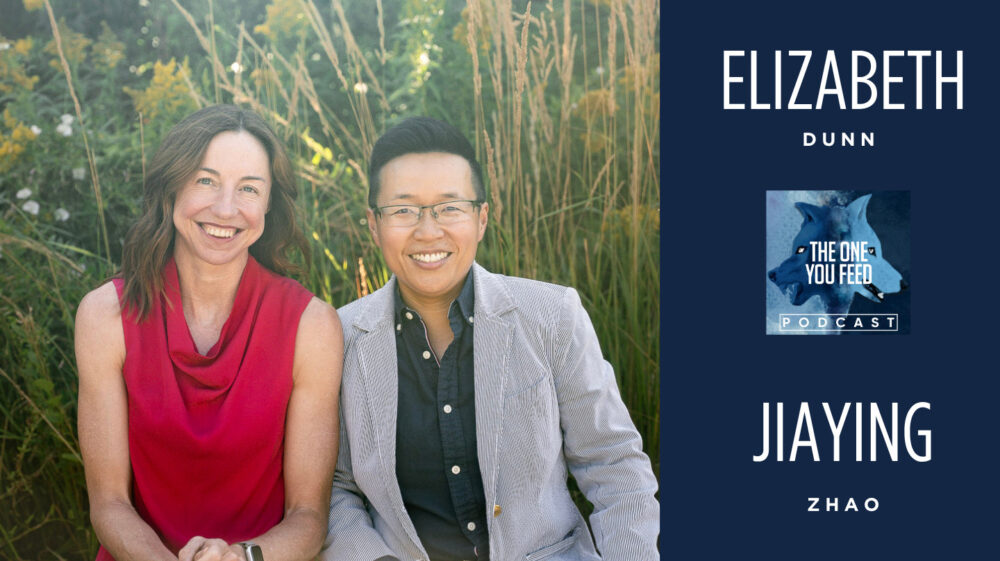
In this episode, Elizabeth Dunn and Jiaying Zhao discuss the surprising choices that can make you happier and help the planet at the same time. Drawing on research in happiness, behavior change, and climate science, they challenge the idea that climate action has to mean guilt, sacrifice, or giving up everything you enjoy. They explain how to find the “sweet spot” where choices that reduce carbon emissions also improve well-being, whether that means rethinking what you eat, buy, or how you travel. They also reveal why some of the actions we focus on most may have less impact than we think, how our everyday choices influence the people around us, and why choosing one meaningful change you actually enjoy may be far more powerful than trying to change everything at once. Their new book is Leave the Lights On: How Joyful Decisions Can Save Our Species
A Weekly Bite of Wisdom: Want to go deeper with the ideas we explore on The One You Feed? Every Wednesday, Eric shares a short, practical email that turns insights about mental health, relationships, purpose, habits, and personal growth into simple practices you can use right away. You’ll also receive our Weekend Podcast Playlist featuring a recap of the week’s episodes. It’s free, takes about a minute to read, and is enjoyed by thousands of readers each week. Sign up at oneyoufeed.net/newsletter.
Key Takeaways:
- Why joy can motivate lasting change better than guilt or fear
- How individual actions and systemic change work together
- Why our everyday choices can influence the people around us
- Which food choices have the biggest impact without requiring an all-or-nothing approach
- Why reusing and buying less can matter more than recycling
- How to rethink travel to get more happiness from fewer emissions
- Why choosing one meaningful change may be the best place to start
Elizabeth Dunn is Professor of Psychology at the University of British Columbia and coauthor of Happy Money. She directs UBC’s Happy Lab, which focuses on how to optimize valuable resources including time, money, and carbon to maximize human well-being. Her work has been featured in The New York Times, The Wall Street Journal, The Washington Post, Los Angeles Times, The Atlantic, TIME, Rolling Stone, and Harvard Business Review; and on numerous podcasts and television shows, including Hidden Brain, NPR’s Short Wave, The Happiness Lab, Ten Percent Happier with Dan Harris, Morning Joe, and CBS Mornings. Dunn spoke on the TED mainstage in 2019, and her talk was selected as one of the top ten TED talks of the year.
Jiaying Zhao (JZ) is Professor of Psychology and Sustainability and founded the Behavioral Sustainability Lab at the University of British Columbia, which designs and tests behavioral solutions that encourage climate action. She has worked with NASA, NOAA, and the US and Canadian Forest Service to develop pathways to net zero. Zhao has appeared on numerous podcasts and in documentary films, including Why Is This Happening? With Chris Hayes and Close the Divide. Her research has been featured in The New York Times, The Washington Post, The Atlantic, TIME, The Economist, Scientific American, CNN, and NBC. In 2023, Zhao gave a TED talk on climate strategies rooted in happiness, which was selected as one of the top TED Talks to be a better you in 2024.
Connect with Elizabeth Dunn and Jiaying Zhao: Website | Liz’s LinkedIn | Jiaying’s LinkedIn
If you enjoyed this conversation with Liz and Jiaying, check out these other episodes:
How Small Choices Create Lasting Change (Eric on The Jordan Harbinger Show)
This episode is sponsored by:
Quince: Refresh your wardrobe with Quince by going to Quince.com/feed for free shipping and 365-day returns. Now available in Canada, too.
ZocDoc – Taking care of your health just got easier – start here with Zocdoc
Shopify – The commerce platform that helps you build, grow, and manage your business all in one place. Start your $1/month trial at shopify.com/feed.
Pebl – an AI-powered platform that helps companies hire and manage global teams in 185+ countries. Get a free estimate at hipebl.ai
Tiny Health‘s at-home gut health test provides science-backed insights into your microbiome, along with personalized recommendations to help you improve your digestion, energy, and overall well-being. Get $50 off your first test kit at tinyhealth.com/FEED
ButcherBox: Make dinnertime easier with ButcherBox, delivering high-quality 100% grass-fed beef, organic chicken, wild-caught seafood, and more, right to your door. Get $20 off your first box, plus your choice of free ground beef for life or free chicken thighs or top sirloins for a year, with free shipping always. Visit ButcherBox.com/FEED to claim your offer.
Talkiatry connects you with licensed psychiatrists for personalized, evidence-based mental health care, all online and covered by most major insurance plans. To get matched with an in-network psychiatrist in just a few minutes, visit Talkiatry.com/FEED.
Episode Transcript:
Elizabeth Dunn 00:00:00 I think we all have the capacity to make changes in our lives that can make us happier and reduce our carbon emissions, but we can’t change everything about our lives all at once. So I would encourage people, if you care about climate change. Pick one area of your life, maybe think about food, or think about your vacations, or think about the way that you commute. Just pick one.
Chris Forbes 00:00:29 Welcome to the one you feed. Throughout time, great thinkers have recognized the importance of the thoughts we have. Quotes like garbage in, garbage out or you are what you think ring true. And yet for many of us, our thoughts don’t strengthen or empower us. We tend toward negativity, self-pity, jealousy, or fear. We see what we don’t have instead of what we do. We think things that hold us back and dampen our spirit. But it’s not just about thinking. Our actions matter. It takes conscious, consistent and creative effort to make a life worth living. This podcast is about how other people keep themselves moving in the right direction, how they feed their good wolf.
Eric Zimmer 00:01:13 We’re all busy. There’s a lot of things that we want to fix, both in our own lives and in the world around us. And when I find something that can do both at the same time, I’m always interested. Elizabeth Dunn and Zhang Zhao call it the sweet spot choices that cut your carbon emissions and make you happier at the same time. Liz studies happiness. Zhang is a climate expert, the one colleagues call the Human carbon Calculator. Their book is called Leave the Lights On and it’s full of changes you might actually want to make. I’m Eric Zimmer and this is the one you feed. Hi, Liz. Hi.
Elizabeth Dunn 00:01:50 Hello. Hello.
Eric Zimmer 00:01:52 Lovely to have you both on. We’re going to be discussing your wonderful new book, which is called Leave the Lights On. how joyful decisions can save our species. But before we get into that, we will start like we always do with the parable. And in the parable, there’s a grandparent who’s talking with their grandchild, and they say, in life there are two wolves inside of us that are always at battle.
Eric Zimmer 00:02:15 One is a good wolf, which represents things like kindness and bravery and love, and the other is a bad wolf, which represents things like greed and hatred and fear. And the grandchild stops. They think about it for a second. They look up at their grandparent and they say, well, which one wins? And the grandparent says, the one you feed. So I’d like to start off by asking you what that parable means to you in your life and in the work that you do.
Elizabeth Dunn 00:02:44 So I actually wanted to be on this podcast because I heard you tell that parable on a previous episode, and it really changed the way that I thought about the work that we’ve been doing. So I think that there is kind of a bad wolf in terms of climate change communication that is all about fear and anxiety, shame, guilt. And it’s a powerful wolf. It’s done some good things. You know, even the bad wolf has its strengths, right? But I see our work as really trying to be about feeding the good wolf, saying, actually, we can motivate climate pro climate behavior by encouraging people to think of this as an opportunity for kindness, for improving their own lives. The bad wolf is not the only wolf. There’s a good wolf, and we can use the power of that good wolf to change people’s behavior in a really positive direction.
Eric Zimmer 00:03:46 I love that, and I think you’re right. And a lot of the book is turning on an idea that I spend a lot of time thinking about, which is what motivates change most effectively. And there’s certainly a school of thought that says being really hard on ourselves, being that so-called more strident voice, the one that says not the one that says like, you’ve got to get in shape. You gotta you have to do this. You have to do that versus the sort of change that happens by feeling good. And the Stanford professor, BJ Fogg, said something to the effect of in his book, we change more by feeling better than feeling worse. And that’s kind of the theme here in a lot of the book. Yeah.
Elizabeth Dunn 00:04:34 I think that’s exactly right. And, you know, feeling good is sort of nature’s reinforcer happiness, joy, feeling good about what we do. It just naturally makes us want to repeat those behaviors. And for a grand challenge like climate change. Doing something once doesn’t usually help very much. It’s doing something many, many times, day after day. And so that’s where I think feeling good becomes a really powerful motivator. And for a grand challenge like climate change. Doing something once doesn’t usually help very much. It’s doing something many, many times, day after day. And so that’s where I think feeling good becomes a really powerful motivator.
Eric Zimmer 00:05:16 You guys talk about joy as the sweet spot. What do you mean by sweet spot with all of this?
Jiaying Zhao 00:05:25 Yeah. So the sweet spot is actually the conjunction of joy and climate benefits. So what are the most high impact actions we can take to fight climate change. So that’s quantified by carbon emission reduction. Then what are the most impactful things we can do to improve our happiness. So the sweet spot is the conjunction of the two.
Eric Zimmer 00:05:47 So it’s the idea of one action produces two good outcomes.
Elizabeth Dunn 00:05:54 It’s like a double word score.
Eric Zimmer 00:05:56 A double word score. Yes, yes. Or another phrase people uses kill two birds with one stone?
Elizabeth Dunn 00:06:04 Yes. Although that sounds a little bad. Wolf ish.
Eric Zimmer 00:06:06 Well, here’s what’s fine. I had Peter Singer on the show years ago. I assume you guys know who Peter Singer is. Really brought animal welfare into the consciousness of everybody. And I unfortunately used that analogy with Peter Singer, who was he was very polite about. He’s like, I think I would use I think I would say it differently. So yes, it’s a little more Dark Wolf, but I think about the sort of opportunities a lot in life. Like if I can go on a walk and do it with a friend. I’m getting sort of two benefits there, right? I’m getting the physical exercise, being outside, and I’m getting the socialization benefit. And I think what you’re saying is let’s look for those opportunities.
Elizabeth Dunn 00:06:50 That’s exactly right. And I think these two benefits, It’s not just that we’re getting, hey, two good things and two is better than one, but also that it can help reinforce us to continue. So, you know, if you go to the gym with your friend, you’re getting that or you go to go and walk with your friend, you’re getting the exercise that you really need, you know, but also the fact that you get to see your friend probably makes you less likely to cancel. Right. And so similarly, if we can identify changes we can make in our own lives that reduce our carbon emissions, but that also make us feel good that we enjoy, then it’s going to be easy to stick with them, just like it’s easier to stick with going to the gym if you’re meeting a friend.
Eric Zimmer 00:07:29 So let’s go back to what you said in your response to the parable where you said, there’s kind of a dark wolf of talking about climate. Tell me a little bit more about what that sounds like, what it is, and how it tends to affect people. Is it useful?
Jiaying Zhao 00:07:49 Yeah. The dark wolf is the doom and gloom narrative of the focusing on the climate catastrophe, the crisis emergency that tends to scare people away. It builds negative emotions like fear, anger, despair. Other narratives around the Dark Wolf are about, you know, give up your meat, give up, travel, don’t shop. So a lot of those sacrificial behaviors that are not very enticing. So the negativity is the dark wolf. And we’ve done a global mega study to show that this dark wolf actually backfires. The doom and gloom narrative discourages climate action, is supposed to encourage it in that. So that’s the reason to move away from the dark Wolf.
Elizabeth Dunn 00:08:39 At the same time, the Dark wolf has some power, so that that same global mega study showed that these doom and gloom messages, the one thing they did really well was replicate themselves, spread on social media so people were likely to share. These doom and gloom messages. So the Dark Wolf has its power and again, I think had an important role to play in kind of raising people’s awareness about the problem of climate change. But now that people know about it, we need that good wolf to kind of step in. And so feeding the good wolf is really what we are all about.
Eric Zimmer 00:09:12 Yeah. I think this is such a nuanced point, because knowing the reality of a situation is important, right? I think reality in general is good to know. Deception denial is not really a great, great standard practice. So knowing some of this is helpful in some sense. But then also to your point, it feels so overwhelming. And I think so much of our world today, whether we look at climate change, whether we look at what’s happening with AI, whether we look at our political system. Regardless of what side you are on, it feels so big. It feels bigger than we are, and you guys are providing an approach that says, here’s a way to make a difference in a way that is more likely to keep going because you enjoy doing it.
Elizabeth Dunn 00:10:14 Exactly.
Eric Zimmer 00:10:15 I want to get into all these actions here in a moment, because the book is full of ways of thinking through this, and I really love that. It’s a very practical thing, and we love practical things here. But I want to talk a little bit more about like, what is a way of thinking about climate change for somebody who is really worried about it? I’ll just speak for myself. Really worried about it, sees it as a potential existential crisis. Feels like we’re not making the kind of progress that we probably need to make. And so what’s a way of holding that thought that also allows me to actually do something about it?
Jiaying Zhao 00:10:58 Yeah. So our approach is to combine both individual action with system level changes. So we tend to not just worry about climate change, but also think that individuals have nothing to do with it. It’s governments and businesses.
Eric Zimmer 00:11:13 Yeah.
Jiaying Zhao 00:11:14 Now that’s only one side of the story. Individuals have everything to do with climate change because we are voters. We set policies. We can vote in the right politicians. We’re consumers. We drive demand. Our wallet is a voting signal for businesses. So everything we do has a carbon impact.
Jiaying Zhao 00:11:35 And if you are in North America, we tend to have the largest carbon footprint per capita. So there’s a lot we can do, especially in Canada, in the US to cut emissions in our lives, but also call for higher system-level changes as citizens. So I think the right approach is to do both, and also do it in a way to boost our own happiness. I think that’s the critical missing ingredient so far.
Elizabeth Dunn 00:12:02 And I would suggest that what we want to avoid here is wallowing in depression and despair, because not only do those emotions feel terrible, they also don’t get us anywhere. And so instead, if we can transform this into taking action, not only can we as individuals actually make a real difference, but also it just feels so much better to take action, to take some control, to reempower ourselves. And we would suggest that this notion that individuals have no bearing on climate change, and it’s all about governments and businesses. You know, we really see that as a new form of climate denial because it’s wrong.
Elizabeth Dunn 00:12:41 It is factually wrong. Individuals have an immense amount of power, both in their through their own actions, the way they influence other people and the way they can potentially shape systems. And that’s really our goal in the book, is to help people reclaim that power.
Eric Zimmer 00:12:55 So one of the things that’s really unique about the two of you, and we have two people on an interview, is that you come together bringing really different things. Tell me about that.
Elizabeth Dunn 00:13:06 So I’m a happiness researcher. I never thought writing a book on climate change was going to be on my bingo card, but I really cared a lot about climate change. And it actually dawned on me that, in fact, happiness research might have an important role to play in tackling climate change. And I brought this idea to Jay-Z, and maybe she can take it from there.
Jiaying Zhao 00:13:30 Yeah. So Liz approached me one day, actually back in 2019, and she asked, can we make climate action feel happy instead of miserable? And her question gave me a lightbulb moment when I realized that happiness is the missing ingredient in the fight against climate change.
Jiaying Zhao 00:13:48 So my job is actually to to change people’s behaviors. And I specifically design interventions to reduce emissions, to reduce waste. To encourage these pro climate actions. So at that time, I had the eureka moment. And ever since then, Liz and I worked together to identify these high impact actions to reduce emissions while increasing happiness.
Eric Zimmer 00:14:34 If I have this right, Jay-Z, you are the climate expert. Elizabeth, you’re the happiness expert. Putting the two together is really what brings this book to life. And what’s unique about this book?
Elizabeth Dunn 00:14:47 Exactly. And Jay-Z calculated just how many hours we spent together. And it is pretty crazy, really, just like hundreds of hours a year we’ve been spending together working on this project for a number of years now, conducting original research and figuring out how to translate these ideas for the public.
Eric Zimmer 00:15:05 Have those hours made you happy?
Elizabeth Dunn 00:15:07 They have made me very happy. It is so fun working with Jay-Z. And also, the great thing about having almost non-overlapping areas of expertise is that each of us is constantly learning from the other, and that is so fun.
Eric Zimmer 00:15:19 So this idea that individuals can’t do very much seems to be, at least to me, a more recent and I mean, in the last several years, take on the climate thing. What I hear from climate people is what this whole individual responsibility thing is, something that the companies, the big emitters came up with to kind of put the responsibility on us and take it off of them. And I think what you guys are counseling, which I always love, is sort of a middle way approach. It’s both.
Jiaying Zhao 00:15:55 Yeah, that’s absolutely right. I mean, it’s individual action. Doesn’t mean that you can eat salad all the way out of the climate crisis. That’s not going to work. But also, you can’t just sit there and do nothing and expect businesses and governments to do everything. So there’s this middle ground where both bottom up and top down actions matter. And this is what we want to do to empower people to take action.
Elizabeth Dunn 00:16:19 As one specific example. You know, biking is a very sustainable form of transportation. And to make it feel safe and comfortable to people, we really do need governments to invest in infrastructure like safe bike lanes. But we also need individuals to use those bike lanes to get out on their bikes. And these things work in tandem. So the more people bike, the more governments tend to be willing to invest. And it’s sort of a self-reinforcing cycle. And so seeing individual action in opposition to systemic action, we think is just completely backward.
Eric Zimmer 00:16:52 You also talk in the book about how individual climate action sometimes radiates outward. Tell me a little bit about that.
Jiaying Zhao 00:17:04 So individual action is contagious. Our behavior is contagious. That’s probably the most important lesson of behavior change. Let me give you an example. So if you have solar panels on your roof, your neighbors are more likely to get a solar panel because they see it and your words spread. So. As a personal example, my dad got an EV. Many years ago. I got to drive it recently. I loved it so much that I got my own EV.
Jiaying Zhao 00:17:31 I not only got my own EV, I wrapped it in hot pink and drive it around the city. People take photos of it. Now the word starts to spread and I’m working on Liz to try to get her to buy an EV. So behaviors spread.
Eric Zimmer 00:17:45 What color will your EV be? Liz. That’s the question.
Elizabeth Dunn 00:17:49 I mean, I’m going to have to think of it as an accessory to Jay-Z’s EV and like, pick a color that, you know, accentuates the hot pink. So I’m gonna have to give that some serious thought. But I will say, seeing how much Jay-Z really enjoys her EV makes me want to get one like this is now the number one big expense that I’m like, saving up for. Whereas, you know, I have other friends. For example, I have a friend who drives across town to go to this store where she can get nuts and things and refillable containers and shampoo and stuff in refillable containers, and that’s like an hour out of the day. It sounds so annoying. You’re filling up these containers. Yeah, it saves a little bit of plastic, but this did not catch on for me because it didn’t sound enjoyable. And so again, I think really finding ways to change our lifestyle or behavior that we actually enjoy. Not only is it nice for us, but it makes us more contagious to other people.
Eric Zimmer 00:18:47 You reference a study, I think, that says that you see solar panels show up in clusters.
Elizabeth Dunn 00:18:53 Well, so solar panels are contagious. So yeah, they seem to appear in clusters, almost like viruses that they spread through neighborhoods. And so I think we often don’t realize just how much of an impact we’re truly having on others. We we can actually see this in a really cool, fun little study that was conducted right on our campus at UBC, where our colleagues observed the orders people were placing at a little cafe. People stood in line at this cafe, and they could choose either a meat entree or a vegetarian entree. And as it turned out, these people ordered the same dish as the random stranger in front of them 72% of the time.
Elizabeth Dunn 00:19:31 So just what you hear the person in front of you order matters. And, you know, we don’t necessarily recognize what the person in line behind us, literally or metaphorically, is taking from our own behavior. But it turns out they’re taking a lot, even if they themselves don’t realize it. And so our own actions make a much bigger difference than we realize.
Eric Zimmer 00:19:52 That is an amazing study, and I don’t know why. I continue to be sort of surprised by them, because there are so many examples of these. But all the ways that our environment works on us that we just don’t even understand. It’s really wild.
Elizabeth Dunn 00:20:09 Absolutely. And I think it’s fun to think about how these little behaviors that we’re enacting are influencing those around us, like these ripple effects that we’re creating throughout the day without even realizing it.
Eric Zimmer 00:20:21 Check in for a moment. Is your jaw tight? Breath shallow? Are your shoulders creeping up? Those little signals are invitations to slow down and listen. Every Wednesday, I send weekly bites of wisdom, A short email that turns the big ideas we explore here in each show.
Eric Zimmer 00:20:40 Things like mental health, anxiety, relationships, purpose into bite size practices you can use the same day it’s free. It takes about a minute to read and thousands already swear by it. If you’d like extra fuel for the weekend, you also get a weekend podcast playlist. Join us at Oneyoufeed.net/newsletter. That’s one you get and start receiving your next bite of wisdom. All right. Back to the show.
I just wrote a book called How a Little Becomes a Lot. So obviously we’re in line on this is. But the little things that we do, they ripple in ways we can never see. It’d be nice sometimes if we could. I suppose our negative actions, it would. They ripple in a similar way and we probably don’t really need to see that. So I suppose it’s a mixed blessing. You guys talk about finding these things to do for the climate that are enjoyable, that we like, that we will continue to do. But you also talk about finding actions that have real impact.
Eric Zimmer 00:21:48 So it’s very confusing. I think, unless you really spend a lot of time on it. What things are most beneficial. Right. And you guys point out a lot of trade offs. So I think this would be a good time to turn into the individual sections of the book where we can talk about the choices that both bring happiness, but also the choices that are best for the climate that are proven to be valuable. And that’s really where I see, again, the interaction between the two of you so powerfully. Right. Like, Liz, you really understand happiness. You research what actually causes us to feel good. What sort of things would become re enforceable. And Jay-Z, you’ve got the knowledge of like, yeah, that actually makes a difference in the climate versus that’s kind of I wouldn’t spend my time there. So let’s use that to move into chapter two, a loaded subject, which you guys title In Defense of Bacon, which is about the choices we make around food. So let’s start maybe Jay-Z talking to us about how our food choices, what the impact of those are. Is it a big impact? How important is it? Give us some of the science.
Jiaying Zhao 00:23:09 Switching diet has a huge impact. And in fact, you don’t have to actually go vegan to be good to the climate. The meat that you should maybe reduce is beef and lamb. But for other kinds of animal protein like chicken, turkey, pork, seafood maybe don’t worry about them so much. In fact, I think pound for pound chicken has half the impact of cheese. So this is another so. Milk and dairy is also high impact because they come from cows. But not all vegetarian food is great. So for instance like a bell meat burger actually has a higher carbon impact than a BLT. So when it comes to food, well, my message is make meat treat, make beef and lamb in particular a treat. So I had my first steak in three years after I finished writing the book as a celebration. So it’s an infrequent, rare, extravagant indulgence for myself instead of eating it on a weekly basis.
Jiaying Zhao 00:24:11 But for most vegetables and nuts, not highly processed fake meat, they are excellent for our health, for our happiness, and for the climate. And so I think that’s kind of the general takeaway from food. There are delicious carbon negative food out there. There are a handful, so maple syrup being one of them, which is the literal sweet spot.
Eric Zimmer 00:25:07 Since I read your book, I have basically been covering everything I eat in gallons of maple syrup. We’re going to need to get a nutritionist on here in a minute to discuss just how bad that might be, but go on. Maple syrup.
Jiaying Zhao 00:25:23 So maple syrup produced in Quebec is is carbon negative. This is because the maple forests in Quebec capture ten times more carbon than maple syrup production emits. So the more maple syrup you eat, the better it is for for the climate. And in fact, if you just eat one teaspoon a day, that’s enough to put one maple tree into production. So you don’t need to eat a ton every day. Just one teaspoon is enough.
Eric Zimmer 00:25:51 You have a lovely chart in the book that shows the size of circle, how impactful certain foods are in the climate, and there were two on there that were a bigger circle that are actually certainly part of my diet. And one was coffee and the other was dark chocolate. Now is the fact that I only drink like a cup of coffee and only a little bit of dark chocolate sort of make this less of an issue, because if you look at that chart, one approach would be like, I just eat these tiny little circles. Let me just only eat these tiny little circles. But that would not be a choice. That probably sparks joy for a lot of people. So how do you think about finding that literal sweet spot again between these things? So Jas, you talked about okay, eating steak or beef as a rarity versus a regular thing. What are some other things that you think of that would that find that sweet spot versus me giving up coffee and dark chocolate?
Elizabeth Dunn 00:26:54 I want to be very clear. As a happiness researcher, I don’t think anybody should give up coffee or dark chocolate.
Eric Zimmer 00:27:01 Okay.
Elizabeth Dunn 00:27:02 And instead, you know what you said about the amount that you that you eat is very important? That you’re just eating like, a square or two of dark chocolate. You’re not eating a £1 dark chocolate bar every day is the impression I’m getting from you.
Eric Zimmer 00:27:14 I’d say it’s somewhere between one square and a pound.
Elizabeth Dunn 00:27:17 Okay, well.
Eric Zimmer 00:27:19 No, actually, it’s four squares, so there it.
Elizabeth Dunn 00:27:21 Is. Yeah. So amount matters. And this is interesting, right? Because if we take a really moralizing approach to climate change than eating any high carbon food. Any amount of it is, you know, might make you a bit of a bad person, right? Might make you feel some guilt. Other people might shame you. But if we instead take a more sort of math based approach, which I think is what we do in this book, to say, actually, what is the true impact of these choices, then we can see that, you know, the amount that you eat matters.
Elizabeth Dunn 00:27:49 And in fact, one reason that we titled this chapter on food in Defense of Bacon is that you can have just a little bit of bacon, and it goes a long way. You can take one strip of bacon and crumble it over some brussel sprouts, and suddenly you have like, really delicious Brussels sprouts that have been substantially elevated by that strip of bacon. Similarly, like small amounts of dark chocolate, I think can go a long way. And the other piece that I would suggest here, in thinking maybe about your dark chocolate habit, is that maybe not just making it a daily habit could also elevate your capacity to enjoy it. So my lab ran a study with chocolate where we, you know, as a happiness lab, we buy a lot of chocolate. It’s a good pleasure stimulus. We brought people into our lab. We had them eat some chocolate. We measured how much they enjoyed it, how much they really savored it. Then we asked one group of students to please give up chocolate for a whole week.
Elizabeth Dunn 00:28:44 Meanwhile, other students were given a big bag of chocolate and asked to eat as much as they comfortably could for the week. And finally, a third group, control group, got no special chocolate related instructions. Then we bring everybody back into the lab a week later, have them eat some more chocolate. And what we see is that overall, people just enjoy eating chocolate less the second time than they did the first time, except for the folks who gave it up in between. So taking a break from that chocolate seemed to really renew people’s capacity to enjoy it. Now, this is not a one size fits all approach. If, like the dark chocolate that you have at the end of the day is something that you look forward to, that you continue to savor, that really gives you pleasure. Then I think you should have it. However, if you’re just eating it mindlessly without really noticing it, not particularly appreciating it, that’s where it’s a great opportunity to take a break from it. Renew your capacity to appreciate it and save some carbon in the process.
Eric Zimmer 00:29:42 The joys of hedonic adaptation.
Elizabeth Dunn 00:29:44 Exactly.
Eric Zimmer 00:29:45 Although there are I mean, obviously it gets a bad name sometimes in happiness research, and it’s a good, useful human skill. Like anything, knowing how to work with it skillfully is valuable.
Elizabeth Dunn 00:29:56 Absolutely. So hedonic adaptations really helpful when it comes to negative things in our lives. We’re able to get used to things, but that also is a real barrier to lasting happiness, in that it can prevent us from continuing to reap joy from the same thing that we do over and over, again and again. What this means is there’s a great opportunity to have more joy in our lives by making some changes.
Eric Zimmer 00:30:19 I had an experience just today, but it’s not unique to today, but I think it speaks a little bit to this. Feeling good about what we do is better than bad, because I really try and be conscious of my water use, particularly around doing dishes like just turn it off or when I brush my teeth, turn the water off. And today I went in, I turned the shower on, and then I got distracted and about four minutes later I’m like, oh.
Eric Zimmer 00:30:46 And my brain says, you just undid two weeks worth of dishes in this one moment. And what happens in that situation to me if I don’t catch it, is that I all of a sudden stop doing the dishes because I’m like, I guess it doesn’t really matter, right?
Elizabeth Dunn 00:31:07 Yeah, yeah. This is called the what the hell effect where, you know, once you’ve messed up, it’s like, you know, in this you see this with dieters, once they start drinking a milkshake, they might as well, you know, eat a tub of ice cream, too. There’s actually research showing this. I definitely think it’s true when it comes to carbon. And if we can overcome it, you know, this can help us make better choices because the reality is, you know, everything still matters to some extent. At the same time, I don’t think we should beat ourselves up for these little mistakes that we make. I think we tried to take a very compassionate approach in this book. And, you know, it’s not about scolding others or scolding ourselves. It’s like, hey, can we just keep trying to do better?
Eric Zimmer 00:31:49 Yeah. In my book, I was a little more direct when I called it The Fuck its, you know, which is which is essentially exactly that thing. And learning to not do that is so valuable. Right. Learning to go. Okay, well, all right, I can start over again. I can start over again. All right. So now let’s move into our buying habits. And I think what’s really interesting also is recognizing how these things interact and overlap. And maybe we can tie some of that together at the end. But these are not. These are not entirely separate things. But let’s talk about buying. There’s a fact that you put out that says the fashion industry generates twice the global emissions of all flights and shipping combined. So I have a question about that. So you don’t mean the shipping of fashion because you said that you’re talking about the production, the just the actual making of.
Jiaying Zhao 00:32:49 So that that statement comes from a report that quantified the emissions of fast fashion and everything else. So that statement means flying just flights, not flying clothes, flying people. Okay. And maritime shipping. Not shipping clothes shipping altogether. Globally.
Eric Zimmer 00:33:07 Got it. Got it. Okay. And so the amount that fast fashion accounts for is partially shipping and partially production of the clothes, then.
Jiaying Zhao 00:33:19 Yes, but the carbon footprint of fast fashion is way bigger. Yeah, than shipping flights combined, in a total sense.
Eric Zimmer 00:33:27 Yeah. I’m just trying to understand what part of it. So. So what is fast fashion? It’s a term I’ve heard a few times, but I can’t honestly tell you that I know exactly what I couldn’t walk into a store and be like, that’s fast fashion. That’s not so. I’m clearly unhip. But what is it?
Jiaying Zhao 00:33:45 So fast fashion is basically the mass production model of clothing, cheap clothing that rapidly gets purchased and thrown away. So a lot of fashion brands, unfortunately use this model. They produce at a massive, rapid scale, so consumers keep buying them and throwing them away and buying more.
Elizabeth Dunn 00:34:07 The sort of fastest fashion will have a two week cycle. So what’s in fashion in all the stores is there for two weeks and then it’s gone, and there’s some new color or new style that’s in. And so it really encourages people to feel like they constantly need something different than what they already have.
Eric Zimmer 00:34:24 So it’s not just that it wears out quicker, it’s that the styles cycle through the shops quicker.
Elizabeth Dunn 00:34:32 The style cycle through more quickly. And because they’re the clothes aren’t really meant to last. They’re often made that way.
Eric Zimmer 00:34:40 Got it. And I think it does exist upon a continuum. Right. So I would say if I buy something from Patagonia, I mean, Patagonia is producing things on a pretty big level. They’re not your mom and pop shop, but I end up owning those things for years and years and years. So that’s on the other side from fast fashion, but not all the way to a hand-sewn suit by my local tailor.
Elizabeth Dunn 00:35:09 Right. And I don’t think too many people are getting the the hand-sewn suits. So if we want to kind of counter fast fashion, it’s more about choosing high quality clothing that is made to stand the test of time that can be worn through different sort of fashion crazes. I will see you again as the happiness researcher. I’m just going to say it doesn’t mean you have to completely deprive yourself of some of these fun, fast fashion trends. You know, it can be nice to have the, like, digital lavender that’s currently in style or whatever. But then what we would say the way to do that is by getting a t shirt, there’s a t shirt or a tank top is actually going to be pretty low carbon. In contrast, jeans, a single pair of jeans emits more carbon than an iPhone. So it’s really with jeans where we want to think, hey, maybe I want to invest in some nicer, possibly more expensive pairs of jeans than I would normally buy, but that, I think will really last, that aren’t just sort of like on this moment’s trend, but or that are really good quality, that look good on me, that I’m going to continue to wear for a long time.
Eric Zimmer 00:36:10 I try and stay focused in interviews, so I’m not going to do this. But now I’m like, what the hell is digital Lavender. I assume it’s a color, but why?
Elizabeth Dunn 00:36:19 The color is not in fashion right at this moment, but I, I, I bought a mug in digital lavender and I was like, why did I do that? And then I was like, oh, this was actually a couple of years ago. I looked around and everything was that color, and I was like, oh my God. But it was just like a flash in the pan.
Eric Zimmer 00:36:33 Let’s talk about recycling. Recycling is a big one, and I feel like I am constantly hearing different things like, yes, it’s really important. No, it doesn’t matter at all. 90% of what you recycle gets shipped off to China. I mean, these are the various things go on here. So you do make a point that reusing beats recycling. But let’s talk about recycling. How valuable is recycling? I mean, I keep doing it. Is it worth doing?
Jiaying Zhao 00:37:02 Recycling reduces waste to a certain extent, but it doesn’t cut carbon by a lot. It’s actually a low impact action when it.
Eric Zimmer 00:37:11 Comes to carbon.
Jiaying Zhao 00:37:12 For carbon, right. You can reduce waste. And as you said, there’s a lot of, you know, issues with recycling because a lot of things that we actually recycle don’t end up being recycled. They are shipped off to other countries, for instance, or dumped in the ocean or landfill. So that’s the demoralizing piece of recycling, you know? In the book, we argue reuse actually is the highest impact action we can engage in over recycling.
Eric Zimmer 00:37:41 So again, I think I will keep recycling because it seems like it has some benefit. And it’s again very simple to do. And it’s a habit at this point. But what you’re suggesting is going through my closet and finding all the clothes that are in there that I don’t wear and donating those has a lot of impact.
Jiaying Zhao 00:38:02 Yes. So instead of throwing away, as in fast fashion, you donate it to thrift stores so it becomes somebody else’s treasure.
Eric Zimmer 00:38:09 And there’s the same go for us trying to reuse other people’s things.
Jiaying Zhao 00:38:14 If we can. Yes. Instead of buying new, we’re buying used.
Elizabeth Dunn 00:38:18 So I belong to a great buy nothing Facebook group for my neighborhood, and these are all over the place. And so almost any time I’m getting rid of something, I offer it to people in my neighborhood on this buy nothing group. And similarly, like if you need something, you know, often neighbors will will turn out to have it. And in line with our sort of sweet spots concept. This is also a fun way of building connection between neighbors. So when you’re actually giving things away, not just sort of dropping them off in the bin at the thrift shop, but actually giving them to other people in your neighborhood. You know, I was getting rid of a coffee maker recently. I got a new one. And so somebody else was happy to to get that. And it creates a cycle of good feeling as well as reducing carbon. Maybe if I can just add, I think Jay-Z would be great if you talked about your recycling study, how people when you asked people about the best ways to reduce carbon.
Jiaying Zhao 00:39:09 Oh yeah, so we ran a quiz, carbon quiz, where we ask people, you know, what is the highest impact action you can take to reduce carbon emissions? Recycling comes at the top.
Eric Zimmer 00:39:23 People say that.
Jiaying Zhao 00:39:24 That’s right. But that’s the misconception. And also in the quiz, which we encourage people to try. We tested almost a thousand people. Only one person aced it. So it’s not a easy quiz. So the quiz basically ask questions like how many hamburgers do you have to give up to offset a trip from a flight from New York to Paris, for instance?
Eric Zimmer 00:39:47 How many?
Jiaying Zhao 00:39:49 But before I give you the answer.
Eric Zimmer 00:39:51 Okay. You want me to think? Yeah. Well, I read the book, so, I mean, I’ll. I’ll appear smart. Of course, I can just flip open to the answers, which would be cheating. And I don’t want to falsely make people think I know more than I do. So.
Jiaying Zhao 00:40:07 So the right answer is around 300.
Jiaying Zhao 00:40:09 That’s the median.
Eric Zimmer 00:40:10 Which would be a whole lot of chicken I don’t eat.
Jiaying Zhao 00:40:13 Oh, yeah.
Eric Zimmer 00:40:14 So I would need to basically devastate an entire state full of chickens to make up for my flight for I’m on a chicken mass murder. All right.
Elizabeth Dunn 00:40:25 I think the important point here is that people’s intuitions about the impact of everyday behaviors on carbon emissions are really off. Even people who care a lot about climate change don’t necessarily have good intuitions about what matters. And that was one of our motivations to write this book, is that Jay-Z is finally known as the human Carbon calculator. And so as somebody who was coming from outside of the area of climate change, I was always asking her, you know, what about this? What about that? Tell me the carbon emissions for that. And often so often I was surprised. And it really changed the way that I think about a lot of these things. And so I was like, we need to be able to share this with people and give people a more accurate sense of what matters and what doesn’t, because behaviors like recycling that people tend to focus on and maybe even shame other people for not doing sufficiently.
Elizabeth Dunn 00:41:09 You know, my husband gets really upset with me if I don’t wash out the peanut butter jars till I can put them in the recycling. You know, these behaviors actually turn out not to matter very much. And meanwhile, there are other things we could be doing that have a much higher impact. And so refocusing our limited bandwidth on the actions that really make a difference, I think is just key.
Jiaying Zhao 00:41:27 I want to put a little pointer in your head, which is the AI environmental climate impact.
Eric Zimmer 00:41:33 How bad is using AI for the climate?
Jiaying Zhao 00:41:35 Yeah. So I got that question a lot. So using a chatbot is actually very low in terms of carbon footprint. So the average query that you put in an AI chatbot generates a tiny amount of carbon equivalent to a human breath human exhale.
Eric Zimmer 00:41:53 Okay.
Jiaying Zhao 00:41:53 That’s the carbon intensity. In terms of energy consumption, every query is equivalent to one second in the microwave.
Eric Zimmer 00:42:01 Okay.
Jiaying Zhao 00:42:02 But your personal AI use is not having a huge impact on the climate period. But what you should be concerned about.
Jiaying Zhao 00:42:13 This is, of course, beyond the climate. Argument is the data centers, the massive consumption of energy and therefore environmental footprint of data centers that are not just running a chatbot, but a lot of the training model. Training is. That’s the lion’s share of energy consumption.
Eric Zimmer 00:42:35 So this is a controversy basically anywhere these days, data centers being built and arguments about whether that’s good or bad. Usually by local politicians. And you certainly look at that and you look at how much are how much more electricity we need as a whole. For AI, the numbers are kind of stunning. I used to own a solar energy company, and I look at some of these numbers and I’m like, oh my God, these are big, big numbers. So you’re saying that the bulk of that is going into training models.
Jiaying Zhao 00:43:10 Yeah. AI is consuming about 1% of global energy. That’s the latest estimate. Okay. And then 90% of that energy consumption is model training not model use.
Eric Zimmer 00:43:24 Interesting.
Elizabeth Dunn 00:43:25 So the practical takeaway here is that as a regular person, you should not feel guilty about asking ChatGPT or Gemini a question.
Elizabeth Dunn 00:43:37 The impact of that action is genuinely tiny. So you could do 200 searches and burn about as much carbon as if you heated up a burrito in the microwave. Like, it’s pretty trivial, but what we should care about is individuals is asking these big companies questions about where, you know, are you using clean energy? Where are you putting your data centers? Are you putting them in places with clean energy? This is where we should be focusing our action. And again, it’s about trading that knee jerk response of wanting to shame and guilt each other for the specific things we’re doing to instead a more informed perspective of going, oh, this is a time where we do want to hold companies accountable.
Eric Zimmer 00:44:18 This is an entirely trivial point, but since we’re on it, I need to ask does it make any difference? JS whether I use the latest model versus a more efficient model? So I could use like in Claude, I’ve got fable 5.0 now, or I could use haiku 4.6. Does that make the slightest bit of difference?
Jiaying Zhao 00:44:39 Not at all.
Jiaying Zhao 00:44:40 Okay.
Eric Zimmer 00:44:40 All right.
Jiaying Zhao 00:44:41 No, don’t don’t worry.
Eric Zimmer 00:44:41 About let it let it rip then. Okay. All right. So we’ve covered food. We’ve covered buying. There was a point I wanted to make also around some of this stuff, which is we are talking about these things from a carbon based angle pretty much exclusively. Right. Whereas if we look at something like recycling, there’s a waste element also to it, right? Carbon is not the only lens which we look at these choices through. It’s just the lens that you guys are focused on through this book.
Elizabeth Dunn 00:45:16 Right. And I think it’s really important to draw that distinction, because you’re going to make different choices depending on what your concern is. So if you’re somebody who’s very concerned about animal welfare, of course, you know, you’re going to want to think very carefully about whether to eat meat at all. And it does often become a moral issue at that point. But these issues can sort of blend into each other in a way that I think creates a lack of clarity for people in thinking about them.
Elizabeth Dunn 00:45:41 And so what we’re trying to say is, you know, if you care about climate change and this is an issue you want to tackle, here’s how you can do it. And so let’s be really focused and clear on what we’re trying to do. And in the book, we really try to give people a kind of a guidebook to making over their lives in different ways, in every domain, from food and shopping, as we’ve already discussed, to travel and work and major life decisions. And so in each one of these, there’s an important carbon lens that we can apply and then understand how we can make a difference in terms of climate change.
Eric Zimmer 00:46:17 All right. Let’s move on to the next category, which is indeed travel. And I love you guys. To share a little bit about your own wrestling around this issue.
Elizabeth Dunn 00:46:31 Yeah, this was the chapter of the book that we kept postponing writing because as a happiness researcher, I will say, you know, there’s a lot of work suggesting that buying experiences, including vacations, it’s a really good source of happiness.
Elizabeth Dunn 00:46:43 But that’s where we kind of bump up against the knowledge that flying is a very carbon intensive activity. So what do we do? Well, actually, in working on the book, I was very pleased to discover that there are a lot of ways out of this carbon conundrum. So for one thing, we can think about cutting out some of our flights. So there’s some really interesting happiness research showing that the worst part of tourism is the travel part. So if you can explore a little bit closer to home and spend less time actually traveling and more time being a tourist, this can be more enjoyable. So thinking about maybe if you’re going to take two vacations this summer, doing one of them closer to home, that can be potentially a really valuable strategy for happiness as well as cutting back on carbon.
Eric Zimmer 00:47:38 Let’s be fair, that’s a little easier to do if you live in Vancouver than if you live in Des Moines. Nothing against my Des Moines listeners. I’m not trying to make you angry. I live in Columbus, Ohio.
Eric Zimmer 00:47:51 I’m just saying some places offer more touristy. I mean, the number of things within a driving distance of Vancouver that are awesome to see is an awful lot.
Elizabeth Dunn 00:48:02 That is absolutely the case. And yet many people who live in these cities that attract tourists from all over the world don’t actually get around to visiting the tourist attractions in their own hometown. So even in London, which of course is one of the world’s great cities, many residents of London have actually visited fewer tourist attractions like Big Ben than folks who have just visited their city for two weeks. So for those of us, again, we do not want to take a kind of listicle approach that you see on the internet where everybody should do these five things. That’s not going to work. It’s about thinking about your own particular situation. And if you happen to live in a place that has a lot of great attractions, then this is a nice opportunity.
Eric Zimmer 00:48:43 Yeah, it’s one of the things I really appreciate about the book is the nuance to it, the nuance and the recognition that all of us are different and we’re going to stack our own things up here to make up our own approach, and to try and dictate one to someone else is not the right way to go for a whole bunch of reasons. So I have a question about travel. So let’s say I have to go to New York City. I live in Columbus, Ohio. I’m going to fly to New York City. Or I could rent a car and drive to New York City. Eight hour drive car. Better. Same. Does it matter?
Jiaying Zhao 00:49:20 Flying in this case makes more sense.
Eric Zimmer 00:49:23 So from a carbon perspective.
Jiaying Zhao 00:49:25 From a carbon perspective, yes. So for a like a short flight, like a three hour flight in the US emits about just under £1,000 of carbon round trip per person. Per person, yes. But if you’re driving the car back and forth, one would takes more time. It will emit over £2,800 of carbon. So you have to drive three people in your car in addition to yourself to equal the carbon impact. So in this case, for a short flight, I would say fly instead of driving a gas car. Now EV is a different story, but for long haul flights. That’s the flight that we should reconsider and try to minimize.
Jiaying Zhao 00:50:05 So fly into Europe. Fly into Asia, Australia. Those are, I think Liz put it beautifully in the book. Treat that as Olympics or FIFA. Every four years you take one long haul flight and make it into a vacation. You know, spend a month in Europe, for instance. Treat that, make that a treat as opposed to a frequent event.
Eric Zimmer 00:50:25 Before you check out, pick one insight from today and ask, how will I practice this before bedtime? Need help turning ideas into action? My free weekly Bites of Wisdom email lands every Wednesday with simple practices, reflection and links to former guests who can guide you even on the tough stuff like anxiety, purpose and habit change. Feed your good wolf at oneyoufeed.net/newsletter. Again oneyoufeed.net/newsletter. I love your do you call it the what the hell approach which is like, if you’re going to go that far. Stay longer. Which is why I’ve ended up being in Europe for like three months at a time. Three months at a time, because I’m like, well, if I’m over here and again, that’s a luxury to be able to do it. But your point is, if you’re going to go try and maximize the amount of time you spend there because you’re getting more out of the same quote unquote, emissions.
Elizabeth Dunn 00:51:21 I try to think about my return on emissions, like how much joy and pleasure and social connection am I getting from this trip. For example, I am going to a conference in a couple of weeks, and I’m staying a bit longer to make sure I get to see friends and really make the most of this experience.
Eric Zimmer 00:51:41 So one of the things that I’ve done over the years and have increasingly wondered if it’s valuable is purchasing carbon offsets. I’m like, okay, I’m using X amount of carbon to do this. I can find airlines. So be like, hey, offset your carbon emissions? Or even the rental car company I went to recently was like, offset your carbon emissions and not all offsets are created equal. What are some actually valuable offsets that I could do if I really wanted to make sure that, like, hey, I’m offsetting this in a way that’s actually doing something. Not just planting a bunch of tiny trees that turns the whole forest into monoculture, which again, I think planting trees is good, but I don’t think it’s the best option. So what is.
Jiaying Zhao 00:52:31 The best carbon offsets you can buy are from Gold Standard.org The projects you need to fund or select is clean cookware cook stoves. So those projects actually offset carbon. Everything else doesn’t. There are many reasons for that. So a lot of projects are going to happen regardless if you’re upset or not. So your additional money doesn’t make additional impact. That’s number one.
Eric Zimmer 00:52:58 So I’m funding a solar project. What you’re saying is that that project may happen with or without. Correct us buying offsets. It’s just additional money that sweetens the pot for a developer.
Jiaying Zhao 00:53:12 That’s exactly right. So try to avoid those even tree planting projects. They’re probably going to happen regardless of your funding or not. I also don’t buy the offsets offer by airlines or car rental companies. They don’t disclose how they’re using the money. So don’t do that.
Jiaying Zhao 00:53:31 But fund projects that that are essentially in Africa or other parts of the world that that offer clean cook stoves.
Eric Zimmer 00:53:40 So if I am buying offsets in a project that is buying clean cook stoves for people, this is going to people who would otherwise be using a cook stove that is burning propane or burning wood. Burning wood. Okay. And that is a very high carbon versus if they get a cleaner stove it’s less carbon. And this is a one well-known way of doing it. But I assume on goldstandard.org there are more options than that.
Jiaying Zhao 00:54:13 Yeah there are many okay. But we we provided a link that only targets those those carbon offsets that work like clean cook stoves. Our book website offers that direct URL on the gold standard artwork.
Elizabeth Dunn 00:54:26 I would also add another way that we can think about carbon offsets is actually to create a carbon savings account for ourselves. And then you know exactly where the money is going and how it’s making a difference. So if there’s something that you would like to buy to reduce your carbon impact.
Elizabeth Dunn 00:54:41 So maybe, like me, you’re saving up for an electric vehicle or you want to buy a heat pump. A heat pump is a great investment, fairly expensive. So if you every time you fly or do some other high carbon activity. You don’t give that money to the airline. You put it in that special carbon savings account you’ve created. And over time, and maybe you do a bit more than you would do if you were giving the money to the airline. Over time, you’re actually going to be able to afford that purchase that otherwise might have seemed out of reach.
Eric Zimmer 00:55:09 How far off is your EV, Liz? Are we talking years? We talk in months. Do you have a model picked out? Where are we in this process?
Elizabeth Dunn 00:55:16 Well, I think it’s still at least a few months away. But I will say one thing that Jay-Z has done is made the process a lot easier for me. So she’s just really interested in EVs. So she’s done a lot of research on them.
Elizabeth Dunn 00:55:29 And this is where I think people can be really helpful to each other and make themselves more contagious, as if you’ve dug into like, you just find it interesting and you’ve dug into electric vehicles or heat pumps or solar panels. You have that knowledge, and sharing that with other people makes it so much easier for them to follow suit.
Eric Zimmer 00:55:49 Wonderful. So is there anything to sort of sum up what we’ve talked about that you would want to leave listeners with.
Elizabeth Dunn 00:55:56 I think we all have the capacity to make changes in our lives that can make us happier and reduce our carbon emissions, but we can’t change everything about our lives all at once. So I would encourage people, if you care about climate change. Pick one area of your life, maybe think about food, or think about your vacations, or think about the way that you commute. Just pick one. Really zero in on that. And I will say, the podcast that we’ve done today should give you the overall introduction to this way of thinking. And then we’ve really written our book so that you can just jump right to that one chapter.
Elizabeth Dunn 00:56:30 I know reading a whole book can feel like a lot. Just pick the one chapter that you think is the area of your life you want to maybe give a little makeover and start there.
Eric Zimmer 00:56:39 I love that advice. And yes, the book is wonderful and has far more than we could possibly ever cover here. We’ll have links to it in the show notes, where people can find each of you individually and the book we’re going to continue in a post-show conversation where, Liz, I want to talk about some of your research on AI and loneliness. So, listeners, if you’d like access to that post-show conversation as well as ad free episodes and you want to support a show that means a lot to you, please go to oneyoufeed.net/join. Liz, Jay-Z, thank you so much. It’s been a real pleasure.
Elizabeth Dunn 00:57:14 Thank you for having me. Thank you.
Eric Zimmer 00:57:16 Thank you so much for listening to the show. If you found this conversation helpful, inspiring, or thought provoking, I’d love for you to share it with a friend. Sharing from one person to another is the lifeblood of what we do. We don’t have a big budget, and I’m certainly not a celebrity, but we have something even better. And that’s you just hit the share button on your podcast app, or send a quick text with the episode link to someone who might enjoy it. Your support means the world, and together we can spread wisdom one episode at a time. Thank you for being part of the One You Feed community.
Leave a Reply