
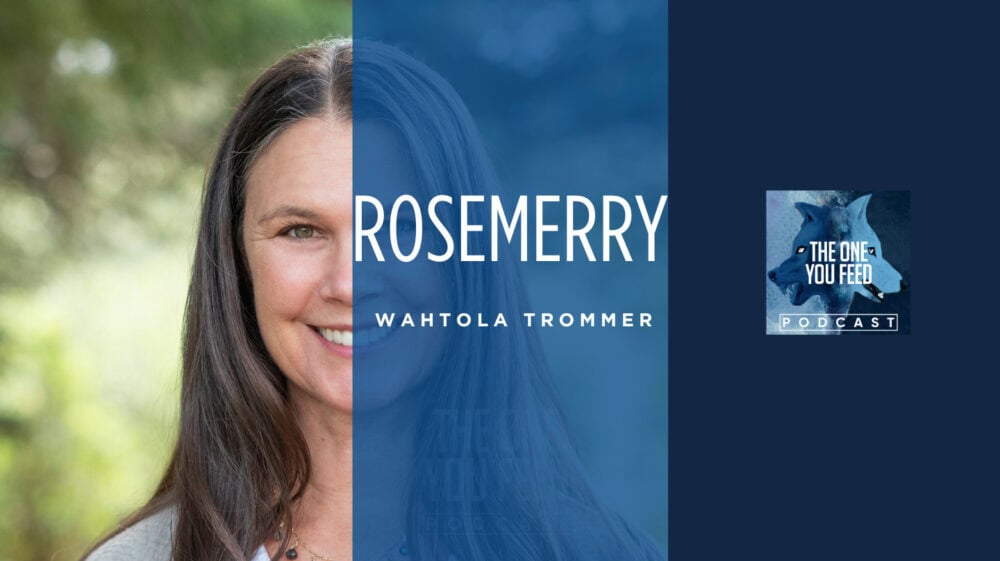
In this episode, Rosemerry Wahtola Trommer explores how to trust life even when it breaks your heart. She talks about grief, healing, and trust following the loss of her son and father. Rosemerry shares how her daily poetry practice and spiritual teachings helped her navigate profound loss, embracing both sorrow and joy. She discusses her book All the Honey, the power of acceptance, and the mantra “adjust.” Rosemerry also discusses how openness, love, and small daily practices can support us through life’s darkest moments.
Have you ever ended the day feeling like your choices didn’t quite match the person you wanted to be? Maybe you slipped into autopilot, or self-doubt made it harder to stick to your goals. If so, The Six Saboteurs of Self-Control can help you recognize the hidden patterns that quietly derail your progress and offers simple, effective strategies to move past them. If you’re ready to take back control and make meaningful, lasting change, download your free copy at oneyoufeed.net/ebook.
Key Takeaways:
- Exploration of grief and its complexities following profound loss.
- The healing process and the importance of trust in navigating emotional pain.
- The role of poetry in expressing and processing human emotions.
- Discussion of the parable of the two wolves and its relevance to personal struggles.
- The interplay of joy and sorrow in life and art, as reflected in Rosemarie’s poetry.
- The significance of acceptance and openness in facing life’s challenges.
- Personal stories illustrating moments of beauty amid grief.
- The concept of emotional triggers and their role in fostering mindfulness.
- The importance of asking reflective questions to guide daily actions and decisions.
- Strategies for integrating spiritual practices into everyday life to support emotional well-being.
Rosemerry Wahtola Trommer has been writing and sharing a poem a day since 2006—a practice that
especially nourished her after the death of her teenage son in 2021. Her daily poems can be found
on her blog, A Hundred Falling Veils, or a curated version (with optional prompts) on her daily audio
series, The Poetic Path, available with the Ritual app. She is the author of Exploring Poetry of Presence II:
Prompts to Deepen Your Writing Practice, and her poetry album, Dark Praise, explores “endarkenment,”
available anywhere you listen to music. Her latest book is The Unfolding.
Connect with Rosemerry Wahtola Trommer: Website | Instagram
If you enjoyed this conversation with Rosemerry Wahtola Trommer, check out these other episodes:
How to Embrace Life’s Paradoxes with Rosemerry Wahtola-Trommer
How to Embrace the Sacredness of Everyday Life with Mirabai Starr
This episode is sponsored by:
Brodo Broth: Shop the best broth on the planet with Brodo. Head to Brodo.com/TOYF for 20% off your first subscription order and use code TOYF for an additional $10 off.
Shopify – The commerce platform that helps you build, grow, and manage your business all in one place. Start your $1/month trial at shopify.com/feed.
Alma has a directory of 20,000 therapists with different specialities, life experiences, and identities, and 99% of them take insurance. Visit helloalma.com to learn more!
Aura Frames: Named #1 by Wirecutter, you can save on the gifts moms love by visiting AuraFrames.com. For a limited time, listeners can get 25 dollars off their best-selling Carver Mat frame with code FEED. Support the show by mentioning us at checkout!
Rocket Money Let Rocket Money help you reach your financial goals faster. Join at rocketmoney.com/feed.
David Protein bars deliver up to 28g of protein for just 150 calories—without sacrificing taste! For a limited time, our listeners can receive this special deal: buy 4 cartons and get the 5th free when you go to www.davidprotein.com/FEED
Taskrabbit: When life happens, your to-do list grows. Get ahead of it now and get fifteen dollars off your first task at Taskrabbit.com or on the Taskrabbit app using promo code FEED. Taskers book up fast, especially for same-day tasks, so book trusted home help today.
Hello Fresh – Get 10 free meals + a FREE Zwilling Knife (a $144.99 value) on your third box. Offer valid while supplies last.
By purchasing products and/or services from our sponsors, you are helping to support The One You Feed, and we greatly appreciate it. Thank you!

If you enjoy our podcast and find value in our content, please consider supporting the show. By joining our Patreon Community, you’ll receive exclusive content only available on Patreon! Click here to learn more!!
Episode Transcript:
Rosemerry Wahtola Trommer 00:00:00 I think that’s a mistake that we’ve been told maybe that we’re not supposed to hurt. What is healing mean? Does healing mean that I’m not going to hurt anymore, that I’m going to be fine with it all? That doesn’t seem right at all to me.
Chris Forbes 00:00:19 Welcome to the one you feed. Throughout time, great thinkers have recognized the importance of the thoughts. We have quotes like garbage in, garbage out or you are what you think ring true. And yet for many of us, our thoughts don’t strengthen or empower us. We tend toward negativity, self-pity, jealousy, or fear. We see what we don’t have instead of what we do. We think things that hold us back and dampen our spirit. But it’s not just about thinking our actions matter. It takes conscious, consistent, and creative effort to make a life worth living. This podcast is about how other people keep themselves moving in the right direction, how they feed their good wolf.
Eric Zimmer 00:01:04 In the days right after her son died, Rosemarie Wachtel, a trauma, found herself saying one word over and over. Not yes, not even acceptance. Just. Okay. She’d get to the car door, okay? She’d open it. Okay. Sit down in the seat. Okay. She says she fell in love with the word because it asks so little. It’s not a verb. It doesn’t require you to do anything. It just isn’t. No. Rosemary is a wonderful poet who’s written a poem every day since 2006, which blows my mind. And her book, All the Honey, was born out of the loss of her son and her father within months of each other. This conversation is about grief, trust, and what it means to keep showing up. I’m Eric Zimmer and this is the one you feed. Hi, Rosemary, welcome to the show.
Rosemerry Wahtola Trommer 00:01:56 Hey, Eric, thanks for having me.
Eric Zimmer 00:01:57 I am really excited to have you on. As I mentioned to you beforehand, I am a fan of your poetry. I do an episode each week that I give to members of our program called Teaching Song, and a poem where I do a little teaching.
Eric Zimmer 00:02:12 I read a poem that I love and I play a song that I love. And your poems have featured multiple times over the last number of years as we’ve done that. So I’m happy to get a chance to talk with you, and we’ll be talking about your latest book of poetry primarily, which is called All the Honey. But before we do that, we’ll start like we always do with the parable. There’s a grandparent who’s talking with a grandchild, and they say, in life there are two wolves inside of us that are always at battle. One is a good wolf, which represents things like kindness and bravery and love, and the other is a bad wolf, which represents things like greed and hatred and fear. And the grandchild stops. Think about it for a second, and they look up at their grandparent and they say, well, which one wins? And the grandparent says, the one you feed. So I’d like to start off by asking you what that parable means to you and your life, and in the work that you do.
Rosemerry Wahtola Trommer 00:03:02 Well, maybe I’ll start by saying it’s probably very different in my life and in the work I do in some essential ways. But I also was wondering if you were going to do a grandparent, a grandfather or a grandmother with me. And I love that I got the grandparent. Here’s the thing I notice, first of all, that they’re wolves. They’re both wolves. And I just think that’s interesting. Why are they so ferocious? You know, it’s just interesting that they’re wolves as opposed to why not snakes or why not? You know, it could have been any number of animals that could have attacked each other. So I think that’s interesting and that maybe I have an inherent fear of wolves in the first place. So but the other thing that I notice is that I haven’t always in my life known which one was the good wolf and which one was the bad wolf. And there have been times where I think I’ve been feeding the bad wolf, believing that I was feeding the good wolf. Which is to say, especially in my story, perhaps the bent toward perfectionism, which maybe was taking good too far.
Rosemerry Wahtola Trommer 00:04:08 And when good got too good, then it became a real problem. So isn’t it interesting that a simple, simple story can create such a complex array of responses? Yeah, I think the other thing my other response is, I would like to think that I feed the good wolf. I wish that were true. I know that even when I do my very best to feed the good wolf, bad things happen still and despite my best efforts. So knowing that the other thing I suppose I’ve learned is that even so, maybe I don’t want to feed the bad wolf. I don’t want to turn my back on it either. And I feel, especially in the last year and a half, I’ve learned how important it is to at least turn and face the bad wolf, to not try to deny the bad wolf, to not try to vilify even the bad wolf. And to notice. What do you have to teach me?
Eric Zimmer 00:05:00 I love what you just said there because it made me think of something. Which is that like even feeding the good wolf, you could give it too much food.
Eric Zimmer 00:05:08 Right? Like, I mean, feeding something is good, but stuffing something, on the other hand, is, you know.
Rosemerry Wahtola Trommer 00:05:15 Well, it’s not.
Eric Zimmer 00:05:16 What did my accountant once say? Like pigs get fat, hogs get slaughtered. Right? Right. To use an unfortunate animal metaphor, I’ve shared this story from time to time, but it just came to me. I was interviewing Peter Singer, who’s like the famous animal rights activist. He’s a well-known ethicist, and I used the unfortunate phrase of killing two birds with one stone, and he which did not slide past him unnoticed. So I hope the pigs get fat hogs to get slaughtered. But that point being that, you know, I think often about the middle way, right? Like that anything we take too far, one direction becomes problematic, whether it be feeding the good wolf, avoiding the bad wolf. I mean, all these things. There’s a time and a place.
Rosemerry Wahtola Trommer 00:05:59 Yes. Yeah. And I think in poetry maybe that is one of the places like with poetry a poem loves tension.
Rosemerry Wahtola Trommer 00:06:08 Right. Which is why this parable is kind of sweet because this parable is based on tension. Right. And all poems thrive on it. Why? Because life is full of tension and a poem wants to speak to. What does it mean to be alive if you only fed the good wolf in a poem? Or if you only fed the bad wolf in a poem, that poem would be boring. It would either turn into a rant or it would turn into hallmark fluff. So in a way, a poem really desperately wants you to feed them both to some degree. To at least honor them both to some degree.
Eric Zimmer 00:06:38 That’s really interesting. I never thought of that in relating to poetry, but I think that you’re right. If I think about the poems I love, there is an element of that. And honestly, if I think about the literature that I love or the TV series that I love or the music that I love. There is that tension. There’s both. You know, it’s always there.
Eric Zimmer 00:06:59 And that is what I’m drawn to.
Rosemerry Wahtola Trommer 00:07:02 Right? Because it’s what’s true. Yes. I used to be so angry about it. Why can’t there just be a pretty poem? And it’s because they’re boring, right?
Eric Zimmer 00:07:13 Yeah. I was just thinking of Wordsworth’s poem about the daffodils and even that poem, which seems to be incredibly hopeful. He still, at the end, you know, in sort of a down mood, recalling the daffodils, you know, and then, you know, so even in a poem that’s largely about daffodils dancing along the water, there’s that element of it.
Rosemerry Wahtola Trommer 00:07:35 And if that element weren’t there, I’d suggest we would forget that poem right away.
Eric Zimmer 00:07:39 We probably would. We probably would. All right. So let’s talk a little bit about the new book. And primarily I was thinking we could talk about What brought this book about? And what’s the heart of all the honey?
Rosemerry Wahtola Trommer 00:07:57 Well, I had a fabulous thing happen almost exactly a year ago. I got a call from a publisher, and they said, we’d love to do your next book.
Rosemerry Wahtola Trommer 00:08:04 And come on, for a poet, that was maybe for anybody, but especially for a poet. What a sweet call to get. And, and so I was talking with the publishers, two of them, Stephen Nightingale and Elizabeth Dilley, and they said, you know, we were thinking you could do a book that contained a broad spectrum of poems, that it would be poems about grief, that it would be poems that were full of joy and maybe put them all into one book. And I said, I really can’t imagine that that feels impossible. And for people who don’t know, about a year and a half ago, my son took his life and there were many poems that have come out of that, and I couldn’t imagine putting those poems next to some of the more lighthearted, you know, Mr. Clean showing up to seduce me in my kitchen and pretending I’m Dolly Parton while I’m making my kids breakfast. They’re like, how could those possibly inhabit the same spine? I told them I’d think about it, and a couple of weeks later, I had a vision, which isn’t a normal thing for me.
Rosemerry Wahtola Trommer 00:09:11 Eric. Although after Finn died, it happened with some regularity. I’m just not going to pretend it didn’t happen. Even so, part of me is like I’m a little more practical than that. But here it was, this vision in which my father, who died just months after my son and my son carved into my bedroom wall these words in all caps, we love you. And then right beneath it, all of the honey. And I knew that they had given me the title for the book. That felt like a transmission of sorts. And I thought, well, what does that mean? And I thought about it all day. I went skiing with my husband and in the woods, and I eventually arrived at this that all of the honey that’s ever been made came from the sweetness of nectar, and from the bitterness of the pollen that feeds the bees, and that that’s really what’s being asked of us at all times in our lives is, is to meet that broad spectrum. So I called the publishers with this kind of elation and said, you were right.
Rosemerry Wahtola Trommer 00:10:13 Yes, of course it has to be. All of it. Of course, all of it. Because that’s what it is. To be alive is to meet it all. So that was the genesis.
Eric Zimmer 00:10:22 Was there going on in you still the positive, the joy I’m curious about, you know, having gone through a grief of that magnitude, which by all reports is the greatest grief that can be imagined. I’m just curious about the process of finding your way back into not even. I’m not even talking necessarily about healing the grief, right. But finding even the sweet parts of things. Were you able to find those and how were you able to find those?
Rosemerry Wahtola Trommer 00:10:53 Oh, Eric, that’s a good question. I’ll start with maybe just a report that even the day that Finn died, even that terrible day, I laughed and fell in love with people, with life itself, even in that most devastated moment. I’m not saying the very moment, but that evening I remember walking in the Georgia night. We were in Georgia at the time, helping my parents move into their new home, and IRA was talking on the phone with my beautiful friend Wendy Whitlock.
Rosemerry Wahtola Trommer 00:11:34 And it was this warm evening and Wendy said to me, he has given you his love light to Carrie. And in that moment she said that this firefly lit up right in front of my face. And it was magic, right? It was this zing of illogical beauty. There was no way to say how that could have happened. It felt important and it felt so whimsical. It was lightning bug, for heaven’s sakes. Right? And it felt like he was there. It felt fantastical. It filled me with wonder. And even in devastation, I felt very open to a larger spectrum of possibility. And why is that? I think it’s because, well, I think it’s a few things, but at the very least, it has a lot to do with showing up every day. I’ve had a daily poetry practice since 2006, where every day I show up and I say, well, what’s here? What’s here? Whether it’s something that’s devastating, nothing ever as devastating, of course, as losing Finn.
Rosemerry Wahtola Trommer 00:12:38 But I think that daily practice of showing up and saying what’s here and exploring what’s happening inside me, what’s happening in the world outside me when the stakes were much lower, allowed me when the stakes were the highest they’ve ever been for me to stay very present.
Eric Zimmer 00:12:55 Yeah, that’s a beautiful story. And I think it speaks to this idea that even our emotions in the worst of times are not these monolithic entities, right? They wax and they wane and other things filter in. If we’re open to looking for them, if we’re not paying attention, it can seem very much that it’s monolithic. There’s only this, you know, I know, like even on a day where I might be feeling like, okay, depression is worse than it might normally be for me. Even if I look at that day closely, there’s going to be moments in there where I was amused, where I heard something that made me smile, where I heard a piece of music that lifted me up. I mean, there’s nuance in there, and I do think that what you’re talking about with your daily practice of showing up is looking for that nuance.
Eric Zimmer 00:13:46 Oh, you know, looking more closely at things that probably did serve you well when the time came.
Rosemerry Wahtola Trommer 00:13:53 Oh, you’re so right. And I love this word. You’ve chosen nuance because that feels very right to me in terms of the monolithic, as you say, that great stone of sorrow. It reminded me, actually, when you said that, that I had a profound physical feeling of what that was like, that enormous monolith of grief. Right. Yeah. And then it was, I think, a day after Finn died, it was the next day when I felt it, this kind of ridiculous tsunami of love that kind of rushed at me and I had this sense of that is way, way, way, way, way too much. Like I was resisting, like I pushed, I was like that don’t even. And it just kind of crashed over me and obliterated all that know and just kind of infiltrated all of me. That’s what it felt like. It felt like I just got infused.
Rosemerry Wahtola Trommer 00:14:47 Carried. Boyd met with love. But what the sensation was was that the love somehow broke down the monolith of grief into the smallest possible atoms, and surrounded every single one of them with tenderness and, yeah, compassion and, oh, beauty connection. I could meet each of those motes of grief in the smallest way, not as a monolith, but as a bite sized, a bite sized piece. Something. Something that was mutable, especially because it was surrounded with so much goodness.
Eric Zimmer 00:15:36 Yeah. I mean, that is the flip side of grief to me, has always been great love, you know. You know, I don’t pretend to know what it’s like to lose a child. And I’m wary of comparing things. So that’s not exactly what I’m doing. But, you know, I mean, I feel like the greatest griefs I’ve suffered have been having to put my dogs to sleep, like, more than losing grandparents. I mean, I don’t know what that says about me as a person, but but I remember one of my dogs, Ralph, when we were putting him to sleep.
Eric Zimmer 00:16:08 The grief was overwhelming. I mean, I was just heartbroken and right in there. There was also just an incredible love. Like it was just so evident to me that to be as heartbroken as I was was also that I must have loved something that much. And there was a beauty in that.
Rosemerry Wahtola Trommer 00:16:28 Yes.
Eric Zimmer 00:16:29 Yeah, there was a beauty in that. I wonder if you’d be willing to read a poem from the new book that is early in the book, and that, I think, speaks a little bit to working with grief. And it’s called The invitation.
Rosemerry Wahtola Trommer 00:16:43 Yeah I will. I love that poem too because it was the night after he died and it was such an important changing moment for me. Do you know what page it’s on, friend.
Eric Zimmer 00:16:57 I believe it’s on page ten.
Rosemerry Wahtola Trommer 00:17:00 Got it. The invitation. Two nights after he died. All night. I heard the same one line story on repeat. I am the woman whose son took his life. The words felt full of self-pity. Filled me with hopelessness.
Rosemerry Wahtola Trommer 00:17:23 Doom. And then a voice came. A woman’s voice just before dawn. And it gave me a new shade of truth. I am the woman who learns how to love him now that he’s gone. It did not change the facts, but it changed everything about how I met the facts. Over a hundred days later, I am still learning what it means to love him. How love is an ocean, a wildfire, a crumb. How commitment to love changes me, changes everyone, invites us to bring our best. Love is Wine is Trampoline is an infinite song with a chorus in which I am sung. I am the woman who learns how to love him. Now that he’s gone. May I always be learning how to love like a cave. Like a rough legged hawk. Like a son.
Eric Zimmer 00:18:36 It’s so beautiful.
Rosemerry Wahtola Trommer 00:18:38 Thank you. You know there’s a line in there. Especially in light of our earlier conversation about perfectionism invites us to bring our best. And, I think that my relationship to that line is this I did really feel like I’ve been asked to bring my best to this whole time, and part of that, for me has been it doesn’t mean I have to show it perfect.
Rosemerry Wahtola Trommer 00:19:03 It means I have to show up. That’s what bringing my best means to me is this willingness to really show up and to meet what’s here.
Eric Zimmer 00:19:14 I want to be careful here that we don’t paint too rosy a picture here of what this experience was like for you, I assume in. You know. Right. Like, right. Like, I, I don’t I don’t want people being like, well, okay, I guess I’m supposed to turn towards love and just, you know, like, I just feel like it’s important to also have you say something about the enormity of the grief?
Rosemerry Wahtola Trommer 00:19:42 Yeah I think. Well, let’s not have a rosy picture of this. I’m glad. I’m glad you said that. One thing I’m so clear about Eric is that everyone’s process with grief is so very different. Right? And that there is no one right way to do it. In fact, that there is many right ways to do it, as there are minutes, as there are seconds as there are humans.
Rosemerry Wahtola Trommer 00:20:05 Right. And what’s right in this very minute is very different in the next. I am exceptionally lucky that I have had a experience that has been ridiculously flooded with love. I don’t know how I would have done it otherwise, and maybe the world knew that that was exactly what I needed and rose up to meet me in that way. There was a moment I remember thinking maybe a week or two after Finn had died, and I knew there were so many people who were writing me letters and sending calls and, you know, and I remember thinking, you know, it’s too much. It just needs to be not that much. And then I’d imagine one person, just one person not thinking loving thoughts toward me. And I was like, nope, nope. Actually, it’s just enough. Like, none of you stop. Nobody can stop, I need it, I need all of that, I guess, to say, what is it, then? To have that kind of grief and a to are I don’t even know how.
Rosemerry Wahtola Trommer 00:20:58 I don’t even know what to say about it. Eric, I, I I’ll say this, that, that there hasn’t been a single day since he’s died, that I haven’t wept. But I don’t mind it either. There is no part of me that wants to push the grief away. And maybe for that reason, because I’m not resisting it. It’s the hardest. Worst thing? Worst. But see, here it is. There’s the wolf. Right? Is this the worst thing that’s ever happened to me? Of course. It’s the worst thing that’s ever happened to me, Gregory. Or has this most gorgeous poem that begins like this. Not to make loss beautiful, but to make loss the place where beauty starts. Where the heart understands for the first time the nature of its journey. Right. So losing Finn is the worst thing that’s ever happened to me. Which then makes me think of what about the women I know who’ve lost multiple children? What about the people who lost their child and their home and their car? And like, what about, you know, like, so many people have so much worse, right? But for me to not ever try to make it anything but what it is, which was the worst, right.
Rosemerry Wahtola Trommer 00:22:05 And that he was suffering so much that that felt like the best choice to him. Yeah. I meet that every single minute. I meet that every minute. And there has been a thousand blessings that have come from it to every day. Just the willingness, Eric, to say yes, even to the hardest thing I’ve ever had to say yes to, to develop a trust in life now beyond what I’ve ever had before because of it, right? Because of this worst thing, to have this deepened sense of trust in life itself.
Eric Zimmer 00:23:11 What you’re describing is remarkable because you’re talking about not resisting what happened to some degree. Right. Which feels almost impossible in that sort of situation. And I’m sure it’s not as clean as that. Like, I’m sure there were moments of like, no, no, no, but there was some openness in you to This is what is. You know, it makes me think of that famous. I don’t know if it’s famous, but it’s famous to me. Idea that suffering equals pain.
Eric Zimmer 00:23:44 Times resistance. Right. And the pain of losing your child is at the very top of any pain scale that could ever be invented. Right? It’s there. Right? Let’s say it’s 100 out of 100, and then resistance is the it shouldn’t be this way, you know, it’s the fighting it. It’s all the why me? It’s all that that comes along and nobody gets to zero resistance. I don’t think. Right. But the thing I love about the way that equation is formulated is it says if I’ve got a pain of a hundred and I’m resisting at a level of a eight, I’ve got 800 units of suffering. This is obviously not a actual scientific description of what happens. But but, you know, you get the point. If I was able just to resist two points Less. You know. Instead of a resistance. Eight. I’m a resistance of a six. My total suffering goes from 800 to 600. Right? Like there’s something in this. But God, is it hard? How do you find your way towards that?
Rosemerry Wahtola Trommer 00:24:48 So before often died for over ten years, probably.
Rosemerry Wahtola Trommer 00:24:54 By then I’ve been working with a spiritual teacher, Joy sharp. She leads satsang, and the very first teaching that she gave me was a question. Can you say yes to the world as it is, which is such a profound teaching?
Eric Zimmer 00:25:15 Yes.
Rosemerry Wahtola Trommer 00:25:15 What an invitation, right?
Eric Zimmer 00:25:17 Yes.
Rosemerry Wahtola Trommer 00:25:18 And so that was something certainly that I’d understood. You know, like any teaching. Right. First. Do you understand it in your head? Okay, sure. I can see this, the world as it is. But then the messier things get and the harder things get, and the harder it is to say yes to that. So I had for, you know, a decade before this, had some practice with that as something that was valuable to me. Yes. Right. I had had, as a prayer for myself, opened me. I wanted desperately to be open. That was something that has been fueling me for a long time. So I think that that kind of daily, more than daily, many times daily question.
Rosemerry Wahtola Trommer 00:26:04 Can you say yes to the world as it is? And let’s be honest, my son was not an easy human. He was an incredible human. He was so funny and smart and anything he put his hand to, he excelled. You know, we started fencing and he won the fencing championship, and he built a computer and won the science fair. And he, you know, he built computers for all his friends. And he, like, he was just so crazy alive. You know, my friend Katherine used to say he was 150% alive, right? So here he is, this incredible, generous, amazing being who loved to push every single button I had. That was his great thrill in life. Was pushing every button right. And poke, poke poke poke. Just, you know, he came into the world and screamed for a year. That was there was nothing perfect about that. That was the beginning of the crumbling of the perfectionism right there. But his life had forced me to say yes to the world as it is, because day after day after day, of being Finn’s mother was an exceptionally difficult thing to do.
Rosemerry Wahtola Trommer 00:27:00 It was the best thing I did. I loved being Finn’s mother. Still. I love being Finn’s mother, but it was so hard, harder than anything I’d ever done before. And so I think that I had so much practice in saying yes to the world as it is by the time we got to his death. You’re right. I mean, the very first response was, no, but I’ll tell you, Eric, that that didn’t last long, that there was only a moment, really, of No. And it was so final. And so I knew immediately how true it was. Right and very real. And the death itself was graphic enough that I knew very well it was real. Right? So it was through a lot of practice, I suppose, to get to a place where I wanted to. I desperately wanted to meet the world as it was and not say no to his death and say yes to it, and find a way to continue to meet the world.
Eric Zimmer 00:27:57 That reminds me of an idea.
Eric Zimmer 00:27:59 I don’t know who said it, but it was like practice while you can for the times that you can’t. And they were speaking about spiritual practice. They meant practice. Now, while things are mildly difficult, like every life is mildly difficult. You know, when I teach my Spiritual Habits program, you know, we talk about this principle and I’m like, don’t start on the hardest stuff. Like, don’t start with like the things that you know, you most can’t let go of, like start on the easier stuff, you know, but it is a muscle. I do think that we develop over time, where we get more and more comfortable being able to just to say, okay, this is what is what is my skillful response to this to be. And what I find is that for me, when I’m able to do that, I’m actually better able to do what it sounds like you have been better able to do, which is actually process the emotions that are happening because the resistance, the no, it shouldn’t be the that’s all mental.
Rosemerry Wahtola Trommer 00:29:03 yeah.
Eric Zimmer 00:29:03 For me, when I can drop that, then there’s just the emotional experience and that can be processed, you know, sort of as you were talking about, I can take these atom sized bits of grief. They’re everywhere but one atom at a time. I’m working through it.
Rosemerry Wahtola Trommer 00:29:20 You reminded me of something else about that time to friend. Is that the word okay. That was really what got me through. Like, I feel like okay was my mantra for the first month. Especially in the day of the day after I heard myself saying it over and over and over. Okay, okay. It was like I affirmed every smallest thing. Like I got to the car door, okay? And I opened the car door, okay. And I sat down in the car. Okay. Like I literally said, okay. Each time the smallest thing happened, like, I met that, I met that, I met that. It was only later, as I started to evaluate it at once, I noticed I was doing it, that I kind of fell in love with this word, okay, because it asks so little of us.
Rosemerry Wahtola Trommer 00:30:08 And the truth was that saying yes to the world as it is, is way too exuberant for what I was capable of in that moment, right? Like I didn’t know. Part of me was yes, but okay isn’t no either, right? Yeah. It was enough for it to not be. No. Yeah, yeah. And also that it’s not a verb. Right. That it asked nothing of me. I didn’t have to do anything. I couldn’t do anything. I remember calling it at the time, autonomic life, the same way that the lungs are, you know, breathed and the heartbeats. I felt like I was just being lived because I couldn’t do anything, I couldn’t anything. Yeah, yeah.
Eric Zimmer 00:30:46 You used a phrase a little while ago. I don’t know if this is exactly what you said, but it had something to do with being supported by the world. And I’m wondering if you could read a poem called On a Clear Day, which is page 17. That, to me speaks to that.
Rosemerry Wahtola Trommer 00:31:03 On a clear day, the way the field holds the shadow of the cottonwood. This is how life holds me, holds me no matter my shape. Holds me with no effort, holds my darkness and knows it as weightless as. Transient as something that will shift. Disappear. Return and shift again. It never says no to me. I am still learning to trust life. To trust. No matter how I show up. I will be held. Trust that my life is not a problem. Trust that as much as I am the shadow. I am also the field.
Eric Zimmer 00:31:53 There are several things in there that are remarkable. One is the turn right at the end. Right? The turn right at the end where it’s like, okay, I’m being held by this field. Oh, wait a second. I am also the field as well as the shadow. I mean, as a Zen practitioner, you know, we talk about form and emptiness. Emptiness and form. Right? You’re both those things.
Eric Zimmer 00:32:15 But the other thing that I’m curious about in that poem is when you say, I’m learning to trust life. I’m always interested in the word trust and what we mean by it. Right? Because I’m going to put words in your mouth and you can refute them if you would like, but certainly you’re not trusting that terrible things aren’t going to happen, because one of the most terrible things that could possibly happen happened. So on one hand, you could very much be like, no, I do not trust life, right? Because here’s great fear. Number one, it happened. So what does trust in life mean to you?
Rosemerry Wahtola Trommer 00:32:55 You’re so right. I wanted so desperately to protect him, right? And to keep him alive, and was very aware that that was a possibility that I couldn’t. Yeah. And then my greatest fear came true. So trusting life doesn’t mean that my greatest fears don’t come true. Trusting life means to me that even when my greatest fears come true, I will be supported enough to be able to show up right that the world Is there to hold me.
Rosemerry Wahtola Trommer 00:33:24 As I stay alive. As I’m alive, right? If I had to say what is the word that comes to me again and again and again and again, what is the most interesting word to me right now? To continue to explore it is trust. Yeah. Which comes, of course, out of the same word is true. Like and this is what I ask myself every time I sit down to write, I ask myself, what is the next true thing? That’s how every poem gets written is what is the next true thing? What is the next true thing? And so then trust this willingness to be with what is true and this willingness to know that it doesn’t mean it’s what I want. It has nothing to do with what I want. And even then, and especially then, life will show up to meet me and hold me and lift me, carry me, boy me. All these are words I’ve been feeling the embodiment of in this time.
Eric Zimmer 00:34:16 Before we dive back into the conversation, let me ask you something.
Eric Zimmer 00:34:19 What’s one thing that has been holding you back lately. You know that it’s there. You’ve tried to push past it, but somehow it keeps getting in the way. You’re not alone in this. And I’ve identified six major saboteurs of self-control. Things like autopilot behavior, self-doubt, emotional escapism that quietly derail our best intentions. But here’s the good news you can outsmart them. And I’ve put together a free guide to help you spot these hidden obstacles and give you simple, actionable strategies that you can use to regain control. Download the free guide now at one you net and take the first step towards getting back on track. I have a lot to say on this. What I’ll say is that me too, with trust was working with a spiritual director for a number of years, and I swear every single conversation we ended up at trust. Now, after a while, I started to question, does that say more about him than me? I don’t know the answer to that question. You know, I kept asking like, are you a one trick pony? Like, is this the only thing you got in your bag and everybody gets this? Or is this specific to me? But I think trust is so interesting.
Eric Zimmer 00:35:35 And I love what you said about true it coming from that word. That for me was just an insight that I’m going to really spend some time with. Because what gets mixed in with trust to me, is also how much of that trust is coming from me, right? Like, I have a tendency to trust myself. I didn’t always right. I’m a homeless heroin addict, right. So I have I have a history of, you know, there being a lot of time where I simply could not trust myself, but I kind of do now, some of that ends up asking, well, if I have to do it, is that trust right? If I have to be the one that has to put this effort in, if I have to be the one that has to rise to this challenge. This is a quick little piece, but I got sober at the age of 24 from heroin and in Columbus, Ohio in 1994. And 12 step programs were the only thing on tap. And I was desperate and they said, believe in God.
Eric Zimmer 00:36:34 And this is 1994, right? It was not very different now, 1994 believe in God. And that meant, you know, the God, the, you know, capital J God. And I developed this really immature spirituality that was like, if I do good things, then God will protect me. And then some bad things happen to me. You know, after I’d been sober a number of years and that all fell apart. And, you know, I drank again. And when I came back, I was like, okay, I’m back to AA. It’s the only game in town. It still seems there is an element here of turning your will in your life over to a higher power God, as you understand. What does that mean to me? Like, what do I actually believe to be true? You know, instead of trying to make myself believe something which is kind of what you’re talking about. And where I landed was this idea that there were these spiritual principles that if I lived my life by them to the best of my ability, and I asked for the support of other people, I would be able to meet what life brought me.
Eric Zimmer 00:37:34 I mean, it was that sort of basic. I’d be able to stay sober and meet what life brought me, whatever it was. And so that’s worked out to be a remarkably good foundation. The thing in there, though, is there is an element of me living by those principles. Which is back to that question I was saying earlier about my ability. Well, what happens if that ability gets wiped out and that’s that deeper trust that you’re talking about? And that’s where I find myself inquiring, okay. What is that? You know what does hold me when I can’t hold myself at all?
Rosemerry Wahtola Trommer 00:38:11 Yeah. Do we get to know? I don’t know.
Eric Zimmer 00:38:15 It’s actually just as I said that, it just occurred to me that at least for me, it’s been all kinds of different things. It’s actually not a thing. I’ve been looking for the thing, and it’s actually things. Sometimes it’s this friends phone call, sometimes it’s this song, sometimes it’s this poem, sometimes it’s this book I read.
Eric Zimmer 00:38:37 To me, it seems like support has come in and all these different places and all these different ways. Sorry to be processing my own trust self I love there, but I’ve had two insights thanks to you here.
Rosemerry Wahtola Trommer 00:38:50 I love that you did. I love that you’re thinking about it too. And of course it’s coming from all over, right? Of course it does. That seems so right to me. I don’t think, friend, that I have a clue what it is, even exactly that I’m saying I trust. Right? That’s why I say I think I trust the world, I trust the universe. I say things like that, I trust life. Maybe that’s the cleanest I can say it. I trust life. And thinking on what you just said, you know, here you are saying it comes from this friend or it comes from this song, or it comes from this, which to me says that it’s coming from a sense of openness right back to what we were talking about earlier, that you’re here, you are, you’re paying attention.
Rosemerry Wahtola Trommer 00:39:27 And when we are in that receptive open space, I think that’s when life rushes in to support us, right? Because. Because it can. Because it can.
Eric Zimmer 00:39:39 Yes, yes. That’s a beautiful way to put it. I’d like to get a couple more poems before we’re done, if that’s okay.
Rosemerry Wahtola Trommer 00:39:46 I have an idea based on something you said.
Eric Zimmer 00:39:49 Of a poem.
Rosemerry Wahtola Trommer 00:39:49 Yeah. You were talking about what is true and how hard it can be sometimes to know what is true. And to me, this is one place where poetry really shines is because poetry loves paradox, which is that when two equal and opposite things are both held up, is true at the same time. And I have quite a few poems that that talk about that.
Eric Zimmer 00:40:15 I would love for you to pick. I have my list, but I’d love to see what you pull out of the hat here.
Rosemerry Wahtola Trommer 00:40:21 Well, I think maybe there’s so many that could have spoken to this kind of paradox, but this was one specifically about meeting death.
Rosemerry Wahtola Trommer 00:40:27 And we were talking earlier about there’s so many ways to do it. Right. Meeting your death because there are no clear instructions, I follow what rises up in me to do. I fall deeper into love with you. I look at old pictures. I don’t look at old pictures. I talk about you. I say nothing. I walk. I sit. I lie in the grass and let the earth hold me. I lie on the sidewalk. Dissolve in the sky. I cry. I don’t cry. I ask the world to help me stay open. I ask again, please let me feel it all. I fall deeper in love with the people still living I. Fall deeper in love with the world that is left. This world with its spring and its war and its mornings. This world with its fruits that ripen and rot and recede. This world that insists we keep our eyes wide. This world that opens when our eyes are closed. Because there are no clear instructions. I learn to turn toward the love that is here.
Rosemerry Wahtola Trommer 00:41:45 Though sometimes what is here is what is not. There are infinite ways to do this right. That is the only way.
Eric Zimmer 00:42:23 There’s a lot in there, and I love that very last line in particular about their infinite ways to do that. That is the way and I think conversations when we talk about dealing with something as profound as dealing with the type of grief you did, I love that you said there’s no right way to do this, because I think we get so focused on, am I doing this the right way? I mean, some of that is just conditioning, but some of it is we just want to be out of pain. You know, what can I do to make this pain better? But recognizing that my way is the way right now, you know, I can look to others. I can look for support. I can look for guidance. But I have to trust myself to some degree. And if we take that and scale it down from the really biggest things, I mean, I think that question is always there.
Eric Zimmer 00:43:12 Am I doing this right.
Rosemerry Wahtola Trommer 00:43:14 Yeah.
Eric Zimmer 00:43:14 You know and unfortunately there is no answer to that question, at least to me. There’s no answer to that question because I am not you and you are not me. And we are radically different. And what I need is going to be it’s just all so slippery. And for me, there’s been a great comfort in being able to go, well, that concept doesn’t exist. No. Am I doing it right? Like, if we really understood it, we’d be like, that is a nonsensical question, but it is a question that arises in all of us, I think, so often.
Rosemerry Wahtola Trommer 00:43:49 Well, I have a lot of thoughts about that friend. One of them is, as a recovering perfectionist, you know, am I doing it right? Has been a leader in my life, right? I’ve certainly wrestled with that in every arena, but somehow not with this, I don’t know. It’s not that I don’t wrestle with it in lots of other places still, but not with this.
Eric Zimmer 00:44:10 Yeah.
Rosemerry Wahtola Trommer 00:44:11 And I have to say that it was interesting for you to say this. How do I make the pain go away? I haven’t wanted that. I haven’t wanted the pain to go away. It’s not like I’m holding on to it either. I wouldn’t say that I’m holding on to the pain, but I think that’s a mistake that we’ve been told maybe that we’re not supposed to hurt. What does healing mean? Does healing mean that I’m not going to hurt anymore? That I’m going to be fine with it all? Like, that doesn’t seem right at all to me. To me, I think maybe it means something more like that. I’m able to be with the pain and not wish it away. Maybe that’s what healing is, is to be able to meet it without wishing it away.
Eric Zimmer 00:44:53 Have you always had that capacity?
Rosemerry Wahtola Trommer 00:44:55 Oh, God. No.
Eric Zimmer 00:44:56 Okay, okay. No, I just didn’t. I didn’t know if you were genetically engineered differently than the rest of us. Because I understand exactly what you’re saying.
Eric Zimmer 00:45:07 For me, there has been a fundamental shift in life. It was the fundamental shift that I had to make to get and stay sober, which was I have to stop constantly trying to change how I feel. Yeah. I mean, because I took that to the ends of the earth, right? I can’t do that to the same degree. And so that’s kind of what you’re saying. But it is a very difficult thing to say. I’m going to let these feelings be. I’m going to feel at all when what it feels like is so awful and dreadful. So it sounds to me like that’s something you have cultivated again over the years.
Rosemerry Wahtola Trommer 00:45:45 Oh yeah. For sure. And let’s be honest, I’m not able to do it in every arena, right? Like wherever I feel, you know, upset with my husband or my, you know, like, I let the little shit get to me, you know? Why does he have to choose so loud? you know, like, why is that such a big deal for me? No, I mean, there’s so many places where I have ridiculous amounts of resistance, right? I couldn’t tell you why.
Rosemerry Wahtola Trommer 00:46:09 Although I’m really seeing it right now. How different? Maybe because this is the wolf I’ve been feeding, right? I can completely go there with this. And I want to. And I want to. And who could say why I’m so available to it? I don’t know, because I love him so much. Because it matters so much. Because so much is at stake. Whereas with the chewing thing, I mean, it’s just annoying, right?
Eric Zimmer 00:46:34 If you get that one figured out, I will have you back immediately as a guest on the show.
Rosemerry Wahtola Trommer 00:46:40 Okay.
Eric Zimmer 00:46:40 If you can figure out the small annoyances like that, I’m all ears because believe me, I have looked. Nobody’s writing many books on not being irritated.
Rosemerry Wahtola Trommer 00:46:50 No, like.
Eric Zimmer 00:46:52 And it’s such a trivial thing, but it’s also such a miserable condition to be in.
Rosemerry Wahtola Trommer 00:46:56 No, it is. It is for sure. I make myself really miserable with it. Yeah, yeah, but not with this other piece. Maybe, like I say, maybe because I’m willing to give it everything.
Eric Zimmer 00:47:07 Yeah, Yeah, that makes sense. I want to bring up something that I saw on your website, and you have a one word mantra and a three word mantra on your website. And I’m curious if these are still current or, you know, sometimes we put up a homepage in about us and it’s like eight years old. One word mantra is a just the three word mantra is I’m still learning. Do those still feel like, you know, if you had to have a one and a three word mantra, those the two you’re sticking with right now?
Rosemerry Wahtola Trommer 00:47:32 Oh yeah. For sure. Okay. Yeah. And they both have, I think, nice little stories too. And I think about them all the time that a just came from my friend Jud Jordan Kalush. She lived in southwest Colorado with me for a while, and she went out in a time of drought. And she said to the trees, what do we do? And the tree said back to her, adjust. And I remember in that moment it just went right through me, that kind of resonance of, oh, and there it is.
Rosemerry Wahtola Trommer 00:48:01 Right? And the word adjust. Then I got pretty obsessed with it and looked it all up and its Etymologies and all. It’s related to the word yoga and yoke, like you would put on a oxen. And it’s literally to yoke ourselves to the moment, to adjust as to allow ourselves to be in tandem yoke with what is, I suppose. So I do love that word a lot and find myself needing to adjust, as we’d all do constantly. And I’m still learning that came from Michelangelo. Those were the last words he said on his deathbed. And I do feel like that willingness to continue to be open and learn and be kind of like, find what’s new and be excited, and to even bring that kind of excitement and enthusiasm to things we think we know. Right? Yeah, I think I know so much about not knowing. So, you know, I think that every time we have that opportunity to be new and still learning is a good way to feed our soul.
Eric Zimmer 00:48:58 Those are great, good mantras and great stories.
Eric Zimmer 00:49:02 Let’s do another poem. We’ll do the question because it references the friend you just talked about.
Rosemerry Wahtola Trommer 00:49:09 Yes, it does the same, Jude. I have to say, Eric, that I have been deeply, deeply, deeply blessed with some of the most incredible humans in my life. Jude. Jordan. Colossians. One of them. I feel so lucky. You know who? Who do we meet when we’re at our most impressionable moments? And I’m really lucky that I’ve met Jude for sure. The question and I’ll say this to that in this poem, the question that she asks. We had been at a dance concert the night before, and we were in this huge auditorium and all around us, all this talking, talking, talking. And there’s Jude being her kind of Jude self. She says. The question I’ve been asking myself is what is the path of love? And I knew my life changed in that second the question all day I replay these words. Is this the path of love? I think of them as I rise.
Rosemerry Wahtola Trommer 00:50:08 As I wake my children. As I wash dishes. As I drive too close. Behind the slow blue Subaru. Is this the path of love? Think of these words as I stand in line at the grocery store. Think of them as I sit on the couch with my daughter. Amazing how quickly six words become compass. The new lens through which to see myself in the world. I notice what the question is. Not. Not. Is this right or not? Is this wrong? It just longs to know how the action of existence links us to the path of love. And is it this? Is it. This. All day I let myself be led by the question. All day I let myself not be too certain of the answer. Is it this? Is this the path of love? I ask as I wait for the next word to come.
Eric Zimmer 00:51:08 I love that just as like an orienting intention.
Rosemerry Wahtola Trommer 00:51:12 Yes, yes. And how quickly? How quickly it changes too. You know, I just feel like the second I think I know this is the path of love, that I really better get curious about it again.
Rosemerry Wahtola Trommer 00:51:23 I feel like I can’t let myself get too certain about it.
Eric Zimmer 00:51:27 Yep, yep. Well, and also in there, the question isn’t is it right? Is it wrong? Right. Which is we were sort of alluding to a few minutes ago, you know, am I doing it right? You know, is this the Path of Love is a very great clarifying question.
Rosemerry Wahtola Trommer 00:51:43 Oh, yeah. Yeah. Thank you, Jude Jordan Kluge, for that great question.
Eric Zimmer 00:51:47 Well, I think the other piece, though, that that poem speaks to is that a great question is great, but not if we don’t ask it often.
Rosemerry Wahtola Trommer 00:51:56 Right. Right.
Eric Zimmer 00:51:58 Like, I mean, like if we just go, okay, well, is this the path of love? And I think about that one time. Big deal. Right. But what you’re doing, if you’re actually able to ask yourself multiple times as you go about your life. At least to me, that’s where questions like that become transformative.
Rosemerry Wahtola Trommer 00:52:16 Exactly.
Eric Zimmer 00:52:17 They become transformative when they filter into the moments of our life.
Eric Zimmer 00:52:21 You know, I’m at my mother’s right now. I’m visiting, you know, is what I’m saying and thinking and doing. Is this the path of love right here, right now? You know, if I don’t bring that question to mind, it can’t do me much good. And that’s, I think, one of the hardest things in our current culture is we’re so busy. We go from one thing to the next to the next without being able to. Let me say that again. I won’t say no. We’re not able to because actually we are able to without reflecting it all about like what is important about this thing I’m about to do. That doesn’t have to be your question. If that question doesn’t resonate. Like there’s countless other good ones. For me, it’s been about how do I bring these ways I want to be into the world to mind. Frequently.
Rosemerry Wahtola Trommer 00:53:09 Yeah. How do we do that? How do we do that? Well, Lucas says live into the questions, right? That’s his dictum for us, you know, and I think that that is part at least of why some kind of I think a daily reflective practice is so important.
Rosemerry Wahtola Trommer 00:53:24 Yep. Whether it’s sitting or walking or writing a poem, meeting a blank page, there’s so many ways to do it, right. Yeah, but some kind of a reflective practice where we aren’t running from one thing to another and open up to that willingness to be with a new question or the same question.
Eric Zimmer 00:53:44 Yeah, I’ve done a lot of thinking about this very question, and it’s part of what the Spiritual Habits program is designed to answer. And, you know, I think we can look at behavior science to talk about this idea of triggers. We all have triggers for good and bad, you know. And if we can start to build triggers into our day. Like, for example, every time I go to the bathroom, right, there’s a trigger. Okay? You know, I’m just gonna, in that moment, go. Have I been on the path of love?
Rosemerry Wahtola Trommer 00:54:15 What a sweet way to write. Just tie it into something like that. Beautiful.
Eric Zimmer 00:54:19 Yeah, or at a red light, or when I go into the kitchen.
Eric Zimmer 00:54:22 But the Holy Grail becomes when we take our emotions as triggers, which they are, they’re just unconscious triggers, primarily. But when we take our emotions, I’m irritated. Okay, good. I recognize that. Now I can ask, is this the path? Like when that emotion becomes the trigger for a reflection? Like to me, that’s where things for me have really transformed?
Rosemerry Wahtola Trommer 00:54:50 Well, that makes so much sense. I love the way you said that. It makes me think, by the way, that that whole parable, which wolf are you going to feed? Is that right in that moment of trigger to realize we have a choice. Yeah, that’s the moment to remember. Okay, I’m. You know, you’re chewing so loud. I’m about to, like, fly off the handle. Or is this the path of love? Is this.
Eric Zimmer 00:55:15 Yeah, yeah, yeah, at least for me in those moments. I mean, I don’t have the ability to turn the irritation off.
Rosemerry Wahtola Trommer 00:55:21 Know.
Eric Zimmer 00:55:22 Right? But I can reflect on. Okay. Just relax. Like, I mean, I can work with myself so that at the very least, I don’t make things worse, right? You know, at the very least, I don’t make things worse. Which irritation often can lead to, you know. Right. My father passed recently, and I think I came by my irritation from him. You know, pretty inherited. I reflect on with him just how painful it must have been to be that way as often. And then also, I don’t think he really learned the skill of dealing with it well. And so then I think then you add the regret of like, well, you know, I’m also letting my irritation seep out too much and like, it’s my least favorite emotion. Maybe because I know what it’s like to be on the other end of someone being irritated. And like I said, it’s an emotion that it is there. I’m just like, well, all right.
Rosemerry Wahtola Trommer 00:56:20 Yeah, exactly.
Eric Zimmer 00:56:22 So if anybody out there knows how to solve irritation, you can be a guest on the One You Feed podcast. You know of a book. If you know of a, you know, is there a method?
Rosemerry Wahtola Trommer 00:56:32 Well, I tell you what I do with it. I have my word of the year. This year is hello. And I’ve just been using hello as a way to recognize the things that show up, especially things that are not positive I perceive as not positive, you know? Hello frustration. Hello irritation. Hello fear. Hello. Stuck. As soon as I noticed that that’s what’s going on in me. Then I greet it. Oh, hello. And I’ve noticed it doesn’t change it, right? It doesn’t change it, but I relax.
Eric Zimmer 00:57:05 Yes, yes, I have told this story before, but it was on a silent meditation retreat, and there was somebody just all kinds of terrible chewing, you know, and sniffing and snorting and just all kinds, you know. And I am getting so irritated, you know, I mean, just and but then, of course, at the same time, I’m like, but you’re on a silent retreat, like, you know, so, so there’s all the judgment and the whole, you know.
Eric Zimmer 00:57:35 So I was asking the spiritual teacher, Audie Ashanti, about this once, and, you know, I was like, well, okay, I know I’m supposed to let it be. So what am I supposed to let be? The fact that that noise is happening? Is that what I’m supposed to allow, or am I supposed to allow the fact that I’m so irritated? And of course, the answer is obvious in retrospect, which is both right. It’s to allow both. But what you said is when that hello comes along and I go, oh, I’m irritated. And I just go, okay, it’s all right, Eric. You’re doing the best you can. Just. It’s okay. Everybody gets irritated, like it gets better. It doesn’t go away. But that whole, like, I shouldn’t be feeling this, you know, I’m bad for feeling this way. Just, you know, makes everything worse.
Rosemerry Wahtola Trommer 00:58:21 Absolutely. I kind of love that. You also have misophonia. That’s the, you know, the annoyance that people doing.
Rosemerry Wahtola Trommer 00:58:27 So I’m high fiving you through the screen.
Eric Zimmer 00:58:31 I have whatever misophonia is equivalent is with all kinds of sounds. I am just a sound, sensitive creature.
Rosemerry Wahtola Trommer 00:58:38 Oh that’s it. Misophonia is all sounds. It’s a sound thing. Oh, okay.
Eric Zimmer 00:58:42 Well, then I am a misophonia.
Rosemerry Wahtola Trommer 00:58:44 Yes, yes. And by the way, Aja is, my teachers, one of my teachers. Teachers is my teacher. Joy sharp is one of her teachers.
Eric Zimmer 00:58:52 So wonderful I have to look her up. Yeah, he has been incredibly influential, and I’ve had the great gift of being able to sit down with him a number of times with this show and just kind of hang out and spend time together. And so he’s meant a lot to me. Before we wrap up, I want you to think about this. Have you ever ended the day feeling like your choices didn’t quite match the person you wanted to be? Maybe it was autopilot mode or self-doubt that made it harder to stick to your goals. And that’s exactly why I created The Six Saboteurs of Self-control.
Eric Zimmer 00:59:28 It’s a free guide to help you recognize the hidden patterns that hold you back and give you simple, effective strategies to break through them. If you’re ready to take back control and start making lasting changes. Download your copy now at once. Let’s make those shifts happen starting today when you feed net book. Well, I think that is a great place for us to wrap up. We’re going to have a brief post-show conversation where I’m going to ask you to read another poem or two. Listeners, if you’d like access to that, you can get access to that to add free episodes to the teaching song and a poem that I referenced earlier by going to one you feed net. Rosemary, thank you so much. This has been really beautiful.
Rosemerry Wahtola Trommer 01:00:15 So fun. Thank you. Eric. Thank you.
Eric Zimmer 01:00:18 Thank you so much for listening to the show. If you found this conversation helpful, inspiring, or thought provoking, I’d love for you to share it with a friend. Share it from one person to another is the lifeblood of what we do.
Eric Zimmer 01:00:31 We don’t have a big budget, and I’m certainly not a celebrity, but we have something even better. And that’s you just hit the share button on your podcast app, or send a quick text with the episode link to someone who might enjoy it. Your support means the world, and together we can spread wisdom one episode at a time. Thank you for being part of the One You Feed community.
Leave a Reply