

In this episode, Suleika Jaouad, author of Between Two Kingdoms, discusses her experience learning how to live in the space between no longer and not yet. Suleika shares how illness shattered her plans and forced her to confront mortality, finding agency through journaling and creativity. She discusses the difference between pain and suffering, the importance of community, and learning to live in life’s uncertain “in-between” spaces. Following a recurrence of her disease, she reflects on resilience, love, and embracing discomfort as pathways to meaning and growth.
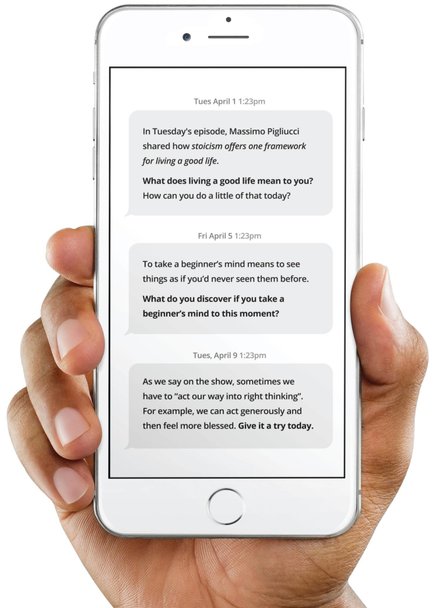
Good Wolf Reminders
A little wisdom, right when you need it. Start receiving free text reminders designed to help you pause, reflect, and take meaningful action. Sign up at oneyoufeed.net/sms.
Key Takeaways:
- Suleika’s personal journey with acute myeloid leukemia at age 22.
- The impact of illness on identity and life plans.
- The psychological and emotional challenges associated with serious health issues.
- The concept of living in the “messy middle” between past and future.
- The role of creativity and journaling in coping with illness.
- The importance of community and connection during difficult times.
- The distinction between physical pain and emotional suffering.
- The idea of bravery in responding to hardship and making active choices.
- The significance of rituals in navigating uncertainty and transitions.
- Finding meaning and beauty in life despite pain and suffering.
Suleika Jaouad wrote the Emmy Award–winning New York Times column Life, Interrupted. Her essays and feature stories have appeared in The New York Times Magazine and Vogue and on NPR. She is also the creator of the Isolation Journals, a global project cultivating creativity and community during challenging times. Her first book is Between Two Kingdoms: A Memoir of a Life Interrupted
Connect with Suleika Jaouad Website | Instagram | Facebook
If you enjoyed this conversation with Suleika Jaouad, check out these other episodes:
How to Find Solace in Discomfort with Lanusha Dameris
Strengthening Our Resilience with Linda Graham
This episode is sponsored by:
Brodo Broth: Shop the best broth on the planet with Brodo. Head to Brodo.com/TOYF for 20% off your first subscription order and use code TOYF for an additional $10 off.
Alma has a directory of 20,000 therapists with different specialities, life experiences, and identities, and 99% of them take insurance. Visit helloalma.com to learn more!
Aura Frames: Named #1 by Wirecutter, you can save on the gifts moms love by visiting AuraFrames.com. For a limited time, listeners can get 25 dollars off their best-selling Carver Mat frame with code FEED. Support the show by mentioning us at checkout!
Rocket Money Let Rocket Money help you reach your financial goals faster. Join at rocketmoney.com/feed.
Taskrabbit: When life happens, your to-do list grows. Get ahead of it now and get fifteen dollars off your first task at Taskrabbit.com or on the Taskrabbit app using promo code FEED. Taskers book up fast, especially for same-day tasks, so book trusted home help today.
Hello Fresh – Get 10 free meals + a FREE Zwilling Knife (a $144.99 value) on your third box. Offer valid while supplies last.
By purchasing products and/or services from our sponsors, you are helping to support The One You Feed, and we greatly appreciate it. Thank you!
If you enjoy our podcast and find value in our content, please consider supporting the show. By joining our Patreon Community, you’ll receive exclusive content only available on Patreon! Click here to learn more!!
Episode Transcript:
Suleika Jaouad 00:00:00 Physical pain is not something that we always have control over. Suffering is something we do have agency over to some extent.
Chris Forbes 00:00:16 Welcome to the one you feed. Throughout time, great thinkers have recognized the importance of the thoughts we have. Quotes like garbage in, garbage out or you are what you think ring true. And yet, for many of us, our thoughts don’t strengthen or empower us. We tend toward negativity, self-pity, jealousy, or fear. We see what we don’t have instead of what we do. We think things that hold us back and dampen our spirit. But it’s not just about thinking our actions matter. It takes conscious, consistent, and creative effort to make a life worth living. This podcast is about how other people keep themselves moving in the right direction, how they feed their good wolf.
Eric Zimmer 00:01:01 There’s an old saying when one door closes, another opens. And I believe that’s mostly true. But what often gets left out is the dark hallway between them, the part where the first store is shut and the next door hasn’t opened, and you don’t know how long you’ll be standing in it. Suleika Jaouad calls that the place between no longer and not yet, and she has spent a lot of her life there through leukemia, relapse and a life she couldn’t plan. Her memoir is called Between Two Kingdoms, and it’s outstanding. This conversation is about learning to make a home in that hallway instead of rushing through it. I’m Eric Zimmer, and this is the one you feed. Hi, Suleika, welcome to the show.
Suleika Jaouad 00:01:44 Hi. I’m so happy to be here.
Eric Zimmer 00:01:46 Yes, I’m very happy that you are here. Ginny is also with me.
Ginny Gay 00:01:50 Hello, Suleika,Hello, everybody.
Eric Zimmer 00:01:53 We are in person in New York City. And as you all know, I love doing these interviews in person. Suleika has written an exceptional book called “Between Two Kingdoms, a Memoir of a Life Interrupted”, which we will talk about here in a moment. But we’ll start like we always do, with the parable. In the parable, there’s a grandparent who’s talking with their grandchild, and they say, in life there are two wolves inside of us that are always at battle.
Eric Zimmer 00:02:18 One is a good wolf, which represents things like kindness and bravery and love, and the other is a bad wolf, which represents things like greed and hatred and fear. And the grandchild stops. Think about it for a second. Look up at their grandparents, say, well, which one wins? And the grandparent says, the one you feed. So I’d like to start off by asking you what that parable means to you in your life and in the work that you do.
Suleika Jaouad 00:02:42 I love that parable so much. Feels especially resonant in the context of the last year of my life, which I’ll get into a little bit more later. So as someone who has an overanxious mind, I’m constantly struggling to figure out how to swim in the ocean of uncertainty. And I’ve heard anxiety defined as fear of some future unknown or threat, and the belief that you can’t handle it if it comes to pass. And so that has been my constant work my whole life. It’s been my work in a more heightened way as of late.
Suleika Jaouad 00:03:25 But I would say that, you know, for me, the bad wolf, so to speak, is the temptation to feel like I can troubleshoot or solve for the uncertain. And of course, you know, the forever acceptance that I’m trying to practice, which is that I can’t. None of us can. We instead have to figure out how to live with fear, to coexist with pain without trying to dodge it or numb it, or in my case, fix it.
Ginny Gay 00:04:00 Yeah, that makes a lot of sense. So I think we should start by giving listeners a chance to know your story a bit. I mean, Eric and I have read your absolutely gut wrenching and gorgeous memoir of your story, so I want listeners to know a bit about what you have been through and what has brought you to where you are in terms of today. So in your book, you say it all began with an itch. Can you take it from there.
Suleika Jaouad 00:04:28 Yes. So it was a literal itch, not a metaphorical itch or, you know, a quarter life crisis.
Suleika Jaouad 00:04:35 When I was 22 years old and my final semester of college, I began having these mysterious symptoms. First the itch and then this sort of bone deep fatigue. But youth and health are supposed to go hand in hand, so I didn’t really think anything of it. I felt, you know, this deeper fear that maybe I somehow wasn’t cut out for the adult world. But as the months progressed and I found myself and my first job as a paralegal out of college, those symptoms began to morph and change. And ultimately, I was given a diagnosis of a very aggressive form of leukemia called acute myeloid leukemia. And up until that point, I had been someone who was, I think, first and foremost, a big dreamer. I had my one year plan and my five year plan and my ten year plan, and I had these aspirations of becoming a foreign correspondent or a war correspondent. And with that diagnosis, it was really a cleaving moment for me. There was my life before and everything that came after.
Suleika Jaouad 00:05:48 And overnight I lost my job. I moved from Paris, where I’d been working back into my childhood bedroom in upstate New York, with its embarrassing pink walls and dusty boy band posters, and I prepared to undergo what would ultimately be four years in the kingdom of the sick. And, you know, the one thing that’s in the contract is that we will all at some point have to contend with our mortality. And yet somehow the threat of death always feels like a plot twist. And I think that was especially true for me. At 22, I had this sense of time, you know, time to figure out who I was, time to get my act together, time to find a vocation that not only paid the bills, but hopefully nourished me in other ways. And suddenly it was this very abrupt realization that I didn’t have time. I had about a 35% chance of long term survival. And within those first couple of months in the hospital, I learned that none of the standard chemotherapy treatments were working for me, and that my only shot at the cure was going to be experimental clinical trials.
Suleika Jaouad 00:07:05 And if I was very lucky, a bone marrow transplant. And so that was my life from age 22 until about 27. But I think what was surprising to me was that more frightening than the fear of death, more unsettling than the illness and the pain that came with it, was the sense that I hadn’t done what I wanted to do in my life that I had spent my entire adult life. You know, all you know, whatever. It was four years of it at that point, preparing to be a person I had, you know, spent all nighters so I could get a scholarship to go to college. I had worked really hard to be able to set myself up for some form of independence, and suddenly I found myself in the very opposite place. Then I’d planned in those, you know, first one and five year plans. I found myself back in my childhood bedroom, living between there and hospital rooms and as dependent on others as I’d ever been since infancy. And so it was this rude awakening and realization of my finitude, of our finitude. And more than that, I think it was a quest for me to figure out what this experience meant for me, and how I could define some sense of selfhood within it.
Ginny Gay 00:08:38 Yeah, yeah. Oh gosh. So much of what you say just really strikes deep chords within me as just so difficult and so true. And I think a universal point of connection there is that like for me, the first lesson of adulthood was like, well, life does not go as planned. You know, we can make these plans, we can have these visions. And inevitably and at some point, you know, sooner or later there’s going to be a plot twist and things are going to be very different from that dream. You sort of held for yourself for that plan that you had. As I read the pages that described the months that you sat in the hospital in isolation because of the bone marrow transplant or receiving the kind of therapy you received in chemotherapy, and then the pain that was associated with that, the physical pain and the mental pain.
Ginny Gay 00:09:21 I just remarked it how you made it through those days, passing the time when there wasn’t an end in sight. I mean, that just to me sounded like those moments could be really anguish inducing. What did you find that sustained you through that?
Suleika Jaouad 00:09:33 So that first summer that I spent in the hospital, I especially when I found out that chemotherapy was not working for me, I me felt so angry. I remember waking up one morning and closing the blinds in my hospital room, and I was very lucky to have a hospital room that happened to face Central Park, which as far as hospital rooms went, was kind of a coveted hospital room to have that I’d found myself in. But I couldn’t stand the sight of seeing, you know, all these tiny little hustlers and their suits going to work, young mothers, you know, wheeling newborns around in prams, people my age who were having fun and, you know, getting ready to have a picnic in the park because it felt like this reminder of what my life could have been and likely was never going to be.
Suleika Jaouad 00:10:22 And more than that, I think it pointed to this yearning I had to participate in the world, and the deep sense of isolation and inability that I felt was my reality. And so all these plans, you know, these aspirations, say, of becoming a war correspondent, felt entirely foreclosed to me. I wasn’t doing any of the normal young people things that I saw my friends doing on Instagram. I wasn’t going to parties, I wasn’t traveling, I wasn’t beginning a career. I was stuck in bed. And it’s around that time that a friend of mine suggested that we do something called 100 Day Project, and the concept was really simple. We were each going to anchor our days around one creative act, and it was something we were going to do together. And my mom, who’s a painter, decided to paint one small ceramic tile every day that she later assembled into a shield and hung above my bed and told me I had protective powers. And my dad, who up until that point had been, you know, a very private man, decided to write 100 childhood memories about growing up in rural Tunisia.
Suleika Jaouad 00:11:34 And he later compiled those memories into a little booklet and gave them to me, and my brother and I really struggled to figure out what my project could be. I could barely, you know, walk around my room, let alone do some big, ambitious thing. And so I decided to return to the thing I’d done from the time I was a child and to journal every day. And I made a couple of rules for myself. One was that I couldn’t go back and read it because I didn’t want to be concerned about how good the writing was, and that it didn’t matter how long or short my entry was. And often it was one sentence, and occasionally it was one word, frequently the F word.
Eric Zimmer 00:12:14 I was just about to say, I think I might know what that word would be exactly.
Suleika Jaouad 00:12:21 but something interesting began to happen in the process of keeping that journal, and I started to use it almost as a reporter’s pad. And rather than feeling, you know, mired and helpless in this situation, I began to observe the hospital world around me.
Suleika Jaouad 00:12:41 I started recording these overheard snippets of conversation by the nurses station. I started writing about the new friends and fellow patients that I was encountering, and a young man a couple doors down from me who was trying to incite a hospital food strike because our meals kept arriving so frozen from the cafeteria. And I began to realize that while this wasn’t necessarily the circumstance I would have chosen for myself, there was a whole world of humanity unfolding right there that I could write about. And little by little, in keeping that journal, although I had no expectations of doing anything with it, I began to find a voice. And I think for me, it was my first indication that while I would never have chosen this new reality for myself. And while I had to cede a lot of control to my doctors, to my caregivers, to the ever changing treatment protocols, to my body, ultimately I did have some agency and that was that. I could make meaning of this experience on my own terms, in my own words.
Eric Zimmer 00:13:59 Yeah, there’s certainly an idea you reference in your book, Post-traumatic Growth, about growing from suffering. And one of the key indicators of the ability to do that is to begin to create a narrative and a meaning out of what’s happening. The other thing I think so instructional in what you said there, and you referenced this a bunch of different times in different ways. But there is a tendency, whether it’s extreme, like you like I have leukemia and the thought becomes, when I get better, then I will X or in our own lives. As you said, there was even some of that before. When I get out of college, I will. Then when I get promoted, we all do it. Then I’ll be a happy and b then I’ll do what I want to do. Then I’ll do what’s important to me. And I think so much of what you learn, and you say so eloquently in the book, is that strategy doesn’t work. There’s a line somewhere where you say, around illness.
Eric Zimmer 00:14:56 I had to learn not to move away from illness, but to move forward with it. Yeah, yeah. You know, and I think that’s just a really powerful idea.
Suleika Jaouad 00:15:07 Absolutely. And I do think, you know, we often feel like we need to check certain boxes or climb certain rungs in order to give ourselves permission to do something that we actually want to do. And I think, you know, one of the things that was most interesting to me in that first year of illness was how quickly my priorities reshuffled themselves. I had very limited energy. I was on a ton of medications. I maybe had about an hour or 2 or 3 on a very good day of usable energy. And what that meant was that I had to get very specific about who I wanted to spend that time with and what I wanted to do during that time. And like I said earlier, you know, especially when you’re young. But I think for most of us, we have this sense of endless time.
Suleika Jaouad 00:15:58 That we can get to it later and overnight. You know, my relationship to time abruptly changed, and I understood that there wasn’t endless time. In fact, in my case, there was likely a very finite amount of time for me to do the things that I wanted to do. And, you know, it’s interesting because I’m very interested in post-traumatic growth now. But at the time, had you told me you can learn something from this, I probably would have punched you in the face as well.
Speaker 5 00:16:28 I’m not a sure. That person. Yeah.
Suleika Jaouad 00:16:30 You know, so I really struggled in that first year. I would seek out illness narratives, and I’d read about someone who had gone on to run an ultramarathon or to start some foundation or to write, you know, a bestselling book. And I hated those stories because they made me feel like there was a right and a wrong way to suffer. And at that time, I wasn’t ready yet to figure out what I might learn from this experience, how it might enhance my life.
Suleika Jaouad 00:16:59 And so what I started doing instead was researching this long lineage of bedridden artists and writers that we have who, you know, wrote or created from the trenches. Frida Kahlo was someone I was very drawn to because she didn’t find herself on the other side of her physical pain. She was in an automobile accident when she was 18 years old and ended up living from bed or from a wheelchair for large chunks of her life. And so what she did, you know, instead of waiting until she was better, was she began painting the self-portraits from bed and the portraits of what it meant to live in a broken body and a pain body, and she engaged with her reality. And so that was, you know, very inspiring to me. And it made me realize, maybe there is a way for me to creatively engage with my circumstances without being Pollyanna ish about it, without putting pressure on myself to find some kind of silver lining or some sort of wisdom. But maybe I can just explore this. You know, the image of a kaleidoscope is what comes to mind, where you sort of twist the cylinder and you see things in a different light.
Suleika Jaouad 00:18:18 And so that’s what I started to do in the journals. But to your other point about waiting for permission. In the lead up to my bone marrow transplant, I realized I had about two months before I entered the hospital, and I knew my chances of surviving that procedure were not very high. And I began to rethink this idea of being a journalist. And of course, there was no way for me to be a word correspondent or to travel to some place. I couldn’t even leave my hospital room. But I began to think about what I could report on from the front lines of my hospital bed. And just that thought experiment alone opened up my entire world.
Ginny Gay 00:19:01 I love that, and I love that you write about the power of story. You talk about how it helps from reducing our life to just inevitability, you know, or something to that effect. The other thing I hear when you talk about this is that you weren’t looking for meaning, you were making meaning, like there’s agency in you having a perspective on what was happening and beginning to connect with that and beginning to own that and write about it. The meaning was yours to make. Like you were able to show up with what was happening in a way that felt healing and engaging to you, and that that was powerful. And that was it. It wasn’t like you had to go find some meaning or find some purpose, or it wasn’t a passive thing. It was very active.
Suleika Jaouad 00:19:39 Absolutely. And you spent enough time in hospitals, and you very quickly learned that you are not the only one suffering, even though it can feel that way, even though it can feel impossible to think that anything else is happening in the world when you’re sick yourself, or when you’re sitting next to the bedside of a loved one who’s ill. And, you know, I think ultimately that’s what drew me to writing first as a reader and then later as a writer myself. It’s that, you know, when we dare to tell the unvarnished truth, be it in a memoir or in a work of fiction, we learn again and again that we’re more alike than we are different.
Eric Zimmer 00:20:23 There’s an idea in a lot of spiritual circles where a distinction is made between pain and suffering. I’ll just sort of lay it out. But I would really love to hear your opinion on it. And the idea is essentially that there is pain in life. We’re all going to have it. Right. You had an enormous amount of it, you know, an amount of pain that scares me, frankly. Right. But that there is an additional layer that goes on top of that pain that some people would call suffering. And it’s the mental things that we layer on top of it. And so some of it would be the fear, some of it would be the jealousy of other people. Some of it would be the ways we resist it, and that there is a way to, while still being in pain and acknowledging that that pain is extraordinarily real, also lessen the total amount of suffering that goes into that experience. And I’m just curious, does that ring true or resonate with you?
Suleika Jaouad 00:21:22 Absolutely. I think that’s been a core part of how I’ve endured these different experiences. You know, physical pain is not something that we always have control over. Suffering is something we do have agency over to some extent. You know how we suffer. Maybe the question isn’t whether we suffer or whether we don’t, but how we engage with that suffering. And so for me, you know, creativity has always been my way of suffering on my terms and in a way that instead of feeling like I’m prisoner by my suffering, unlocks not only the suffering for me, but often the world around me.
Eric Zimmer 00:22:08 We were talking yesterday with your agent, Richard Pine, and. Well, I’ll let you take this one. Yeah, okay. Actually, I think it’s better. Better to come from you.
Ginny Gay 00:22:17 Well, I just thought he posed such an interesting question because I mentioned to him I was like, so like his bravery, her courage and her bravery. And he said, you know, I wonder if she would describe herself that way. He said, like, I feel like people that have had to endure a lot of pain and inevitable suffering, maybe just don’t see that there was a choice to show up or not. And in how you show up. Or maybe there’s just a desire to be normal, you know, and not be labeled as something like brave. And so it just really got me thinking about a lot of different aspects of that. And it did make me curious to know, like when I say like, gosh, you strike me as so brave. Like, how does that land on you? And how do you consider yourself?
Suleika Jaouad 00:22:55 My answer to that now is very different than it would have been ten years ago. But I think, you know, in general, we often conflate the hero’s journey with the survivor’s journey survivor of an illness or some other kind of heartbreak or difficulty that brings us to the floor. And so when I first got sick, I really resisted the idea of anyone calling me brave or inspiring, because I felt like this is not a circumstance that I had chosen, and I didn’t feel brave or strong or inspiring. I felt like I was in the belly of the beast, and I was really struggling, and I couldn’t really see a way forward for myself.
Suleika Jaouad 00:23:38 What I do feel proud of, and where I will accept that word bravery is not, you know, the mere fact of having been sick or having endured some kind of pain. It’s, you know, where I see that strength is in our response to the inciting event. So I felt brave when I began writing in the hospital. I felt strong when I turned it into this column that I later went on to write. I felt not like a hero. I don’t think I’ve ever felt like a hero. And I’d be very suspicious of anyone who does think of themselves as a hero.
Suleika Jaouad 00:24:20 Yeah, but I felt courageous when, in the aftermath of my illness, when I was really trying to figure out who I was and what I wanted to do with my life, I made a choice to take things into my own hands and to embark on a very long, slightly inadvisable road trip that I went on, because in those moments, I was choosing something. I was not the passive agent and an experience I wouldn’t have opted for. I was active, I was engaging, I was making decisions.
Eric Zimmer 00:25:13 One of the things I’m always interested in is what is it that causes some people? When faced with enormous difficulty to. In some way, I want to be careful with my words here, but they’re able to make something generative out of it, and other people, when faced with extraordinary difficulty, are crushed by it. It’s a variation on a question I’ve always had as a recovering addict, like, why are some of us getting sober? Why are some of us not? There are some things we can certainly point to. The level of support that you have, the access to, the care that you have, the quality of the care. We can point those out and see those, and yet we can find examples on both sides of the coin of people who had all that and still, you know, were sort of emotionally, mentally crushed by. And on the other hand, people who had none of that. I’m just curious, did you see that in the world that you were in, and was there anything in seeing that any pattern you saw in the people that were. Again, I like your distinction between surviving and a hero’s journey. And maybe let’s step it back from hero’s journey, right? We don’t need to be that ambitious with the word, but more than just surviving.
Suleika Jaouad 00:26:20 So I became obsessed with this very question when I found myself, you know, on paper, finally cancer free, but off paper, more lost than I’d ever been. And I was really struggling with reentry, which is a word that we use in the context of veterans returning from war. But we don’t use it as much in the context of surviving a traumatic experience like a long illness. And I expected to feel grateful for that. I expected to feel stronger for it, and it was the very opposite of that. I had never been more lost in my life. I knew that I couldn’t go back to the person I’d been pre illness, and I was no longer a patient, but I had no idea who I was. I had no idea how to live my life or what that would look like, and I began to take a great interest in people who had figured out how to move forward without staying crystallized.
Suleika Jaouad 00:27:23 And in that trauma, because we all know people, and I was one of them for a very long time, who stay in that survival mode. And for a very long time, I was more comfortable in survival mode than I was dealing with, you know, everyday life. But I knew intuitively that the key for me was going to be to figure out how to shift out of surviving and into some form of living. I just didn’t know how to do that yet. And so what that looked like for me was going on this road trip and interviewing different people who had experienced all kinds of life interruptions. I interviewed a man on death row in Texas who, at the time that I met him, had spent more than half of his life in solitary confinement and was facing the death penalty and had no expectation of ever, you know, getting out. And something that struck me about him was the way that he talked about community. One of the very first questions he asked me was, how did you spend all that time in the hospital? And I said, I played a lot of Scrabble.
Suleika Jaouad 00:28:29 And he responded, me too, and explained to me that he and his neighboring cellmates would make boards out of scraps of paper and call their plays out to each other through, you know, the meal slots and their cells. And that made a lot of sense to me, because I think that community, whether it’s a pre-existing community or one that you have to construct for yourself in the aftermath of an experience, is crucial to figuring out how to move forward, because of course, you can’t really move on from a trauma. Like we said, you have to learn to carry that forward with you. And so for me. You know, aside from my wonderful friends and family, finding people who had been where I’d been, who were where I was, was really important, and being able to have frank conversations about what that experience was like, where I didn’t feel the self-imposed pressure to say, I’m alive. I’m so grateful. Which, of course, on some level I was, but was glossing over all the complexity and the day to day challenges of really figuring out what it meant to take my place among the living.
Suleika Jaouad 00:29:38 The second thing I’d say is that when you’ve endured a trauma, the impulse can be to stay in a very small, safe place. Because when you’ve had the ceiling cave in on you, you no longer assume structural stability. And that can make the world a scary place to be. It can make opening your heart up a very scary act, because it’s only natural to want to protect yourself against new loss when you’ve endured a loss. And so for me, it was really a process of learning not to do what was my impulse, which was to dodge any sort of discomfort, to numb myself against it, to paper over it. But you really allow myself the time to engage with that grief. But those losses with that trauma, and to find a sort of container where I could explore that distance between no longer and not yet, and to learn to embrace existing in that messy middle where I didn’t know who I was. I didn’t know where I was going, I didn’t know what my life was going to be and ultimately To come to think of discomfort not as a bad thing, but as a necessary passage. When you’re in transition.
Eric Zimmer 00:31:08 Did you say between no longer and not yet? Yeah, that’s a beautiful phrase. I sometimes talk about that, you know, cliché. Like when one door closes, another one opens, which I do believe generally to be true. But I often say what is missed is there’s a there’s often a long, dark hallway between them, like the one door is closed, the other is not open yet, and it’s just scary in there.
Suleika Jaouad 00:31:30 Absolutely. You know, and the title of the book is Between Two Kingdoms, because ultimately, I believe most of us live large chunks of our lives in the in-between, in transition, in that space between no longer and not yet. And once we can learn to get comfortable with that discomfort, with that sense of uncertainty, there’s a lot of richness to be gained from looking around when you’re in that liminal space and really, you know, boring into the unknown. And as someone who, you know, when we opened this conversation about the two wolves copped to having a great degree of anxiety about uncertainty. My impulse is to rush through those transitions. I don’t want to be in that space between no longer and not yet. I want to know exactly what I’m doing and where I’m going, and what my day is going to look like. And my work, for whatever reason, for the last decade, has been being forced to not rush through those transitional moments and and really learning to make a life for myself and a home for myself and the messy middle.
Ginny Gay 00:32:45 Yeah. You say to learn to swim in the ocean of not knowing. This is my constant work. So when you find yourself running up against that edge of like wanting to rush through it, but knowing that being present with it is the way to some freedom and richness for yourself. Like, are there practices or their ideas you orient towards? Like, how do you sort of remind yourself at a at a cellular level to be here and to open to that uncertainty? How do you do that?
Suleika Jaouad 00:33:13 Well, I think the first thing is rooted in historical understanding of my maladaptive coping mechanisms, which is that when I tried to resist grief, when I tried to resist discomfort, I end up injuring myself more.
Ginny Gay 00:33:33 Yeah.
Suleika Jaouad 00:33:33 So that is my bedrock knowledge that I’ve gained by not using tools that serve me and savoring that transition. Journaling has been a huge part of how on a, you know, day to day, I take a little time for myself to tap into the subconscious, to write in stream of consciousness and to allow. You know, whatever pressure valve needs to be released to have a little respite. And I love the journal. I know journaling gets a bad rap as this sort of infantile thing that children do with a diary and a little locket, but to me, the journal feels like a rare space in today’s world where we really get to show up as our most unexamined, unedited, unvarnished selves and where we get to just write. And so I find that all the messiness for me happens in the journal. And that’s the whole point of it. It’s not for anybody else’s eyes. It’s not for public consumption. There’s no, you know, end goal to it. It’s just pure exploration. And so for me, it’s journaling. Sometimes it’s walking or being in nature. But I need to have those Daily commitments to the messiness. In order to stay anchored in it.
Ginny Gay 00:34:59 What I hear you say is that, like journaling is a place where you have given yourself permission to let whatever’s here be here and to let it express itself. I can really relate to that. I mean, I have a daily mindfulness meditation practice where that’s kind of my sacred time to just find whatever’s going on inside of me. I try to connect with it in my body so it’s not so abstract, but just to work with not being so hostile towards it and work with just sort of allowing it to be there and express itself. Yeah. I mean, I just think that’s so powerful because I mean, again, in mindfulness, we talk about like turning towards our pain versus away from it. I mean, I’m a recovering addict as well. And I’ve spent a lot of my life just orienting around comfort and trying to avoid pain, thinking that’s a brilliant strategy. We just dodged the bullet. Guys like in that. Clearly it ran my life into the ground. So now just that daily practice of turning towards whatever is, and I still find myself resisting it. So the daily practice is to try to drop that resistance and to open to it. It seems like a powerful way to relate to your grief and relate to your pain.
Eric Zimmer 00:36:02 You say at one point the idea of striving for some beautiful, perfect state of wellness mires us in eternal dissatisfaction, a goal forever out of reach. To be well now is to learn to accept whatever body and mind I currently have. And I think that speaks to what you were just saying, Ginny, and what you’re saying about being with what is uncomfortable and recognizing like this is what is here. I interviewed the author, Andrew Solomon yesterday, who’s written very eloquently about families and depression, and something stands out as he talks about being in depression and recognizing, like, you can’t wait till it feels like it’s over because time is happening. Your life is always what is right here, right now, even when it’s really unpleasant. That is what we have to work with.
Suleika Jaouad 00:36:50 We don’t get to skip over the hard work of healing and grieving, or to stow away the uncomfortable or painful parts, because, as we know, the more we do that. The more it comes back for blood. Yeah. And so, you know, before we started this conversation, I was sharing with you what I do when I don’t want to write, which is pretty much most days of the week, if I’m being honest, in part because it’s not fun necessarily to sit with that discomfort. Who wants to do that? Sure. You know, it’s much more enjoyable to binge watch whatever newest show is on Netflix. Right. And so what I often do, and this is a practice the poet Marie Howe does is when I’m in that space of really resisting whatever it is that I have to say or don’t know how to say, I write in my non-dominant hand and I say I don’t want to write about and then I write into that.
Suleika Jaouad 00:37:51 And so there are so many little tools like that that I’ve had to cultivate, not because I’m some peaceful mountaintop guru that has learned to, you know, lovingly coexist with pain. But because I have to work at it every day and because my survival is tied to it.
Eric Zimmer 00:38:27 Hey, friend, before we dive back in, I want you to take a second and think about what you’ve been listening to. What’s one thing that really landed, and what’s one tiny action you could take today to live it out? Those little moments of reflection. That’s exactly why I started Good Wolf reminders short, free text messages that land in your phone once or twice a week. Nearly 5000 people already get them and say the quick bursts of insight help them shift out of autopilot and stay intentional in their lives. If that sounds like you’re kind of thing, head to oneyoyufeed.net/sms and sign up. It’s free. No spam, and easy to opt out of any time. Again, that’s oneyoufeed.net/sms. Tiny nudges, real change. All right, back to the show.
Eric Zimmer 00:39:20 I think that’s such a beautiful point, because I do think we are in a culture that, well, it’s cultural and it’s human to want easy answers, to believe that pain can be banished, to believe that if you just do this practice or that practice like it will, life will be great. Right. And and I just I don’t believe that. You know, and it’s we talk about these things and we talk about difficulties we’ve gone through. And yet being in difficult times is just being in difficult times. Being in pain is just being in pain. There are more there are more and less skillful ways to do it. But even I think it’s back to what we talked about earlier between pain and suffering. Even if you’re skillfully relating the best of your ability to these challenges that we’re talking about, they are still challenges and they are still deeply unpleasant.
Suleika Jaouad 00:40:15 And life keeps unfolding and time keeps unfolding. And with that comes new beginnings and new challenges and new difficulties. Yeah. So, you know, we opened this conversation speaking about the fear of some future threat happening and the belief that you can’t handle it. And so for me, much of the last ten years was waiting for that ceiling to cave back in. Fearing the possibility that one day might leukemia might return. And I had to, you know, do battle with that fear and that anxiety every day. And last year, right, as I had sort of started to trust the structural stability, my most feared thing did happen, I learned that my leukemia had returned. And it’s so interesting because, you know, I’ve been the sickest I’ve ever been in the last year I had a second bone marrow transplant, and while I’m doing okay right now, I also learned that this time there wasn’t going to be an end date in sight. I’m going to be in treatment indefinitely for the rest of my life. And that word indefinite initially was so crushing to me.
Suleika Jaouad 00:41:35 But I was saying this to my husband the other day. There’s a strange freedom that I feel now that my most feared thing has come to pass. Because I just have to learn to live with it now. There is no expectation that I will ever be on the other side of it. And while that was crushing in a lot of ways, I have no choice but to accept it. I have no choice but to coexist with the facts of my mortality. I won’t say that my anxiety has dissipated, but its shape shifted.
Ginny Gay 00:42:13 Can I connect with you about that point? Just about how that has shown up in my life. So for my entire life, the death of my mother was the thing I feared most. I just did not know how I would go on. I had grown to fear it as just this big looming monster that, you know, unless I died first, it was going to happen one day and I didn’t know how I would survive. I couldn’t see the other side of it.
Ginny Gay 00:42:37 And she passed away in in October. And here I am. Yeah. You know, it was and still can be. It’s full of grief and a lot of sadness. The way you write about losing Melissa and like, The Nevers, like, life goes on. But she’ll never experience the things that you’re experiencing or that one should experience in life. You know, I think about that. It’s the finality of her death that just I still can’t wrap my mind and head around. So not to make light of it and not to say that, oh, it was nothing. It was it was awful. And it is awful in moments. And I’m still here. Like there’s a sense of having had it happen. That doesn’t make sense, but you know what I mean? And it didn’t destroy you right now. Like you’re still around to talk about it. It’s like you’re looking around, like, okay, it happens here I am. There is a freedom in that, isn’t there? You live with the awful, but here you are.
Suleika Jaouad 00:43:26 And we adapt.
Ginny Gay 00:43:27 And we adapt.
Suleika Jaouad 00:43:29 You know, the word resilience gets thrown around. But for us to be here in this room, having this Conversation. Our ancestors had to survive so many things. We have resilience and adaptability encoded in our DNA. And so, you know, thank you for sharing that. And I so deeply understand it. And, you know, I at my lowest point last summer when I learned this news, I was back in treatment. I was using a walker, which at 33 is not the thing that you expect that you’ll be doing. And I had this really difficult moment of realizing, you know, this quality of life is not the quality of life that I want for myself, and I don’t know how to go on. And it was this really scary moment, because I had never really reached the limits of what I thought I could endure up until that moment, and I couldn’t do, you know, the things that I loved for a while.
Suleika Jaouad 00:44:28 I was on a medication that caused my vision to double, and so I couldn’t write, I couldn’t journal, and that felt like such a deep loss. And at the time I thought, I don’t know if I’ll ever be able to do the thing that I love. And yet we adapt. I started using a voice transcription app on my phone. I started painting in the place of writing, which is not something I ever thought I was going to do. And painting has become this hugely important part of my life and now career and a very, very bizarre, unexpected way. And so that’s the thing that I returned to. It’s that, you know, when we lose some part of ourselves that feels integral to who we are. If we can get quiet enough and observant enough to notice what other things start to, you know, appear on the peripheries of that absence. We learned that, well, you know, you can’t go back to the way your life was before. there are new ways of living, new ways of surviving, new ways of interacting with the world around you.
Suleika Jaouad 00:45:40 And so that’s what I’ve been doing this year, is learning to adapt. And on some days it feels incredibly challenging, and on other days it feels thrilling. I feel almost bulletproof because the ceiling has caved in and I’m okay. The other day I was walking my dog and it was a beautiful sunny day and I’m no longer using my walker. And I just had, you know, one of these great New York moments. Someone was playing something on a boombox. And, and I had this moment where I turned to my dog and I said, out loud, I said, I’m outside and I’m living. And it was such a small, thrilling, ordinary moment and it meant everything.
Eric Zimmer 00:46:24 Do you think that coming back to a diagnosis a second time to leukemia returning. Do you think that you are more prepared to handle it than you were? You had leukemia. Then you went on this journey across the country of interviewing these people, and you wrote this memoir, which you’re mining all that for what you learned, what became of you. And now you’re sort of like, all right, I got to do it again. And I assume that there are some ways that you feel more prepared and in some ways, maybe worse.
Suleika Jaouad 00:47:01 All of those things. You know, I think some of it is muscle memory. For example, as soon as I relapsed, you know, my husband and I, within 48 hours, had to pack up our things, leave our home, rehome our dogs, which was the most heartbreaking thing. And I had this feeling of, you know, I’ve been here before. I’ve had this moment of my life imploding overnight, and none of that gets easier. But also, I think this time I went into it without any illusions that I could hold on to the plans that I had, that I could hold on to the person I’d been even 48 hours before. And with that came an openness to everything, to the terror, to the beauty, to maybe even the learnings. And that made it easier.
Suleika Jaouad 00:47:56 The last time I went through this, I was clinging to the person that I’d been. That I was no longer. And I was constantly comparing myself to that person. And this time, you know, I just let it all happen to me. And instead of trying to control or trying to resist, I, you know, tried to flow with it. and that made things a lot easier. the other thing I feel like I learned and I alluded to this earlier from the last time, was how crucial community is. The thing I’m proudest of, my proudest accomplishment in the last decade, is the community that I’ve built of family, of friends, of chosen family, of fellow artists and writers who I learn from, who inspire me every day. And the thing about community is you can’t just create one overnight in a moment of need, and then expect people to be there for you. Right, right. Ideally, your initial way of showing up in a community is one of generosity and one of extending support, long without expectation of ever needing anything in return.
Suleika Jaouad 00:49:08 And so this time around, well, you know, illness, even when you’re surrounded by people, can feel isolating because you alone live in your body and know what’s happening in there. Yeah. I never once felt lonely. I was surrounded by more love than I ever dared dream possible. And ultimately, for me, you know, I feel like love is the crucial, essential ingredient to enduring.
Ginny Gay 00:49:41 You visit on your road trip, Catherine. And she speaks a bit about this going through, you know, something that she thought she could never survive. And yet he or she is surviving. You know, she says you have to shift from the gloom and doom and focus instead on what you love. She told me that’s all you can do in the face of these things. Love the people around you. Love the life you have. I can’t think of a more powerful response to life’s sorrows than loving.
Suleika Jaouad 00:50:07 I love by those words and Catherine has become a dear friend and a teacher to me.
Suleika Jaouad 00:50:13 She lost her 27 year old son to suicide, and then shortly thereafter was diagnosed with a very advanced form of cancer. And long after the book was finished, I actually ultimately went back to California to teach a creative writing course with her for a semester to a group of 16 year old students. And I think to me, she’s an embodiment of leading with love. She has every reason in the world to be someone who feels betrayed by the world, who feels embittered by her losses, who might not even find a reason to get out of bed. And yet she has planted these seeds of love and the students that she teaches, and her children and now grandchildren and the perfect strangers like myself, who she encounters and takes under her wing. And so I try to live my life in such a way where attempt to emulate Catherine and attempt to focus on the love and to cultivate it.
Eric Zimmer 00:51:22 I was going to say we were listening to a song this morning by one of my favorite artists, Jason Isbell, and he’s got a song called I Don’t Know What It’s Called.
Ginny Gay 00:51:30 I can’t believe you’re saying this. I literally was thinking about these lyrics. I think this is what you’re about to say about ten minutes ago.
Eric Zimmer 00:51:36 Yeah, I mean, it’s find something to love.
Ginny Gay 00:51:38 I hope you find something to love. Something to do when you feel like giving up a song to sing a tale to tell something to love. It’ll serve you well.
Suleika Jaouad 00:51:45 I love that so much. And I really love my life. By that. I have a hard time with gratitude journals or gratitude lists just because, especially as a cancer patient, you’re kind of bombarded with messages of gratitude where I have been able to anchor myself as an a practice of seeking out small joys and small loves, because you can always find something to love. The smallest little thing. You know, I mentioned I like to play Scrabble when I was in the bone marrow transplant last year for about five weeks, I befriended one of my nurses, and she would come and play Scrabble with me during her lunch breaks, and we would get fiercely competitive and we would cuss each other out.
Suleika Jaouad 00:52:31 And it was just such a delight and such a joy, and also such an act of love for her to choose to spend her precious, you know, 15 minutes or whatever it was with me when that was her job.
Eric Zimmer 00:52:47 Who wouldn’t want to spend?
Ginny Gay 00:52:51 I completely agree
Suleika Jaouad 00:52:54 Mean, but I believe that you don’t have to find the silver lining. You don’t have to feel grateful for some terrible thing that has happened to you. But we can all find a small thing to love.
Ginny Gay 00:53:05 Yeah, because the beautiful and the terrible coexist. Yeah, right. But how powerful to hear, you know, you talk about it in that way. There’s another connection I want to make. There’s something else just really beautiful and rare. That I took from your book and I take from your story and connected to community, which is, you know, the community that you built in the hospital with the fellow patients that were suffering in their own cancer journeys.
Ginny Gay 00:53:29 But you all seem to connect with one another in the real messy pain of it all, in the most vulnerable and open way, and therefore found a closeness and connection with one another that seemed so sacred and so precious and so supportive to you all. I mean, you were in the hotel room in Vegas. I remember like that scene in your book when you’re talking about all of these things that are like, even at that point you hadn’t shared with one another, but then at that point decided to just how much closer that even brought you to one another. I mean, the way you then travel around the country, opening yourself up to connect your pain with the pain that those you visit have experienced, and then how you found your way forward, how they found their way forward. You know, the community you seem to have built for yourself is built on openness and honesty about your pain. It makes me think about Brene Brown and how she talks about like, you know, fitting in is not about like fitting yourself into some mold. It’s about showing up in who you are. Right. And finding the connection with whom there’s a fit.
Suleika Jaouad 00:54:26 You know, the irony is I’m a deeply guarded person. I’m not comfortable with vulnerability. I have to constantly overcome my own instinct to self protect in order to open myself up to, you know, cultivate relationships that are born of a kind of honest, deep sharing. In part because I know those are really the only kinds of relationships I’m interested in having and that feel worth having. But, you know, this crew of friends who I befriended, there were ten of us. Only three of us are still alive. And, you know, my impulse after that was to never befriend someone who was sick because I couldn’t bear, you know, the thought of losing a beloved again. And yet, you know, my favorite moments in my life have been shared with that group of people. And they really taught me what friendship meant. And I would suffer that loss and that grief and that heartache over and over and over again to just get one day with them.
Suleika Jaouad 00:55:33 But I remember, you know, early on and my friendship with this group of people, they were all in their 20s and early 30s, and we had all been in treatment for quite a long time, to the point that we were going to, you know, chemotherapy by ourselves and trying to do things a little more independently. And we formed a buddy system together. We would accompany each other to radiation. We would answer phone calls in the middle of the night when the panic attack struck. We always showed up when there was bad news, and there was this shared sense of understanding that went beyond the strange twist and fate and malignant cells that had yoked us together. But that was really grounded in something deeper, which was a desire to, like we said earlier, not just survive, but to make as rich and as beautiful and as fun of a life as we could. Even within the fluorescence of the hospital and one of the young women in that group of friends, her name was Anjali and she had no one.
Suleika Jaouad 00:56:34 She was an orphan. Her only sibling she reached out to as a potential bone marrow donor, and he never returned her calls. She was an immigrant. She had had a really hard life and she, unlike me, you know, after her first bone marrow transplant, learned that it hadn’t worked. And she had a few short months to live. And I’ll never forget that last week in the hospice ward at Bellevue Hospital, because she was there and all of us were with her and our varying stages of baldness. And a hospice nurse turned to me and said, I’ve never seen anything like this before. I’ve never seen a patient who is surrounded by fellow patients in their final moments. And to me, you know, that’s what friendship is. It’s, you know, the moment of accountability that all relationships arc toward, which is how we show up in the midst of the hardest things. And they taught me that in spades over and over again, that even when our instinct is to self protect or to shy away from something that might break your heart, it’s always worth it to move through that and to be the person that shows up.
Suleika Jaouad 00:57:51 And it’s an honor to grieve. And I’m not the first person who said this. And it might be a cliche, but I think it’s a true one, which is that grief is a measure of how deeply we’ve loved.
Eric Zimmer 00:58:02 Yeah. And for someone who describes herself as not naturally good at connecting with people. You have done an extraordinary job. If we had more time, I would like to have a whole interview about how you have done it, because it’s remarkable with the cancer patients, with the people across the country, with fellow writers like you really do have a knack of nurturing community. So even though you may not think you’re good at it from an outside perspective, you clearly are. You know, you clearly have figured that out to some degree.
Suleika Jaouad 00:58:35 It’s a muscle I’ve had to exercise.
Eric Zimmer 00:58:38 When you were just describing the group of the cancer patients, it sort of reminded me of my early days in recovery from heroin addiction. There’s a similar camaraderie of people, you know, who are facing not quite as dire a prognosis, but being a homeless heroin addicts, a fairly dire place, let’s say.
Suleika Jaouad 00:58:58 It’s as dire.As the stakes are life or death.
Eric Zimmer 00:59:00 And when they are like that, there is a closeness that emerges. And there are times that I miss those early days of that because there was something so elemental, you know, and just visceral about those connections.
Suleika Jaouad 00:59:15 And I think those moments, you know, you’re brought down to your most savage self. You know, all the varnish has been stripped away. And vulnerability isn’t really a choice when you’re in that place. Yeah, yeah. Whether you want to be or you don’t. That’s what’s happening.
Ginny Gay 00:59:35 Yeah. I love how you talk about the role of ritual when life feels so sort of out of control, and you’re in the messy middle and and the uncertain and the dark hallway that sometimes there is sort of a lifeline we can grab on to, to help pull us to the other side. I don’t know if that’s the right way to language it or not, but you say so. These rites of passage allow us to migrate from one phase of our lives to another. They keep us from getting lost in transit. They show us a way to honor the space between no longer and not yet. But I have no predetermined rituals. These are mine to create. Does the role of rituals still show up in your life, and how so?
Suleika Jaouad 01:00:13 Absolutely. And I have different rituals depending on the week, depending on the month. Ritual is hugely important to me. It creates a sort of sacred container. When you are living in a liminal space. When you are in transition, I mean, we have all kinds of rites of passage in our culture. We have funerals, we have baby showers, we have weddings, and they mark these important transitional moments. And I think the reason that we have so many of them is because, first of all, they invoke community, right? Often these things happen with at least 1 or 2 other humans, if not many more than that. But they also force us to acknowledge the transition, which is what we’ve been talking about.
Suleika Jaouad 01:01:04 To honor what was and to honor what’s to come, even if it’s unclear what that might look like. And so I have all kinds of rituals. I did another 100 day project when I was recovering from my last bone marrow transplant, and this one for me was around painting. I started painting my own kind of Frida inspired, very surreal, fever dream esque self-portraits when I was in the hospital, and I found a kind of language in watercolor that I couldn’t express myself in any other way. And Melissa, my friend, one of my cancer comrades who’s no longer with us, was an incredible watercolor artist, and she used to always say, I love watercolor because it’s messy and you can’t control it like life. And so that has been my ritual. I make watercolors every day. I have no idea if they’re any good and they don’t really care. But that’s the kind of metaphor that I get to embody on a daily basis that helps orient me, that helps me accept what I can’t control, that helps me live in the mess.
Eric Zimmer 01:02:20 As we wrap up, take one thing from today and ask yourself, how will I practice this before the end of the day? For another gentle nudge, join good Wolf Reminders text list. It’s a short message or two each week, packed with guest wisdom and a soft push towards action. Nearly 5000 listeners are already loving it. Sign up free at oneyoufeed.net/sms No noise, no spam, just steady encouragement to feed your good wolf.
Eric Zimmer 01:02:55 Well, I think that is a beautiful place to wrap up. Thank you so much.
I know it’s a cliche, but you are inspiring.
Ginny Gay 01:02:57 Well, I have just learned so much from you in this last hour or so. I’ve learned so much from reading your book, and it’s inspired in me the intention to be brave when I feel fear or pain within my life, to be intentional about how I want to move forward. And so I just really appreciate it.
Suleika Jaouad 01:03:19 Thank you both. This has been such an honor.
Eric Zimmer 01:03:21 Thank you so much for listening to the show. If you found this conversation helpful, inspiring, or thought provoking, I’d love for you to share it with a friend. Share it from one person to another is the lifeblood of what we do. We don’t have a big budget, and I’m certainly not a celebrity, but we have something even better. And that’s you just hit the share button on your podcast app, or send a quick text with the episode link to someone who might enjoy it. Your support means the world, and together we can spread wisdom one episode at a time. Thank you for being part of the One You Feed community.
Leave a Reply