

In this episode, Leslie John explores why you should say the thing you’re afraid to say and how opening up can strengthen trust, deepen relationships, and improve our well-being. She explains why we’re often biased toward keeping things to ourselves, the hidden costs of holding back, and how to decide when sharing is worth the risk. Leslie also shares practical ways to become more aware of what we’re not saying, navigate difficult conversations, and reveal more of ourselves without crossing the line into sharing something we might regret.
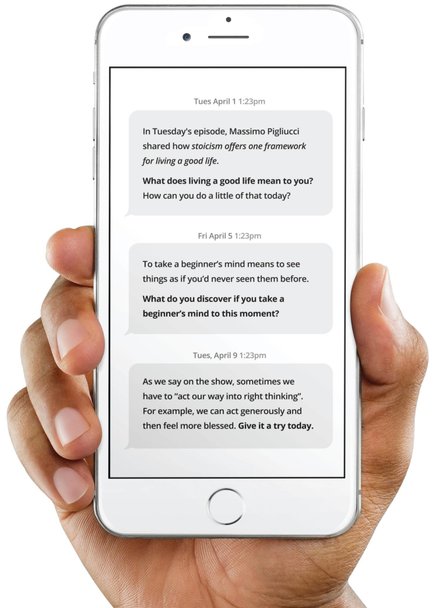
Good Wolf Reminders
A little wisdom, right when you need it. Start receiving free text reminders designed to help you pause, reflect, and take meaningful action. Sign up at oneyoufeed.net/sms.
Key Takeaways:
- Why we often default to holding back without realizing it
- How opening up can build trust and deepen connection
- The hidden emotional and mental costs of keeping things to yourself
- Why we tend to overestimate the risks of saying what we really think or feel
- How to weigh the risks and benefits of speaking up versus staying silent
- Why understanding your “why” can help you decide what to share and with whom
- How putting difficult thoughts and feelings into words can make them more manageable
- Why validation can make difficult conversations more productive
- How sharing feelings instead of arguing over facts can reduce conflict
- Why revealing wisely is a skill you can strengthen with practice
Leslie K. John is an award-winning Harvard Business School Professor, behavioral scientist, and sought-after speaker and consultant. She is the author of Revealing: The Underrated Power of Oversharing. Prof. Leslie John’s insightful research appears in top academic journals and media including The New York Times, The Wall Street Journal, and The Economist. Her new book – Revealing: The Underrated Power of Oversharing – is a groundbreaking book about the hidden power of opening up by a celebrated Harvard professor. Packed with bold insights and unforgettable stories, Revealing shows how revealing wisely can deepen friendships, supercharge careers, and transform how we connect, love, and lead.
Connect with Leslie John: Website | Instagram | LinkedIn | YouTube
If you enjoyed this conversation with Leslie John, check out these other episodes:
How We Can Improve Communication in Polarized Times with Charles Duhigg
Oren Jay Sofer on Mindful Communication
How to Unlock the Power of Deeper Connections with David Brooks
This episode is sponsored by:
Pebl – an AI-powered platform that helps companies hire and manage global teams in 185+ countries. Get a free estimate at hipebl.ai
Tiny Health‘s at-home gut health test provides science-backed insights into your microbiome, along with personalized recommendations to help you improve your digestion, energy, and overall well-being. Get $50 off your first test kit at tinyhealth.com/FEED
ButcherBox: Make dinnertime easier with ButcherBox, delivering high-quality 100% grass-fed beef, organic chicken, wild-caught seafood, and more, right to your door. Get $20 off your first box, plus your choice of free ground beef for life or free chicken thighs or top sirloins for a year, with free shipping always. Visit ButcherBox.com/FEED to claim your offer.
Talkiatry connects you with licensed psychiatrists for personalized, evidence-based mental health care, all online and covered by most major insurance plans. To get matched with an in-network psychiatrist in just a few minutes, visit Talkiatry.com/FEED.
Episode Transcript:
Leslie John 00:00:00 Getting negative feedback is really important to him, but it is really hard and I think we can only take a pretty small dose at one time in fact. Studies and practice has shown that you need to have like a very high ratio of positive feedback to negative feedback in order for people to even hear the negative feedback.
Chris Forbes 00:00:24 Welcome to the one you feed. Throughout time, great thinkers have recognized the importance of the thoughts. We have quotes like garbage in, garbage out or you are what you think ring true. And yet for many of us, our thoughts don’t strengthen or empower us. We tend toward negativity, self-pity, jealousy, or fear. We see what we don’t have instead of what we do. We think things that hold us back and dampen our spirit. But it’s not just about thinking our actions matter. It takes conscious, consistent, and creative effort to make a life worth living. This podcast is about how other people keep themselves moving in the right direction, how they feed their good wolf.
Eric Zimmer 00:01:09 Leslie John kept a running list of the things she thought about but didn’t say out loud. Small stuff, mostly the gray hair she spotted in the mirror but didn’t mention to her husband, the memory she had of a friend who she never called to say hello to, the nerves about a presentation that she hid behind, I’m great. Four of these chances to share what was going on with her before lunch. Leslie is a Harvard Business School professor who studies disclosure, and the lists taught her how often she was holding back without realizing it. Most of us are. Her new book is called Revealing the Hidden Power of Oversharing. I’m Eric Zimmer, and this is the one you feed. Hi, Leslie, welcome to the show.
Leslie John 00:01:55 Hi. Thanks so much for having me.
Eric Zimmer 00:01:57 I’m really excited to have you on. We’re going to be discussing your book, which is called Revealing the Underrated Power of Oversharing. But before we get into that, we’ll start in the way that we always do, which is with the parable. And in the parable, there’s a grandparent who’s talking with their grandchild, and they say, in life there are two roles inside of us that are always at battle.
Eric Zimmer 00:02:18 One is a good role which represents things like kindness and bravery and love, and the other is a bad wolf, which represents things like greed and hatred and fear. And the heart stops. They think about it for a second. They look up at their grandparent and they say, well, which one wins? And the grandparent says, the one you feed. So I’d like to start off by asking you what that parable means to you in your life and in the work that you do.
Leslie John 00:02:46 Well, I think that the one we feed is often the one we unwittingly feed. But part of the point of the parable is, of course, becoming more aware of how what you feed is what you become. And this is such an important parable for the question of how much to share, whether to say the thing or not. Because the more I’ve learned about revealing about opening up versus keeping things, mom, the more I’ve come to appreciate that. The bad wolf I mean, I’m being overly simple, but is this invisible bad habit we have of under sharing the invisible bad habit we have of concealment? And the wolf that we want to feed more is the wolf that you said.
Leslie John 00:03:33 It is more courageous and has the courage to really open up and share more and say the thing. And I’m saying this with being very cognizant that there are very real risks to opening up, and there are often things that we should not say to a certain person in a certain place. But the more research I’ve done and the more lived experience I’ve had with this question I’m constantly thinking about to share or not to share. The more I’ve come to appreciate that the real problem is not over sharing, it’s actually under sharing, and that so often we treat oversharing as if it’s the greatest social sin. But under sharing, I think is a far deeper problem because it costs us missed opportunities in life like missed. Now I’m rambling on. But under sharing I think is a much bigger problem.
Eric Zimmer 00:04:23 So the popular take on this has been Brené Brown’s work around vulnerability. In what ways are you amplifying that, and in what ways is what you’re talking about different?
Leslie John 00:04:35 That’s a great question. I mean, I’m amplifying it in the kind of top line number as a B-School prop, the general thesis that there’s so much upside to being vulnerable, doing something that we’re often scared to do.
Leslie John 00:04:51 I think the way I approach it, I’m a huge decision making nerd. I come from a long line of indecisive people, and so as someone who studies the wisdom and error of our decisions, what I’ve discovered is that these decisions of what to share and what to not share were systematically biased in making them. We’re systematically biased against opening up. We’re biased towards concealment, and that’s not always good for us. So I view this as fundamentally a decision making problem. And fortunately it’s also a skill and we can get better at making this decision.
Eric Zimmer 00:05:28 I really love that part of your framework, which is recognizing that there are a lot of disclosure moments, and we’ll do that later in the interview, because you do such a great job of doing that. But you make a very clear point that, like, this is a decision, you know, when should we when shouldn’t we? There’s no blanket rule here.
Leslie John 00:05:49 Yeah.
Eric Zimmer 00:05:50 And that every situation is going to be different. And often these decisions are slightly challenging.
Eric Zimmer 00:05:57 And that’s what I love about the book, is there’s just so much nuance in it.
Leslie John 00:06:02 Thank you. And, you know, I think you’re also keying in on something super important, which is that just the idea that it is a decision is kind of an insight in and of itself, because so often we go through our daily lives without actually appreciating just how many disclosure decisions were implicitly making. I think a fundamental issue with opening up or not opening up is the fact that we don’t appreciate just how often we default to silence. So, like what I started doing in my own life so that I could become more cognizant of how often I was defaulting to silence, is I started doing these disclosure audits. I know that’s like the least sexiest name ever. We need we need some more branding for it. But basically I would write down I have like little notepads on my phone. I have pieces of paper all over my house where I write down the things I set, and then also the things I thought and could have said but did not say.
Leslie John 00:07:00 So a quick example. Imagine like you wake up in the morning, you’re standing next to your spouse in front of a mirror. And you know, I say to my spouse, oh geez, I slept really badly. I’m brushing my teeth. Okay, so I’m actually going to do a tally right now. That’s what I say. But then I look in the mirror and I’m like, geez, I feel older than I thought I would at this with this age. And it’s another gray hair, you know, I think these things, but I don’t say them. They just crossed my mind. And maybe later on in the day you’re driving into work and you think of a bestie, a bestie, a nice little memory of something that reminds you of your bestie, and you don’t say it to them. You don’t reach out to them. You just think about it. Then you get to work. And your colleague that you’re really close with said, how are you doing? And you say, oh, I’m great, but I have a big presentation.
Leslie John 00:07:46 What you don’t say, though, is you’re feeling really anxious about it. And can we just run the first few lines? Right. Like, I’m not even, like really at lunch yet. And I’ve got four in the onset and two in the said. Right. And so the point isn’t take all of the unsaid and say it. Not at all. You don’t want that. I don’t want that. We often withhold for good reason. Right? Like you get to work your assistant as how you are. You say I’m fine, like you don’t want to unload on them inappropriately. So there’s very good reasons to withhold. But my point is that this exercise taught me just how often I’m holding back. I didn’t realize it, like I’d have these thoughts about my body when I’m brushing the teeth in front of the mirror and I’m like, the thought of revealing them didn’t occur to me. And so now that I’m more aware of it, I’ve started to do it more. And doing is believing because then you got to do it.
Leslie John 00:08:38 It’s revealing is the kind of thing that’s really can be hard in the short run. So you have to keep doing it to experience the benefit.
Eric Zimmer 00:08:45 Yeah. My history with this is a little bit of an odd one, because at 25, I was a homeless heroin addict and I went into recovery and I went all the way in, and then I went kind of back into the workforce. And I was so revealing about that fact because I couldn’t not be more.
Leslie John 00:09:03 Because it was you. It was your identity.
Eric Zimmer 00:09:05 It was my identity. But it was also like, well, why do you have this big gap in your resume? And why do you think it’s just the sort of stuff that makes it hard? And so I was like, I can’t dodge all this. I guess I’ll just be honest. And I just learned over the years, particularly in a career sense, the benefits of being leaning more on the disclosure side. I mitigated it over time. I think in the beginning, if you knew me for five minutes, I’d be like, I’m a heroin addict.
Eric Zimmer 00:09:35 No. Yeah. As I went on, I was like, I toned it down. But I just always noticed that me being a little bit more revealing than the average people around me made me good at my job.
Leslie John 00:09:47 That’s amazing.
Eric Zimmer 00:09:48 It made people trust me more. Yeah. So how was it doing it? Manipulative. I was doing it because that’s kind of who I was. It wasn’t lost on me. The benefits that it was having. And your book does a really good job of laying out a lot of the different benefits of learning to be a little bit more disclosing a little bit more revealing. So before we get into more of the how, yeah, let’s talk about what are some of those benefits, both the costs and benefits of withholding or keeping a lot of things to ourselves?
Leslie John 00:10:20 Yeah. So withholding can take a toll on us. It’s kind of sneaky. It sneaks up on us. So when we withhold, like if we have a secret, something that’s really on our minds or something that’s really part of identity and we feel like we have to suppress it.
Leslie John 00:10:35 That is very cognitively depleting. Nerdy word for it makes it hard for us to think. Right. And there have been studies, actually, that have had people keep a secret and then measured their IQ, and it lowers your IQ temporarily to hold a secret. So it really is consuming. So you’re not going to perform as well. It’s not opening up isn’t just removing bad symptoms. Right. There’s so many rich rewards to being a bit more open a lot of the time. The number one, as you said, is it increases people’s trust in you. Because when you say something sensitive, you’re showing the person that you trust them, right? Because you’re relinquishing control to the universe and you’re taking a social risk. And that’s implicitly communicating to the recipient that I trust you, because I wouldn’t be revealing this if I didn’t trust you. Right? So it shows that you trust them. And in turn, when we all know when we’re on the receiving end of that, it feels warm and fuzzy and we trust them.
Leslie John 00:11:32 That mutual trust is the fundamental benefit of opening up when we do it interpersonally, because that is the spark of human connection, right? It’s the spark of friendships, of college ships, of romances. And so that’s really kind of the core thing, but expanding outward, you know, and we’ve done many studies on all kinds of different benefits. It does help you build friendship. It is a key source of intimacy. It even in leaders, it can make you much more influential at work by sharing some of your weaknesses to your employees. Some of the things you’re working on, they actually they trust you more, they work harder. You get better feedback. That one really surprised me for sure. We’re going to talk about the edge cases and the downsides, because it is a risky thing to do as well.
Eric Zimmer 00:12:15 You tell a story in the book about a company, a credit card company you worked with. Tell me about that.
Leslie John 00:12:20 Yeah. So this is with my dear colleague and friend, Ryan Buell.
Leslie John 00:12:23 We worked with a very large bank, and what Ryan convinced them to do was to reveal the downsides of its credit cards on the credit card landing site. So if you wanted to sign up for a credit card, you know, you go online, you go to the bank’s website, you look at the different options. And what does this web page usually say? It’s like standard marketing copy. This is amazing. Like lo Rey, lo fi, all these things and the downsides, whatever the negative things about the card is, whether it’s, you know, if it’s a high fee or whatnot is in the T’s and C’s, right? And so what he convinced them to do was make it super salient. So when they showed the downsides in a really salient way alongside the benefits. So hey, this credit card has a low fee entry fee. But keep in mind that the interest rate is really high, right? So something that you would think you’d never reveal, right. As a B-School prop, I’d be like, what? Like is this anti marketing? And when they did this though it increased customer retention.
Leslie John 00:13:23 It didn’t scare people away. In fact it made them stay longer. And it’s because one they trust the company more. And when you think about it and when you feel like they’re being honest, they’re telling you something that they usually hide that enhances trust. But it also helps you make a more informed decision, right? Like, if you know what the trade offs are, then you can choose a better card and then you stay longer. So I love that example because it’s like even when companies reveal there’s money to be made, right. Like that’s not of course, my primary goal, but I think it’s an important one and it’s pretty striking.
Eric Zimmer 00:13:56 Yeah, I learned that in a software sales role earlier in my career. I was more like the sales engineer. I was the guy that kind of came in and said, like, here’s how our systems would work together and here’s what it’ll do. And I always found that, like when I would say, but it won’t do this or I won’t do that, or that part’s gonna be tricky or they love it.
Eric Zimmer 00:14:17 Again, same thing. I went with my son to buy a car recently. Right. I go in there with my defenses up so high because I feel like all I’m going to get is hard sell. But once I recognize that’s not there in that way, and somebody being more honest, I’m able to settle a little bit and listen better.
Leslie John 00:14:36 So it’s striking to me that because to many executives, this does not come naturally. Like, wait, you want me to? When I introduce myself to my team, tell them that I’m working on time management or whatever. When you did software sales, it seemed to come naturally. Like how did you discover that?
Eric Zimmer 00:14:50 It may be because that was a time in my life where I was still relatively in my early phases of recovery. I mean, I’ve been in recovery for the better part of 30 years now. So but it was in the earlier phases where there was just a lot more day to day disclosure in my life. Right. I was going to 12 step meetings.
Eric Zimmer 00:15:09 Those are just a big disclosure party, right?
Leslie John 00:15:12 Right, right. Exactly.
Eric Zimmer 00:15:13 I mean, those are essentially just a disclosure party.
Leslie John 00:15:15 Yeah.
Eric Zimmer 00:15:16 And so maybe it just was in the way I just sort of did things. Or maybe it’s something temperamental. I’m not sure. And I don’t mean to make it sound like I’m the perfect disclosure.
Leslie John 00:15:28 No, no.
Eric Zimmer 00:15:28 It’s because there are certain aspects with the disclosure, but in other aspects I did it, and I just sort of was like, Like, I see this being an effective strategy. And I think maybe it’s partially that I do want to be close to people that I’m working with.
Leslie John 00:15:47 Yeah.
Eric Zimmer 00:15:48 Whether it’s a client that we’re trying to sign, whether it’s somebody on my team, I want relationships that feel genuine.
Leslie John 00:15:56 Totally. Yeah. And then in the sales context, it’s genuine and it’s credibility boosting because it’s like the salesperson who’s willing to tell me this downside, then they’re coming clean about it. They’re being honest. Right. And they’re trustworthy.
Eric Zimmer 00:16:29 You have in the book this idea that people will trust someone who makes a disclosure more than says they won’t answer that question. I think you do this with STDs. Tell me about that.
Leslie John 00:16:44 Roll up your sleeves, folks. So one of the things that I do in my job, because I study how people make decisions, is I put people in really awkward positions, and I force them to make a choice that they don’t want to make. And if I’ve set up the choice, well, ideally it illuminates something fundamental about human behavior. So in this study, what we did was we said, we’re going to ask you which of two people you’d rather date. Now suppose that at some point in the convo with each of them privately, you’d ask them whether they’d ever had any STDs or, yes, STIs now. But sounds more damning with STDs anyway. So have you asked them about their STD history? And the first person says, I had so many STDs like I can’t even. I’ve lost track.
Leslie John 00:17:29 I’ve discovered new ones. All the STDs, all the time. Basically. Like it can’t get worse. The other person says, I’m not answering your question. They just like, refuse to answer. So you have the revealer who says admits to unsavory things, and then the hider, the person who’s saying, I’m not doing this. Of course, this is like, you probably would like to opt out of this choice, but if you had to.
Eric Zimmer 00:17:53 Choose, you’re probably right. You’re gonna be like a swipe left or whatever the one is that says, like you.
Leslie John 00:17:59 My father would say, neither is a fine specimen.
Eric Zimmer 00:18:02 Exactly.
Leslie John 00:18:04 If you had to choose. Or do you want to just not choose? Listeners, do you have someone in mind? Which one? The revealer or the hide?
Eric Zimmer 00:18:11 I know I would choose the revealer.
Leslie John 00:18:13 Yeah.
Eric Zimmer 00:18:13 Yeah, right. I would choose the revealer because a I just trust them more because they’re telling you the truth.
Leslie John 00:18:20 Because you’ve just. Right.
Eric Zimmer 00:18:21 And the person who’s not saying it, I just can imagine the worst, you know?
Leslie John 00:18:27 Yeah, exactly.
Leslie John 00:18:28 People prefer the revealer, the person that’s plainly admitting to really undesirable things relative to someone who doesn’t do this, which shocked me the first time. And then we repeated it in many different contexts. And what we realized, you know, in dating, employment, even like, who would you rather sit next to the subway? On subway beside. Again and again people choose the revealer. And we thought, why is this the case? And that’s when we discovered that trust is really the fundamental thing that the person who withholds, we don’t trust them. And I think the reason is because human connection relies on trust. And we know, you know as well as anyone that when we are deprived of connection, we suffer our mental and physical health suffer. So we really need this. It’s important for our functioning, for our survival. I don’t think I’m being too extreme here. And so when someone abstains from this activity of building trust by self, disclosing the way that humans build trust, we view them with contempt.
Leslie John 00:19:29 So we’d rather date someone. Hire someone. Sit next to the subway beside someone who says like bad, bad things relative to someone who’s like, I’m not doing this. Which is I think is pretty striking. There’s also been some interesting studies on neuroscientific evidence of what happens when you self disclose evidence suggesting that it is intrinsically rewarding, so to speak. So one of the studies, what they did was they got people to. They scanned their brains. They stuck them in fMRI machines. And half of the people they asked fun, personal trivia questions like, what’s your favorite ice cream flavor? So questions that let you self disclose the other half of people just got normal random trivia questions that didn’t let them self disclose. And what they found, as you might imagine at this point, is that the people who got to self disclose the pleasure centers of their brain were activated. So the same areas that are activated when we eat something delicious, when we have sex, when we do drugs. There are these primal reinforcing areas now, of course.
Leslie John 00:20:33 So nature has a way of making what’s good for us pleasurable in like I’m having waving my hands here in moderation and moderation. Right? But like so that was really striking the fact that self-disclosure is intrinsically pleasurable.
Eric Zimmer 00:20:46 It makes sense because I think that if we look at humans as a whole, our ability to cooperate has been our superpower. And you don’t cooperate generally with people you don’t trust completely.
Leslie John 00:20:59 Yeah. And the key thing with that trust is social risk, right? You have to take a risk to get trust. So it’s precisely because sharing is edgy. It’s precisely the sensitive stuff that is the most likely to increase trust. Just saying like I had a good day. There’s no risk to that. And so it’s that edgy, risky part that really enhances trust. Just like, you know, you see this in many ways in the animal kingdom. Like how puppies. Now I’m rolling my back like a puppy that they expose their bellies, right? They arch back. That’s a very vulnerable part.
Leslie John 00:21:31 And when they do that, they ingratiate themselves to other puppies, to humans, right. That takes risk. So it’s really our version of showing our bellies is revealing something sensitive.
Eric Zimmer 00:21:44 So let’s talk about what makes someone more of someone who shares more, discloses more, versus somebody who doesn’t. What do we know about what goes into that? Yeah, into the patterns that we have. I mean, I think that’s probably the word I would use, like the pattern of, you know, for sure or the pattern of not right.
Leslie John 00:22:06 That was a question that I’m still very fascinated by. And I have done research to answer it. Are there personalities that make people more disclosing or less disclosing? And going into it? I thought, well, maybe extroverts, right? They talk a lot. They are gregarious. We love being around them. They must be really revealing. And it turns out that being extroverted or introverted is not related to how comfortable we are opening. The personality trait that is related is a trait called agreeableness, which essentially is like plays well with others, right? Easier to get along with those kinds of people.
Leslie John 00:22:44 I’m a people pleasing Canadians, so it takes one to know one. It’s good and bad to be agreeable in the context of revealing. Why do they tend to be more comfortable opening up? It’s because people who are agreeable tend to be more trusting. Right? And again, as an agreeable person, I say this like it’s helpful to be trusting it. Also, sometimes it bites me.
Eric Zimmer 00:23:05 I’m the same. I’m the same.
Leslie John 00:23:06 Yeah, yeah. So that’s the personality trait. There are gender differences. Women are a little more comfortable revealing, but there’s a lot of complexity there. Right. Because there’s social norms and things that expect women and there’s a lot going on there. Oh, and the thing about extroversion too, so it’s that I learned. Extroversion is not related to comfort opening up. And it’s because when you think about extroverts are really outgoing. They’re really they have a lot of positive affect. They’re gregarious. Like decibels don’t equal death necessarily. Right. So it’s kind of a different thing.
Leslie John 00:23:38 But personality plays a pretty modest role in predicting. Right. This I view as largely a skill. And it’s largely something that we modulate situation by situation. It’s a skill of self and situational awareness, learning how to reveal wisely.
Eric Zimmer 00:23:53 Yeah. And I think like in my case, there’s certainly a reinforcement learning that I learned, I saw early on like, oh yeah, there are benefits of doing this right. Like this is useful. So I learned that like, oh, this is good to do. I mean, if my first several attempts to overshare had left me being shamed and all kinds of other things, I might very well have right become an under sharer, right? So I would imagine that how we’re responded to. Certainly has something to do with it.
Leslie John 00:24:24 Right. So when you were like going back into the workforce and you told your story. I mean, do you remember the first time you told it to a prospective employer? Like what happened? How did you feel? How did they react?
Eric Zimmer 00:24:37 Well, I mean, it was the thing that launched my entire career.
Eric Zimmer 00:24:40 So I was 25. I’d never done anything except work in a restaurant and commit felonies. That was my entire track record up until then. And one of the first internet companies was in Columbus, Ohio. It was called CompuServe. And someone told me about it, and I just was like, I just was like, I really wanted to do it. So I went and interviewed. And when they started asking me, like, do you have any experience doing this? You know, why are these big gaps in your resume? And I basically just said, look, I’ll tell you the truth. The truth is I’m a recovering I’m a recovering drug addict. I you know, it’s been a rough few years. I’m in recovery now though. I really want to do this job. I work really hard, like I just, I revealed. And then I sort of sold what I could sell about myself.
Leslie John 00:25:27 Yeah.
Eric Zimmer 00:25:28 And I got that job. And so that was hugely, like.
Leslie John 00:25:32 Totally.
Eric Zimmer 00:25:32 Reinforcing.
Eric Zimmer 00:25:33 Yeah, for me it was very reinforcing because I never went to college, I never did any of that. And I had a very good career in the software business before I kind of came over and started doing that. And that all kind of came out of, I think that decision to reveal in that moment, because I don’t think otherwise. If I had just tried to hide everything that they would have hired me.
Leslie John 00:25:57 Yeah. And people can tell, like if it’s something that’s really core to you, it would have been hard for you to hide because it would have been like on your mind of like, oh, the thing, the thing, the thing and would have felt disingenuous or whatever.
Eric Zimmer 00:26:07 Yeah. And I’ll be making up stories like, why have you not had a job for nine months? Oh, it’s because I’ve been in treatment and in a halfway house. Otherwise I’m making things up. I spent time working with my brother. On what? I mean, I just would be. Yeah.
Eric Zimmer 00:26:20 Then not telling the truth.
Leslie John 00:26:22 And it’s exhausting. Yeah, yeah, yeah, it’s interesting because I think, like, sometimes we do get burned when we open up and. Well, let me say, the first thing I wanted to say is that, okay, even if it did go badly, it went well. That’s wonderful. Yeah. But if suppose the boss showed you that he was not okay, I’m assuming it was male. He or she.
Eric Zimmer 00:26:47 Was not okay, actually.
Leslie John 00:26:48 Oh, great. Okay, so suppose she showed you that she was not okay with it. So at least you know, right? Even when you get burned, wouldn’t you rather know sooner that she’s not okay with. She doesn’t believe in you in the moment? That sucks for sure. But yeah, I think this is the broader pattern that makes learning to share more really hard or like a hostile learning environment, because we get burned and then we just freak out and we stop. We just stopped doing it.
Leslie John 00:27:18 Yeah. And so as I was writing the book, the book contains a lot of stories, some of my own embarrassing stories, and some others not just because I weirdly, my brand of oversharing is telling self-deprecating jokes, but it also was intentional because I realized I went back in these moments in my life where I thought I had over shared, and I woke up with this like, disclosure hangover of like, oh my God, what? Like, can I please roll back time? And I looked at those moments and I thought, wow, yeah, that sucked that moment. But even those quote over shares there was redemption in them. And if I had to do it again, I’d do it all over again. So we see them as black and white, but even when we overshare, would we feel like we crossed the line? Almost always, there’s something good. And for me, as I was reflecting and researching, the good is actually typically better than the momentary crappiness of the overshare. Yeah.
Eric Zimmer 00:28:13 There’s a little intrinsic and extrinsic motivation here, right? Meaning that I felt good about the way I behaved in that situation. Yeah, right. And look, in recovery there’s a high premium put on honesty. Right. There’s a high premium put on honesty. So it was good for me to do it because it was good for me to do it right. The extrinsic, which would be what happened as a result of it, can be good or bad. I mean, not every time I’ve disclosed has it been positive. I’m certain it’s not right.
Leslie John 00:28:48 Right.
Eric Zimmer 00:28:48 But I do think that’s a thing in general, right? You just published a book. I published mine at the end of March, and there’s a certain amount of that’s like, well, I want it to really do well, and I’ve got these extrinsic things. But for me, I kept coming back to the intrinsic thing.
Leslie John 00:29:03 Yeah.
Eric Zimmer 00:29:04 Which is that I wrote a book and I feel good about the book, and I feel like it’s valuable now how it goes on to do.
Eric Zimmer 00:29:11 After that, I can’t control. But I can control that. Like, I put everything I could into this thing, and I feel good about that.
Leslie John 00:29:18 I love that, I love that, yeah, it’s so true. And I think, like on the intrinsic piece, we know so much about how revealing is good intrinsically. Like in addition to the neuroscientific stuff on how it’s pleasurable, there’s also like our well-being, our mental and in turn, physical health. Because we know, of course, they’re deeply tied. We benefit from revealing. So if you have something that is on your mind constantly and you write it in a diary, you’re journaling the practice of journaling that just taking your thoughts, those things swirling around in your head, the thoughts and feelings and putting words onto them by the process of putting, like saying the thing out loud or writing it down. I know it sounds like, wait, what’s the difference? It’s still me. It’s still private, but it’s very different in terms of your brain.
Leslie John 00:30:06 Because when you put the thoughts and feelings into words, you activate the more logical part of your brain. It’s like you suddenly become the CEO of your thoughts and your feelings, and you have more control over them. And you can make sense of them, and they feel more certain, like everything is just so much more manageable. And so it’s such an important point that intrinsic number one, like writing the book, that’s a huge achievement. You wrote the book you wanted and that is the fundamental goal. We hope everybody reads it because they should. We hope everybody buys it. But saying with disclosure that like the intrinsic value of it is just so important.
Eric Zimmer 00:31:07 Oh. Hey, friend, before we dive back in, I want you to take a second and think about what you’ve been listening to. What’s one thing that really landed? And what’s one tiny action you could take today to live it out? Those little moments of reflection. That’s exactly why I started good wolf reminders. Short, free text messages that land in your phone once or twice a week.
Eric Zimmer 00:31:34 Nearly 5000 people already get them and say the quick bursts of insight help them shift out of autopilot and stay intentional in their lives. If that sounds like your kind of thing, head to one Eufy net SMS and sign up. It’s free. No spam, and easy to opt out of any time. Again, that’s one you feed. Net. Tiny nudges, real change. All right, back to the show. You were just talking about putting words to kind of what we’re feeling, and you might be inclined to think that the STD story is the most upsetting experiment in the book, but it is not because the most upsetting experiment in the book, at least for me, is the one that Lieberman does with tarantulas.
Leslie John 00:32:22 No, I know. Jeez.
Eric Zimmer 00:32:24 Yeah, I kind of really want to be part of that study because I’ve been thinking maybe I need to do exposure therapy for my spider fears, but share that one with this. Also, because it gets to this point about putting words to something.
Leslie John 00:32:35 Yeah. So basically they brought this like giant tarantula into the lab. I know we’re just sick. Yeah, yeah. There’s something wrong with a psychologist. No. In the name of science.
Eric Zimmer 00:32:47 Exactly.
Leslie John 00:32:48 They brought this giant tarantula into the lab. And, of course, people were scared of it. And half of the people they said, like, try to calm yourself down. Do whatever you can. The other half of people, they’re like, just put your feelings into words. How you feel about this, right? Like, I’m scared. I’m terrified. Ooh! It’s Harry. Ooh! Is it gonna eat me? Whatever it is. But that’s what I love about this. You don’t have to try to feel better. You just have to put it into words. It’s very executable, right? Very doable. And then they, of course, brought them back a few days later, and they showed them the tarantula again. And the people who had used their words and put their thoughts and feelings into words, they were less physiologically stressed the second time around.
Leslie John 00:33:30 So literally it calmed them, putting their feelings into words.
Eric Zimmer 00:33:34 Yeah, right. And this is tying to the benefits of yes sharing. Yeah, with others. Because if that benefit comes that way from just writing in a journal or just writing down a couple of words, there’s the benefit of doing it to others. Right.
Leslie John 00:33:50 So and then when you tell others, like a trusted confidant, if you tell them that, it’s an even stronger effect. Exactly to your point, the private one works and works even better if you have the right confidant. Yeah, yeah.
Eric Zimmer 00:34:03 All right. So we’ve kind of covered. Why. To do it some of the basics here I’d like to get into how a little bit, but I want to go back to this idea of disclosure decisions, because you did a great example of sharing that. Like even before noon, there are a number of opportunities to disclose what we’re thinking, what we’re feeling. It seems to me that the first thing and what I liked about that is it starts to bring some degree of awareness to that.
Eric Zimmer 00:34:36 If you asked me like, did you not disclose anything important this morning, I’d be like, well, no, of course. I mean.
Leslie John 00:34:41 Right, we do it so naturally we don’t even think we’re censoring.
Eric Zimmer 00:34:44 Yeah, but of course I have thoughts and feelings all morning.
Leslie John 00:34:48 Yeah. And so it’s not about saying all the things of course, but now you’re like, oh, there’s a possibility. And then we can interrogate very strong word. Very, but we can interrogate whether we should share Now that we’re aware, we can think, oh, should I say it? Should I not say it? We’ve studied that further. How do people, when they’re aware that they have a decision, what we call a disclosure dilemma, do you tell your spouse about that old fling? Do you tell your kids about your old ways? Do you tell your boss that you feel really anxious or that you deserve a raise? Right. These are real dilemmas. It’s really hard to know whether to reveal or not.
Leslie John 00:35:25 And what we found is when people consider these decisions, the number one thing they think about are the risks of revealing. So, okay, you’re not given credit at work. Someone missed giving you credit. If we say, well, should you say something? People say, oh no, they’ll think I’m petty. It will ruin the relationship. All these negatives and those are totally valid. There are very real risks to revealing. But the problem is we stop there. We’re like an anything else, they’re like, nope. So we don’t think then of the risks of holding back. So when we then ask people, okay, those are fair, those are risks of revealing. But what if you don’t say anything and then they’re like, oh, I never thought of it like that. I might ruminate. And when I ruminate, sometimes if you don’t say the thing, passive aggression, your negativity can leak out in other ways. Maybe that will be bad for your relationship with your colleagues. So you start to see that there’s also downsides to not opening up.
Leslie John 00:36:22 And then you start thinking, oh, maybe there’s actually real risk, real benefit. Maybe there’s actually real benefits to opening up. Like if I found the way of talking to my colleague about it. And we know there’s lots of ways of saying hard things, there’s books written on that. If we figure out how to do it right, maybe they’ll trust me more. Maybe they’ll respect me. I certainly will respect myself. I’m modeling self-respect and that ideas matter and credit matters. So then you start thinking there’s maybe actually benefits from saying something hard. And, you know, there’s also benefits to not saying something. Maybe you’re like, well, this is just not the right day for me to have a difficult. And that’s totally fair. But my point is that when we make these decisions, we zoom in on the risks of revealing, and we neglect the other considerations, which are the risks of not revealing the benefits of revealing and the benefits of not revealing. So there’s risks and benefits of revealing and of holding back.
Eric Zimmer 00:37:24 Yeah, that’s a really good point. On a completely tangential note, though, I did an interview earlier today that I found fascinating, and she’s a scientist at the University of British Columbia. One of the studies that she.
Leslie John 00:37:37 What is her name?
Eric Zimmer 00:37:38 Elizabeth Dunn.
Leslie John 00:37:39 I love Liz Dunn. Oh. She’s amazing.
Eric Zimmer 00:37:42 Well, her lab did a recent study about whether AI can help with difficult conversations.
Leslie John 00:37:48 Cool. Very cool.
Eric Zimmer 00:37:50 And the idea was that indeed it can. Because you get to practice, you get to strategize, you get to say, like, what are the things they might say back that it was useful in that way.
Leslie John 00:38:00 I use it all the time, like I talk to my GP and I do that, I practice. It’s so helpful, if only till I give you confidence, right? I love it.
Eric Zimmer 00:38:09 Yeah. Yeah. So let’s talk a little bit about these disclosure decisions. So you talk about two things to do. Which one is to ask why. Yeah right I’m on a disclosure decision.
Eric Zimmer 00:38:24 So it sounds like one thing I want to do is think about the risks and the benefits, both of saying it and not saying it. Right. Instead of just focusing on the benefit or the risk of what could go wrong.
Leslie John 00:38:38 Right. Right, right. And so here I’ll give you an example of why the why is important by like a mistake that I made. So when you ask why might I reveal this? What’s my goal? It’s kind of a deceptively simple question in that it requires a level of self-understanding and self-awareness of why we’re doing the things we do. So I had a moment where I was not doing best practices. I was had written the book, yet I was early pregnant, and I was so excited about it. And, you know, I just really wanted to share the news. And I blurted it out to our landlord. And then a series of events that I won’t bore you with happened. Where basically, after I had said that, she basically kind of kicked us out, she decided to put the house on the market.
Leslie John 00:39:26 I think she didn’t want babies. And because there was lead painting. So there’s a whole rigamarole in Massachusetts. Anyways, I digress. I should just say that I blurted it out that I was pregnant and a series of events occurred, a chain reaction that basically forced us to move out. So I should not have said that. And looking back at that, what’s my why? My why was I wanted someone to be excited for me. I wanted to share happiness. I wanted to have laughter, have wonderful hugs and like, just be excited together and have someone share that with me. Okay, if I had realized that in the moment, is the landlord the right person to do this? No, it’s call my bestie my bestie. Like whether the pregnancy works out or not, I’m gonna tell her. And so that’s why the why is important because it’s like directs your questions of the risks and rewards. Like it helps you hone in on those. It helps you hone on is this the right situation? Is this the right person? And oftentimes we kind of forget, myself included.
Leslie John 00:40:26 We forget the why. And then we can make mistakes like I did in blurting out I’m pregnant.
Eric Zimmer 00:40:31 Yeah, I said that I’m not. Early parts of the conversation would have made it seem like I am a super disclosure, and I am pretty good at disclosing what’s going on with me, or how I’m feeling, or different things. I’m really bad at any sort of disclosure that might make the other person uncomfortable, unhappy, Etc.. That’s where I run up against the challenge. Interesting. So I think the why is a good question there. And also, I think the exercise you just walked through of like thinking through, it’s very easy for me to think of all the ways that not saying something would be the right thing to do.
Leslie John 00:41:07 Yeah, yeah.
Eric Zimmer 00:41:09 It’s spending more time on okay, what are the benefits that could come at some point in the book? You talk about that, figuring out how to do this as a matter of inner awareness and situational awareness. Right. Yeah. Which is I’m taking into account me and what’s going on.
Eric Zimmer 00:41:25 And I’m kind of taking into account the situation. The room.
Leslie John 00:41:29 Yes.
Eric Zimmer 00:41:30 And I think I do a lot of situational awareness in those things that may be overdoing it.
Leslie John 00:41:39 Oh. Say more.
Eric Zimmer 00:41:40 I get intensely practical when I think about bringing something up. So again, I don’t have a very difficult time. Like if I was having a difficult day and you and I knew each other, I probably wouldn’t have a difficult time saying it. That’s pretty easy. But if you and I had a potential conflict.
Leslie John 00:41:56 Yes. Yeah.
Eric Zimmer 00:41:57 The way that I talk myself out of them often is to go. Will it do any good?
Leslie John 00:42:04 Right.
Eric Zimmer 00:42:05 So, like a classic example would be somebody that I’m close with and we have a disagreement around politics. Yeah, I often will just not say anything because I’m like, what is the point? Yeah, right. And I’m not saying that’s the right or the wrong Reid I actually don’t know. And I think that’s like everybody has to answer that for themselves. Right.
Eric Zimmer 00:42:23 But that’s one that I often get hung up on is like, is it really going to make any difference? Is it going to do any good? You know, I think that’s where I get stuck.
Leslie John 00:42:32 And I think there comes down to the goal too. Like with politics, is your goal to change the person’s mind? Is that a reasonable goal? Right. So being realistic and knowing what the goal is. But I think there’s also another important thing which might be your agreeableness, because I suffer from the same thing, maybe, which is it’s hard. I struggle to say things when I feel like it’s going to be a have a conflict, right? Like I’m conflict avoidant, right? And then just because we think that there’s going to be a conflict, I have started to learn because I’m trying to get better at this. That’s not in and of itself a reason. It can be a reason like, but sometimes as of course, you know, conflict is really helpful. Like the example of like the credit not getting credit at work.
Leslie John 00:43:17 Something like that had happened to me, which I write about in the book. But like the old me was like, I wouldn’t even consider saying something. And part of that is because I am conflict avoidant. And then when I was realized, oh wow, there’s a way I can say it. And this is a skill. And if I say it and then no conflict arose. And then like we actually became closer, like so part of this is like a little bit of CBT, right? Cognitive behavioral therapy where like you got to actually do it to disprove your false beliefs. Yeah.
Eric Zimmer 00:43:44 And I think there are Situations where, like there’s an ongoing area of dispute in a relationship. Yeah, totally. And one person’s over here and one person’s over here. And previous conversations haven’t done much to bridge that one way or the other. And so then the question for me often becomes, what’s the point in again?
Leslie John 00:44:08 Yeah.
Eric Zimmer 00:44:08 But the thing that I’ve realized the cost that I’ve realized is that, yeah, a lot of my mental energy is there, and I’m not being honest about that.
Leslie John 00:44:18 Totally.
Eric Zimmer 00:44:19 Right. So I don’t feel like I’m being as authentic in that situation, because I feel like talking about it isn’t going to do, quote unquote, any good. And now, as I’m talking out loud, I think I’m back to the why question. Exactly why if I’m saying something is not because I want you because I’m going to I don’t want to relitigate this and talk about how I want you to change.
Leslie John 00:44:43 Right.
Eric Zimmer 00:44:44 My why is just that. This is on my mind often, and I just feel like I need to sort of. Yeah, let you know where I’m at. Yeah. Often.
Leslie John 00:44:53 Yeah, totally. And even like I have found like vocalizing my why is helpful too in my relationships. Like what I kind of tend to default to when my husband shares something is like hyper to your. I think we’re similar in some ways, hyper practicality and like, how can I help? Like, who should I go? Like, what should we what should we do? And I’ve come to relieve that actually with my husband.
Leslie John 00:45:14 What I think with humans in general, actually there’s research on this that less is often more, that the number one thing you can do is validate feelings. Like it makes sense that you feel that way. I would feel the same way too. Like it calms us down. I’m thinking of Ethan Cross’s work, right? It calms us down when someone validates. And so that’s extraordinarily helpful. But I also think I’ve found in my own relationships that when sharing some of the tough stuff, this stuff that I would worry about conflict, sharing difficult feelings, or that I’m disappointed, or that my spouse is disappointed with me in some way. It’s hard, but then it’s also a tremendous opportunity because you really know them. Then you really learn that.
Eric Zimmer 00:45:55 Like, I know.
Leslie John 00:45:55 When I put the toilet paper on and it goes underneath as opposed to over top, hypothetically speaking, that really agitates my husband. I didn’t even know the difference, and he had been holding this in for like years. And that’s valid.
Leslie John 00:46:11 Like that’s how he feels. Feelings are always valid in my book. And so now like I love him more for it. Right. It’s like knowing these idiosyncrasies is really a cornerstone of intimacy.
Eric Zimmer 00:46:23 Yeah. Interestingly, talking about Ethan Cross’s work, what I love about his work is he actually doesn’t end there, though. He goes, yeah, the most supportive relationships are where it starts with validation.
Leslie John 00:46:36 Yeah.
Eric Zimmer 00:46:36 But then feedback is also part of Right. That relationship, I think that idea that like people only want to be heard. We sometimes get a little over on that because most people don’t do it.
Leslie John 00:46:49 Don’t do it enough.
Eric Zimmer 00:46:50 Exactly. But obviously if you don’t start with that step.
Leslie John 00:46:54 Yeah. You can’t.
Eric Zimmer 00:46:55 The rest of it can be useful. Right. At all.
Leslie John 00:46:58 You need to calm the lizard brain first.
Eric Zimmer 00:47:01 Yeah, 100%. I mean, like, one of the things that’s really valuable about, like, a AA sponsor is they will tell you the truth about what they see.
Leslie John 00:47:09 Yeah.
Eric Zimmer 00:47:09 Yeah. But in my experience, and different people are different. Some people are just so brutally straightforward with that. I would feel like you’re not listening to me. You’re not hearing me. You’re not relating to me as a human. So I don’t want to listen now to your advice. But on the other hand, what I wouldn’t want out of a sponsor is somebody just to be like, oh, yeah, Eric, I totally understand. I can see why, you know, I want somebody to be like, that’s a dangerous thing to be doing, right? So that’s what I love about that work.
Leslie John 00:47:37 Totally. And I found, for what it’s worth, that I think people, myself included. Getting negative feedback is really important to him, but it is really hard and I think we can only take a pretty small dose at one time. In fact, studies and practice has shown that you need to have like a very high ratio of positive feedback to negative feedback in order for people to even hear the negative feedback.
Leslie John 00:48:01 Right. So lately I’ve been on somewhat of a praise campaign where I just compliment people, like with specific praise that I need. You know, I’m walking around the office. Academia is brutal. People are so stingy with compliments and I say, I love that experiment you ran. I love that paradigm. Well, chef’s kiss and people initially they’re like, what? What is going on? But I find that when I do need to give someone a piece of constructive feedback, we’ve established that safe base. They feel understood, they feel appreciated. Then it’s more useful to them. The other thing about praise, it’s made me happier. Not that I was unhappy, but you feed that wolf, right? You see the praise, you see the goodness. You become more observant of the positive things, makes you feel good. It makes the person feel good. And it enables you to have the tough conversations that really grow someone.
Eric Zimmer 00:48:51 Yeah, I’ve shared this before, but my partner Ginny was one of the things I noticed from her very early on in our relationship was she just naturally did that.
Eric Zimmer 00:49:01 Oh, we walk into a store and she’d just be like, I love your earrings or that looks I mean, yeah, just she just constantly does it. Yeah. And I think it’s just sort of natural to her at this point.
Leslie John 00:49:11 It becomes a habit. Yeah.
Eric Zimmer 00:49:13 I just kind of watched as somebody who just doesn’t interact generally at all with people I don’t know.
Leslie John 00:49:20 That’s like my husband. And meanwhile I’m like, I love your dress. I’m glad. He’s like.
Eric Zimmer 00:49:23 Yeah, I mean, but she’s making friends.
Leslie John 00:49:25 Everywhere we.
Eric Zimmer 00:49:26 Go. Yeah. I mean, she’s.
Leslie John 00:49:27 Sincere, right? There we.
Eric Zimmer 00:49:28 Go.
Leslie John 00:49:29 Like sincere. Yeah.
Eric Zimmer 00:49:30 Yeah. I just remember watching that being like, boy, this is wonderful to be around. And you know.
Leslie John 00:49:35 Like.
Eric Zimmer 00:49:36 I do try. I do try.
Leslie John 00:49:38 And what have we missed that you want to touch on still?
Eric Zimmer 00:49:43 Well, what do you think we’ve missed? That’s important.
Leslie John 00:49:45 Well, one of the things you know, in relationships, it feels like we’re rehashing the same thing, because implicitly, we’re, like, talking about facts and we’re talking about, like, who’s wrong and who’s right.
Leslie John 00:49:55 But as soon as we shift to how we’re feeling, like my husband, I feel this oriented when the toilet paper is underneath or I feel disorganized, right? Like if something is bothering you as a feeling, it’s actually much easier as a couple to have conflictual conversations. Because feelings, you can have two feelings at the same time. It’s not like a logical argument where there’s one right and one wrong, and if you’re going down that path, there’s no salvaging it. So if instead you try to focus on how do you feel when you do this or when I do this or whatever, I think it’s I found that it’s more lends to more productive conversations, which requires more revealing right to say how you feel requires again some insight into how you feel. And I had an experience with my own therapist where I was kvetching about something. I don’t even remember what it was, and he kept saying, how do you feel? How do you feel? Because I was saying how others felt, or like how what I thought.
Leslie John 00:50:48 And he was like, no, no, how do you feel? Until finally this was just a few years ago. I said, what does it feel like? And then he handed me this emotions wheel, which is a tool, as you know, I also have in my book, but it really the one I made for my book is actually even simpler than the one on the internet, because I needed that much remedial help. But you basically just start with mine. Is it a good or a bad feeling? Like I can do that and then, okay, if it’s a bad feeling, is it sadness or anger? Those are like the two fundamentally different. And then I’m done. So then it gives me suggestions. These are all different forms of sadness. It really is a tool to enhance emotional literacy. I learned that part of my issue with holding back was actually not knowing how I felt.
Eric Zimmer 00:51:33 As we wrap up. Take one thing from today and ask yourself, how will I practice this before the end of the day? For another gentle nudge, join Good Wolf Reminders text list.
Eric Zimmer 00:51:44 It’s a short message or two each week, packed with guest wisdom and a soft push towards action. Nearly 5000 listeners are already loving it. Sign up for free at once. You feed us. No noise, no spam, just steady encouragement to feed your good wolf. I loved that just feels good, feels bad. And yeah, I’m a longtime Zen practitioner, and in Buddhist psychology they talk about something called Vedanta, which is that almost instantaneous with any experience is a I like it, I don’t like it or it’s neutral. To me, that is almost the fundamental beginning. Yeah. And then we start being able to think, have thoughts and have feelings that are more than that. And I loved that about what you’re doing, because I think it’s just such a great thing for me just to notice, like experience happens, positive, negative, neutral, like even that for me oftentimes is illuminating.
Leslie John 00:52:47 Say just being aware of it, right? I think so often I just ignore but being more intentional.
Eric Zimmer 00:52:52 Yeah, yeah. And recognizing that it happens in almost any sort of stimulus that we encounter, it’s right there.
Leslie John 00:52:59 And it’s informative. It’s incredibly informative.
Eric Zimmer 00:53:02 Yes. So we are at the end of our time here, but I’m wondering if you could just leave us with a couple last words about this idea of the benefits of sharing more and how to do it.
Leslie John 00:53:16 Yeah, I love that. I would say one, I would make sure we continue to ask or start asking ourselves not just what are the risks of opening up, but what is the price I’m paying for staying mum, right? Not just the costs of opening up. The other thing, what I would encourage us to think about is revealing wisely is a skill. And like all skills to get better at it, we need to practice it. We need to try revealing a little bit more. A lot of the time, or just try revealing a little bit more. See what happens. And the goal here is you want to find that line.
Leslie John 00:53:51 You want to find that TMI point. Because at some point, if you never get to TMI, you’re not doing it enough. You’re like leaving money on the table. So try revealing a little bit more of your feelings, a little bit more, a little bit more, maybe. Then you see, oh, there’s a cringe. Okay, I’ve hit the line, but that’s cause for celebration on occasion because, you know, you’ve stretched, you got to stretch to see where it is.
Eric Zimmer 00:54:16 Wonderful. Well, you and I are going to continue in the post-show conversation with an amazing story about you and your mom, an omission, a not sharing enough with you That was really a big deal. So listeners, if you’d like access to this amazing story, it really is a great one as well as ad free episodes. And you want to support us here at the one you feed. You can go to one you feed.net. Leslie, thank you so much. I really enjoyed the book. We’ll have links in the show notes to where people can find you and the book.
Eric Zimmer 00:54:49 Thank you.
Leslie John 00:54:50 Thank you so much.
Eric Zimmer 00:54:52 Thank you so much for listening to the show. If you found this conversation helpful, inspiring, or thought provoking, I’d love for you to share it with a friend. Share it from one person to another is the lifeblood of what we do. We don’t have a big budget, and I’m certainly not a celebrity, but we have something even better. And that’s you just hit the share button on your podcast app, or send a quick text with the episode link to someone who might enjoy it. Your support means the world, and together we can spread wisdom one episode at a time. Thank you for being part of the One You Feed community.
Leave a Reply