

In this episode, Dr. Pooja Lakshmin challenges the modern self-care industry and explains why meditation apps, bubble baths, and wellness routines often fail to address the real causes of burnout. She shares a more meaningful approach to well-being, one built on boundaries, self-compassion, values, and power. Pooja also discusses how to let go of guilt, stop chasing perfection, and create a life that reflects what truly matters, even in a world that constantly asks us to do more.
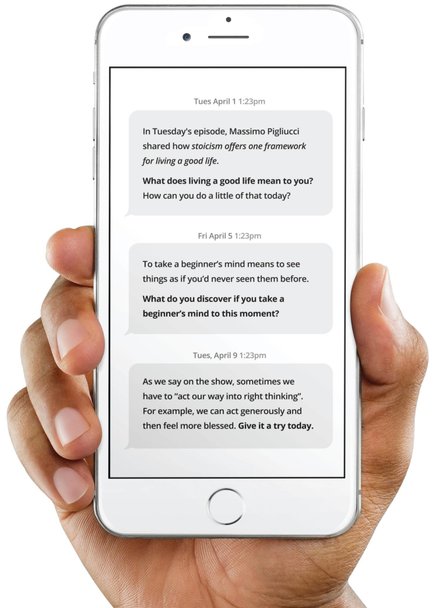
Good Wolf Reminders
A little wisdom, right when you need it. Start receiving free text reminders designed to help you pause, reflect, and take meaningful action. Sign up at oneyoufeed.net/sms.
Key Takeaways:
- Why modern self-care often fails to address the root causes of burnout
- The difference between faux self-care and real self-care
- How systems and expectations shape our well-being
- Why boundaries are essential—not selfish
- The hidden role guilt plays in keeping us stuck
- Practicing self-compassion without lowering your standards
- Aligning your choices with your deepest values
- Reclaiming your personal power in everyday decisions
- Building sustainable habits that support long-term well-being
- Why true self-care helps you show up more fully for yourself and others
Pooja Lakshmin MD is a board-certified psychiatrist, New York Times contributor, and a leading voice at the intersection of mental health and gender, focused on helping women and people from marginalized communities escape the tyranny of self-care. In 2020, Lakshmin founded Gemma — a physician led women’s mental health education platform centering impact and equity. She maintains an active private practice, where she treats women struggling with burnout, perfectionism, and disillusionment, as well as clinical conditions like depression and anxiety. She is the author of Real Self-Care: A Transformative Program for Redefining Wellness
Connect with Dr. Pooja Lakshmin: Website | Instagram | Twitter
If you enjoyed this conversation with Dr. Pooja Lakshmin, check out these other episodes
How to Set Boundaries with Nedra Glover Tawwab
How to Integrate Behavior Change with Your Values with Spencer Greenberg
Crafting a Meaningful Life with Emily Esfahani Smith
This episode is sponsored by:
Shopify – The commerce platform that helps you build, grow, and manage your business all in one place. Start your $1/month trial at shopify.com/feed.
Tiny Health‘s at-home gut health test provides science-backed insights into your microbiome, along with personalized recommendations to help you improve your digestion, energy, and overall well-being. Get $50 off your first test kit at tinyhealth.com/FEED
Monarch: Take control of your finances with Monarch, the all-in-one personal finance app that helps you budget, track spending, monitor investments, and work toward your financial goals. Get 50% off your first year of Monarch Core, go to https://www.monarch.com/ and enter Promo Code: FEED
ButcherBox: Make dinnertime easier with ButcherBox, delivering high-quality 100% grass-fed beef, organic chicken, wild-caught seafood, and more, right to your door. Get $20 off your first box, plus your choice of free ground beef for life or free chicken thighs or top sirloins for a year, with free shipping always. Visit ButcherBox.com/FEED to claim your offer.
David Protein bars deliver up to 28g of protein for just 150 calories—without sacrificing taste! For a limited time, our listeners can receive this special deal: buy 4 cartons and get the 5th free when you go to www.davidprotein.com/FEED
Talkiatry connects you with licensed psychiatrists for personalized, evidence-based mental health care, all online and covered by most major insurance plans. To get matched with an in-network psychiatrist in just a few minutes, visit Talkiatry.com/FEED.
Pebl – an AI-powered platform that helps companies hire and manage global teams in 185+ countries. Get a free estimate at hipebl.ai
Quince: Refresh your wardrobe with Quince by going to Quince.com/feed for free shipping and 365-day returns. Now available in Canada, too.
Alma has a directory of 20,000 therapists with different specialities, life experiences, and identities, and 99% of them take insurance. Visit helloalma.com to learn more!
Episode Transcript:
Pooja Lakshmin 00:00:00 In some kind of spiritual movements or wellness movements, we tend to kind of exalt the person who has overcome the obstacle and forget that there’s going to be more obstacles.
Chris Forbes 00:00:18 Welcome to the one you feed. Throughout time, great thinkers have recognized the importance of the thoughts. We have quotes like garbage in, garbage out or you are what you think ring true. And yet for many of us, our thoughts don’t strengthen or empower us. We tend toward negativity, self-pity, jealousy, or fear. We see what we don’t have instead of what we do. We think things that hold us back and dampen our spirit. But it’s not just about thinking our actions matter. It takes conscious, consistent, and creative effort to make a life worth living. This podcast is about how other people keep themselves moving in the right direction, how they feed their good wolf.
Eric Zimmer 00:01:03 For about six years. Jenny and I went back and forth between Columbus and Atlanta every month to care for both our mothers and wherever we were. One of them wasn’t happy. I felt guilty all the time. And then one day I saw it. It was impossible to make them both happy at the same time, and that was a strange relief. Dr. Pooja Lakshmin is a psychiatrist who works a lot with mothers, and her book real Self-care is about this boundaries and the guilt that follows after we set them. She describes that guilt as a broken check engine light. It keeps going off, but it isn’t telling you anything new. This episode is about which feelings to trust and which to just let blink. I’m Eric Zimmer and this is the One You Feed.
Eric Zimmer 00:01:53 Hi Pooja, welcome to the show.
Pooja Lakshmin 00:01:55 Hi, Eric. Thank you so much for having me.
Eric Zimmer 00:01:56 Yeah, I’m really excited to have you on. We’re going to be discussing your book, Real Self-care: A Transformative Program for Redefining Wellness (Crystals, Cleanses and Bubble Baths Not Included). So we’ll be talking about that. And I think there’s so much great material in there. But before we get there, we’ll start, like we always do with the parable and the parable. There’s a grandparent who’s talking with their grandchild, and they say, in life there are two wolves inside of us that are always at battle. One is a good wolf, which represents things like kindness and bravery and love, and the other is a bad wolf, which represents things like greed and hatred and fear. And the grandchild stops. Think about it for a second. They look up at their grandparent and they say, well, which one wins? And the grandparent says, the one you feed. So I’d like to start off by asking you what that parable means to you, in your life, and in the work that you do.
Pooja Lakshmin 00:02:51 I love the parable. I think that it applies in so many different contexts. And as a psychiatrist, one of the ways that it speaks to me is that it calls our attention to our internal worlds, and it calls our attention to the agency that we have. There is so much, obviously, that’s out of our control, given the sociopolitical context that we live in, and global events that are kind of always taking place and our internal worlds, we get to decide what we give our attention to internally and externally. And the parable to me is really that’s what it’s about, that you can exert choice, you can exert agency. And in doing that, it’s kind of radical, right? And sort of even recognizing that it’s powerful.
Eric Zimmer 00:03:39 I love the way you frame that up. And I’d love to start by heading into talking about real self-care. What’s the difference between real self-care and what you call faux self-care?
Pooja Lakshmin 00:03:51 I wanted to set up this framework in a way that called to attention the wellness industry, for starters. And that’s why, you know, one of the subtitles crystals, cleanses and bubble baths not included. Because in my practice, I see patients come in all the time and they say, you know, Doctor Lakshmin, I’m stressed out, I’m burnt out, I’m not sleeping well, I’m not eating well. And I feel like it’s my fault because I have this meditation app on my phone that I know I’m supposed to be using, but by the end of the day, the last thing I want to do is meditate.
Pooja Lakshmin 00:04:25 And, you know, I’ve said over and over, you can’t meditate your way out of a 40 hour workweek without childcare. Like, that’s not a wellness works. And when we focus on things that are sort of commodified, when we focus on what you can buy, it really takes away from the true meaning of wellbeing. So when I say faux self-care, what I mean is it’s the juice cleanse. It’s the bubble bath. It is also the yoga or the meditation. And I and I know that there’s folks that are listening that are like, hey, wait a second, Pooja yoga really works. Meditation really helps me. And I’m not saying that they’re bad. What I’m saying is that the actual real self-care is the internal process that you take to get to the thing. So you can imagine one person is at a yoga class and they’re on their mat totally in their head, comparing themselves to the person next to them that’s doing a headstand. And they can’t do a headstand. And and maybe they’re not wearing the right Lululemon leggings.
Pooja Lakshmin 00:05:26 And. Right, that’s their yoga class versus somebody else who’s gone through the principles of real self-care, set boundaries, understood how to apply self-compassion to that inner critic in their head, really understood their values, and why yoga is so important, and what it means for them to be at yoga once or twice a week, and how that is actually an exertion of power that person is actually fully present in the yoga class and able to really kind of take it in. But on the surface, both of those are I went to a yoga class.
Eric Zimmer 00:05:58 Right.
Pooja Lakshmin 00:05:59 That’s what I’m kind of trying to explain here. And I will say it is a little bit abstract. You know, the principles of real self-care. There’s four principles boundaries, compassion, values, power. They’re all internal, right? Part of the framework, too, is that I can’t actually tell you what your real self-care is like, what your tool is. You have to work through the principles yourself because it’s different for everybody. Right. For one person, it might be yoga. For another person that week, it might be I’m going to actually go out to dinner with my close friend. For another person. It might be actually, what I’m really avoiding is doing my taxes, and I need to sit down and do my taxes right. So it’s always changing as well.
Eric Zimmer 00:06:39 Yeah, yeah. And I’ve heard you talk about this in a sense of, you know, real self-care is a principle or a set of principles, not tools. Now there are tools that we can use, and I think your yoga class example is a great one. You know, the obvious one being a hammer, right? A hammer could drive in a nail. It could also smash ten windows with it if I wanted. Right. Like, the tool is sort of only as effective as the way in which it’s used, in the circumstances in which it’s used and why it is used. And I think that’s what you’re kind of aiming at is this deeper internal sense of what really matters to me. And am I living my life that way? I mean, to me, that’s the foundation of any kind of good life. You know, it’s not even just self-care. It’s just a good life is about knowing what matters to us and aligning ourselves with that and the situations, the power structures that we find ourselves in often make that very difficult to do.
Pooja Lakshmin 00:07:38 Yeah, I completely agree with you, Eric, and I think that it all comes back down to values, and we can talk a little bit about what values means and kind of how to get there. but like you said, it’s actually hard. It’s actually radical because so much of our external world and the way that we live our lives in this kind of very productivity oriented culture is actually pushing against that, is pushing you against your own unique sort of preferences and quirks and things that actually bring you joy and are telling you, well, no, actually, you know, you should just have an example in the book of a patient who was redoing her kitchen and was like, you know, everyone’s telling me to like, get beige, write beige, everything because that the resale value. And then she says, I hate beige. I hate these. You know, you know, that’s kind of it seems like a silly example, but but it’s actually those are the types of decisions that can be really empowering.
Eric Zimmer 00:08:35 I think about these ideas a lot. Like what does it actually mean to be well, and how do people become well and how do they heal? You know, with my own addiction recovery and depression recovery. And, you know, there’s an idea that I talk about often. It’s not my idea. It comes from the Buddhist concept of refuge. Right. Refuge being a place that you go when things are difficult. And we’ll talk about true and false refuges. Right. And that is like, you know, a false refuge is maybe zoning out all the time to Netflix versus engage in your life. A true refuge might be something like more like yoga or meditation or. But you’re talking about an even deeper level than that, right? Like, it’s one thing to to spend less of our time on the false refuge.
Eric Zimmer 00:09:20 This is the things that don’t actually rejuvenate us, refresh us, make us feel better, and spend more on things that do. But you’re talking about an even deeper level where we’re making really difficult decisions about how and where we spend our time, and that can be really difficult to do. My experience is that’s really difficult for people to do when they’re already overwhelmed. So let’s talk a little bit about, you know, the person who’s like, I’m already drowning. How do I start to implement deeper principle based things which seem like they are going to take a lot more time and energy? How do you approach that with someone?
Pooja Lakshmin 00:09:56 Yeah, and I really appreciate you bringing that up, because it’s true that so many folks really kind of feel like they’re in that drowning place. And I will be totally honest. I have a a little kid, a toddler, I have a demanding career. My partner has a demanding career. I sometimes feel like I’m drowning, too, in all of it. Yeah.
Pooja Lakshmin 00:10:13 So it’s it’s not right. It’s. And I also want to pull back and just also note that the whole framework of real self-care is based on the idea of the concept of eudaimonic well-being, which is probably not new to you or to your listeners. But just as a recap, eudaimonic well-being says that a well-lived life is one in which your activities and your behaviors are aligned with what’s most important to you, with your purpose, and there’s tons of research out there that shows that folks who are able to identify and name their values and their purpose and feel that their life is, for the most part, aligned with those things, not 100%, because no one’s perfect, but right, mostly in that direction. They have better mental health outcomes, they have better physical health outcomes. And this is in contrast to hedonic well-being, hedonic well-being. You can kind of think of it as the pursuit of pleasure or the absence of suffering. That’s kind of like the treat yourself sort of mentality, which I think that’s what we’re kind of referencing a little bit, too, because when you’re drowning, you just kind of feel like, well, you know what? I just need to get that, you know, 600 calories.
Pooja Lakshmin 00:11:27 Starbucks latte, that’s actually a milkshake because I deserve it, right? I just need to escape. I need to watch six hours of Netflix. Right? So the reason that the first principle of real self-care is boundaries is because you can’t even actually get to the values part until you start to make some space for yourself, and you start to energetically really consider what it means to take up space and how to sort of take some stuff off of your plate. The boundaries piece is probably the hardest piece to this whole process, and that’s the reason that it’s the first one. And it’s also the reason that the four principles are sort of it’s a circular process. It’s not just linear. It’s like you’re always kind of basically coming back to boundaries, because if there was one mental health skill to learn, boundaries is the one. And to get back to your question of like how to actually do it. So folks might be kind of rolling their eyes a little bit because I will acknowledge that, you know, basically every therapist on Instagram is talking about boundaries at this point.
Pooja Lakshmin 00:12:31 So it could be a little bit sort of cliche, but my take on boundaries is a little bit different. So I think of boundaries as the pause. Not saying no, but it’s the pause that it’s the boundary. And this was kind of an moment for me back in 2016 when I had just graduated residency from George Washington University. My mentor took me out for lunch, and it was my first day on the faculty, and I was like, bright eyed and bushy tailed. And she was like, Pooja, I have one piece of advice for you. And I thought it was going to be some sort of like, clinical pearl about how to dose SSRIs or like mood stabilizers or something. And she was like, no, Pooja, you don’t need to answer your phone. You can let it go to voicemail. Listen to what they want, decide and then respond. And that’s when I was like, oh, it’s the pause. And then you can choose yes, no or negotiate. Because the truth is there is always a cost to no.
Pooja Lakshmin 00:13:24 Yeah. And that cost might be financial, it might be emotional, interpersonal. But we can’t pretend that no is accessible to everyone all the time.
Eric Zimmer 00:13:33 Right, right. That pause is so important. I had a coaching client once where, you know, we had to set up a new rule, and the rule was that anytime anybody asks them to do anything, they had to say, that’s a really interesting opportunity. Let me get back to you. Even if inside they were screaming yes, yes, yes, yes, I want to do it. The answer was always for this person. Thanks for the invitation to do that. Let me think about it. Because part of what happens, and I know I do this, is I get asked to do something and I evaluate that thing on its own individual merit. I’m like, oh, that does sound really cool. And I’ll say, yes, but does it sound cool when I consider it in the context of everything else that’s going on in my life? I need a pause to be able to do that, you know? And this person we just found like that was the rule we had to set so that they could come back and go, all right, let me have a few minutes to actually think about this.
Eric Zimmer 00:14:27 When is it? What else is going on that week, that sort of thing. So I think that pause is so critical. And I love the idea that a boundary isn’t always no right. That a boundary could be yes. Could be no, could be negotiate. But the critical thing is taking the time to contemplate the decision.
Pooja Lakshmin 00:14:45 Yes. Yeah. And you know, it’s funny. This isn’t my therapy session. I have my own therapist, too, but. But I’m totally going through that right now with writing a book and all of the influx of demands that have come and opportunities in this new kind of phase of my career where I really love seeing patients. I love working with people one on one. I also love writing. And now all of a sudden, my weeks I don’t have time to write anymore. And so I’m going through my own round of real self-care where I’m like, hey, wait, what happened here? How do I get back to the things I actually really enjoy? I do enjoy these conversations too, for sure, but it’s like you have to really be selective and understand, like you said, the context and and I share that story and my own personal experience because I think it’s important for folks to understand that this is always a work in progress.
Pooja Lakshmin 00:15:35 And with every new season of your life, whether it’s a new, whether it’s a promotion you get, whether it’s, you know, a new baby, whether it’s going through divorce or illness, you’re going to have to relearn the skill set because it’s, again, it’s a new context. You don’t know yet what all of the data points are. So it doesn’t mean that you failed. It doesn’t mean that you don’t know how to set boundaries. It just means that you’re just developing the same muscle in a new context.
Eric Zimmer 00:16:02 Yeah, absolutely. So I would love to maybe for a moment, go back to a little bit on the faux self-care side. I wonder if you could share with me what you mean when you use the phrase the tyranny of self-care.
Pooja Lakshmin 00:16:15 Yeah, that came to me, actually in the context of my experience as a health care worker, as a physician. So as many folks know, whatever side of healthcare you’re on, whether it’s the clinician provider side or the patient side. Health care in America is broken. And especially mental health services. It’s so hard to find affordable, accessible care. And so what I was seeing, I mean, even starting in like the 2010s, was everybody was burnt out. I was burnt out as a resident. But the answer that the hospital systems and kind of the higher ups were giving is like, well, you know, learn how to meditate. You know, resilience training, you know, here’s your yoga class. But it was like they weren’t doing anything to actually fix the structural issues. So making sure that there’s like adequate paid leave, making sure that people can have, you know, a certain number of sick days, all of those kind of systemic supports were not there, and instead they were putting the onus on the individual to meditate or to do yoga or to lose weight or whatever the thing might be. And so that’s what I mean when I’m pointing to the tyranny. Like, it’s sort of it’s another way that greedy capitalism. I just came to learn that term greedy capitalism, you know, exonerates the system and puts the onus of responsibility on the individual.
Pooja Lakshmin 00:17:42 And then you feel bad because, you know, like I was saying earlier with, like the meditation app where you go through your whole day and you’re working like triple shifts, but then you feel like, oh, well, if only I took the time to meditate, I’d be able to fix all these problems. And that’s not to say that meditation or any of these individual choices. It’s not that we don’t have agency. We certainly do. But I think, you know, I come from a framework of the dialectic. It’s both and right. We need both the systemic change, and we need to be able to exert our own agency. And you can’t have one without the other.
Eric Zimmer 00:18:13 Yeah. So talk to me a little bit about that idea of the both and of individual change and systemic change. Because this I think is a really it’s a concept I find really interesting to think about and and often difficult to put into practice. Right. Because on one hand, we recognize that the individual solutions are not sufficient, and yet we can’t snap our fingers and have the world be different than it is right now.
Eric Zimmer 00:18:43 And so we are then often back to individual solutions. And even in this role, I think about how many of my conversations should be about the individual ways of dealing with life circumstances versus the systemic. And I’ll be honest, I lean towards the individual because it’s where I feel like I have the most to offer. And yet there is the systemic side. And what I have seen happen in a lot of what I would consider the wellness movement. The self-care movement is this idea of it becomes very individualized and it can become very self-absorbed. And where all my energy is going into, I’m going to get better. And then it’s often talked about like, well, once I’m better then I can contribute to the world. And I think that’s a false choice because that often doesn’t come. I mean, my first introduction to wellness and healing and all that in any real way was a 12 step program. And right from day one, we were encouraged to be helping other people. Right. Working on the collective whole and ourselves were joined together.
Eric Zimmer 00:19:51 And I’m just curious how you think about that. You know, the individual versus the collective or the systemic change. And I think the way you do think about it is different than a lot of ways I’ve heard it articulated. So I’d love to get your thoughts on that. That’s a long question.
Pooja Lakshmin 00:20:06 I love long questions. I appreciate you saying that you lean more towards the individual side because I hold that bias, too. You know, I’m a psychiatrist. I work with people one on one, and that’s where I feel like I can be the most helpful as well. And part of what my own real self care process. Like, part of what rejuvenates me is using my voice to advocate for the structural changes and for my patients and, you know, kind of hopefully moving the conversation to a different place. So I did I actually had a conversation a few months ago for The Ezra Klein Show with Tracy McMillan, who’s a sociologist and an amazing powerhouse. She’s a sociologist, so she comes from the complete other side.
Pooja Lakshmin 00:20:56 And I was a little nervous because I was like, oh, gosh, I’m going to have to really prove to her, you know, because the reality is, the examples that I give in the book of, let’s say, a woman who a patient who is, you know, going through the boundaries, the compassion, the values, and works up the strength to have a hard conversation with her partner about the fact that after having, you know, two kids for the third, she really wants him to ask for having a paternity leave. Right. And that leads to him asking and his company saying yes. And that change goes on to impact everybody else. That’s rare. Right? Like, a lot of employees would say no. And that’s true, that this isn’t every situation or every circumstance. But my take on this is that if wellness and self-care stays commercial, if it stays commodified, then we don’t even have a chance of getting to collective change. Whereas if we start conversing about self-care as an internal process, as a personal process, then at least we have a chance of getting to that collective change.
Pooja Lakshmin 00:22:00 You know, I think of this as the dialectic that we discuss, which isn’t my concept. That comes from dialectical behavior therapy. Marsha Linehan, work of, you know, being able to hold two opposing truths at the same time. And I think that change is always so much slower than we want it to be. One of the things that gives me hope and that helps me stay in the fight, really, because I think that’s what it is, right? Staying in the fight and continuing to have these conversations and reflect and think about your choices is I’m actually the first generation of women on my mom’s maternal side to go to graduate school to get a doctorate, to work professionally outside the home. That’s just one generation. And those types of changes like that’s that’s a big deal. Yeah, that’s a big deal. And yes, it’s it takes a long time. But I think that probably most listeners can look back at their family tree, their family history, and see in 1 or 2 generations how much has changed and how much is different collectively.
Eric Zimmer 00:23:10 Yeah, I think being able to hold the opposites there is really important in this area because it’s both at the same time. The little things that we do, like you being the first person in your family to do X, Y and Z, is like a really big deal and progress is being made. I mean, I can’t help but look around at certain aspects of society and be like, wow, the progress is tremendous and there’s a long way to go. Like I often think about like gay rights, right? Gay rights from when I was an 18 year old to where they are today is a night and day proposition difference. It is an order of magnitude difference. And at the exact same time, there is some gay child being bullied somewhere in some small town in Missouri. Right. Both of those things are true. We’ve made a ton of progress and we’ve got a long way to go. But I feel like it’s so important to grasp both of those things, because at least for me, if I don’t acknowledge and see the progress, it doesn’t give me much hope to continue to try and do things differently. But if all I do is get into a Pollyanna, everything has gotten better phase then. I’m not continuing to advocate for changes that need to occur.
Pooja Lakshmin 00:24:19 Yeah, I completely agree. And I was just thinking back to an experience that I had at Esalen, and I write about this in the book. Actually, I went to Esalan. It was in I think it was like 2018 and I was burnt out as a psychiatrist. I went like very seriously, like I was going to get these deep questions answered. It was like this mindful movement week, and it was a lot of money, you know, it was expensive. Esalan is not cheap. And I remember when I was there, there was this couple. They were in their 60s, I think, and we were eating lunch together and they’re like, oh yeah, we come here once a year for our vacation. We’re here on vacation. And I was so insulted. I was like, this isn’t a vacation. You know, this is serious work.
Pooja Lakshmin 00:25:00 And, you know, this was after Trump had been elected. As I reflected more on this, I think they were more right than I was in terms of thinking about it actually, as a vacation, as a refuge, as a way to get away was probably more accurate than the pressure that I was putting on myself for that week of time. And one of the things that stuck out to me while I was there is that nobody was actually talking about Trump there. It was totally this internal, spiritual, woo woo place. A lot of wealthy white folks. Right. And the absence of any of that discussion about social determinants of health, about identity and race and privilege. It was glaring. So I think even actually just bringing it into the room, just bringing it into the room and like having it be part of the conversation in the wellness space. That in itself is powerful. Like we all know that change takes a long time and it’s hard. And I don’t think anyone’s expecting, you know, their meditation teacher to be able to solve, you know, the mortgage crisis, right? No one has that expectation. Right. But at least to be aware and to bring that into your framework of how you’re teaching and how you’re presenting information, I think goes a really long way.
Eric Zimmer 00:26:44 I had a conversation recently with Padraig O’Tuama. I never know how to say his name. He’s a poet. He runs a podcast with the On Being network called On Poetry, and he had a section and we got into this conversation and I never thought of it this way, but I think it ties a little bit in to what you’re saying, which is he talks about in any sort of church movement or an AA movement or anything. There’s a lot put on the testimony, meaning somebody saying like, I was this broken person or and I did this, or I was having a lot of problems with depression. And then I took ketamine and suddenly I’m better, or I meditate and it makes me feel x, Y, or Z, and those are useful things. But what happens for the people who are sitting there who that’s not happening for? For the person who is the meditation teacher is going on and on about how much meditation has changed their life for one of their students is talking about, and somebody else is sitting there going, well, I meditate 20 minutes every day and my life is still a mess.
Eric Zimmer 00:27:47 Like, what about that? So like, what does that do to people? And I think it ties to what you were just saying. If we’re not talking about the social determinants of wellness, if we’re not taking into consideration the context of which people’s lives are, these ideas can actually become. And I think this is what you’re talking about. With the tyranny of self-care, these ideas can become ways that we feel worse about ourselves, or cause us to disengage from potentially helpful modalities at all, because we feel like we’re not being understood by them.
Pooja Lakshmin 00:28:19 Yeah, that’s such a great point. And it’s interesting, as you were talking, I was also thinking my mind went to the person giving the testimony. And what happens to that person when understandably something traumatic happens in their life, right? And they stop meditating. Or maybe they are still meditating, but it doesn’t work like it used to. And then where do you go from there? And I think for me, that’s why with real self-care, it was so important to frame it as it’s not an outcome, it’s not a destination.
Pooja Lakshmin 00:28:54 Yes, it’s a continuous process. And I think you could probably say the the same about, you know, whether you call it activism or organizing or whatever term you use for moving our society to a more progressive place that it’s, I think, just because of the nature of how deeply inequitable our society is and then the roots on which we were built. I don’t think it’s a destination. I think it’s like we just always have to keep going. And it’s kind of an in some sense, it’s a little aspirational. So to me, progress is actually staying in it. Right. Like staying in the game and like continuing to come back to that work, even when you have moments of burning out, even when you have times where you’re like, you know what? Yes, I did just order something on Amazon, even though I know I should be supporting the small businesses down the street and. Right, like not beating yourself up too much and just being like, okay, well, next week I, you know, I try again.
Pooja Lakshmin 00:29:54 Yeah, that’s I think how we have to think about success. And in my mind, I think there’s a connection there with the testimony and the way in which in some kind of spiritual movements or wellness movements. We tend to kind of exalt the person who has overcome the obstacle.
Eric Zimmer 00:30:10 Yes.
Pooja Lakshmin 00:30:10 And forget that there’s going to be more obstacles.
Eric Zimmer 00:30:13 Yeah. My life is a testament to that, right? I mean, like, you know, I got sober at 24 from heroin addiction. You know, stayed sober eight years, then started drinking again. So it was like, what now? Like all that’s out the window and then, you know, get sober again and depression. And you probably run into this a little bit, too. I think one of the other elements that gets into this, if you’re the sort of person who helps others to any degree you suddenly are worried about when you’re not doing great. Like, is everything I teach people BS?
Pooja Lakshmin 00:30:44 Yep, yep.
Eric Zimmer 00:30:45 Right? Yep. You know, I’ve evolved with that over the years where I’m like, well, no, of course it’s not. You know, because I’m just a human and I have difficult times and I cope with those difficult times way better than I used to. Doesn’t mean I cope with them perfectly, you know. Doesn’t mean that I don’t make mistakes. Doesn’t mean that I don’t do all that stuff, but I do it a little bit better than I used to. But, you know, ten years ago when we started this show, I can’t remember the exact phrase, but I wrote out a little introduction for the show, and listeners can probably tell you exactly what it is because it plays at the beginning of every episode. I just don’t listen to it. But with something along the lines of living a good life takes consistent, creative and constant effort. Meaning like this never ends. You know, it’s not like you’re going to just listen to just the right conversation on a podcast or go to just the right weekend, you know, retreat or week long retreat, and then it’s over, you know, and you’re suddenly, well, for good. Like, that’s not how life works.
Pooja Lakshmin 00:31:40 Yeah, yeah. I’m just nodding my head because I just agree so feverently. And I hate that we live in a culture that like exalts or, you know, kind of puts on the pedestal that it’s better for it to just be neatly tied into a bow, you know, kind of because I think it’s so much more interesting to, you know, I would say people I do therapy with my patients as well as prescribed medications. And that’s relatively unusual for a psychiatrist. But I say it’s because, like, there would be so much more fun for me, like writing prescriptions like that’s fine. That’s like, you know, that’s but the therapy piece is like getting to be with somebody on their journey like that is that’s just such an honor. And, and I, I gain so much from that too, in terms of just the privilege of being there. And what did I want to say? You know, I share in the book, in the introduction, my own kind of tumultuous history, which about a decade ago, more than a decade ago at this time, I left medicine, blew up my marriage, moved into a wellness commune that was focused on sexuality and spirituality and meditation.
Pooja Lakshmin 00:32:44 And I was with that group for two years and then ultimately left and had to kind of rebuild my life and come back to medicine. And part of what led me there was the false belief that there’s just like one answer and that there’s just like this one thing that will fix everything. And also the belief that it’s outside of you that somebody else knows, whether it’s, you know, the meditation teacher, the podcast host, the psychiatrist. Right. Like, it really isn’t, unfortunately, like the reality is for real wellbeing. It’s something that you have to work at every single day for the rest of your life. And ultimately, it does have to come from you. And that’s, you know, and maybe that’s depressing, but I think that’s hopeful, actually, because that gives you back the agency.
Eric Zimmer 00:33:33 Yeah, I was going to say it on one glance. It can feel overwhelming, particularly if you’re in a very difficult spot and you’re like, it’s always going to feel like this. No, I don’t think that’s what we’re saying. I think we’re saying that there’s no destination, you know? Yeah, I think it’s absolutely true. And I think part of the problem, too, is the way that wellness has become commoditized and commercial. And I’m part of that. Right. Like I have a podcast and we get advertising in order to run the podcast. I teach courses, right. And I have to market those courses. Right. And I’m always really struggling with like, the sort of marketing that will actually entice somebody into doing the course versus going over the top. Or, you know, I’ve often said, like, you could boil my entire philosophy down to like, I’ll teach you how to not make things worse. I’m like, that just doesn’t sell. Like nobody’s gonna buy that. It’s a tremendously useful skill, actually, if you have.
Pooja Lakshmin 00:34:27 A great life skill to have.
Eric Zimmer 00:34:29 You know, but I wrestle with this in my own way. And, I mean, you know, anybody who writes a book, right? You’ve got you’re getting blurbs on the book that are just over the top, right? They’re just like, you know, we want those blurbs because that’s what’s going to sell the book. And I just find it. It’s a complicated relationship to have to be both critiquing that space and be in it.
Pooja Lakshmin 00:34:50 Yeah. Yeah. It feels like you’ve been in my brain for the past year or so. as I launch a self-help book. And but you know, what I would say is that the way that I handle this is to be transparent, you know, and to acknowledge like that I do wrestle with it, and that I do not to pretend that it’s not there, those contradictions, but to really bring it into the room. And I think that humanizes the quote unquote experts. I think that it also gives people who are looking for a structure. Right, because we can’t give answers, but we can provide a structure. Right? People that are looking for a structure, it helps them to be as they’re choosing sort of what they put in their ears. Right. Yeah. Who’s on their feet when they’re scrolling, you know. As a physician, I think that I’ve come to the where I’ve landed is that when when doctors are not in these spaces, then the void gets filled with a lot of junk.
Pooja Lakshmin 00:35:54 And so it is actually important to for folks who are coming with integrity and do have training and background and knowledge to, I guess, do the messy work of figuring out how to be there. Yeah, as opposed to kind of staying up on this like high horse and kind of being like, well, that’s beneath me, you know?
Eric Zimmer 00:36:14 Yeah. Let’s get into the principles a little bit more and maybe we can, you know, give some tools for people to use again. Real self-care is not about a tool, but some practices and different things. And so I’d love to just have you sort of reiterate, you know, the four principles of self-care. Again, let’s go into those a little more deeply.
Pooja Lakshmin 00:36:35 Yeah. So there’s four: boundaries compassion, values and power. You could kind of distill it down to because I know everyone likes, you know, just a list. Do less things. Be nice to yourself. Spend your time on what really matters. That’s the hardest one. And either give back or ask for help.
Pooja Lakshmin 00:36:57 And you know, we talked a little bit about boundaries and how my conceptual boundaries is the pause. Right. And you can think of that on the micro level. You know, when an email comes in from your boss or your kid’s school asks for you to join a committee, or you can also think of it on the macro level of like, you know, what do I want my career to be? Where do I want to live? Do I want to have children or not? Like, those are big, big life decisions that you can take a pause or you should take a pause. You shouldn’t just kind of continue on the path of what you think you’re supposed to have your life look like, and then end up doing what I did, which I would not advise blowing it up. And, you know, right. So that’s those there’s kind of two levels to that. Compassion is the next principle because obviously as soon as you start setting limits with people in your life, everyone’s going to be mad at you and have feelings and then you’re going to feel guilty.
Pooja Lakshmin 00:37:57 And so because in my clinical practice, I work with women, mostly mothers, pregnant and postpartum folks. You know, the number one complaint I get is sort of like, okay, Doctor Lakshman, I’m saying no, I’m setting boundaries. But like, I feel so guilty. Yeah, I feel so guilty. You know, and the way that I work with this comes from Acceptance and Commitment Therapy, Act. It takes a lot from Buddhist philosophy, which is like, you know, yeah, you feel guilty. Like, yes. Yeah. We can’t change our feelings. That’s not how feelings work. It doesn’t work to try and run away for from the guilt or to turn the guilt off. And so I think of guilt as actually a manifestation of all of these external social constructs and contradictory expectations that are put in particular on women, but not only women, because I know men experience this in different ways too. But when you’re told that you have to be in two places at once in order to be a good mom, like that doesn’t make sense.
Pooja Lakshmin 00:38:56 You can’t do that. There’s no right choice. And so our brain takes that conflict and makes us the bad guy. And that’s guilt. So one helpful kind of metaphor that I use is to think of guilt as if it’s a broken check engine light on your car dashboard. So, you know, like if you’ve taken your car to get serviced and the oil changed and everything and everything’s good, but then there’s like a light on the dash that keeps going off. It doesn’t actually give you any meaningful information. It’s broken, but it’s just going off. That’s what guilt is. You don’t have to set your moral compass according to the guilts. Like you can just sort of let it be in the background.
Eric Zimmer 00:39:36 Hey, friend, before we dive back in, I want you to take a second and think about what you’ve been listening to. What’s one thing that really landed and what’s one tiny action you could take today to live it out? Those little moments of reflection. That’s exactly why I started good wolf reminders. Short, free text messages that land in your phone once or twice a week. Nearly 5000 people already get them and say the quick bursts of insight help them shift out of autopilot and stay intentional in their lives. If that sounds like your kind of thing, head to one oneyoufeed.net/sms and sign up. It’s free! No spam, and easy to opt out of any time. Again, that’s oneyoufeed.net/sms. Tiny nudges, real change. All right, back to the show.
Eric Zimmer 00:40:27 So let me ask you a question about that, because this ties to another concept that comes up that you talk about later on under values. And it’s this idea of the shoulds, right? I should do this. I should do that. Right, which is associated with there’s a guilt element of that. Right. And there are certainly ways in which we are absorbing these shoulds from the outside world, and they’re making us feel guilty. But I found in my life that guilt is often also the way in which I recognize when I’m not living according to my values.
Eric Zimmer 00:41:03 So how do you tell the difference between the guilt that is sort of being put upon you, that you just need to sort of ignore, like the broken engine light, like just kind of okay, yeah, it’s there. I’m going to let it be there. The feeling’s there. I’m just but I’m still going to proceed in this direction versus a sign that I’m not living according to what I value. And this is where the should gets really interesting because we’ve got, you know, it’s become a big thing. Like don’t shoot on yourself, don’t shoot on yourself. But a lot of times for me, my values end up almost being a should. Let me say that in a different way. It’s very difficult for me to tweeze out what is a externally given should that I don’t want to live into anymore? And what is an actual internal should that I actually know and believe? And tweezing that apart sometimes feels nearly impossible because we are conditioned at every level, all the way through our being. I’m just kind of curious how you think about those different things, because to me it’s more complex than just saying, I’m going to ignore the shoulds and ignore the guilt because there are times that those things are actually, to me, ways of being an indicator that I’m off track.
Pooja Lakshmin 00:42:17 This is a great question. There is a difference in how the guilt presents itself when it’s coming from the culture and the expectations of an external environment, versus when it’s more based on an internal kind of conflict. And of course, there can be overlap. Right? Right. At times I think that from what I’ve seen, is that when it’s externally based, there’s more of an urgency like that feeling or like the voice or however your internal dialogue or narrative works. Like, it just it comes really quickly and there’s like a panic to it. And it usually has sort of like the same quality over a variety of different situations. So whether we’re talking about like things in your personal life with your partner or whether we’re talking about something that’s going on in your work life with your boss. Like there might be a similar tone to the narrative or there’s like just a generally a more urgent sort of feel and a consistent voice. Whereas the more internally based feedback maybe we could call it, I think is is like softer.
Pooja Lakshmin 00:43:35 It doesn’t have as much of like a panicked urgency. Like it’s more like you’re reflecting and you’re thinking and you’re kind of like, Oh, okay, let me, you know, let me go there. Let me let myself sort of like go there and explore that. Whereas the external voice is like, it’s not about like, go there and explore that. It’s like it’s shouting at you.
Eric Zimmer 00:43:57 Yeah. That’s interesting.
Speaker 5 00:43:59 And they might be mixed too.
Pooja Lakshmin 00:44:00 Yeah. Like right. There can be times where they’re mixed, and then that’s where it’s helpful to have a therapist or a coach or, you know, somebody that can be an external, supportive, validating, non-judgmental person to be able to tease things apart with.
Eric Zimmer 00:44:42 I’m trying to feel into that experience. And I think you’re actually right to some degree, that the guilt that comes from disappointing someone else does feel more panicky. Like I’ve said before, on this show in my life, I have noticed, like a particular voice that will show up for years, it was, I need a drink, I need a drink, I need a drink. Even after I was sober. And then it transformed from that into what does not sound better, which is I wish I was dead, I wish I was dead, I wish I was dead. But what I realized when I started to really look at that, I noticed where it most often came up, and it most often came up when I was in a situation where I was going to have to disappoint someone, primarily when I was in a situation where there was no way not to disappoint someone. You know, like the decision I’m going to make is either going to make my wife happy and my son unhappy, And that caused in me a sense of despair. That isn’t the same as when I am feeling internally off track. The phrase I wish I was dead right is so over the top. Urgent feeling in comparison. And that’s where it came up in me. You know, it comes up in those circumstances.
Eric Zimmer 00:45:53 And you know, I love what you said about a mother who can’t be in two places at once. Ginny and I had a similar experience recently. I talked about this at great length on another episode, and I don’t know where they come out in relation to each other, but an insight I had. But my mom was in Columbus and was having some health challenges. Her mom was in Georgia and was battling dementia, and we went back and forth between the two and I realized, you know, I was carrying this weight that like when I’m in Georgia, my mom’s not happy. And when I’m in Ohio, her mom’s not happy. And I was carrying that emotional weight until I realized one day, like, oh, wait, it is literally Impossible to make them both happy, like it can’t be done right. All of a sudden there was a freedom there for me in that. And so I think that was a way of resolving that conundrum. But but I think what you just said really makes a lot of sense to me about the tone and the urgency of, quote unquote, that guilt.
Pooja Lakshmin 00:46:52 Thank you. And you know, what you just said to about, like, it’s literally impossible for me to act in a way that will have both of them feel happy at the same time. And you said that gave you freedom, and I think, or a sense of freedom. And like one of the ways that I think about that, I think it’s a similar thing, is that it’s not yours, that it’s not your feeling, the weight of it that you were carrying around. It was not yours to carry. Yeah. And so maybe that’s one of the ways where when I’m talking about like internal versus external, that’s a way that it’s maybe a little bit of a semantic thing too. But I think, you know, what we’re describing here is the whole point of real self-care. And my hope for real self-care is that it invites these deeper conversations in ourselves and with others, where we can reflect on how we manage our time, how we think about the expectations that are put on us and that we have of ourselves, and kind of tease apart all these different threads, because the answer is, again, like they’re different for everyone and they’re not easy to come to in that you do have to wrestle with it. You do have to kind of work with it. It’s not the same as just kind of saying, okay, well, you know, here’s the exercise plan. Here’s here’s the right, you know, here’s the ten step like skincare routine, you know.
Eric Zimmer 00:48:15 Yeah. And I think the other thing about this idea of boundaries is that we get the idea that sort of once we set them or establish them, they’re sort of in place. Right. And life is a lot more dynamic than that, right? Like, I may set a boundary, which is I’m going to take very good care of my physical health. And the way I’m going to do it is X, Y, and Z, and that is my boundary and it’s my value. And then there can be a circumstance in which another value of mine say my dog’s well-being, there’s a crisis, and that then all of a sudden needs to supplant the boundary that I just set around around this thing. Right? Like, it’s not so easy as, like, you just line your values up one through five, and then you just kind of have your marching orders because life doesn’t work that way.
Eric Zimmer 00:49:05 Right. You know, life is always throwing different circumstances at us. You know, there’s this idea in in habit creation. You know, we our culture has become so obsessed with the idea of habits. I mean, I talk a lot about behavior change, and I think they’re important. But the key thing in there is that habits only form in a stable context. And most of us don’t have stable contexts is our lives. If you’re a parent, you do not have a stable context, right? If you have a career on top of it, you probably your career doesn’t give you a stable context either, because some weeks you can leave every day at five, and other weeks you know, you’ve got some big thing and you’re like, oh, there’s an emergency. I’ve got to be here till nine, right? You know. And so with the context always shifting, our boundaries also have to be shifting. And that’s why I love the idea that you have over the pause.
Eric Zimmer 00:49:53 Right. The pause of okay. Given all the circumstances that are at play right now, what’s the right wise response for me? Yeah. To allocate my time because that’s often what we’re talking about here. Right. We’re talking about a time allocation. You know where I spend my time.
Pooja Lakshmin 00:50:08 And the flexibility. Right. When you kind of think of it as like just a rigid thing that’s actually not helpful. Like, we need to be able to cultivate that flexibility. And I think this is probably a nice place to talk about values too, because I think that values, you know, it’s the crux of all of this. And the reason that values isn’t the first principle is that because you actually do need to get some understanding of the boundaries and the compassion before you come to values. I think one of the things that I’ve noticed with my patients is that when I ask them about their values, like when I say like, well, what really matters to you? What do you really care about? What’s most important? I get one of two responses.
Pooja Lakshmin 00:50:49 Either I get like a very stock answer, like, you know, will my kids, you know, or or my parents, which is like, that’s actually that’s not helpful because we all value our children. We all value our families, right? And the other piece of that too is a value. It needs to be like an adverb or an adjective, like it’s supposed to be a quality, because you can embody the value as you’re moving towards the goal, right? It’s not static. Again, pointing to that flexibility. The other interesting response I get is is actually anger because people are like, well, I don’t have time to think about that. Like, I’m worrying about, like, what’s for dinner tonight? And who’s going to pick up Johnny from soccer practice? And like, who has time? Right. Which is true. And it’s worthwhile to make time because this is the type of inner work that is an investment. Yeah. It reaps the rewards. So one of the exercises that I have in real self-care for values, and I really love it a lot, and it comes from acceptance and commitment therapies.
Pooja Lakshmin 00:51:52 And it’s silly, but it’s silly for a reason, because I think you do have to sort of like shake things up for people to not be so worried about the shoulds with values. So imagine you have $200 to throw a dinner party. What is that dinner party going to look like? And you kind of just let your mind go with it, you know? Is it going to be or are we going to be outside in the park? Is my friend who plays in a band going to come play? Is it going to be a potluck? And like everybody brings their favorite dish from the last state or country that they visited. Or maybe your mind goes through like, you know, sitting down at a table and the color scheme for the placemats. And it’s so easy in that little activity or exercise to understand that every single person is going to have a completely different dinner party. There’s no best or right dinner party. It really is like it’s your preference. It’s what you care about. And then from there, then you pull out the adjectives and the adverbs and you know, for one person it might be like, I want to look around and see everybody in like really deep conversation.
Pooja Lakshmin 00:52:54 And maybe the value is like connection or like intimacy or something like that. But maybe for somebody else it’s like, I want to see everybody dancing and maybe it’s like physicality or like embodiment, right? And you play with that because like what you were saying in different seasons of your life, the values are always changing. You have to be flexible with it. But I share that because I think it’s a nice introductory way for folks that are wanting to, you know, take some of this work and try and implement it in their lives right away. You can do that, and then you can play around with it and see like, okay, how do I incorporate that value into my week? How do I take whatever values came out from there? And how do I actually put that into my yoga class, or how do I put it into I’m training for a marathon. How do I put that into my training? You can take that and put it anywhere in your life.
Eric Zimmer 00:53:43 I love that, I love that exercise. I mean, I’ve interviewed both Stephen Hayes and Russ Harris and asked them, like, what do you think is the best tool for creating values and all that? But I’ve never heard that one, and I love that idea because it does show how different it is. And, you know, I think values work for me is often overwhelming because, you know, there’s a big list of values. And I’m like, well, yeah.
Pooja Lakshmin 00:54:05 They all sound good. I agree, I agree with all those things.
Eric Zimmer 00:54:07 Right. And so I think that values work is difficult for people because, you know, you do have to really contemplate fairly deeply and it causes you to recognize that you can’t value everything in the same way that contemplating your time, how you spend your time deeply causes you to confront a very similar fact, which is, I can’t do all the things I want to do. So I have to decide. And, you know, anytime we make a decision about choosing one thing, we’re not choosing other things and that can be deeply uncomfortable.
Eric Zimmer 00:54:40 And then the other thing that values, I think, is so interesting, is that sometimes living according to your values is actually a drag. You know, like we talk about it as if, you know, living according to your values and it’s all going to be wonderful. Sometimes that kind of sucks, right? Like, you know, Ginny and I both had a value of taking care of our mother, right? And that caused us to live through a season of life that we did a lot of things we didn’t particularly want to do. If I was just choosing what makes me happy, but were about what we valued, you know? And so but I’m a huge proponent of values and reflecting more deeply because again, you can’t. And I think this is where I think your, your framework of these four are sort of interdependent or circular. Right. Like maybe I start with boundaries to clear out a little bit of space. Right. But after I do my values work, I may come back and change those boundaries because I’m like, oh, wait a second, now I totally see what I value in a different way than I did before. It often seems like boundaries work is, at least in the beginning, a little messy and then can get refined over time.
Pooja Lakshmin 00:55:46 Yes, yes. And you know, I was just thinking as you were talking and you’re sharing the example of with you and Ginny and your aging parents. Like the crux of why you’re able to feel the way you do about it now is because you could make meaning of the time and energy that you spent, because you named your values and you were very clear and reflecting on that meaning. And I think this is important because I think that many folks are living lives aligned to their values. They just haven’t taken the step to name it and understand the meaning. Yes, it is an extra step. It takes time, but once you do it, it gives you a better understanding of why you’re doing what. Yeah. Gosh, it really it sucks that I have to drive my kid 30 minutes to soccer practice, you know, every other day. And. But then you think, like, actually, this soccer team is something that I know he loves and is giving him just such an amazing experience of, like, middle school or whatever, right? And then when you name that, it reminds you of the why?
Eric Zimmer 00:56:53 I could not agree more with what you just said, which is that I do think a lot of people I don’t know if I’ll say most people doesn’t even matter. Yeah, yeah, are living according to their values and they’re not connecting the dots. So I use the exact same example you just did, which is, you know, taking my son to soccer practice. Right? I would get into this. I have to take him to soccer practice. I have to take him to soccer practice. And then, you know, realizing like, no, actually I do not. So why am I doing it right? Okay, now I’m connecting to why this thing matters. You know, in my Spiritual Habits program, I talk about generosity. And I’m like, one way to take this lesson is you need to do more. But the other way to take it is you could look at the ways in your life that you actually already are a generous person and connect to those you know, connect to the meaning that being a good parent is right.
Eric Zimmer 00:57:41 We just get on autopilot and it just becomes something we keep thinking, I have to do, I’m trapped by. But when we reflect on what really matters, we’re suddenly like, oh, these things are what really matters. It’s just they’re not always as fun as I might like them to be. And but can, you know, making meaning does require that connection that you’re talking about. Makes me think of another part in the book that you talk about. And I want to see if I could find it here. You’re talking about being too goal focused, and you say when you’re too two goal focused, you spend too much time in the problem solving part of your brain, and you miss out on the good feelings that come when you achieve your goals. And you said, I think of gratitude not as counting your blessings, but as a form of digestion. Right. Talk a little bit about digesting good experiences, because I think it applies to what we’re talking about here too, which is digesting the meaning that our lives actually hold.
Pooja Lakshmin 00:58:34 Yes. So this comes from, again, sort of the Buddhist framework of the hungry ghost, those beings inside of us that have those thin necks but big, big bellies. And so you’re just taking in all these experiences, but they’re getting stuck. You’re not actually digesting the nutrients. So that is one of the ways that I connect to gratitude, because I find like the gratitude lists and things like that to be a little bit tyrannical. Like another thing I beat myself up over because I haven’t done it right at the end of the day. So instead, thinking of it as looking at what you have and actually being present for it and allowing yourself to fully have it. You know, I was listening to an episode that you did with Greg McKeown. I think it was a while ago, and he talked about, you know, the way to have more is not to try and get more, but to actually have the things that are already in your life. Yeah. And I think that’s a similar ethos, right, where you actually engage and are present and enjoy what is already there.
Pooja Lakshmin 00:59:42 The reason that I like digestion, I guess, is because it calls to mind actually taking in the nutrients. And, you know, it’s funny because I think I’m I’m living that right now with, you know, having my first book out and all of the things that have come with it that are so great, but also like having to really do some internal work to be present and to allow myself to have it and to like, give myself that. Especially if you’re somebody who’s, you know, admittedly an overachiever and a type A person. You’re just, like, so easy to just run to the next thing. Yeah, that’s not real self-care, right? You have to stay in what you have. I was also thinking that this is a great segue into power. The last principle we were talking about meaning and actually like naming these connections. And as I was researching the for the book and looking at the origins of of self-care, one of the things that came out is that there’s actually two parallel origins.
Pooja Lakshmin 01:00:38 There’s people in medical community, actually. Psychiatrists started using self-care as a term to refer to like exercise and diet and things like picking out your clothes that folks who are in locked psych units could do as like places. They actually had choices while being, you know, involuntarily committed. But then the other side there was Audre Lorde and bell hooks, the black queer activists and thinkers who were talking about self-care as self-preservation, especially for marginalized groups. And so with power as the last principle, what I’m trying to do is like, bring this back to the boundaries, the compassion, the actually aligning and acting according to your values is that’s a way that we take our energy back. That’s a way that we actually live some form of resistance against a society that’s sort of constantly trying to extract, extract, extract anyway. And so I was actually in Saint Paul at McAllister University on my book tour, talking to a group of higher education professionals. And there was a woman there, professor she she was gay and she taught queer literature at Macalester.
Pooja Lakshmin 01:01:50 And she said, Pooja, you know, I’ve read your book and I really resonate with things you’re talking about, but how do I deal with the rage? Like, how do I deal with the fact that there’s so much that is unfair and there’s so much that’s out of my control. And I have students who are gay who come into my office crying and who at times are, you know, suicidal. Like, that’s the level that I’m dealing with and I feel like I’m not doing enough. And so we chatted and we talked a little bit more. And she remembered that she writes young adult queer sci fi novels for fun on the side. She had forgotten about this. So right. She takes all of her rage and she puts it into these books and she self publishes them and, you know, they’re on Amazon. And that’s what she does with the rage. She puts it back into the community and create something that is meaningful for young people. And just by naming that and making that connection, she felt a level of kind of freedom, like a little weight was lifted, like, oh, I am doing something that this is my way. Like, maybe I’m not holding a picket sign. Maybe I’m not running for political office, but I’m doing this.
Eric Zimmer 01:03:05 As we wrap up, take one thing from today and ask yourself, how will I practice this before the end of the day? For another gentle nudge, join Good Wolf Reminders text list. It’s a short message or two each week, packed with guest wisdom and a soft push towards action. Nearly 5000 listeners are already loving it. Sign up free at oneyoufeed.net/sms. No noise, no spam, just steady encouragement to feed your good wolf. We are at the end of time. We’re actually even over the end of time. Which is fine because I’ve loved this conversation. You and I are going to talk briefly in the post-show conversation. I would love to talk about the real self-care thermometer. How do I know how I’m doing here? And we’re going to talk about that in the post-show conversation. Listeners, if you’d like access to the post-show conversation to add free episodes and the pleasure of supporting a show that really does need your support.
Eric Zimmer 01:04:04 You can go to one youfeed.net/join. Pooja, thank you so much for coming on. This has been a great conversation. I feel like I just sort of abruptly ended it, but I’ve been trying to find a way to end it for like 20 minutes and I’m like, oh, I got to hear that. I got to hear that. So this has been really enjoyable.
Pooja Lakshmin 01:04:20 It’s been such a pleasure. Thank you so much for having me, Eric.
Eric Zimmer 01:04:23 Thank you so much for listening to the show. If you found this conversation helpful, inspiring, or thought provoking, I’d love for you to share it with a friend. Share it from one person to another is the lifeblood of what we do. We don’t have a big budget, and I’m certainly not a celebrity, but we have something even better. And that’s you just hit the share button on your podcast app, or send a quick text with the episode link to someone who might enjoy it. Your support means the world, and together we can spread wisdom one episode at a time. Thank you for being part of the One You Feed community.
Leave a Reply