

Are you playing a game you actually want to win? In this episode, Seth Godin explores how to make intentional choices about the life you’re building—and recognize when someone else’s definition of success is steering you off course. Drawing on his book, This Is Strategy, Seth shares why chasing more can distract us from what matters, how the systems around us shape our behavior, and why a disappointing outcome doesn’t necessarily mean we made a bad decision.
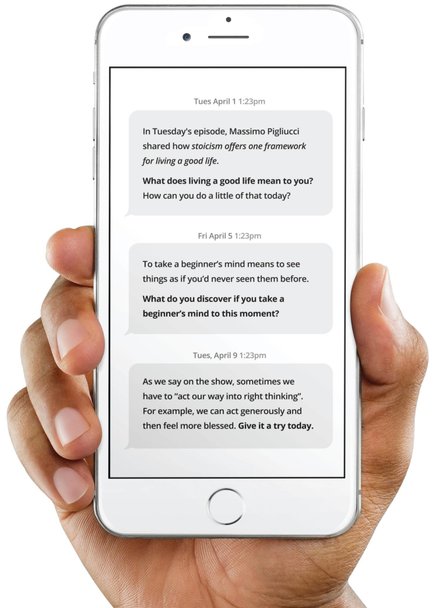
Good Wolf Reminders
A little wisdom, right when you need it. Start receiving free text reminders designed to help you pause, reflect, and take meaningful action. Sign up at oneyoufeed.net/sms.
Key Takeaways:
- Why strategy matters in everyday life, beyond business and career goals
- How to recognize the systems shaping your choices—and find opportunities to act differently
- Why measuring the wrong things can pull you away from the change you want to make
- How to shift your attention from achieving more to doing work that matters
- The difference between a good decision and a good outcome
- How to think about whether to keep going or change your approach
- Why community helps us sustain meaningful change
- How today’s choices shape the person you’re becoming
Seth Godin is the author of 21 international bestsellers that have changed the way people think about work and art. They have been translated into 38 languages. His breakthrough books include Unleashing the Ideavirus, Permission Marketing, Purple Cow, Tribes, The Dip, Linchpin, The Practice, and This is Marketing. His new book, This is Strategy, is an essential guide to thinking strategically in a complex, ever-changing world. He writes one of the most popular daily blogs in the world and has given 5 TED talks. He is the founder of the altMBA, the former VP of Direct Marketing at Yahoo!, and the founder of the pioneering online startup Yoyodyne.
Connect with Seth Godin: Website | Instagram | LinkedIn
If you enjoyed this conversation with Seth Godin, check out these other episodes:
How to Integrate Behavior Change with Your Values with Spencer Greenberg
How to Get Unstuck with Adam Alter
How to Think More Clearly and Make Better Decisions with Shane Parrish
This episode is sponsored by:
Ka’Chava is your daily all-in-one shake, with protein, fiber, greens, superfoods, vitamins, minerals, omega-3s, probiotics, and more. Go to KaChava.com and use code FEED for 15% off your first order.
David Protein bars deliver up to 28g of protein for just 150 calories—without sacrificing taste! For a limited time, our listeners can receive this special deal: buy 4 cartons and get the 5th free when you go to www.davidprotein.com/FEED
Episode Transcript:
Seth Godin 00:00:00 The problem with holding a grudge is your hands are too full to hug somebody. And what I found is that carrying around a narrative of insufficiency or anger or revenge doesn’t hurt the other person. It hurts us.
Chris Forbes 00:00:21 Welcome to the one you feed. Throughout time, great thinkers have recognized the importance of the thoughts. We have quotes like garbage in, garbage out or you are what you think ring true. And yet for many of us, our thoughts don’t strengthen or empower us. We tend toward negativity, self-pity, jealousy, or fear. We see what we don’t have instead of what we do. We think things that hold us back and dampen our spirit. But it’s not just about thinking our actions matter. It takes conscious, consistent, and creative effort to make a life worth living. This podcast is about how other people keep themselves moving in the right direction. How they feed their good wolf.
Eric Zimmer 00:01:06 Years ago, Seth Godin directed a fourth grade production of The Wizard of Oz. He cast for Dorothy’s Four Tin Men Four of everything and swapped them in and out during the show. So 16 kids got to be the star. The first two weeks of rehearsal had no script. He just taught them how to stand up and be loud. It was not a good Wizard of Oz, but 15 years later, kids still tell him they remember it. That’s an example of a strategy, and Seth’s argument in this strategy is that everyone has one, whether they choose it or not. We talk about families, systems, and how to tell whether what you’re doing hasn’t worked yet or it isn’t going to work. I’m Eric Zimmer and this is the one you feed. Hi, Seth. Welcome to the show.
Seth Godin 00:01:57 Well, thank you for having me. It’s really a pleasure.
Eric Zimmer 00:01:59 We are going to be discussing your latest book, which is called This is Strategy. Make better plans. But before we do that, we’ll start like we always do with the parable. In the parable, there’s a grandparent who’s talking to their grandchild, and they say, in life there are two wolves inside of us that are always at battle. One is a good wolf, which represents kindness, bravery, and love. And the other is a bad wolf, which represents things like greed and hatred and fear. And the grandchild stops. They think about it for a second. They look up at their grandparent and they say, well, which one wins? And the grandparent says, the one you feed. So I’d like to start off by asking you what that parable means to you and your life and in the work that you do.
Seth Godin 00:02:43 Well, of course, it reminds me of Zig Ziglar. And Zig showed up in my life with that story just in time to change it. When I was in my early 20s, and he expanded it by talking about the bank. And if you’re constantly making deposits into your savings account, it’s going to grow. And we don’t think it’s odd that someone takes a shower every day or eats lunch every day. Why don’t we feed our good wolf every day? And I have found through the years that every time I focus my attention and offer sustenance to the good wolf, it makes my life better. It’s not something I have to do. It’s something I want to do, and I’m glad to do it.
Eric Zimmer 00:03:29 Yeah, it really is this sense. Oftentimes with things like this, we think we’re going to do something that’s going to be the last thing we have to do towards our well-being. And again, we recognize it with things like showers or exercise. Like that’s preposterous. Like you’re not going to take one shower that’s going to last forever. But when it comes to our inner lives, we often believe in some end state that we arrive at.
Seth Godin 00:03:53 Yeah. No. And the Buddhists haven’t done us any favors by talking about achieving nirvana. The problem with holding a grudge is your hands are too full to hug somebody. And what I found is that carrying around a narrative of insufficiency or anger or revenge doesn’t hurt the other person. It hurts us. And so finding ways, you know, zig took it really far. He refused to call that thing at the traffic intersection. A stoplight said its only purpose is to help the traffic go so it’s go light. But the absurdity of that is part of it is that if we find ourselves constantly adopting hygiene about who we want to become, it happens.
Eric Zimmer 00:04:42 So let’s talk about your new book. This is strategy. Make better plans. I said to you before we started, we’re not generally a a business podcast, but your book makes pretty clear that strategies aren’t just for business. They are for us. They are for our families. Talk a little bit about the role strategy plays in our personal lives or our family lives.
Seth Godin 00:05:08 Well, isn’t that where it begins? I mean, most of us don’t spend all of our days thinking about business. We spend thinking about the change we seek to make, who we seek to become, the influence we want to have on other people. And so you need a strategy to talk your way out of a parking ticket. You need a strategy to figure out how to have a family life that sustains you. You need a strategy for how you’re going to use your limited resources to build the life that you want to have.
Seth Godin 00:05:40 All of these things are simply what choices do we make today to build the assets that lead to tomorrow being what we hope for, and they should not be reserved for Microsoft or some other giant corporation. And for anyone who has to deal with anybody else or anything else in the world. If you’re stranded on a desert island, you’re still going to need a strategy to survive.
Eric Zimmer 00:06:05 So how do we start to go about thinking about strategy on these smaller levels? What are the main components of a strategy?
Seth Godin 00:06:17 So for something that we talk about all the time, we hardly ever talk about it. And what I found is there are almost no good books about strategy which attracted me to writing one. And I am arguing that there are four components systems, games, empathy, and time. So let’s start with time. Nobody says I need to have a full grown apple tree in my backyard today. What they do is they plant seeds. They water them, they fertilize them. It’s understood that trees grow over time.
Seth Godin 00:06:50 Well, we have a strategy of going through the educational system. We have a strategy for developing your lifestyle over time. So the first question I ask is why will this be better tomorrow if you do something today? That’s the first part. The second one is empathy, which is when we deal with anything in the outside world, that thing, that person has power. They can make choices. Why will they choose to do what we need them to do? Why will they choose to hire us as a freelancer instead of going on Fiverr and paying half as much? Why will they choose to come to our dinner party instead of you? Get the idea. When we have the empathy to grant people power. We don’t get disappointed and surprised when they make a choice. Third one is games, not board games, because most board games aren’t very good. But the concept of games which have rules, boundaries and outcomes. And if you view what you’re doing as a game, it’s much easier to not take yourself so seriously and to realize it’s not personal.
Seth Godin 00:08:03 They’re making moves. You’re making moves. Where does that get us? And the last one, which we could talk about for 17 hours, is systems. You know, there are lakes and there are rivers. And I live near the Hudson. The Hudson River looks a little bit like a lake, but it’s not because it has a current. And currents are the invisible or not invisible forces that push us in a given direction. Fighting a current. Fighting a system might be worthwhile, but you better do it on purpose. So a lot of the things we’re going to talk about today are. Yeah, but what system are you in, and how is the system pushing you to act in a way you don’t want to act?
Eric Zimmer 00:08:42 You said we could use strategy for improving our family. Using that as the example, let’s talk through those four components. So time.
Seth Godin 00:08:54 Okay. So if we’re going to focus on family let’s say you have a seven year old kid. Your seven year old kid is going to be eight next year.
Seth Godin 00:09:04 The effort that you’re putting into developing your relationship and this person is not so that they will be the perfect seven year old. It’s so that they will go on a path to become an adult who is self-sustained, satisfied, confident, etc. when we think about this seven year old, what do they want? Well, empathy teaches us that what they want is status, affiliation, and the freedom from fear. Those are the three things everybody wants. So what do they mean? Well, if a seven year old is being oppositional and you say, time to go to bed and they say no, they might be tired, but they’re saying no because their status goes up if they defeat you. Right? And affiliation is people’s desire to be connected. To fit in. To be part of something. So when we alienate someone in our family because we want to get something right now, we have sacrificed our connection, our affiliation. And the last one is freedom from fear. So if a kid’s at summer camp and I helped run a summer camp for 43 years, it is homesick.
Seth Godin 00:10:12 Homesickness isn’t a real thing. It is fear of a real thing. Right? That a kid is safe, surrounded by a friendly kids, but they’re homesick because they’re afraid of what might happen. We don’t deny the fear. We acknowledge the fear. We name the fear. We talk through the fear and then offer affiliation. And then over time, that person can get to where they hope to go. So all of these things They’re not manipulations. They’re the empathy of having strategy to intentionally make relationships and people better. And as soon as you do that and personalize it and realize it’s a game. When your seven year old swears at you, you don’t take it personally and you don’t yell back because you see what they’re doing and you understand it with empathy.
Eric Zimmer 00:11:04 What are the systems at play in a family?
Seth Godin 00:11:10 So there are therapists who are trained in this, and I am not. But let me tell you some of the systems that are going on. First of all, that seven year old wants a smartphone.
Seth Godin 00:11:21 Why? Because their peers have a smartphone. Because the smartphone has a network effect. Because if they don’t have one, their status is going to go down, their affiliation will be broken. And the system just keeps reinforcing that. We have to push against that if we’re going to have a different outcome. There is this system within families of people wanting to fit in all the way but stand out, wanting to be part of something but separate from something. There is the College industrial complex, which is a huge, powerful system that pushes people from a very early age to think that they have to go to a famous college, and that has created the conditions for parents to think they are failures. If their kids don’t get into a famous college and to make go into quarter million dollars into debt. These are systems. So, you know, I coached a kid down the street who just went to college, and the application process feels like you’re being judged. You’re not being judged. Your application is being judged.
Seth Godin 00:12:25 You are playing a game. Once you see the system, once you realize if 50% of the people who get into Harvard get in because of sports, et cetera, et cetera, etc., you play a different game and not take it so personally And end up achieving what you want to achieve by helping them achieve what they want to achieve. So there are games within games, systems within systems. None of us are doing this all by ourselves.
Eric Zimmer 00:12:49 You talk about there being a couple of myths with systems. One is that we have unlimited power, which is basically to ignore that systems are at work, right? More or less like I could just do whatever I want. There’s, you know, it’s all up to me. And then the other myth is that we have no power. When you say that the the power lies somewhere between infinity and zero. And I think that question of understanding what things we can change and what things we cannot change, is a really difficult one. We often set up straw men to make it seem easy.
Eric Zimmer 00:13:29 You know you can’t change the weather, but you can’t change your clothes. You know something dumb like that. But this is really hard. And when you start talking about complex systems. It gets even harder.
Seth Godin 00:13:38 Yeah, yeah. No, this is brilliant. And it gets right back to. Which wolf are you feeding? Because left to our own devices, none of us would feed the Bad wolf its systems and pressure and fear that causes us to do that. And the easiest thing to do is become a victim. I’m just doing my job. I just got to feed the family. I just got to pay the bills. And the next thing we know, we’re been working for a cigarette company for ten years, and we have a drinking problem because we let the system win. But the alternative is to believe that the system doesn’t affect us whatsoever, and that we can just do exactly what we want to do. So the dance in between them, acknowledging our privilege, but also acknowledging that we don’t have complete control, forces us to do the adult thing, which is to see the system, name the system and pick our shots.
Seth Godin 00:14:33 You know, as a parent, you got to think really hard about it. Are you going to tell the school system? I’m not participating. Are you going to tell the school system I’m participating, but my kid’s going to say whatever they feel like saying, and we don’t care about grades. Are you going to tell the school system? I will do exactly what you say all the time. Right. Clearly, there’s something in between those that makes you a great parent. And there’s no map. There’s no easy checklist. There’s just a compass. And the compass is. Can I define describe what this kid is going to be like when they’re 22? Can I tell you the stories that they’re going to tell about their childhood? Now how do I create the conditions for that to happen?
Eric Zimmer 00:15:41 You know, I think on one level it’s easy to distinguish strategy from tactics, right? Strategy being the overall plan, the tactics being what do I do next? Right. I think you say somewhere that a strategy is just all the tactics after each other, and yet you can’t define all that completely in advance.
Eric Zimmer 00:16:05 So how do we think about strategy changing over time? I’m trying to maybe anchor us on something a little bit more specific. Yeah. How do we think about when our strategy is either we had the wrong goal or we’ve got the wrong plan to get there.
Seth Godin 00:16:28 Right? Right. So Strategies are hard to come up with and worth sticking with. Tactics change all the time. You can have secret tactics, but you shouldn’t have a secret strategy. So if we can keep talking about this child rearing thing. If your vision of the 22 year old is that they are going to be self-assured and independent, that’s a strategy you can stick with for a very long time. What might be a tactic? A tactic might be that when they’re seven, they build a website to post their poetry. Not because it’s assigned, but because they can. When they’re eight, you encourage them to run a lemonade stand to raise money for charity. You have them do projects, not just get an A, that you create the conditions for them to be able to point to things they did that weren’t just complying.
Seth Godin 00:17:32 Now some of them are going to discover my kids are terrible at that. They hate that there’s too much fear. So your tactics change, but your compass is still the same. I want to raise an independent, confident kid. That’s a strategy and you can ask for help on which tactics. But if someone says no, don’t do that. Raise a kid who is compliant, obedient and afraid, you’re going to say, no, I’m not going to do that. Not allowed. I’m not changing my strategy.
Eric Zimmer 00:18:00 That I want to raise a confident, self-assured child is a strategy, but it’s sort of a goal, right? The strategy is going to be more than that. Yes. So there’s something between stating a goal and stating a tactic that you’re pointing at here.
Seth Godin 00:18:15 Right? You’re thank you. The strategy in that case would be I will create the conditions for them to encounter a parent risk. And when they survive, things that have a parent risk, they will realize that their narrative about risk can be expanded.
Seth Godin 00:18:33 I will create the conditions where there isn’t a lot of reassurance, but there is the ability for them to succeed not by pandering to them, but by building scaffolding so that they can get better at what they do. That is a strategy with meat on it. So, for example, there’s a school called the Acton Academy. I don’t know if you’ve talked about it on the show. So it’s 120 kids in one building and there’s only two adults. One adult is the custodian whose job is to keep things clean and to keep the other adult from doing anything. That’s it. So these kids, starting from the time they’re five every week, they have to announce what they want to learn. They get a report card twice a week and they can learn anything they want, and they learn it from each other or by doing research. And they do that for 12 years. And when they’re done, these kids outperform on every metric of mental health and performance because they’re enrolled in the journey. Now, if your strategy is I need to show I’m a good parent by fitting in to the dominant system, you will never send your kid to an acting again.
Seth Godin 00:19:53 It’s bad tactic for your strategy because you have to explain over and over again to your peers what a crazy thing you’re doing. On the other hand, if your strategy is the one we just described, you’re going to think seriously about this because it’s a tactic that aligns with your strategy. So that’s a big global thing. But the smaller things are the ones that matter. So I produced the fourth grade musical years ago at a local school. It was The Wizard of Oz. And my strategy was these 60 kids are going to grow as a result of this event by me creating the conditions for growth. My strategy was not I will look good by putting on the best performance of The Wizard of Oz that anyone has ever seen. Because that’s what most directors seek to do. So, for example, we had for Dorothy’s, for ten men for whatever, and we kept swapping them in and out as the play went on. So 16 kids got to be the star, not four. And we spent the first two weeks of rehearsals with no script whatsoever, just teaching kids to be loud, just teaching them to stand up and speak loud and on and on.
Seth Godin 00:21:03 All of these tactics so that 15 years later kids would say to me, I still remember being in The Wizard of Oz when I was ten years old. And that’s a choice. That’s a strategy of what we seek to do, the change we seek to make.
Eric Zimmer 00:21:21 So that’s a great, great example. So let’s explore systems through that lens. What were the systems in that case that you were interacting with.
Seth Godin 00:21:31 Okay. So the biggest system for sure was the parent industrial complex. So for example I had been a soccer coach when the kids were much younger. I got kicked out of coaching because my team didn’t win one game, and the parents acted like there was a trophy shortage. These kids were six. There isn’t a trophy shortage. There is a confidence shortage. There’s a confidence shortage. So every single kid got to play and I taught them the things they needed to learn, as opposed to figuring out how to beat other six year olds at soccer, which isn’t the point. So I knew when I was doing this musical that parents were going to say, but it’s not a good version of The Wizard of Oz.
Seth Godin 00:22:13 I prepared for that early and often, and there was also the system of the school because they’re giving me the space and blah, blah blah. So how do I make it so that the principal’s status with the community goes up when she lets me do this? How do I give her stories to tell? Ideas and pictures to share so that parents say to her, you’re doing a good job because there’s a system in place. I’m not by myself. And if I get the parents on my team and the principal on my team, then I can pull it off. But first I had to acknowledge the dominant system.
Eric Zimmer 00:22:49 And you brought empathy in thinking about how to make what the principal’s challenges were. And I assume you also did the same with the parents you you had. I got to say what what?
Seth Godin 00:23:01 Thereafter, I got to say to 16 sets of parents, your kids, the star of the show. Right. That that was a huge win. That gave me like a month of cover because then I then the last thing that we did was we had six dress rehearsals and one performance.
Seth Godin 00:23:22 Because I wanted the kids to feel like it was showtime, without the hassle of parents putting pressure on them so that by the time we got to the last one, they were totally grooved. They were like, fine. We didn’t make drama around the last one for the kids, because the dress rehearsals in private was what made them excited. So by the time there was the one and only performance, it didn’t matter that it wasn’t a great version of The Wizard of Oz. What mattered was they saw their kids light up beam beaming, and there was no time to then come back to me with notes about how to make The Wizard of Oz better.
Eric Zimmer 00:23:57 Just how bad was it in the in the end? I just really I’m really curious to have seen it now.
Seth Godin 00:24:06 Well, okay, so here’s here’s one of the things that you can do if you have some spare time. go on YouTube and look up bad performances of middle school orchestras because they’re really, really bad. Really bad. And the reason they’re bad is that the people who are conducting the orchestras care very much about repertoire in music, and they give kids music that’s just a little too difficult for them.
Seth Godin 00:24:34 And so their desire for status is associated with the canon that they’re approaching. What they should do is play the same three songs every year, because they don’t need to do new songs, and they should pick songs that are totally in the realm of delight. For kids. That would sound good to the kids. But again, when the status and the systems collide, we end up with stuff that we don’t like. So my answer is it was fantastic. But Judy Garland was not in it.
Eric Zimmer 00:25:31 Hey, friend, before we dive back in, I want you to take a second and think about what you’ve been listening to. What’s one thing that really landed, and what’s one tiny action you could take today to live it out? Those little moments of reflection. That’s exactly why I started good wolf reminders. Short, free text messages that land in your phone once or twice a week. Nearly 5000 people already get them and say the quick bursts of insight help them shift out of autopilot and stay intentional in their lives.
Eric Zimmer 00:26:03 If that sounds like your kind of thing, head to one. You feed, SMS and sign up. It’s free. No spam, and easy to opt out of any time. again. That’s one you feed. Tiny nudges, real change. All right, back to the show. Interestingly, I saw a middle school, a choir concert sometime in the last six months, and it was really bad. But I think hearing you talk now, I think part of what made it really bad was how good the music teachers wanted it to be. They were very serious people. I could tell that there were very serious people, and what made it so bad was just how bad it was, like it would be hard pressed to get a bunch of middle schoolers to have less energy than this thing had. Right.
Seth Godin 00:26:57 Exactly.
Eric Zimmer 00:26:58 So.
Seth Godin 00:26:59 Right. So I think what we’ve uncovered here is that strategy is misunderstood and strategy is everywhere. It’s not just how do I get people to, you know, buy more of my whatever item it is and the thing that we haven’t talked about is how we change systems that we care about, systems of oppression, systems that are getting in the way.
Seth Godin 00:27:20 And the thing is that a lot of self-motivation is internal, but systems change is always external, and that comes from community action. When we find the others, when we feed their better wolves, then the system begins to change. So the opportunity we have is to build circles, circles of people that reinforce choices because we’re going together. And when that happens, when you’re standing next to the others, you end up with more resilience because they’re feeding your wolf and you’re feeding the earth.
Eric Zimmer 00:28:05 You mentioned I don’t know exactly what you said. Self-improvement is an internal thing. Right. But even in that case, sort of an internal thing. Right. You referenced the famous marshmallow test. Right. Which is a measure of self-control. It was a Stanford experiment where you gave kids, you know, one marshmallow and said, if you don’t eat this one marshmallow, I’ll come back in a little while and give you two. And it appeared that this was all about kids self-control and and that it predicted future outcomes.
Eric Zimmer 00:28:37 But it was more complicated than that because it was part of a system.
Seth Godin 00:28:41 So this experiment. The data is fascinating. They’ve covered these people for more than 20 years. And we’re talking about kids who are three and four years old, that the experimenter leaves the room with a three year old and a marshmallow and comes back. And if the kid hasn’t eaten the marshmallow, that kid is going to get into a more famous college. That kid’s going to make more money. That kid’s going to report more happiness. ET cetera. Etc.. So the takeaway, as you said, is grit and self-control is the key to thriving in Western civilization. And my argument is it’s not controlled because poor kids, kids from broken homes, kids who haven’t had privilege are used to people breaking their promises, adults breaking their promises, adults saying they’ll be dinner and there is no dinner. And if that’s the way you grow up, when an adult says, don’t eat the marshmallow and you’ll get a bonus, you’re like, hey, you know what? I need to eat the marshmallow because I don’t know if you’re coming back and we can do something about this by building communities that support kids who end up believing in themselves enough that they can wait for the second marshmallow.
Seth Godin 00:29:57 And it’s not something we’re born with. It’s something we can learn.
Eric Zimmer 00:30:01 Absolutely. Yeah. I mean, I agree, I find that that experiment fascinating because at first glance, it almost seems to be a well, if I didn’t have good self-control at three, I’m doomed, right? I’m not going to be any good at things. The other thing that they did find in that experiment was they could teach those children how to delay to the second marshmallow, so even then they could see ways of teaching the child. But I think the thing that you illustrated is the second fascinating piece, which is, yeah, depending on what a child believes about adults trustworthiness. Grabbing the marshmallow might be absolutely the smartest thing you could do, you know. And and it didn’t control for that and it didn’t understand those factors. And when I was 18, I formed this nonprofit program to tutor disadvantaged children from generally very poor schools. And it was so evident then that what children of an affluent school and children of a school like this, how different the circumstances were.
Eric Zimmer 00:31:08 Just if you send a child home in a in an upper middle class background with homework, there was a reasonable chance somebody might say, hey, how about the homework? You working on the homework? You sent a child home with homework in these other systems that wasn’t even on the radar, right? It was just chaos.
Seth Godin 00:31:24 Yeah. So this shifts into the next thing, which is the idea of false proxies, which is so important. False proxies are things that are easy to measure but not helpful. So if you’re hiring a programmer, knowing how many words per minute they type isn’t helpful because it’s easy to measure how many words per minute someone types, but it’s not relevant to whether they’re going to do a good job. And you know, if you’ve got one of these things on your wrist and it’s measuring things, is it measuring things that help you address the things that you’re trying to change, that align with your strategy? Or is it simply measuring things that are easy? And one of the things that we have the opportunity to do is walk away from false proxies.
Seth Godin 00:32:16 So in my case, I don’t use Twitter, Facebook, LinkedIn, any of them, because I would be under pressure to make those numbers go up. But those numbers are not related to the change I seek to make in the world. I know that I have some one star reviews on Amazon. I have not read 1 in 10 years, and that means I can’t read the five star reviews either. So I don’t read any of the reviews because I’ve never met an author who said, oh yeah, I read all my one star reviews and now I’m better at writing. It doesn’t make us better at writing. It just feeds the wrong wolf. It persuades us that we’re no good when it really means I didn’t like your stuff because it wasn’t for me, right? Right. So we need to seek out. Actively seek out. Useful proxies, right? If I am good at this, it is likely that I’m getting closer to the thing I seek to do. And I’ll give you one specific example.
Seth Godin 00:33:12 Years ago, I did the swim across Long Island Sound because I liked the swim and I thought this would be a fun challenge. And they put you in a boat and they take you miles out into the ocean. You have to swim home. And the boat totally freaked me out because there were all these people on the boat in their fancy suits, with their oils and their lotions and trash talking each other, hyping themselves up to get a good time on the swim. And I got in the water and I swam too fast for the first half mile. And then I wiped myself out, right? Because I was using the proxy of how do I please these people? How do I fit in here and earn their status? Instead of saying, swimming is a lonely sport, I’m going to swim by myself. It doesn’t matter what the people on the boat think, and we spend too much time on the wrong boats thinking about what people think, as opposed to getting back to our strategy of what is the change we seek to make? Who are we here to change? Who are we here to help? How do I bring tactics to bear to do that?
Eric Zimmer 00:34:11 Yeah, this is such a difficult thing to do because when we start to think about wanting to make change, I don’t know how much of it is natural human thing and how much of it is cultural imposed.
Eric Zimmer 00:34:25 But there’s always it’s got to be more. If I’m helping ten people, I really should be helping 10,000. And once I do that, I need to help a million. And once I help and it just goes on. And you’re right, you can start to pay attention to all the wrong things. I’ve talked about this a lot with this show, right? Like there’s intrinsic and extrinsic motivation, right? On one hand, I pay attention to downloads because downloads are part of how we make a living, so I can’t ignore it. But if I give it too much attention, I end up very unhappy, right? Both. I’m unhappy and I’m not probably doing a great job. When I turn my focus to what am I trying to do? Why am I doing it? If things get better to me. It feels like it’s sort of a consistent redirection, right? Bad wolf over there. I don’t even know if I want to call it bad wolf, but not useful wolf over there.
Eric Zimmer 00:35:19 Right. And over here is the good wolf that’s going to help me. And it’s this consistent redirection, particularly given that we swim in systems that are trying to measure all these things.
Seth Godin 00:35:32 Right. Well, you bring up two points and they’re let’s do the old one and then shift to the new one. The old one is you’re got a false proxy right in front of you. Downloads. It’s not a useful proxy for the importance and impact of this podcast. It’s just not. And you need to find a better proxy and measure that relentlessly because it will make the podcast better. But you must ignore the other one because you can’t do anything to make your downloads go up so it’s not worth you know it. Yeah. And then the second one about this idea of more, it is directly related to industrialism and Western culture. So I’ve spent time in little villages that had no electricity. And the spiritual leader there, I just bought a solar lantern. And I said to him, what are you doing with these solar lanterns? And he sat me down and he said, we sit on my front lawn.
Seth Godin 00:36:25 I have 24 people in my congregation and we just wait for it to break. It’s something to talk about, and he’s not saying, how am I going to get 50 people to come here? He’s got 24 people he needs to take care of. That’s it. And when you have a farm, you’re not going to get any more acres. You grow what you grow. If you can make a tree more productive, that’s fine, but it’s unlikely. Once you have a factory and you’re leveraged and you’ve borrowed the money, and your competitors have borrowed the money and there’s another machine for you to buy. All of a sudden, more becomes the nature of it. And the thing is, people who are very successful get hooked on that. And, you know, we think about the richest people on earth. They are working harder than you and me. Why? What what game are they playing and why are they playing that game? Yeah, right. And so the opportunity is to say, how do I do better? Not how do I do more.
Seth Godin 00:37:25 And the lovely silver lining is if you do better, do you get more?
Eric Zimmer 00:37:30 Yeah. Let’s change direction a little bit here. This probably isn’t even the right thing to talk about in the podcast, but I can’t help it. I can’t help it because you talk about flipping a coin ten times, and there’s a slim chance you’ll get ten heads in a row. And I talk about this idea that, you know, when you when you roll a die, it’s not more likely that the next roll is going to be a six again, because there was just a six because the the dice doesn’t know what it rolled before. But you then went on to say something that explains something that I’ve seen fancy mathematical formulas never do, which is that the coin doesn’t know what it did yesterday. Each flip is an independent event, but time knows. Time keeps score over the long run, right?
Seth Godin 00:38:16 So let’s assert for a minute that the system we’re in is actually fair, that the system we’re in doesn’t judge us or know about our personality.
Seth Godin 00:38:28 That’s coin flipping, right? We know that if you flip a coin enough times, it’s going to come out, even give or take. There’s some, you know, physics involved, but give or take. So that means that over time it has to even out. That doesn’t increase the chances that you’re going to get a tail next time if you’ve got six heads in a row. But it does mean that if we do 20 more, it’s probably going to regress to the mean. Now, the danger of knowing this is you then apply it to applying for a job. You say to yourself, I’ve applied for 20 jobs. I’ve been rejected every time. So the odds are if I keep going, it’s going to work out. What’s missing from that is the system isn’t fair and the system is already judging you somehow. Something about your background or your resume, or what job you’re applying for or whatever needs to change. Because repeating what you did yesterday, this is someone who got 800 book rejections in a row.
Seth Godin 00:39:30 My first year in the business doesn’t work. What works is learning from something not just the rejection, but going deeper and improving what you do to make it a better fit for what you’re trying to accomplish. And so we have to balance both of those things, understand our probability works, but also understand we don’t live in a fair world.
Eric Zimmer 00:39:53 Right? And I think that talking about things that are really hard to know, one of them being like, what can I control and what can I? The other is, is what I’m doing not going to work? Meaning then I need to change it? Or is what I’m doing hasn’t worked yet and that right? I mean, I think you have a book about this, right?
Seth Godin 00:40:17 Exactly. It’s it’s such a challenge in our fast moving Western world to navigate this. But the thing is, almost everything rhymes with what came before. Someone is going to win the lottery. It’s probably not going to be you. Somebody is going to be the first X to do something.
Seth Godin 00:40:38 It’s probably not going to be you. So the opportunity we have is to pattern match. So my first book proposals were idiosyncratic. They were delightful to me. They were unique and original, and nobody in book publishing could find the confidence to say yes to that, because who was I? But as soon as I said, this is just like this, but was a little twist, oh, we can match that pattern. And then I was off to the races, and only 20 years later was I able to come up with things that are original that no one had ever done before. Like a book about quitting. But I couldn’t do that the first day because I didn’t have the ability, the right to do it in their eyes, and to the empathy that I got from John Boswell, who wasn’t very nice to me about it, but I learned so much was, oh, I am being self-absorbed and arrogant by insisting my books are better. Instead of saying, you have good taste, this rhymes with what you like.
Eric Zimmer 00:41:40 You just mentioned the lottery. And that leads me to something else that you talk about in the book that I really like, which is the difference between the good decision and the good outcome. So, so share with me that difference.
Seth Godin 00:41:52 Well, for the people who have made it this far in the podcast, this is a gem. It’s from my friend Annie Duke. This will change your life. Here we go. We’ll do a little telepathy right now. Think hard about a decision. A good decision you made in the last six months. A really good decision. Got it. Got in mind? Yeah. Yeah. Okay. Did it turn out well? Everyone says yes. That’s what made it a good decision. They say it turned out well. They’re unrelated. Buying a lottery ticket, even if you win, is a bad decision because the math is against you. The odds are against you. It doesn’t make sense. It’s not a good way to increase your money if you start congratulating yourself for decision making because it worked, you don’t understand how decision making works if you make the right decision and it doesn’t work, that’s okay.
Seth Godin 00:42:47 You still made the right decision. Good for you. And we need to let go of our attachment to the outcome, because that’s not how you make a good decision. You make a good decision by knowing what you know now, understanding what came before and making a choice. And if you did that with rigor, it was a good decision no matter what happened.
Eric Zimmer 00:43:07 Yeah. For example, for some reason we seem to be talking about coin flips and dice. And I went to the casino recently and I won money. It was still, from a financial perspective, not a good decision, right? Going to the casino with the goal of having more money is a bad decision right now. From the perspective of having a good time and spending time with my friends. Maybe good decision in that regard. But from a financial perspective, the fact that I won money that night, it just happened to be a good outcome. But playing the game in a casino is a bad decision if you’re just caring about finances and so, you know, it’s really being able to separate those two things is such a useful idea.
Seth Godin 00:43:46 Yeah. I mean, I’ve done more projects than most people, and I have failed way more than most people. And people point to my successes and they say, I’m really good at this. No, what I’m really good at is launching projects in a way that if they don’t work, I’m still in the game. I never put all my chips into a project because I know it might not work, but I still did it like a professional. If it doesn’t work, that’s okay because I get to do it again tomorrow.
Eric Zimmer 00:44:12 As we wrap up. Take one thing from today and ask yourself, how will I practice this before the end of the day? For another gentle nudge, join good Wolf Reminders text list. It’s a short message or two each week, packed with guest wisdom and a soft push towards action. Nearly 5000 listeners are already loving it. Sign up free at once. You feed us. No noise, no spam. Just steady encouragement to feed your good wolf. So last thing here, I’m just going to read something you wrote and let you just say a couple words about it as a way to go out here.
Eric Zimmer 00:44:50 You say when the person you could have been meets the person you are becoming. Is it going to be a cause for celebration or heartbreak? And I’ll let you finish us any way you want with that prompt.
Seth Godin 00:45:02 I can’t believe I wrote that because when I read it. It choked me up. That doesn’t happen to me very often when I’m writing the person. You could have been the one you’re dreaming to become, the one with high aspirations. And who wants to make a difference? That person, a year from now and five years from now, is going to meet the person you are going to become. And if those two people get along, thank you and congratulations. But if they don’t, because the other one didn’t have a strategy, the other one got buffeted by systems. The other one made bad decisions. That’s where heartbreak comes in, because we know we could have. And what I’m trying to help people do is not lower their expectations, but instead raise them and meet them by deciding it’s worth it to have a strategy because the work is worth doing.
Eric Zimmer 00:45:55 Beautiful. Seth, thank you so much for coming on. It’s been such a pleasure to talk with you.
Seth Godin 00:46:00 Thank you. Eric, keep making this ruckus. It matters.
Eric Zimmer 00:46:03 Thank you so much for listening to the show. If you found this conversation helpful, inspiring, or thought provoking, I’d love for you to share it with a friend. Share it from one person to another is the lifeblood of what we do. We don’t have a big budget, and I’m certainly not a celebrity. But we have something even better. And that’s you just hit the share button on your podcast app, or send a quick text with the episode link to someone who might enjoy it. Your support means the world, and together we can spread wisdom one episode at a time. Thank you for being part of the One You Feed community.
Leave a Reply