
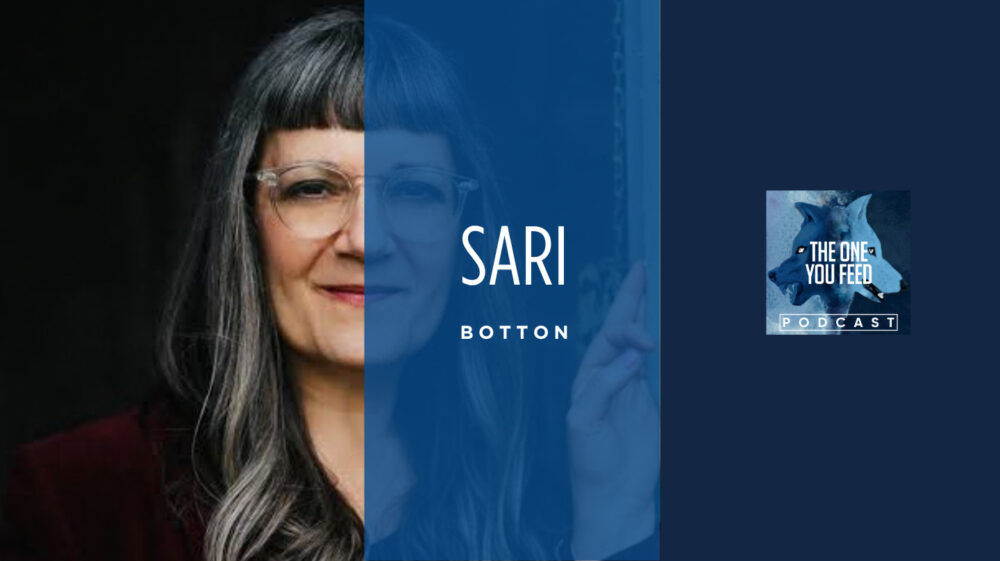
In this episode, Sari Botton discusses how to start a new chapter when you think it’s too late and explains what happens when the life you expected stops making sense. At 54, writer and editor Sari Botton struggled to get interviews for jobs she was qualified for and feared her career was over. Now, at 60, she’s doing some of her most fulfilling work. In this episode, Sari and Eric talk about the realities of getting older, how to tell what deserves acceptance and what’s worth pushing back against, and why an unexpected crossroads can still lead somewhere good.
Free Guide: Outsmart the Hidden Saboteurs of Self-Control. What’s been holding you back lately? In this free guide, Eric shares the six common saboteurs that quietly derail our best intentions—like autopilot behavior, self-doubt, and emotional escapism—and offers practical strategies to help you regain control and move forward. Download your free copy at oneyoufeed.net/ebook.
Key Takeaways:
- Getting older can bring loss and new possibilities at the same time.
- You can accept changes in your body without accepting someone else’s limits on your life.
- A career setback may close one path while giving you room to create another.
- Rejection is part of pursuing creative work, but it can also be a reason to refine your approach.
- Taking one step can reveal options you couldn’t see from where you stood.
- You don’t have to have yourself completely figured out to begin again.
Sari Botton is a bestselling author, editor, and teacher with decades of experience. She is the author of the memoir in essays, And You May Find Yourself…Confessions of a Late-Blooming Gen-X Weirdo, which was chosen by Poets & Writers Magazine for the 2022 edition of its annual “5 Over 50” feature. An essay from it received notable mention in The Best American Essays 2023, edited by Vivian Gornick. For five years she served as the Essays Editor for Longreads. She edited the bestselling anthologies Goodbye to All That: Writers on Loving and Leaving NewYork and Never Can Say Goodbye: Writers on Their Unshakable Love for New York. She publishes Oldster Magazine, Memoir Monday, and Adventures in Journalism. She was the Writer-in-Residence in the creative writing program at SUNY New Paltz for the spring of 2023. She teaches creative nonfiction in various places, including online through her own Kingston Writers’ Studio. She is also available for private consultations including developmental editing, editorial coaching, and individualized advisement.
Connect with Sari Botton: Instagram | Oldster Magazine
If you enjoyed this conversation with Sari Botton, you might also enjoy these other episodes:
Midlife Reinvention: How to Create Your Own Script for What Comes Next | Allison Aubrey
How to Turn Life’s Pain into a Path of Meaning and Joy with Danielle LaPorte
Finding Hope When Life Isn’t Okay and the Power of Micro Joys with Cyndie Spiegel
This episode is sponsored by:
Ka’Chava is your daily all-in-one shake, with protein, fiber, greens, superfoods, vitamins, minerals, omega-3s, probiotics, and more. Go to KaChava.com and use code FEED for 15% off your first order.
Monarch: Take control of your finances with Monarch, the all-in-one personal finance app that helps you budget, track spending, monitor investments, and work toward your financial goals. Get 50% off your first year of Monarch Core, go to https://www.monarch.com/ and enter Promo Code: FEED
Talkiatry connects you with licensed psychiatrists for personalized, evidence-based mental health care, all online and covered by most major insurance plans. To get matched with an in-network psychiatrist in just a few minutes, visit Talkiatry.com/FEED.
David Protein bars deliver up to 28g of protein for just 150 calories—without sacrificing taste! For a limited time, our listeners can receive this special deal: buy 4 cartons and get the 5th free when you go to www.davidprotein.com/FEED
Quince: Refresh your wardrobe with Quince by going to Quince.com/feed for free shipping and 365-day returns. Now available in Canada, too.
ZocDoc – Taking care of your health just got easier – start here with Zocdoc
Shopify – The commerce platform that helps you build, grow, and manage your business all in one place. Start your $1/month trial at shopify.com/feed.
Pebl – an AI-powered platform that helps companies hire and manage global teams in 185+ countries. Get a free estimate at hipebl.ai
Tiny Health‘s at-home gut health test provides science-backed insights into your microbiome, along with personalized recommendations to help you improve your digestion, energy, and overall well-being. Get $50 off your first test kit at tinyhealth.com/FEED
ButcherBox: Make dinnertime easier with ButcherBox, delivering high-quality 100% grass-fed beef, organic chicken, wild-caught seafood, and more, right to your door. Get $20 off your first box, plus your choice of free ground beef for life or free chicken thighs or top sirloins for a year, with free shipping always. Visit ButcherBox.com/FEED to claim your offer.
Episode Transcript:
Sari Botton 00:00:00 You can change the script. You’re not necessarily stuck in the life you started as a young adult for the rest of your life, and that’s really hopeful to me.
Chris Forbes 00:00:18 Welcome to the one you feed. Throughout time, great thinkers have recognized the importance of the thoughts. We have quotes like garbage in, garbage out or you are what you think ring true. And yet for many of us, our thoughts don’t strengthen or empower us. We tend toward negativity, self-pity, jealousy, or fear. We see what we don’t have instead of what we do. We think things that hold us back and dampen our spirit. But it’s not just about thinking our actions matter. It takes conscious, consistent, and creative effort to make a life worth living. This podcast is about how other people keep themselves moving in the right direction, how they feed their good wolf.
Eric Zimmer 00:01:03 Sari Botton had a writing mentor who made her students do one thing before pitching an essay anywhere. Take an index card and write the word no on it 19 times. The 20th word is yes. It every rejection you cross off a no. The obvious point is we get a lot of no’s in life. Sarah is 60 at 54. She could barely get a first interview for a job she was qualified for and thought her career was over. Today she runs older, a magazine about getting older at every age, and she says she’s in the best stretch of her working life. We also talk about the age you feel inside versus the number on your license, what to accept about getting older and what to push back on, and the harsh voice she still uses to get herself to work. I’m Eric Zimmer, and this is the one you feed. Hi, Sarah, welcome to the show.
Sari Botton 00:02:02 Thanks for having me.
Eric Zimmer 00:02:03 I’m excited to have you on. You run a really fascinating Substack called Old Stuff, and we’ll be getting into all of that in a moment. But we’ll start like we always do, with the parable. And in the parable, there’s a grandparent who’s talking with their grandchild, and they say, in life there are two wolves inside of us that are always at battle.
Eric Zimmer 00:02:22 One is a good wolf, which represents things like kindness and bravery and love, and the other is a bad wolf, which represents things like greed and hatred and fear. And the grandchild stops. They think about it for a second. They look up at their grandparent and they say, well, which one wins? And the grandparent says, the one you feed. So I’d like to start off by asking you what that parable means to you in your life and in the work that you do. Hi, Siri, welcome to the show.
Sari Botton 00:02:53 That’s so interesting. Well, I agree with that. What you put your attention on is what grows in your world. And I am very focused on being kind and just. I’ve joked in the past that like, kindness is my kink. I like to try and give people the benefit of the doubt and to do work that matters. If I find myself feeling jealous or envious or greedy, it’s not a place I want to be. It’s not a place I feel comfortable.
Sari Botton 00:03:30 So I try to shift things. And when I do yoga at the end, when there’s like a meditative moment, I try to send loving kindness to the people who I am struggling with in life, because I think that’s a good thing. More loving kindness is a good thing, and maybe it can shift things, and I’ve found that it does.
Eric Zimmer 00:03:58 I’m laughing because setting loving kindness is kind of a Buddhist practice. There’s another Buddhist practice along the same lines where you say, just like me, this person wants to experience pleasure and avoid suffering or just like me, this person wants to be happy. And I was doing that with somebody recently. Doesn’t matter who. My brain went like this. Just like me. This person wants to experience pleasure just like me. This person wants to avoid suffering. And then my brain could not help. But unlike me, they’re an asshole. Well, I was like, okay, all right, all right. This is maybe this person is I need to try an approach, but I agree.
Eric Zimmer 00:04:38 I mean, I was told very early on in AA we talk a lot about resentments and they’re like, if you’ve got a resentment for someone, pray for them. Pray for the good things to happen to them. And it turns out to be something that actually works.
Sari Botton 00:04:51 Yeah, it softens you and somehow it like, works miraculously. Like suddenly when you do that kind of thing where you send loving kindness to someone who maybe wasn’t so kind to you. They soften somehow. I don’t know if it’s because you soften, but I don’t like to be in conflict with people. I don’t like to be resentful toward people. I’ve also often found that when there are people that I have, like an energetic clash with later on after time has passed, I come to see that person as a full human being and not just the person who was posing a challenge to me. There were a few exceptions. I rarely encountered people who I didn’t really like, who didn’t also have more to them. There are some people running big parts of this world that it’s hard for me to imagine them having any redeeming qualities, and you might have an idea of who I’m talking about.
Sari Botton 00:05:53 But you never know.
Eric Zimmer 00:05:56 You never do know. So I could describe what Ulster is, but you’re probably better to describe it. So tell people what old ster is and what it means to you while you’re doing it.
Sari Botton 00:06:08 Ulster is a magazine that I publish on Substack. It’s also about to become an anthology that I will. Congratulations for one.
Eric Zimmer 00:06:17 I think you saw that.
Sari Botton 00:06:19 And it will also become a podcast video cast that my husband and I are making together. So we’re branching out. Ulster explores what it means to travel through time in a human body at every phase of life. So it is not just about old people, it is about getting older throughout life. And aging is something that I have been thinking about since I was ten years old. It’s a story I’ve told ad nauseam, but at my 10th birthday party, my uncle arrived and said to me, wow, you’ll never be one digit again. And it was like the beginning of this curiosity, anxiety about when was I supposed to do things? What were the milestones around me? When was I supposed to achieve them? Was I achieving them at the same rate as my friends and I wasn’t? I was always either ahead or behind everybody.
Sari Botton 00:07:12 And so this has been a lifelong fascination of mine that became more urgent in my 50s, when my body was going through changes and I wasn’t able to get a job. And so I started to want to know what were other people’s experiences around this. And that’s really a big, important part of my life’s work, is collecting voices around a subject for which I have great curiosity and anxiety. The first of those was leaving New York. I left New York City in 2005 after getting kicked out of an apartment and I was very anxious about it. Still am. It’s 21 years later and I still feel like I was ripped from my home. I love Kingston, but I still miss New York City, and I wanted to know what’s everybody else experiencing around this now that New York City is being so heavily gentrified, it’s becoming too expensive for people. It’s so expensive. And it also sucks in a lot of ways, like you’re paying all this money to live there, and you have rats and roaches and there are places where it’s decrepit.
Sari Botton 00:08:21 So I wanted to know what everybody else thought about it. So I created this anthology, Goodbye to All That Writers and Loving and Leaving New York. And it led to another anthology. And then that’s the same thing with Old Stir. I wanted to know what’s everyone else’s experience of getting older? And, you know, at various junctures throughout life, and my best work comes from my curiosity when I follow my curiosity and my anxiety, I succeed.
Eric Zimmer 00:08:49 Yeah. Obviously I’m similar because I’ve recorded something like 900 episodes of this show with other people, so I am the same. And wanting to hear lots of different voices and lots of different perspectives. One of the things I really appreciate about oldsters is a like you said, it’s kind of all different ages because we start worrying about aging. Like you said, some of us start worrying about it when we’re ten. Some of us start worrying about when we turn 20 or 30 or 40. And I do think as the signs of aging become more visible both outside and inside, we start to become even more interested.
Eric Zimmer 00:09:25 What I love, though, is you present all of that with a great deal of nuance, because I hear two stories about growing old out there. There’s the older cultural story that growing old is pretty much a bad thing. It’s just sucks to get old. Right. And then given the type of work I do, I’ve talked to tons of people who come on and sing the praises of getting older, which are also true. Both those stories are true, and what I love about oldsters is it really brings them both together, because one narrative or the other to me, always feels very incomplete.
Sari Botton 00:10:03 Thank you. Early on, someone accused me of toxic positivity and I said, no, that doesn’t fit. One of the earliest questions in the Old Star questionnaire, which is a weekly feature, is what’s hard about being your age or difficult? Maybe that’s the word I use, and I have people talking about the physical difficulties, the loss. There’s so much that people talk about. And I also, in addition to publishing essays where people talk about their achievements and surprises, they also write about the harder aspects of getting older grief and limited lifespan, you know, realizing that more of their life is behind them than in front of them? Yeah.
Sari Botton 00:10:47 Limited opportunities. So I really tried to show people’s experiences of aging with great complexity.
Speaker 4 00:10:55 Yeah. And I mean, honestly.
Eric Zimmer 00:10:57 Any age, being a human has its great things and it’s difficulties. I really like the experience of that is they’re different. Now I’m later 50. So, you know, I feel like every time I turn around I start doing some new exercise and I’m like, oh, there’s a new pain. Yeah. But obviously mentally, emotionally, I’m in a far different place than I was as a 20 year old or a 30 year old. There are benefits to that, so I really love that. It might be helpful for listeners if you gave us a few more of the older questionnaire questions, just to get an idea of the sort of things you’re asking all these different people.
Sari Botton 00:11:36 Well, there are 20 questions on the Ulster questionnaire. Actually, some of the questions have multiple directions. They go in, but basically it’s 20 questions. And the most popular question, the one that really came out of my anxiety about my own experience is the second question, which is, is there another age you associate with yourself in your mind, different from your chronological age? And if so, what is it? Why do you think? And almost everyone, I would say that 95% of respondents say they do have a different sort of internal age, an age at which they envision themselves.
Sari Botton 00:12:17 They think of themselves, and many of them have multiple internal ages. I do. There are moments where I feel like I am the ten and a half year old 11 year old. There are times when I am 15, when I’m 35, 47, like I embody these versions of myself depending on what situation I’m in. And I thought, am I crazy? And then I’ve learned that it’s almost everyone. And not only that, The Atlantic did a piece on this experience. It was an article by Jennifer Senior and she interviewed me for it. She had posted on Twitter saying, does anybody else feel like they have a different age in their head about how who they are than they than their chronological age? Is it just me? And I said, not only is it not just you, it’s a question on the Ulster questionnaire. So then she interviewed me and she linked to Ulster, which was great and brought me a lot of new subscribers. But it was very validating for me because I was identifying something that other people go through.
Sari Botton 00:13:20 So that’s one of the most popular questions. Occasionally someone will say, nope, I am the age I am, and much more. Occasionally people will say, actually, I identify with older ages. I’ve been an old soul my whole life, so it’s a very interesting question. Other questions. What’s on your bucket list? What are your big regrets? I love the way I phrased one, if I do say so myself. What do you plan on doing with your body when you’re done using it? Are you going to be buried or are you going to be cremated? Or are you going to go to a body farm?
Eric Zimmer 00:13:53 I keep trying to talk my partner into a traditional Mongolian ceremony, which is your loved one, takes you out, chops you up in pieces, and leaves you for the animals. But she she is not. She is not agreeing.
Sari Botton 00:14:06 I thought it might have involved a funeral pyre.
Eric Zimmer 00:14:08 Yeah, I mean might, but this seems to be the goal is to get your body back into useful form as fast as possible.
Sari Botton 00:14:16 Right. I’m donating my body to Albany Medical Center, and then they give you whatever they don’t use. They give your loved ones ashes. So it’s 50 bucks. That’s a pretty good deal.
Eric Zimmer 00:14:25 That is a good deal.
Sari Botton 00:14:26 Yeah. Other questions are like, you know, what are some aging related adjustments you’ve made? And the follow up question is, what are some aging related adjustments you refuse to make? There are people who say, I refuse to color my hair. There are people who say, I refuse to stop coloring my hair. It’s a big gamut of responses, and it’s always interesting to hear what people are doing to accommodate the changes they’re going through and what they just know. Not for me.
Eric Zimmer 00:15:07 So as you look across all of that, do you see themes that emerge? That might be, I’ll use this word more skillful ways of aging than others. Or is that not really where your mind even wants to go with all this?
Sari Botton 00:15:26 My mind does not go there. I’m not into this whole like, longevity movement where people are doing weird things to themselves, you know, to try and like, live forever.
Sari Botton 00:15:37 There was a really good article in allure recently by a 30 year old man who was like, why try to live forever when I can barely afford living at 30? And also, I was interviewed for a podcast a couple of years ago where the question was about aging competitively. Do people feel compelled to age competitively, whether that was to enhance their longevity in some way? Or was it? Look at me. I’m aging more naturally than anybody else. I never color my hair. I don’t do this. I don’t do interventions. The podcaster had me throw that question out to my readership, who responded, and then we used their responses as the basis.
Eric Zimmer 00:16:24 I think that’s fascinating because we generally will be competitive about anything. It’s sort of a natural thing, but I love the way you’re sort of pointing out that we can be competitive in completely opposite ways, right? And I want to use the word skillfully. I think that’s a term that maybe let me ask that question in a better way, because I don’t mean live longer.
Eric Zimmer 00:16:49 I just mean another word I might use instead of skillfully. But I think that I’m asking you to sum up a lot of other people’s ideas, and it would actually be better to ask you that question in your mind. What are the elements of aging? Pick the term you want skillfully, gracefully, with dignity.
Sari Botton 00:17:09 I think dignity resonates for me more than gracefully. Like has become a little bit of a problematic word in the aging space.
Speaker 4 00:17:18 Because why?
Sari Botton 00:17:19 Who gets to age gracefully? There’s a lot of privilege involved in that. You have to be in a place where there are no consequences for keeping your hair gray, for letting yourself wrinkle. For example, in Hollywood, unless you’re Amanda Peet. Very few of the people in Hollywood can succeed in their fields if they age gracefully. And the same is true in a lot of cultures. You know where there are consequences and usually where there’s lower economic status and where people are punished for not going with the cultural status quo when it comes to keeping up a certain kind of appearance, I think.
Eric Zimmer 00:17:58 I mean, only talking about the inside work of aging. Whatever word resonates with you, like what do you think? For you are some of the key elements of aging? Well, again, we’re stumbling around words here.
Sari Botton 00:18:13 Yeah, I think it’s a combination of acceptance and bucking the cultural messaging. So there are certain things I need to accept. Like I’m going to lose people. I’m going to die. I am also going to in some ways naturally decline. No matter what I do, some of it is genetic. Some of it is, you know, certain things happen to women’s bodies. Everybody’s bodies. But women’s bodies in particular go through a lot of change later on. So there’s a certain amount of acceptance. And then there’s also bucking what the culture wants to tell me about aging. Like, oh, you’ve had your turn. Oh, you’re done with this. Oh, that’s not for you. You’re too old for it. Oh, dress your age. That’s when I have a really hard time with.
Sari Botton 00:19:14 I don’t know how to dress my age, and I don’t know that that’s even a real thing. And I don’t know that I should concern myself with it. But I do know that in certain settings, I feel, you know, I defer to dressing like I did in junior high. And there are certain settings in which I want to feel more polished, more adult. There are a lot of clothes that feel too adult for me. I feel like I’m playing house or playing school or playing bank teller if I wear those clothes. So it’s really, I think, a lot about finding who you are authentically as an aging person, while accepting certain things and deciding which things you want to push back against.
Eric Zimmer 00:19:56 Love that. And I think a lot about this question. I think much like you do, which is aspects of my current age are things that I accept, I lean into, and what aspects of it do I want to use the opposite of acceptance change. So, for example, one of the things that I’ve noticed as I’ve gotten older is that I naturally have an inclination to sort of shrink my life outside my home.
Eric Zimmer 00:20:28 Right? Yeah. I just noticed that trend towards prioritizing being comfortable over other things. And so there’s a certain part of me that really wants to know. I don’t want to do that. I don’t want to ossified in that way. And yet then my other part of my brain says, yeah, but I mean, that’s kind of like what seems to sort of happen. Is it a big deal? I think about these questions about what it means. The other one, that when you were talking about like what it means to be an age question I ask myself all the time is like, what level of energy should a 56 year old have? And so then I’m like, well, I don’t feel as energetic as I used to. Is that a problem that I go solve somehow? It’s that question of what’s appropriate for this age. And of course, I think ultimately I end up with like there is just like there’s no normal in anything. There is no exact appropriateness for a particular age. There’s only, as you said very eloquently, what’s it like for me authentically?
Sari Botton 00:21:26 I think for me, it has also meant finding my limits with certain things, like one thing I no longer do and my husband is with me on this is we don’t go to concerts where there’s no seating like I don’t do standing room concerts.
Sari Botton 00:21:41 We went last year. We paid a lot of money for Elvis Costello tickets at Bearsville Theater here.
Eric Zimmer 00:21:47 Oh, lovely.
Sari Botton 00:21:48 In Bearsville, Woodstock. And we were so excited. And we got there and we learned that it was standing room the whole show. And after an hour, the two of us were in agony. We both have arthritis. Yeah, we both have back issues, knee issues, the ankle issues. And we looked at each other after an hour and Elvis Costello puts on a long show. I have seen Elvis Costello live many, many times, happily, but after about an hour we looked at each other and said we got to go home. So now if we are invited, or if we see a show that we like, we check to make sure that it’s seated. And if it’s not, we don’t go. I also, you know, I don’t think I’ve ever really liked camping. Now it’s like, no, it’s not in my. Nope, nope I don’t.
Eric Zimmer 00:22:37 It’s clear.
Eric Zimmer 00:22:38 You’re clear.
Sari Botton 00:22:38 Not for me. I learned what’s for me and what’s not for me. And some of that is affected by my getting older. I never really liked roughing it, and now it’s just out of the question. My bladder is too weak for me to be in a place where I can’t pee every hour on the hour.
Eric Zimmer 00:22:57 So yeah, that all makes a lot of sense. I saw my best friend who’s the editor of this podcast. His band played the other night, and it was Standing Room and I’ll go stand, but like you, about an hour, I’m like, I’ve seen enough, and I no longer am. Like, I should really stick around. I’m like, no, I mean, why stick around if I no longer am enjoying it? It just your sense. Yeah.
Sari Botton 00:23:21 Your shoulds at this stage of life, it’s like, you know what I gotta do? What works for me? I’m older. I have less time in the world and I also can only tolerate certain things for so long.
Eric Zimmer 00:23:34 How do you balance this? Knowing what’s not for me with also not being potentially not being open to new or new experiences? Is it that there are certain things that you’ve just done enough to know? Like, no, I know what that is and I don’t want to do it anymore. How do you think about it? Because that’s something I think about a lot like because again, my default is to be comfortable. But sometimes new experiences ask me to be uncomfortable in order to do them. And so how do you think through that?
Sari Botton 00:24:07 I think I’m naturally inclined to be resistant to new things. I made a joke about it. I did a comic panel for Old Stern called The Woman Who’s Afraid to Learn New Things. and it was about, like, all the things that I. Oh. Oh, wait, there’s going to be a learning curve. Oh, wait. I’m not going to be good at it. Right out of the gate. I’m aware of this and I try to push back against it.
Sari Botton 00:24:33 I try to force myself to reconsider certain things, but it’s also useful. It’s like, okay, listen to my gut. Do I really need to learn this new thing? Do I really need to open myself to this new experience, or does it remind me of other things that I already know are not for me, but I do default to no when it comes to new experiences, and I have to check myself now and then because I could be shedding myself out from something that’s valuable.
Eric Zimmer 00:25:03 So you wrote an essay recently. Give me an assignment, any assignment. And before I even had a chance to consider angles or sources in my mind, I’ve already failed. So say more.
Sari Botton 00:25:17 Yeah, this is something I struggle with. I’m very hard on myself, and I always have been, and I think it’s something I learned as a way to motivate myself. I think it’s also taking on the voices of early influences, like early editors that I had, maybe teachers where the minute I get an assignment, I feel like I’ve failed to achieve it, even though I haven’t started it.
Sari Botton 00:25:49 There’s this several people read that post and said they really identify with that. And I think it’s very common for writers and editors, people in this field that has deadlines. I used to work at newspapers, and I would be given an assignment and it would be due in an hour. So there was like this looming feeling of, if I don’t get it done in an hour, I’ve failed like I should be on this. I also worked at MTV news. I had to produce these 32nd or one minute scripts. I had to, like, crystallize the news in a way that was interesting, funny, and covered it in a minute and I had 20 minutes to do it. So I’ve had these fast turnarounds that have been an important part of my career, and I’ve internalized them in such a way that I’m yelling at myself. So I only recently was given the opportunity to make this old podcast, and before my husband and I even had a chance to strategize on it, I felt like I had failed in that I hadn’t produced it yet, which is utterly ridiculous.
Sari Botton 00:26:52 I didn’t include this in the piece because it was just like a little too much. But the truth is, I also often tell myself I can’t do it. I tell myself this about everything and I have a lot on my plate. Well, you can’t do that and you’re not going to do a good job at that, and you’re going to do a bad job at that. And it has been the only way, I think, I’ve known to motivate myself to prove myself wrong. Of course I can do this. Well, give me a little time and I’ll do it. It would be productive to eliminate this from my process, but I don’t know how yet. But it’s destructive. It hurts me. I’m hurting myself. Being so down on myself. I wish that I could remove this from my process, but I think it is a way that I learned to motivate myself.
Eric Zimmer 00:27:39 Yeah.
Sari Botton 00:27:40 Come on idiot. Just try harder. But I’m always trying hard. I’m always trying hard. And I always prove that I can do it.
Sari Botton 00:27:47 But I get there partly by betting against myself. And that’s something I gotta stop. I just don’t know what to replace it with.
Eric Zimmer 00:28:08 Before we dive back into the conversation, let me ask you something. What’s one thing that has been holding you back lately? You know that it’s there. You’ve tried to push past it, but somehow it keeps getting in the way. You’re not alone in this. And I’ve identified six major saboteurs of self-control. Things like autopilot behavior, self-doubt, emotional escapism that quietly derail our best intentions. But here’s the good news you can outsmart them. And I’ve put together a free guide to help you spot these hidden obstacles and give you simple, actionable strategies that you can use to regain control. Download the free guide now at one Eufy Net and take the first step towards getting back on track. It’s a very interesting question, and I’ve thought a lot about it, and I wrote about it in my book that you were kind enough to put on your bookshelf one month, which is this idea that, yeah, that way of motivating works for a while.
Eric Zimmer 00:29:10 It really does. I mean, it’s what most people do. And then my experience has been in my own life and in other people’s lives, eventually it ceases to work so well or the cost of it becomes kind of so high. And then basically you ask the question in the piece, you say, but I’d like to find a different way to keep arriving at that one in which I’m not a complete jerk towards myself. And I think that’s really the key. And it is this idea that, like, there is a way to hold ourselves really accountable, but also to be kind to ourselves while we do it. And in my mind, it was sort of separating those two things out. Right. Being able to say like, okay, there’s the accountability that I have because I do want to do a good job, because I do care, because these things matter. And then there’s these scripts that just run. And how might I say that same thing in a way that is less harmful to myself because, I mean, I totally get it.
Eric Zimmer 00:30:14 And I think that’s change. I think we all do well at making some changes, not well at others. I feel like and it’s been a years long process of that one actually settling in me a little bit more, where I can be critical of the work or the process or the thing, but not so much of me. But that is quite a journey. I think the thing that’s interesting, though, is what energy can that open up when all that energy isn’t spiraling down in that way? What energy might it open up?
Sari Botton 00:30:45 And yeah, I’d like to find a way to be kinder to myself. It’s taking a toll on me. The thing is that now I have more work on my plate than I’ve ever had before. And so I’m doing this negative thing to myself more. It’s suddenly I’m like, yeah, this is getting very loud, and I can’t do this. I want to fight back against this mean boss. And so it’s something I need to work on.
Eric Zimmer 00:31:10 One of the things that I love about your work, and you do a really good job of, is showing that there is a lot more possibility Then we might think.
Eric Zimmer 00:31:19 Available to us at any given age. And I’m wondering if you could talk about that in general and maybe share something from an older survey that was like a great example of this, of where like, it didn’t look like there was a possibility. And then this person, something happened that was really positive for them at a at an older age.
Sari Botton 00:31:40 Well, first of all, that’s one of the best surprises for me about getting older and also publishing oldsters that I keep learning that there is so much more possibility later in life than the culture wants you to know. The culture wants to show you problems. They can sell you products to solve, you know, or systems or software or and also, I don’t know, ageism is just prevalent. And so when I was getting anxious about turning 60 last year, many of my readers would write in and say, what? Things only improved for me after 60. I figured out who I really was, and I did the things that really mattered to me. I took on a new hobby.
Sari Botton 00:32:23 I became a painter. I became a writer, I left a marriage, I was unhappy, and I, I learned to live on my own. I mean, just amazing things. People are constantly reporting in almost every old questionnaire. One woman who was a psychologist for many years, she’s in her late 80s. She became a painter and she was having art shows. And it’s very exciting. And people are pursuing the things that they put off in order to succeed in their careers, whether or not they’re retired. Sometimes they’re doing it on the side. They’re learning to play piano, they’re learning to play a sport or hike and camp and the things I would never do. But it’s really amazing. But you’ll find it in almost every Ulster questionnaire and also the personal essays. People will say, I left this home where I wasn’t really happy and I tried a new place to live. And I love it. And I’ve made new friends and it’s not too late to make new friends. And I just keep hearing this story over and over again.
Sari Botton 00:33:28 And every time I do, it nourishes me. It makes me less afraid to grow old. It makes me think that you can change the script. You’re not necessarily stuck in the life you started as a young adult for the rest of your life, and that’s really hopeful to me.
Eric Zimmer 00:33:45 Yeah it is. I love that, and you’re a great example of it. I mean, you were featured in The New York Times recently for the work you’re doing with Old Syria. You are, as you have said, pretty clearly in the best phase of your career ever like, and that happened after it looked like many of the avenues that you thought were your career were closed to you.
Sari Botton 00:34:08 I just cannot believe that at 60 I’m doing so well. When at 54, I thought it was all over. I really thought I was doomed. I had left a job where I was probably going to get laid off from. And I thought there were these other jobs. There were these other jobs that I thought I would be a shoo in for.
Sari Botton 00:34:32 And when I got interviewed for them, they said like, really ages things to me. And I didn’t get a second interview and I could barely get a first interview. And I was a leader in the personal essay and memoir fields. And so that was really shocking to me. And I thought, I’ve got to get another skill because I can’t do this anymore and no one will have me. And then I did my own thing. And guess what? They’re doing really well, so I’m always happy about that changed my life. And I and I keep hearing that story from other people too, that they thought it was over. In fact, I have an essay in Ulster by Michael Musto, who is a Village Voice writer. Nightlife writer. It’s called everyday I write the book and talks about. At 28, he thought his career was over. And then he discovered later on. And he keeps finding new ways to publish and new places. And he amazes me. And he’s in his 70s now, so it’s not unusual for people to assume that it’s all over for them, especially when certain things stop working.
Sari Botton 00:35:37 But guess what? If you look up and around, you might find that there are other possibilities and maybe they’ll make you even happier, which is what’s happening for me right now.
Eric Zimmer 00:35:47 Yeah, I’ve certainly found that. I mean, I left my software career to start doing this about eight years ago, almost to the day, actually, and I’ve been doing this for a living for eight years. And like you said, I’ll hit a point where it’s like, well, that no longer seems to be working in the way. Maybe this thing’s about it’s going to it’s going to wrap up and then something else will happen. And then and I’m in one of those phases right now where there’s certain amounts of reinvention happening and my brain will go, are not going to happen. Right. You’re your late career. You’re doing that. And I just for me, I just try and remind myself like that is one version of a story, but the future is not written. It simply isn’t. And the way that I choose, the attitude I take towards the next phase has a lot to do with whether it’ll be successful.
Eric Zimmer 00:36:42 It’s not the only thing that matters, of course. Yeah. But that openness that maybe it could even be better. The hopeful one for me without really being Pollyanna about it. Right. It’s a mindset that allows me to take positive action in the direction of something that matters to me.
Sari Botton 00:37:00 Yeah, sometimes just taking a step in one direction, even if it’s not the right direction, we’ll kind of open up your world in such a way that you’ll see other possibilities. A great life lesson is that the only constant is change, and it’s something that you learn more and more as you get older. Even though we don’t want to. Even though we’re still surprised by change that occurs externally that we have to respond to. But change is the only constant, so it helps to be open to adaptation. How are you going to adapt to these changes? And we’ve all had to adapt. I mean, the biggest paradigm shift in recent years was the pandemic, and we all had to adapt how we work, where we work, how we live.
Sari Botton 00:37:48 We all became denizens of zoom like I had. Goodbye to all that. My first New York anthology was reissued in April of 2021, in the middle of a Covid wave, so I didn’t get to do any live events, and that made me sad. But what it did allow me to do was big zoom events where I could reach way more potential readers than I could in one little bookstore in Brooklyn. Yeah, so there are advantages and disadvantages to everything. And also it helps to learn, to adapt to change because change is the only constant.
Eric Zimmer 00:38:28 And if you ever want to write a fantasy novel, we now have the title Denizens of Zoom. It’s a perfect fantasy title. I somewhere I was going to go and then my stupid joke threw me off. Yeah. I’m always amazed that we are surprised by change. Like, I mean, I’ve been a long time Buddhist practitioner. I mean, it is one of the core messages of Buddhism, right? Everything is always changing, without exception. And yet when you make change comes, I’m startled by it, I find it, I find that amazing.
Eric Zimmer 00:39:04 I guess it’s just something about being human. Oftentimes, the changes are things we simply can’t imagine. We spent lots of time imagining other things. And then the thing that happens, we’re like, wait, I didn’t see that one coming.
Sari Botton 00:39:17 I mean, I sure didn’t see the pandemic coming. I mean, we’re hearing about this virus out of Wuhan, and we’ve heard about so many viruses, SARS, and I can’t even remember the names of all of them all these years. Oh, the mosquitoes are carrying XYZ. And it never really blossomed into this thing where we all had to wear masks and hide in our houses for years. And I know I’m not the only one. Like, it really threw me off. And then when we learned that it wasn’t just going to be like three weeks, it were like years. I remember just I had to keep adjusting my expectations and also keep adjusting how I functioned in the world. In a way, it was a great exercise. I mean, I wouldn’t want to go through it again if I didn’t have to, but it was a great exercise in like flexibility, Adaptability.
Sari Botton 00:40:08 There were some really beautiful moments with people. We would frequently have these backyard fires and invite people. The first ones, we were all six feet apart. We had very few people and we’d all sit six feet apart, you know. And then as time went on, they became big parties and there was a lot of connection. And it was more connection than I had had in recent years with people. There were aspects of that experience that were beautiful. So everything is really complex. That’s just something that I keep discovering how complex things are.
Eric Zimmer 00:40:41 Yeah, exactly. There’s a Darwin quote that I will not get right, but the essence of it is it’s not the the strongest survive. It’s the most adaptable service. Right. And I think that’s a really interesting it’s a take from a scientific perspective about this sort of philosophical approach that we’re taking is that there’s a lot of talk about the disadvantages of adaptation in at least the world that I travel in, because you stop appreciating the good things in your life, right? You just you adapt to them.
Eric Zimmer 00:41:12 And that is good to kind of work on. But that adaptability is also so valuable in that do adapt incredibly well as a, as a species.
Sari Botton 00:41:23 Yeah, it’s really necessary. It’s just one of the most necessary aspects of being alive is this ability to adapt. Sometimes you have to be shocked, and it might take you a little while to accept what’s happening. But the sooner you do, the sooner you can adapt and then find a new reality that works or discover what doesn’t work. Find a new limit for yourself.
Eric Zimmer 00:41:47 There’s another essay that you wrote. I don’t keep track of dates, but the essence of it was no just means not right now. Share some examples of that from your own life.
Sari Botton 00:41:58 Well, publishing my memoir, I kept not being the one not having the opportunity. Some of it was also I was standing in my own way. But then it was time. And it was also during the pandemic that I had the time to work on it. But I learned this early on, I think, because I’m in a competitive creative field and I don’t remember exactly how I learned it.
Sari Botton 00:42:26 I also had a mentor who, in her personal essay workshop, she would for every personal essay that we tried to pitch somewhere, she would have us write out an index card. We’d write the word know 19 times, and the 20th word was yes. Rejection was part of the process that you came to accept that you’re in a competitive, creative field. There are more people who want to succeed than there are opportunities for it at any given time. Persistence is going to get you closer. So keep going. Expect rejection. And if you get to the 20th word and it’s not, yes, make a new card. And that kind of just really opened my mind to the idea that this is going to take time, and there are going to be other people who succeed before me, and I want to exist in this world with them. And then I was introduced to the idea of literary citizenship, where you cheer on other people, you go to their book events, you meet them, you take workshops, you join a writer’s group, you immerse yourself in this world of writing and writers.
Sari Botton 00:43:30 And yes, there’s some jealousy that arises. There is competition. I am not, by nature a competitive person. That also helps. I don’t know, it’s just I don’t know if it’s because I’m a Libra. I don’t know if it’s because also, I grew up, I was one of two children, and then both of my parents, after divorce, remarried and there were suddenly children ahead of me in line. I had been the oldest and then my birth order got changed. I just adapted and I learned that, well, it’s a big world with a lot of people. We all got to get along and that if you are kind and helpful to people, maybe they’ll be kind and helpful to you. Maybe not in a transactional way, but along the way the goodwill will come back to you. And I find that it does. I find that it does.
Eric Zimmer 00:44:18 That’s a really beautiful philosophy. I never heard of literary citizenship until you mentioned it. I mean, I think it’s a world in which I try and exist because part of what I do, like you, is to share other people’s work with the world, like share the great things about people.
Eric Zimmer 00:44:35 And I think with you, I mean, I’ve heard you say about the recent New York Times piece, I was featured in a New York Times Well column recently, and I was like, oh my God, this is this is amazing. You had an entire feature about you and what you do. I mean, it was a big thing. You talk about how you had been. Yes. It’s on the wall, you know, that you had been wanting to get some sort of major coverage for what you’d been doing, and it had not been happening. And then suddenly it did because you kept trying.
Sari Botton 00:45:06 Yeah, I knew that what I was doing was different and valuable and newsworthy, and I had been trying to engage lots of different gatekeepers. Hey, do you think that what I’m doing is newsworthy? I do, I’d love to tell you more about it. And, you know, in small ways, I was getting on. Some people were interviewing me for their newsletters, and there were little things here and there, or I was on a podcast here and there, but I really I felt like I was ready for the big guns, the big time, and it feels like organic.
Sari Botton 00:45:36 And I had to wait for it. I had to wait a long time for it, but I’m happy with how it happened. It felt like it happened at the right moment, and I’m glad I had the patience and persistence. Patience and persistence in equal measure.
Eric Zimmer 00:45:50 Yeah. So back to the index card with the 20 no’s on it. Obviously, a no is part of any creative field. There’s a lot of them. The question that I often wonder about is, and I think this is true and creative, or it’s say you’re trying to build a business. It’s the same core question, which is, do I just need to keep going with this thing the way it is? And eventually someone will will find it? Or is this a signal that maybe what it is isn’t good enough? It’s not quite in the right lane? I need to modify. I need to change. As somebody that’s been in this world thinking about those questions for a long time. How do you arrive at is this something that I just keep doing exactly the way it is, or do I take the fact that it’s not getting picked up as a sign to maybe do something different?
Sari Botton 00:46:45 Sometimes if you get enough Nos, you got to pay attention to that.
Sari Botton 00:46:49 Sometimes it’s that people aren’t ready for you or you’re not ready for them. But if you feel strongly enough, you have to keep going. For example, with me, with Goodbye to All That for like eight years, everyone who’s anyone in publishing told me I couldn’t do it. Great idea, but you can’t do it. It’s all inspired by Joan Didion’s Say Goodbye to All That, stories about people leaving New York City and editors and agents kept saying to me, it’s a great idea, but you can’t do it. You don’t have enough of a platform. Anthologies don’t sell. Deep down, I knew that this was going to be a great idea. And so in between agents, I went and got my own deal, and it became an instant bestseller. And it’s a continual bestseller. 13 years later, it got reissued. So that was an instance in which I didn’t trust people’s nose. Yeah. Also, my last agent, like, Pooh poohed my idea for an ulcer anthology, and I knew that was the wrong answer.
Sari Botton 00:47:54 And I was approached by my current agent who said, hi, are you happy with your representation? I said, no, I’m not. She said, Because I’m wondering when you’re going to do an Ulster anthology. So there are times when your idea is right. You just haven’t found the right person to say yes to it. But then there are times when either your idea is not quite perfectly honed or. You haven’t found the right person, or it’s time to do something different. And maybe that ideas time will arrive and maybe it won’t. You can’t do everything. Yeah, if you have a really, really strong gut feeling that something can exist in the world, that it will be good, you need to follow that. Because every time I do, I succeed.
Eric Zimmer 00:48:43 So I’d like to wrap up with kind of where your book ends. And in it you’re talking about this idea of Finding yourself. I think the if I remember epilogue is called found. Ish. So tell us a little bit about the epilogue, and I would love you to read the last chapter, because I think it’s a really beautiful summation of a lot of what you talk about.
Sari Botton 00:49:08 In the last paragraph.
Eric Zimmer 00:49:09 Yes.
Sari Botton 00:49:11 Well, so when I was working on the book, initially, I was proposing it. I thought the world was going to be one way. And then Covid came about and it changed just everything about my life. And it threw me a lot of unexpected things, including that the place that I worked that I loved was going to self-destruct, and I was going to have to leave, and that I was going to have to find new ways to work. And so I thought the book was going to end differently than it did, because I thought my life was going to be different than it was, like what we were talking about. That change is the only constant, you know. And suddenly I wasn’t as found. It’s a book about finding yourself. When I first proposed it, and when I started working on it, I thought I knew I was found. This is the end. This is the definitive end. I am found. And then I suddenly had to adjust everything in my life.
Sari Botton 00:50:08 And I was only found ish. I kind of knew who I was now. I definitely knew who I was, or I had a better idea of that. I knew who I wasn’t, but suddenly there were more variables that I had to take into account and adjust. So that’s why the final chapters, the first chapter is called lost, and the last chapter was going to be called found. And now it’s called Foundation because my soul is still. Nope, nope. I’ll read you the final paragraph. This is the book part anyway. I suppose what I’m saying is that you may indeed find yourself, but then lose access to what seemed like a clear path ahead of you. You may think you have your life figured out and then discover you’re once again at a big, scary crossroads, one you never saw coming. The only thing to do then is to remember who you are, and with that knowledge, take a step forward in what feels like the truest direction. If you get it wrong, you can always turn another way.
Eric Zimmer 00:51:15 Before we wrap up, I want you to think about this. Have you ever ended the day feeling like your choices didn’t quite match the person you wanted to be? Maybe it was autopilot mode or self-doubt that made it harder to stick to your goals. And that’s exactly why I created The Six Saboteurs of Self-control. It’s a free guide to help you recognize the hidden patterns that hold you back and give you simple, effective strategies to break through them. If you’re ready to take back control and start making lasting changes. Download your copy now at one. you feed net. Let’s make those shifts happen starting today. One you feed. Net book. Thank you so much for coming on. It’s been a great conversation. I love the work that you do have links in the show, notes to your memoir and to your old stir and all the places people can find you online. Thank you for spending some time with us.
Sari Botton 00:52:13 Thank you so much.
Eric Zimmer 00:52:14 Thank you so much for listening to the show. If you found this conversation helpful, inspiring, or thought provoking, I’d love for you to share it with a friend.
Share it from one person to another is the lifeblood of what we do. We don’t have a big budget, and I’m certainly not a celebrity. But we have something even better. And that’s you just hit the share button on your podcast app, or send a quick text with the episode link to someone who might enjoy it. Your support means the world, and together we can spread wisdom one episode at a time. Thank you for being part of the One You Feed community.
Leave a Reply