

In this episode, John Miles explores the mattering effect and how to find your way back to meaning and connection when you feel invisible in your own life. Drawing on his experience of achieving career success while feeling increasingly disconnected, John explains how we can slowly lose our sense of worth when life becomes a constant effort to prove our value. He also discusses how to recognize that gradual withdrawal, reconnect with the meaning in everyday actions, and make more room for relationships that help us feel seen. This conversation offers a starting point for anyone who’s getting things done but struggling to feel fully present in the life they’re living.
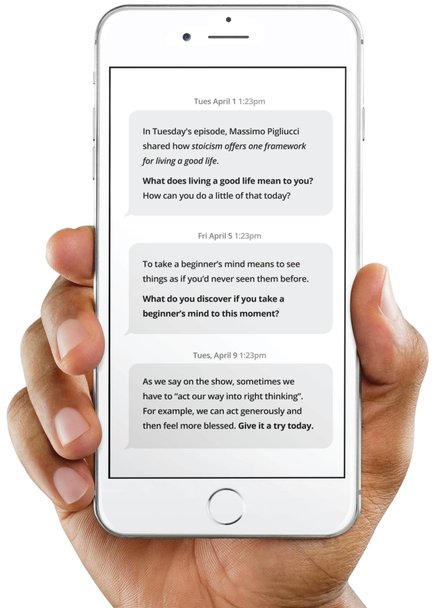
Good Wolf Reminders
A little wisdom, right when you need it. Start receiving free text reminders designed to help you pause, reflect, and take meaningful action. Sign up at oneyoufeed.net/sms.
Key Takeaways:
- Why feeling like you matter involves both feeling valued and knowing you make a difference
- How the “slow fade” can leave you physically present but emotionally absent in your own life
- The importance of belonging, having a say, and feeling safe enough to be yourself
- How connecting everyday tasks to what you care about can restore a sense of meaning
- Why reclaiming your choices starts with questioning the expectations you’ve been living by
- How protecting time for meaningful relationships helps interrupt the cycle of disconnection
John R. Miles is a worldwide expert on intentional behavior change, leadership, and personal mastery. He is a keynote speaker, top-rated show host, and is the founder and CEO of Passion Struck(R). Miles is devoted to promoting personal mastery, fostering an intentional mindset, enhancing health and wellness, and building meaningful relationships. His globally renowned podcast, Passion Struck with John R. Miles, has garnered tens of millions of downloads and consistently tops the charts as the number one alternative health podcast on iTunes. Miles is committed to inspiring people worldwide to believe in their ability to push beyond limits and achieve their aspirations. His book is called The Mattering Effect: Creating a Life of Meaning and Worth.
Connect with John Miles: Website | Instagram | LinkedIn | YouTube | TikTok
If you enjoyed this conversation with John Miles, check out these other episodes:
How to Unlock Your Potential and Strategies for Intentional Living with John Miles
Learning to Take Action for a Meaningful Life with Gregg Krech
This episode is sponsored by:
Ka’Chava is your daily all-in-one shake, with protein, fiber, greens, superfoods, vitamins, minerals, omega-3s, probiotics, and more. Go to KaChava.com and use code FEED for 15% off your first order.
David Protein bars deliver up to 28g of protein for just 150 calories—without sacrificing taste! For a limited time, our listeners can receive this special deal: buy 4 cartons and get the 5th free when you go to www.davidprotein.com/FEED
Episode Transcript:
John Miles 00:00:00 A healthy environment answers three questions. Do I belong here? Which is inclusion. Do I have a say in what happens in this environment, which is control? And can I be real here, which is openness. And what I found is when those three signals weaken, which they’re doing for many of us, people don’t necessarily rebel. They end up shrinking.
Chris Forbes 00:00:30 Welcome to the one you feed. Throughout time, great thinkers have recognized the importance of the thoughts. We have quotes like garbage in, garbage out or you are what you think ring true. And yet for many of us, our thoughts don’t strengthen or empower us. We tend toward negativity, self-pity, jealousy, or fear. We see what we don’t have instead of what we do. We think things that hold us back and dampen our spirit. But it’s not just about thinking. Our actions matter. It takes a conscious, consistent and creative effort to make a life worth living. This podcast is about how other people keep themselves moving in the right direction, how they feed their good wolf.
Eric Zimmer 00:01:14 John Miles had the job he’d spent his career chasing one of the top technology executives in the country, and he couldn’t tell whether the company cared more about him or the chair he sat in. He was judged on the last 48 hours of output, and he ended up going numb at work and then at home. He calls that state the vanish, physically present, psychologically gone, essential and inconsequential at the same time. A lot of people I talk to understand that feeling. His new book, The Mattering Effect, is about why that happens and the path back to feeling like you count. I’m Eric Zimmer and this is the one you feed. Hey, John. Welcome to the show.
John Miles 00:02:01 Hey, Eric, it is so great to be back here in such an honor to be on your fantastic show.
Eric Zimmer 00:02:06 Well, thank you. I’m really excited to have you on. We’re going to be discussing your latest book, which is called The Mattering Effect: Creating a Life of Meaning and Worth. But before we do that, we’ll start in the way we always do with the parable.
Eric Zimmer 00:02:21 And in the parable, there’s a grand parable who’s talking with their grandchild, and they say, life. There are two wolves inside of us that are always at battle. There is a good wolf which represents things like kindness and bravery and love? And the other is a bad wolf, which represents things like greed and hatred and fear. And the grandchild thinks about it for a second. They look up at their grandparent and they say, well, which one wins? And the grandparent says, the one you feed. So I’d like to start off by asking you what that parable means to you in your life and in the work that you do.
John Miles 00:02:57 Eric. I think it’s the perfect starting point to actually discuss this book, because it was that parable of what was feeding me in my life about a decade ago that caused me to start researching the underlying conditions that make up this whole book. For those who aren’t familiar with me, at that point in time, I was a senior executive working in a very large $80 billion entity.
John Miles 00:03:27 And what I found at that time was that I had allowed myself to become very good at extracting the very authenticity that I so much wanted to bring forward to the world. But was afraid to show to the world. And it led to severe burnout, numbness, and ultimately an incredible feeling of invisibility in someone who, on every measure looking in, would have seemed to have been top of the world. And I think I let one wolf possess me. And I hope I’ve spent the last decade taking control of that wolf.
Eric Zimmer 00:04:19 Yeah, you tell stories in the book about that time, about like, what things were like with you and your children. I think there’s a particularly telling part where maybe your son said, dad, why don’t you ever laugh?
John Miles 00:04:31 Yeah. I mean, it was a tough book from that standpoint to write, but I think you can’t serve another person who’s reading your book or you’re trying to help unless you’re completely honest. And I had two different things that were going on kind of simultaneously at that time.
John Miles 00:04:50 I was traveling and working probably more than I ever had in my entire career. I had hit the pinnacle of what I had always dreamed was the epitome of the job I had wanted, you know, to become a chief information officer. And not only that, one of the top ten CIOs, probably in the entire country. But at the same time, I was working in an environment where I couldn’t tell if they cared more about my output or the chair that I was sitting in. And I just realized that I had become completely judged on what my output was over the past 24 to 48 hours, and not really for the human beings sitting there in the room. And at that same point. You know, it was becoming very apparent as I was becoming more and more numb inside, that I was taking that to the home front and wasn’t really experiencing any joy or aliveness at all in my life at that point.
Eric Zimmer 00:06:05 You describe it as the vanish, and you say it’s sort of the disorienting experience of feeling both essential and inconsequential at the same time, with a strange mix.
John Miles 00:06:17 Well, I mean, what ends up happening in The Vanish is it’s really a mix of two different concepts that I talk about. I talk about this thing that I refer to as the slow fade, which is the gradual withdrawal from full participation in your own life. And over time, as it did with me, it eventually hockey sticks into the condition I call the vanish, which is the broader state of becoming physically present but psychologically absent.
Eric Zimmer 00:06:48 And so out of that, you start to talk about needing to move towards mattering. So tell me, what does mattering mean to you? Like in what way are you using that word?
John Miles 00:07:02 Well, Eric, I will tell you that when I went on this quest that I’ve been on now for a long time, I can tell you, when I started it, mattering wasn’t a word that I used in the same vocabulary. I’m using it now. I would never have thought that would have been the answer to the questions that kept driving my curiosity. What I was really trying to get to the bottom of is we have all these epidemics that we say are epidemics that are plaguing humanity.
John Miles 00:07:34 We have an epidemic of growing mental health crisis and anxiety, of loneliness, of hopelessness, disengagement at work. More people burned out than ever. But my hypothesis was that there had to be something larger driving all of this. And that was the question I was trying to answer. Could all of these things be separate entities in themselves? Or was there something bigger at play here? And that’s what I tried to go and figure out. So at its most basic level, when you think about mattering, Isaac Perlin, who recently passed away, unfortunately, as I was writing the book, really defined it as you have to have two different conditions for mattering to take place. First, you have to feel valued. You have to feel that you are seen or heard. But the other side of that is you have to add value. And so those are the two dimensions that I look at that define mattering.
Eric Zimmer 00:08:49 So do you think when you were leading those organizations in that role, you certainly described you didn’t feel like anybody particularly thought that you mattered.
Eric Zimmer 00:09:01 Do you feel like you were adding value? Was one side of it missing? Were both sides missing? Like talk to me about if we look at life through that lens of we need to be seen as valuable and we need to actually then add value, which we’re missing for you.
John Miles 00:09:17 I think whether you’re talking about a work environment, it could be a home environment. I’m trying to to let people understand the gravity of this. So for me, I was given a lot more than I was receiving back. But I think there probably a lot of spouses who might be listening to this who feel the same thing. They’re probably kids, teens, young adults who probably feel the same thing about either their school systems or the way that they were brought up.
Eric Zimmer 00:09:48 Yeah. I mean, I agree with you that I think the thing underlines so many of these different things is a question of you can use different words for it. You know, we can say it’s a meaning related question which is in your subtitle.
Eric Zimmer 00:10:02 Right. Creating a life of meaning and worth, lack of meaning is is problematic. And so mattering then is I mean, obviously it’s a way of saying we feel like we matter.
John Miles 00:10:15 Well, what I discovered through the research is that it is almost impossible. To make other people feel like they matter, or have them make you feel like you matter if the personal mattering aspect is missing.
Eric Zimmer 00:10:35 In what sense? When you say the personal aspect, you mean like that coming from within.
John Miles 00:10:40 That coming from within. And psychologist Gordon Flett, who I was so thankful. Gave me countless hours of his time. For those not familiar with them, I. I really call him the father of the science of mattering. It’s what he calls anti-matter. And anti-matter is what happens inside you when experiences of insignificance become a belief.
Eric Zimmer 00:11:05 So in the book, you talk about the mattering needs pyramid that we that there’s four layers that we need to feel an internal belief of it like I matter to myself, a relational aspect.
Eric Zimmer 00:11:19 I matter to others, and emotional resonance I feel felt and then an actual impact. I feel like I’ll make a difference. Are those sort of keys that that you go into to sort of help us get back to feeling like we matter?
John Miles 00:11:36 Well, those are the four. Later in the book. I kind of flip this, and I look at them as different coordinates of what I call the matter in compass, but they’re kind of the different layers that you need to have in place to feel like you matter. You need the first one to possess an internal sense of worth that doesn’t rise and fall from things like approval, other people’s opinions, achievement, productivity, whatever it might be. Second, you have to feel like you’re seeing that your very existence registers with someone else, which is what I wasn’t really feeling when I was in those corporate environments. And this is more than just being surrounded by people. It’s it’s feeling that you’re valued by them. You need to then have an emotional resonance to this that I am known someone understands who I am.
John Miles 00:12:31 And then the last one, you have to feel that you can make a difference. My presence changes. Something outside of me or simply my life leaves a mark.
Eric Zimmer 00:13:09 So as you’ve gone about trying to sort of piece all of this together, you know, I think we can look at things from an individual lens, or we could look at them in more of a systemic lens, like, why is this happening in so many different ways? What did you find when you looked at it that way?
John Miles 00:13:27 Eric, I went into this trying to look at all different aspects of this, and I really started to look at the work of Jonathan Haidt in his book The Anxious Generation. In his books before that, on what is causing youth mental health to skyrocket. I looked at the work of Peter Gray and was at the school systems that were causing this influx of what’s happening to so many intergenerational people who are feeling like they don’t matter. And I came to the conclusion that I don’t think either one is wrong, but I don’t think either one of them is completely right.
John Miles 00:14:08 And what made me start to think about this is I happened to talk to Harvard professor Alexis Redding, who happens to be Dorie Clark’s wife, and she’s been studying some of the same things. And she came across work from William Perry, who’s another famous psychologist, where he examined students in the 1960s. And then he reran his work about a decade later, and she happened to stumble upon it in the 2000. And what she found were that the same mental health issues, the same anxiety that they were feeling in the 60s, they were feeling in the 70s. So then she started to have her newer students today listen to the audio from these interviews, and she would ask them, is this a student from the 1970s, or is this a student from today? And every single one of them from the 1970s, they said, this is a student from today. So what this is showing me is, I think with some of the changes that we’ve had in the school system starting in the 80s and the influx of social media happening in 2010, etc., those are accelerants to something that I believe has been going on much longer.
John Miles 00:15:35 I think over the past 200 years, the great erasure has been happening. And what I mean by this is I believe that we are living in a mattering market. The mattering market is the system in which human beings increasingly exchange their inner sense of worth for external measures of value, such as status, achievement, productivity, approval, visibility, utility, you name it. But I think what’s happening here is ever since the first whistle blew in the first factory during industrialization, what’s been happening is the gradual loss of individuality as people become increasingly interchangeable parts inside the systems that organize their lives, whether that’s the work system where they’re seen for what they output. The school systems, which now we’ve taken what’s worked in the work environment, and we’re now taking into the school systems, which is then carrying into our home systems. These same things are being used by the product engineers that are in these companies creating these social media tools. And now the AI systems that we’re interacting with. And it’s the same things that companies, the retailers where we shop and everything else are using to drive consumerism.
John Miles 00:17:03 So everything that’s happening around you is repeatedly creating these experiences. In other words, when I mentioned anti-matter earlier, that feeling of insignificance hitting you again and again and again, that’s the wound on mattering is the environment that keeps creating it. And I think that is one of the most important things for the audience to understand.
Eric Zimmer 00:17:30 So what do we do in the midst of that? I’m always interested in when conversations happen on the show between personal and and the systemic. And oftentimes it’s easy, at least for me, to feel overwhelmed by the systemic. If it’s everything, all the systems all around us, what do we do with that? Like from your perspective, how does that inform our path to feeling like we matter?
John Miles 00:17:59 So I went into this really looking at self-determination theory and having a number of conversations with Richard Ryan about this topic, and I thought that self-determination theory was going to provide the major framework for a lot of what was going to come out of this. But along the way, I was introduced to something called Firo theory.
John Miles 00:18:22 And Firo theory really plays into this theory really rests on inclusion, control and openness. And so to answer your question, a healthy environment answers three questions. Do I belong here? Which is inclusion? Do I have a say in what happens in this environment which is control. And can I be real here, which is openness. And what I found is when those three signals weaken, which they’re doing for many of us, people don’t necessarily rebel. They end up shrinking. And I think that’s what’s happening to so many of us, and why so many people today are feeling more invisible in their own life and in the environments that they inhabit.
Eric Zimmer 00:19:12 So that was control, belonging and openness.
John Miles 00:19:15 Inclusion, control and openness.
Eric Zimmer 00:19:19 Okay. So we’ve sort of established that this erasure is happening across more and more systems. They model themselves after each other were seen in a lot of different places. I’d love to talk a little bit more about the price that we pay for these things. So you talk about use the example earlier of being physically present, but psychologically not there. Say more about that.
John Miles 00:19:48 Yeah, well, this feeling of mattering isn’t just emotionally painful. It’s got a cost that accumulates and the cost is enormous. It’s in our bodies. It’s in our relationships, our families, our communities. And it spreads through those same architectures in our life. And in order to look at this from a research standpoint, I needed to have a case study that I could look at for an environment that had mattering in it when it was performing exceptionally well, and what happened in that same community when it dissolved. So I’m a big fan. I’m guessing you are, too. Eric of Malcolm Gladwell.
Eric Zimmer 00:20:39 I know his work. Yes.
John Miles 00:20:41 So in The Tipping Point, I first got introduced to the town of Rosetta, Pennsylvania, which was a town founded by Italian immigrants. And what was remarkable about this community for decades and decades is that the residents experienced, experienced unusually low rates of heart disease, neurological factors, loneliness, helplessness, mental health issues, despite risk factors that should have predicted otherwise, like they weren’t eating differently or anything like that.
John Miles 00:21:20 So the explanation wasn’t simply diet or genetics. What Stuart Woolf, who was the psychologist who started to analyze them, found was that it was the role of dense social connection, multigenerational relationships and mutual support. So the connection around them in that community had functioned as a social buffer. But what ends up happening over time was the more that the populace of Rossetto became conditioned to more of the American way, those connections started to drop off. And when it started to drop off and people started to leave and the connections started to diminish, Rossetto started to conform to the rest of society with their levels of heart disease, mental health issues, neurological issues, which is a finding that you see in many of the blue zones that are around the world as well.
Eric Zimmer 00:22:23 Yeah. You do. Unfortunately, we do see a fair amount of exactly that thing, which is as the ties weaken, then we become less healthy as a group. You use the term dysthymia. Is that how you say that word?
John Miles 00:22:41 Yeah.
Eric Zimmer 00:22:41 It is dysthymia low grade depression. Yeah. You’ve got a great phrase from Rebecca Neuberger Goldstein who calls it existential deflation. That’s a great way of describing it. So for you, tell me about how the process went. You know, you gave us the story of you working in this role that wasn’t working for you. What did the transition out of that look like, and how did your own mental health change and improve over time?
John Miles 00:23:14 Well, I think the first thing that we need to understand is two. Two core concepts. The experience that I was living in is something that I call the mattering gap. And then what it leads to is us paying something that I refer to as the mattering tax. So a simple way to think about this is the gap is the distance and the tax is the cost. So the mattering gap is the distance between what you’re giving out and the degree to which you actually feel valued. And when you stay inside that gap for too long trying to close it, which is exactly what I was doing.
John Miles 00:23:58 The things that start presenting themselves are exhaustion, depression, overwork, numbness, loneliness, self-editing that come from constantly trying to prove that you deserve to matter. So the gap is what you feel. The tax is, what you spend your time trying to compensate for. And a good way to think about this is I’m a big believer that you need metaphors. And so in the book I use this metaphor of the collapse of the Surfside condominium, where 98 people died in 12 seconds just a few years ago, because it really shows what happens with progressive failure. And that’s the same thing that happens with systemic and mattering. It occurs throughout our lifetime. Like what I felt when you brought up my low grade depression wasn’t like this huge wallop across the head. I started to feel the slow fade coming in. What ended up happening is I just felt like I wasn’t as alive as I was the week before. For some reason, the world around me just seemed to be getting dimmer and I couldn’t put my finger on it.
John Miles 00:25:17 And that’s because, similar to the collapse of that condominium, I was experiencing small structural weaknesses that were accumulating much like they were in Surfside. But I wasn’t doing anything about them because they were happening so gradually. I didn’t really see them until they hockey sticked, which led me into the vanish, just like the condominium collapsed when the system could no longer bear the load. So that’s kind of the way that I like to explain it.
Eric Zimmer 00:26:11 Hey, friend, before we dive back in, I want you to take a second and think about what you’ve been listening to. What’s one thing that really landed, and what’s one tiny action you could take today to live it out? Those little moments of reflection. That’s exactly why I started good wolf reminders. Short, free text messages that land in your phone once or twice a week. Nearly 5000 people already get them and say the quick bursts of insight help them shift out of autopilot and stay intentional in their lives. If that sounds like your kind of thing, head to oneyoufeed.net/sms and sign up. It’s free. No spam, and easy to opt out of any time. Again, that’s oneyoufeed.net/sms. Tiny nudges, real change. All right, back to the show.
So let’s move now, in the second half of our conversation into what we can do Knew about this for ourselves. And so you have the matter framework, which walks us through ways of of working with this and those. I think as I understand remaining autonomy, trust, time, energy and reciprocity. Let’s start with meaning. How do we go about starting to find meaning in our lives now that we recognize that meaning is not given to us anymore? There are a lot of meanings or no meanings on display, depending on how you want to think about it. What? Where do we start? Here?
John Miles 00:27:49 Well, as I was researching this chapter, I ran across the research of Shige Oishi. He teaches at the University of Chicago, and he has this great concept called psychological richness, which he’s a happiness researcher. but what he found is that a good life is not only about happiness or purpose. Psychological richness comes from experiences that expand your perspective and deepen your understanding of life. So when I think about meaning, I think there’s a huge connection between having psychological richness and feeling meaning deep inside of us. Because meaning isn’t always found by changing what you’re doing, sometimes it’s found by changing how deeply you understand why your presence and whatever you’re doing matters.
Eric Zimmer 00:28:47 Yeah. The other thing that you talk about in that section that I really like is that you say that meaning is something revealed. And the example I’ve often used for this, and I’ve used this one in the past before a little bit is because sometimes, at least for me, if I get into the meaning game intellectually, my brain can start to play the game of like, well, you’re one of 9 billion people, so who cares? And you’re on a, you’re on a small planet spinning through the universe. Like, who gives you. Like, none of it matters, right? And if I walked outside my house right now, if I’m at Chris’s house recording this, I went out to my car and there was a dog laying there that had been hit by a car.
Eric Zimmer 00:29:32 There is nothing you could say that wouldn’t tell me that. It did not matter for me to help that dog. There’s no intellectual argument for it. Like who cares? It’s another dog. So what? Right. By one lens, it’s all insignificant. But in that moment, you could not talk me out of the meaning of that. And that is a meaning being revealed or a meaning happening, not as a theoretical construct, but as an experience. And I think that’s kind of what you’re pointing to here.
John Miles 00:30:05 Yeah. What I’m trying to get to is I was trying to apply each of these conditions to the concept of mattering. So I was looking at meaning as orientation. The way we experience significance is revealed, just as you said in that example, by how you see your life. And it deepens through presence, connection and reflection. And so you and I love to talk about the power of of behavior change and that it really comes down to micro choices. But in this concept of meaning, it’s the same thing. Micro meanings, small moments of significance accumulate over time, or they weaken over time.
Eric Zimmer 00:30:54 Yeah, I feel like somewhere in your book, I can’t remember where somebody was talking about how sometimes we’re not stitching all those meanings together coherently.
John Miles 00:31:04 Yeah, that’s the work of Lisa Millar. And, you know her work and she does a lot of work in spirituality, but it really shows that people can be performing the same tasks or similar tasks, but experience them completely differently based on their orientation and how they orient themselves towards purpose and significance.
Eric Zimmer 00:31:25 Yeah, and I think that is such a key and important point is that very thing. The way I often talk about it is in recognizing choice. Right. Like realizing why we are doing something, connecting the dots in our mind. I am doing this because X, Y, and Z, you know, I did that recently with I was not really feeling like recording a couple of things that needed to get done. And I had a moment where I just paused and I went like, well, why? There’s the first The I have to do it comes up right? And I’m like, okay, yeah, but no, I don’t really I mean, I don’t have to.
Eric Zimmer 00:32:08 Then it’s like, oh, well, I’m doing this because and for me, I just go to something like, well, because there’s going to be one person out there who’s going to be listening who this might be the thing that they need in the middle of a dark day. So all of a sudden now it’s not like I suddenly jump up and I’m like, I can’t wait to sit down and record. Like, it’s not that dramatic, but it’s this shift where I go, okay, I’m doing this because it matters to me in some way. It has a meaning to me that it didn’t have five minutes ago, even though the task is exactly the same. But it’s a matter for me. I have to connect those dots sometimes, because I think it’s very easy to get into just going through the motions, which is natural and normal. But connecting the dots is often really an important way for me to get back to meaning.
John Miles 00:33:01 Yeah. It’s so important because before you can restore the direction of your life, the psychological safety that you feel, where you spend your time, use your energy or relate to others, you have to reconnect with why your life is worth inhabiting in the first place.
Eric Zimmer 00:33:16 Yeah. Yep. So let’s move on to number two, which is autonomy. And this you mentioned earlier, I think when you were talking about Firo. Am I saying that right? Firo theory.
John Miles 00:33:30 Firo theory. Firo theory.
Eric Zimmer 00:33:33 Yeah. Which one of the ones was control, which is similar to autonomy? Right. Being able to reclaim authorship of our lives, which I guess is similar to what we were just talking about.
John Miles 00:33:44 Well, it’s similar, but it’s it’s different. This one, I think, is becoming more and more important as AI infiltrates our life much more, because there’s a big difference between living your life and managing the life that’s been handed to you. And what this whole chapter was really about was reclaiming that authorship, because so many of us have quietly lost authorship, you know, because we keep increasingly living to an invisible scorecard of expectations that are all around me. So that’s why this is so, so important, is getting out of that invisible scorecard loop where, you know, external expectations are dictating what we think our happiness, our success or fulfillment are coming from.
Eric Zimmer 00:34:41 This one is you say talk about moving to an ROI of aliveness. I love this shifting from how much did I produce to how much did I inhabit. Talk to me about what you mean by inhabit in this case.
John Miles 00:34:54 Well, as I told you earlier on, I felt like as I was going through the slow fade that it felt like I just didn’t feel alive. I just felt like a little bit of that aspect of of what brought me happiness and joy and everything else in life was drifting, but I couldn’t put my finger on what was happening. And that’s kind of the concept that I’m talking about here with ROI of aliveness. Like, what are you choosing to do in your life that’s driving you more towards feeling more alive instead of the opposite? And that’s what the whole chapter was really supposed to examine and show the corollary to, because autonomy isn’t doing whatever you want. To me, it’s refusing to wake up one day and realize you’ve become the manager of a life you’ve never consciously chose. And part of what got me here was I was actually listening to an episode of Joe Rogan a couple years ago where Joe, you know, was talking about, you know, how do people get to a certain point in life and then they get stuck there and they can’t, can’t get away from it.
John Miles 00:36:19 And this is exactly what ends up happening. It’s you’ve become a manager of a life that you’ve never chosen, and you’ve become such a manager of it. You don’t even know what your real life is anymore, because you’ve stopped making choices about it for so long. You don’t even know what it’s like to have true agency anymore.
Eric Zimmer 00:36:39 Yeah. Let me ask you also, in that section, you talk about something from Barry Schwartz called The Calculation Trap.
John Miles 00:36:47 And Barry Schwartz is someone I wish I would have interviewed years in advance. What a wise, what a wise man. And his books on decision making are just invaluable. But when it comes to, like, a calculation risk, so many of us, our autonomy is taken through kind of a lens of calculated risks that we’re willing to undertake or not willing to undertake in our lives. And that’s where this this gets to his framework of we are losing our autonomy because we’re, we’re we’re so calculated in the risks that we’re taking that we’re not taking the risks in life that we should. That would bring about true fulfillment. It’s really driving us to conformity instead of fulfillment.
Eric Zimmer 00:37:39 When did you interview Barry? For the first time?
John Miles 00:37:42 About nine months ago at this point. Okay.
Eric Zimmer 00:37:46 Yeah. He’s done some great work. I want to pivot here into a little bit of a harder story, a little bit. I’m skipping over trust for a second and going into the time section, and you talk about your sisters cancer, which is one of the more revealing and touching parts of the book. Will you tell us a little bit about that and what you learned going through that experience?
John Miles 00:38:11 Yeah. This chapter looks at time a little bit differently. What I’m trying to explore here is how do we create shared presence. Because connection is something that is becoming more and more lost. So time is one of the clearest signals of what we believe is worth protecting. And my sister unfortunately got the diagnosis that no one ever wants to hear. Not only you have cancer, but you have pancreatic cancer. Yeah.
John Miles 00:38:45 And she fought valiantly for a number of years and including. She was on a clinical trial where she she got to use the drug that just got FDA approval within the last couple of weeks, which prolonged her life. But as she was living her final years, I started to see her put more and more effort on the things that mattered most to her in life and the legacy she wanted to leave, and less and less time to the things that really didn’t matter. And it was really interesting because if if it almost became binary to her, if if you weren’t important and urgent in her pursuing, then you got kind of dropped off the list. But what was really important to her was her relationship with family members, her relationship with her son, relationship with her closest friends. She actually, during the midst of all of this, went back to University of Texas and got a degree in social work so that she could help others while she was going through this, because she thought that this brought a completely different dimension to her life that would allow her to help others overcome whatever challenges they might be going through.
John Miles 00:40:11 So the whole thing about it is that she used time completely differently than she had in the 45 or 46 years prior to her diagnosis. And I use this because I’m a big fan of the work of Tom Gilovich at a Cornell, or someone I’ve always wanted to interview, but I have never been able to, and he has done a lot of work studying regret and the ideal self. And his work really shows that across many, many thousands of people he’s interviewed in their third trimester. 76% of them identified their deepest regret as failing to live up to the ideal self, rather than failing their duty based self. And the switch I saw on my sister is that she really gravitated towards the ideal self and the legacy that she wanted to leave, instead of the a duty based self that had propagated her life for so many of her earlier years.
Eric Zimmer 00:41:16 So you’re saying that his work is with people in the later aspects of their lives who are feeling regret?
John Miles 00:41:24 Well, the 76% statistic is specifically to that, and it really mirrors the work of Bronnie Ware, if you’re familiar with her work, The Five Regrets of the dying, the number one regret of the dying is basically the same regret that Gilovich found talking and interviewing people in the third trimester of their lives.
Eric Zimmer 00:41:45 I love that framing of ideal self versus duty bound self. Because what I think is interesting about that is ideally in a better world, those two selves are aligned, right? We feel like our duty is our ideal, right? When I’m working at my best, sometimes the ideals I have. I get them done out of a sense of duty. I don’t think duty is a bad word. I think that time is distorting. And so look at our like for you and I to look at our lives in the same way as somebody who has six months to live from cancer. Doesn’t make sense. Exactly. Right. Because we have to think about, well, I could be here 40 years from now, right? And yet, though there’s still wisdom to be gleaned from what we consistently here again and again and see which is what happens when people don’t have long to live. What is it that they start to prioritize? What is it? People who are at the end look back on and start to prioritize.
Eric Zimmer 00:42:50 And I think that duty and ideal self is what I was talking about a little bit earlier, where part of the connecting to the dots for me is trying to get those things so that they line up, you know, so that the things that I sometimes quote unquote, make myself do or the things that I say I should do, and I’m not against that word should, but it’s a reflection of deeper values that I’ve been very clear about and reflected upon.
John Miles 00:43:19 Yeah, I agree, and I think one of the things I was trying to expose in this entire chapter is that so much of us not pursuing that ideal self is because we’re experiencing chronic time scarcity, because we’re we’re spending our time on things, as you’re saying, that don’t really matter. And so we end up losing ourselves through what appears to be reasonable postponements. But what ends up happening is the more we experience this chronic time scarcity, the more our lives contract, and then it causes us to be less present, less generous, more likely to withdraw from relationships and providing less and less value.
John Miles 00:44:10 And so the counter of that is we get less value in return.
Eric Zimmer 00:44:16 As we wrap up. Take one thing from today and ask yourself, how will I practice this before the end of the day? For another gentle nudge, join good Wolf Reminders text list. It’s a short message or two each week, packed with guest wisdom and a soft push towards action. Nearly 5000 listeners are already loving it. Sign up free at oneyoufeed.net/sms. No noise, no spam. Just steady encouragement to feed your good wolf.
Yeah, that is such a pernicious cycle that you’re describing there, which is that it’s the downward spiral idea of the less connected I feel, the more time strapped I feel, the more I make decisions that prioritize. Like you said, getting the urgent done, but not the important. That gives me less energy and the whole matter in peace, in the way that you put it together in this book, is sort of the opposite of that, right? It’s how do we start to create the upward spiral towards feeling like we matter?
John Miles 00:45:17 Yeah. This whole book is all about tracing the signal and where that signal is going. And what you describe is exactly right. It’s changing the path of the signal throughout these six different conditions.
Eric Zimmer 00:45:31 Beautiful. Well, I think that is a great place for us to wrap up. John, thank you so much for coming on. It’s always a pleasure to have you on. And we’ll have links in the show notes to where people can get access to the book, and I wish you lots of success with it.
John Miles 00:45:47 Thank you so much, Eric, and I always appreciate you spending the time reading the book, which many hosts unfortunately do not do. So thank you for taking the time.
Eric Zimmer 00:45:56 You are welcome. Thank you John, thank you so much for listening to the show. If you found this conversation helpful, inspiring, or thought provoking, I’d love for you to share it with a friend. Share it from one person to another is the lifeblood of what we do. We don’t have a big budget, and I’m certainly not a celebrity, but we have something even better. And that’s you just hit the share button on your podcast app, or send a quick text with the episode link to someone who might enjoy it. Your support means the world, and together we can spread wisdom one episode at a time. Thank you for being part of the one You Feed community.
Leave a Reply